
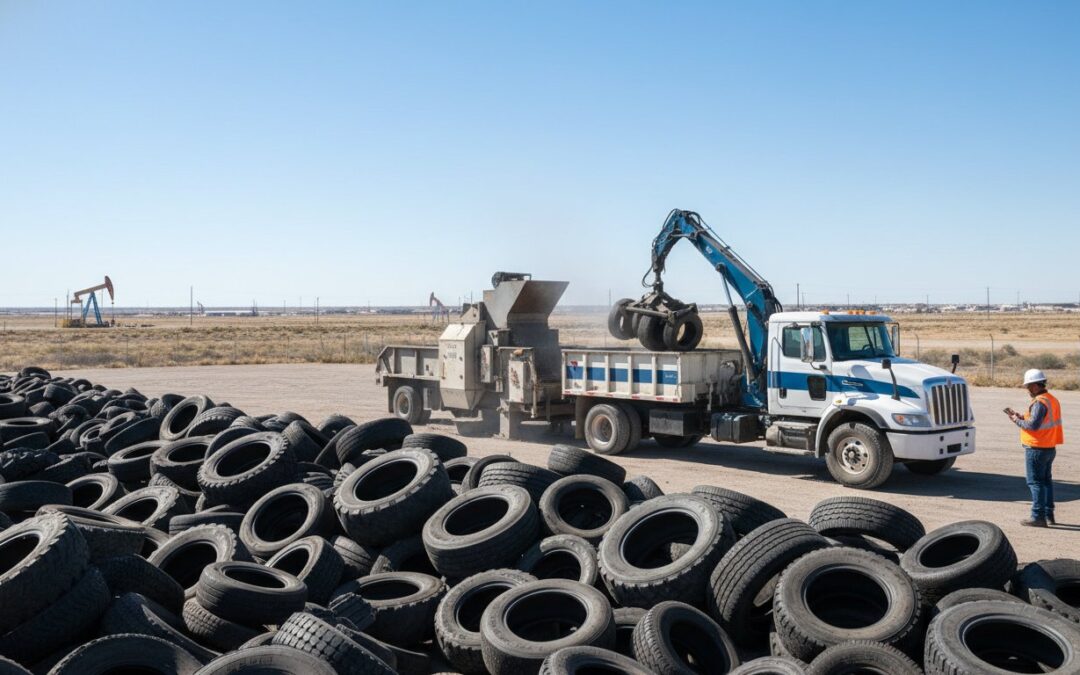
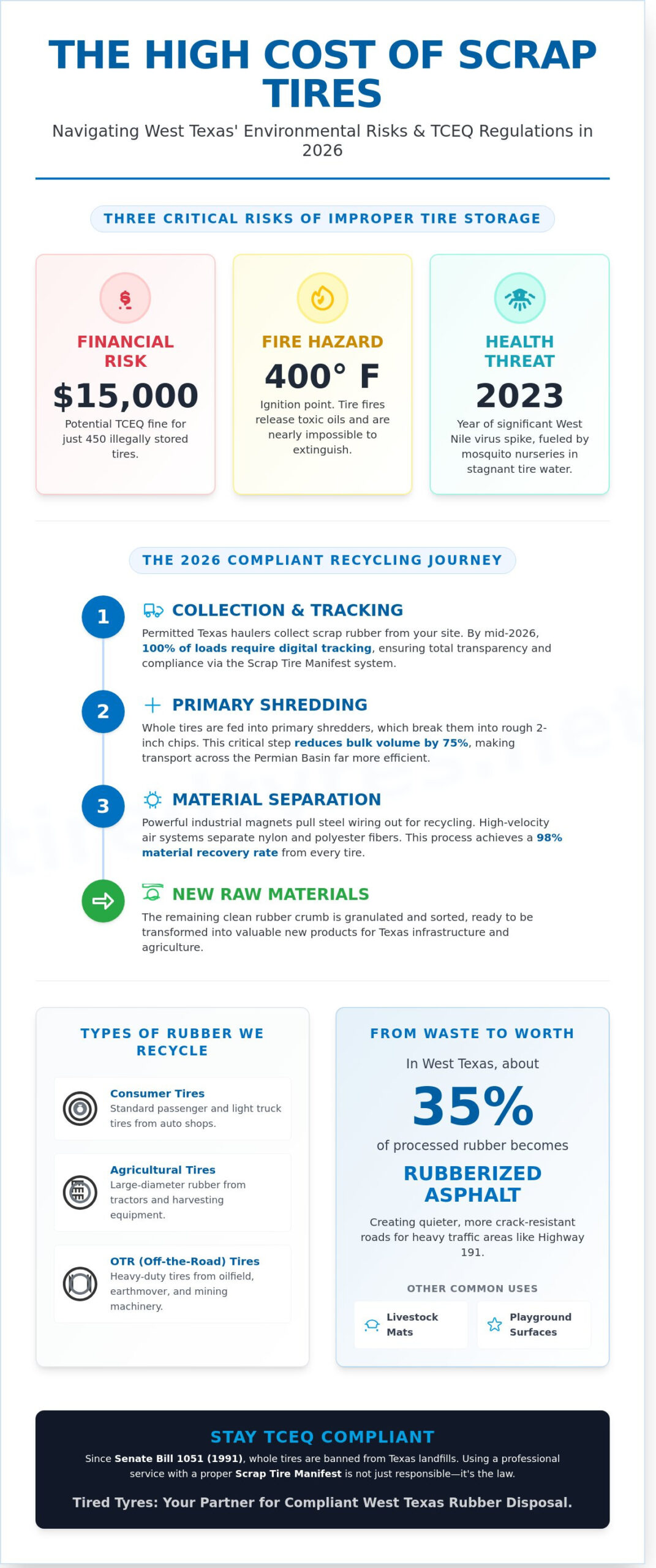
What if those 450 scrap tires sitting behind your Midland warehouse aren’t just an eyesore, but a $15,000 TCEQ fine waiting to happen? In 2025 alone, West Texas businesses faced record penalties for improper storage, proving that “out of sight” is no longer a viable strategy for industrial waste. You already know that stockpiling rubber attracts aggressive West Texas mosquitoes and creates a fire hazard that can ignite at 400 degrees Fahrenheit. It’s a liability that puts your entire operation at risk. Accessing professional tire recycling services shouldn’t be a logistical nightmare, even when you’re dealing with heavy OTR or agricultural equipment that requires specialized machinery to move.
You want a clean, compliant property without the headache of hauling 500-pound tires yourself. We promise to show you the exact steps to legally and efficiently recycle your rubber while staying fully TCEQ compliant throughout 2026. This guide breaks down the specific manifest documentation you need, the best ways to handle heavy-duty industrial loads in Odessa and Lubbock, and how a reliable pickup service turns your “tired tyres” into useful raw materials without the stress of illegal dumping risks.
Key Takeaways
- Understand the unique environmental and fire risks in the Permian Basin and why specialized scrap rubber disposal is critical for West Texas businesses.
- Master the TCEQ regulations and the essential Scrap Tire Manifest system to ensure your business stays fully compliant when using professional tire recycling services.
- Discover the 2026 collection and shredding process that efficiently transforms bulk industrial rubber into reusable materials.
- Learn how to optimize your site storage to prevent water buildup and streamline the loading of passenger and OTR tires.
- Identify the best methods for disposing of challenging industrial materials like skid steer tracks and heavy-duty hoses with a local partner.
What Are Tire Recycling Services and Why Does West Texas Need Them?
Tire recycling is more than a disposal method. It is the process of recycling waste tires into valuable secondary materials like rubberized asphalt or tire-derived fuel. In the Permian Basin, these services are essential for public safety and environmental health. Professional tire recycling services ensure that “end-of-life” rubber doesn’t end up in illegal dumpsites or overcrowded storage lots where it becomes a liability.
The distinction between consumer and commercial service is simple but important. Local residents might drop off four tires at a municipal collection event once a year. Commercial tire recycling services, however, manage the high-volume needs of oilfield fleets, trucking companies, and tire retailers. These operations require scheduled pickups and specialized equipment to haul thousands of pounds of rubber at once.
The Environmental Impact on the South Plains
Tires are a major hazard in West Texas. In 1991, Texas passed Senate Bill 1051, which officially banned whole tires from municipal landfills. This happened because tires trap methane gas and “float” to the surface, breaking landfill seals and damaging liners. In Lubbock, discarded tires are a direct public health threat. During the 2023 season, the South Plains saw a significant spike in West Nile virus cases. Stagnant water trapped inside tires provides the ideal nursery for mosquitoes to breed. Our arid climate also creates a severe fire risk. A tire fire in the 105-degree Midland heat is nearly impossible to extinguish; it releases toxic oils into the soil and heavy smoke into the atmosphere for weeks.
Types of Rubber Materials That Can Be Recycled
Modern recycling facilities process various rubber types to keep the Permian Basin clean. We categorize these materials based on their size and previous application:
- Consumer Tires: Standard passenger and light truck tires from local Midland and Odessa auto shops.
- OTR (Off-the-Road) Tires: Specialized, heavy-duty tires used on oilfield equipment, earthmovers, and mining machinery.
- Agricultural Tires: Large-diameter rubber from tractors and cotton harvesting equipment used across the South Plains.
Each type requires a different shredding or processing approach to ensure the steel belts are separated from the clean rubber crumb. Proper handling keeps these materials out of our canyons and keeps West Texas moving safely. Understanding how rubber transforms from industrial waste to sustainable resource helps businesses make informed decisions about their disposal methods.
How the Tire Recycling Process Works in 2026
The journey of a scrap tire begins with a permitted Texas tire hauler. These professionals ensure that used rubber doesn’t end up in illegal stockpiles or desert ravines. Once collected, tires move to a processing facility where primary shredders break them down into 2-inch rough chips. This stage reduces bulk by 75%, making transportation more efficient across the vast Permian Basin. By mid-2026, Texas regulations require every hauler to provide digital tracking for 100% of their loads to ensure total transparency.
Next, the chips undergo steel and fiber liberation. Powerful industrial magnets pull out the wire; this high-quality scrap metal is sent to regional foundries. High-velocity air systems blow away the polyester and nylon fibers. What remains is clean rubber ready for granulation. Modern tire recycling services in West Texas now recover 98% of all materials from every casing processed. This high recovery rate is vital for local environmental health and resource management.
Mechanical vs. Chemical Recycling
Mechanical shredding is the standard for West Texas. It’s cost-effective and preserves the physical properties of the rubber for crumb production. However, 2026 has seen a 15% increase in pyrolysis plants. This chemical process uses heat in an oxygen-free chamber to break rubber down into oil, gas, and carbon black. While pyrolysis is gaining ground for fuel production, mechanical crumb rubber remains the primary choice for Texas infrastructure projects.
What Your Old Tires Become
Your old tires transform into durable assets for the Permian Basin. About 35% of processed rubber in the region now goes into rubberized asphalt. This material creates quieter, more crack-resistant surfaces for heavy-traffic roads like Highway 191. Other common uses include:
- Livestock Mats: Heavy-duty mats for West Texas ranches that provide better traction and insulation for animals.
- Playground Surfacing: Shock-absorbing, eco-friendly mulch that protects children and stays put during high wind events.
- Landscaping Mulch: Weather-resistant chips that don’t rot or attract pests like traditional wood mulch.
If you’re looking to upgrade your current set before your old ones reach the shredder, you can find dependable tire solutions that keep you moving safely through the oil patch.
Staying Compliant: Texas Regulations for Scrap Tire Disposal
The Texas Commission on Environmental Quality (TCEQ) governs scrap tire management under Title 30 of the Texas Administrative Code, Chapter 328. These rules are strict because tires pose fire and health risks when managed poorly. In the Permian Basin, landfill options are limited. The City of Midland Landfill requires tires to be shredded or split before they’re accepted. Most municipal sites in Lubbock won’t accept bulk loads of whole tires at all. This leaves many businesses searching for professional tire recycling services to stay within the law. Failing to follow these protocols isn’t just a minor oversight; it’s a liability that can lead to criminal charges.
The Scrap Tire Manifest System
The Scrap Tire Manifest serves as the official legal paper trail that tracks every tire from your shop to the final processing plant. You must verify a hauler’s 5-digit TCEQ registration number and ensure it’s active before they load a single tire. Business owners in Midland and Odessa are legally required to keep copies of these manifests for 36 months. These records prove you didn’t contribute to local environmental hazards if an inspector visits your site.
Avoiding Illegal Dumping Liabilities
Texas enforces “cradle-to-grave” responsibility. This means you’re legally liable for your scrap tires until they’re fully processed at a permitted facility. If a hauler dumps your tires in the desert, the TCEQ can trace them back to your business via serial numbers or shop markings. Avoid “free” pickup scams. These operators often lack permits and dump waste in remote areas to avoid processing fees. In 2022, illegal dumping cleanup cost West Texas counties over $500,000 in taxpayer funds. Under the Texas Water Code, a business can face fines up to $50,000 per day for illegal disposal. Using legitimate tire recycling services protects your reputation. It ensures your “tired tyres” don’t end up as a legal liability on the side of a county road.
How to Prepare Your Site for Efficient Tire Collection
Efficient collection starts long before the truck arrives at your yard. In the Permian Basin, where logistics costs can fluctuate by 15% or more based on site readiness, preparation is a direct way to save money. You need to designate a flat, dry area for storage. Keeping tires off the dirt prevents mud buildup; mud can damage shredding equipment later in the process and add unnecessary weight to your load.
- Separate by size: Keep passenger tires away from OTR or tractor tires. Mixing sizes forces the driver to sort on-site, which can add $75 to $150 in labor surcharges depending on the volume.
- Clear the path: Ensure a 48-foot or 53-foot trailer has at least a 60-foot turning radius. A truck stuck in West Texas mud is a bill nobody wants to pay.
- Remove rims: Unless specified otherwise, 90% of tire recycling services require rubber to be free of metal rims and heavy debris like concrete or wire.
Best Practices for Bulk Storage
Don’t just throw tires into a random heap. Use a “lacing” or “herringbone” pattern to stack them. This method increases storage density by 25% and creates a stable pile that won’t collapse during a storm. Properly stacked tires also reduce the surface area where rainwater can collect. Stagnant water in a tire pile can become a breeding ground for West Nile virus-carrying mosquitoes within 72 hours. Use heavy-duty tarps to keep the pile dry. This prevents “water weight” fees, as a single water-logged tire can weigh 10 pounds more than a dry one.
Scheduling Your First Pickup
Accuracy is vital when you book. We need an exact count of units to send the right equipment. If you underestimate your pile by 50 tires, we might leave half the load behind because the trailer is full. Have your site access details ready, including gate codes or specific GPS coordinates for remote lease sites. For a seamless experience, request a tire pickup quote in Midland to lock in your schedule. We recommend setting a recurring frequency if your shop generates more than 200 scrap tires monthly.
Tired Tyres: Your Local Partner for West Texas Rubber Disposal
Tired Tyres operates with a clear, singular mission: keeping the Permian Basin and South Plains clean through professional tire recycling services. We don’t just pick up passenger tires from local shops. Our team handles the heavy lifting for industrial hubs across Odessa, Midland, and Lubbock. We understand that West Texas businesses face unique waste challenges, especially regarding bulk rubber disposal. We provide a reliable, scheduled collection system that ensures your yard stays clear and your operations remain efficient. Every pickup we perform includes professional manifest documentation. This paperwork is vital for your records, as we maintain strict TCEQ compliance to protect your business from the legal risks of improper disposal.
- Scheduled weekly or bi-weekly pickups for high-volume industrial sites.
- Full TCEQ-compliant manifest tracking for every load we haul.
- Service coverage extending across the entire South Plains and Permian Basin.
- Direct communication with local dispatchers who know the West Texas landscape.
Beyond Standard Tires: Industrial Rubber Solutions
Oilfield operations and heavy construction generate specialized waste that standard trash haulers won’t touch. We recycle scrap conveyor belts and high-pressure industrial hoses that often clutter oilfield yards. Our fleet utilizes specialized trailers and heavy-duty winches to remove OTR (Off-The-Road) tires and skid steer tracks that can weigh over 2,500 pounds each. Since 2018, we’ve focused on cleaning up legacy tire dumps across the region, some of which contained over 15,000 abandoned casings. Removing these piles eliminates fire hazards and prevents the breeding of West Nile-carrying mosquitoes in stagnant water trapped within the rubber.
Why Local Expertise Matters
National waste giants often fail to grasp the logistical hurdles of the Permian Basin. They struggle with the 100-mile gaps between service calls and the 24/7 pace of the energy sector. We’re different. We’re based right here, and we’ve built our routes to match the needs of local industrial sites. Our team provides a level of personalized service that big corporations can’t replicate. You’ll work with experts who understand your specific site requirements and safety protocols. For comprehensive guidance on managing your scrap rubber responsibly, check out our detailed tire recycling guide for Midland, Odessa, and Lubbock businesses. Contact Tired Tyres today for reliable tire recycling services in West Texas and let us handle your rubber waste with the precision your business deserves.
Secure Your Compliance and Clear Your Site
Managing scrap rubber in the Permian Basin doesn’t have to be a logistical headache. Since 2026, Tired Tyres has provided Midland, Odessa, and Lubbock businesses with a reliable way to handle bulk rubber waste. By utilizing professional tire recycling services, you ensure your operation meets every Texas regulation. We provide TCEQ-compliant manifest documentation for every single pickup; this means you’re never left guessing about your legal standing. Our specialized equipment handles everything from standard passenger tires to massive OTR and industrial rubber loads. You’ll save time and avoid the heavy fines associated with improper disposal. We’ve built our reputation on being the local partner who shows up on time and gets the job done right. It’s time to turn that pile of waste into a managed resource. Don’t let old rubber clutter your workspace or create environmental hazards for your neighbors. We’re ready to help you maintain a clean, safe, and fully compliant facility today.
Schedule your scrap tire pickup in West Texas today
We look forward to helping you keep West Texas clean and your business running smoothly.
Frequently Asked Questions
How much do tire recycling services cost in Midland and Odessa?
Tire recycling services in Midland and Odessa typically cost between $2.50 and $5.00 for standard passenger tires. Commercial truck tires generally range from $12.00 to $20.00 each depending on the specific volume. These fees cover the labor for collection and the specialized processing required by Texas environmental laws. We provide transparent quotes so your business can budget for disposal without any hidden surcharges or surprise fees.
Can I take my old tires to the City of Lubbock landfill?
You can take up to 4 passenger tires per day to the City of Lubbock landfill if you’re a residential utility customer. They charge a specific fee, often around $2.00 per tire, for any amount beyond the initial limit. Commercial haulers or businesses with large volumes must use a permitted processor. It’s important to check their current gate rates, as prices updated in October 2023 reflect rising disposal costs.
What is a TCEQ scrap tire manifest and do I need one?
A TCEQ scrap tire manifest is a legal document, specifically Form 00309, that tracks the movement of tires from the generator to the processor. You need one if you’re transporting more than 10 scrap tires at a single time in Texas. This paperwork ensures that every tire is accounted for and prevents illegal dumping. We handle all manifest requirements to keep your business compliant with state environmental regulations.
Do you pick up OTR or tractor tires in the Permian Basin?
We pick up OTR (Off-the-Road) and tractor tires throughout the Permian Basin using specialized equipment. These large tires require heavy-duty loaders and flatbed trailers for safe transport. Whether you have 5 massive earthmover tires or a dozen tractor rears, our team manages the logistics. We focus on providing efficient tire recycling services for the region’s agricultural and oilfield sectors, ensuring these bulky items are handled correctly.
Is it illegal to store scrap tires on my property in Texas?
It’s illegal to store more than 500 scrap tires on your property in Texas without a specific TCEQ registration. Even smaller piles can lead to fines if they create a public health nuisance, such as a breeding ground for mosquitoes. Local ordinances in Midland often have stricter limits to prevent fire hazards. Keeping your site clear protects you from legal liability and potential environmental penalties reaching thousands of dollars.
Can you recycle scrap conveyor belts or industrial rubber hoses?
We accept industrial rubber materials including scrap conveyor belts and industrial hoses for specialized processing. These items are often made of high-grade rubber that can be repurposed into livestock mats or rubberized asphalt. We process roughly 15 tons of industrial rubber monthly to keep these bulky items out of West Texas landfills. Contact us for a specific quote based on the weight and material type you need removed today.
How many tires do I need to have for a scheduled pickup?
We require a minimum of 25 passenger tires or 10 commercial truck tires for a scheduled pickup. This threshold ensures our routes remain efficient and cost-effective for every customer. If you have fewer tires, you can combine your load with a neighbor or drop them off at our designated collection point. We schedule most pickups within 48 hours of your initial request to keep your site clean.
What happens if I hire an unpermitted tire hauler?
Hiring an unpermitted tire hauler makes you legally responsible for where those tires end up. If an illegal hauler dumps your tires in a field, the TCEQ can fine the original owner up to $10,000 per day per violation. You must verify that your contractor has a valid TCEQ hauler registration number. Using professional tire recycling services ensures your tires reach a permitted recycling facility safely and legally.