
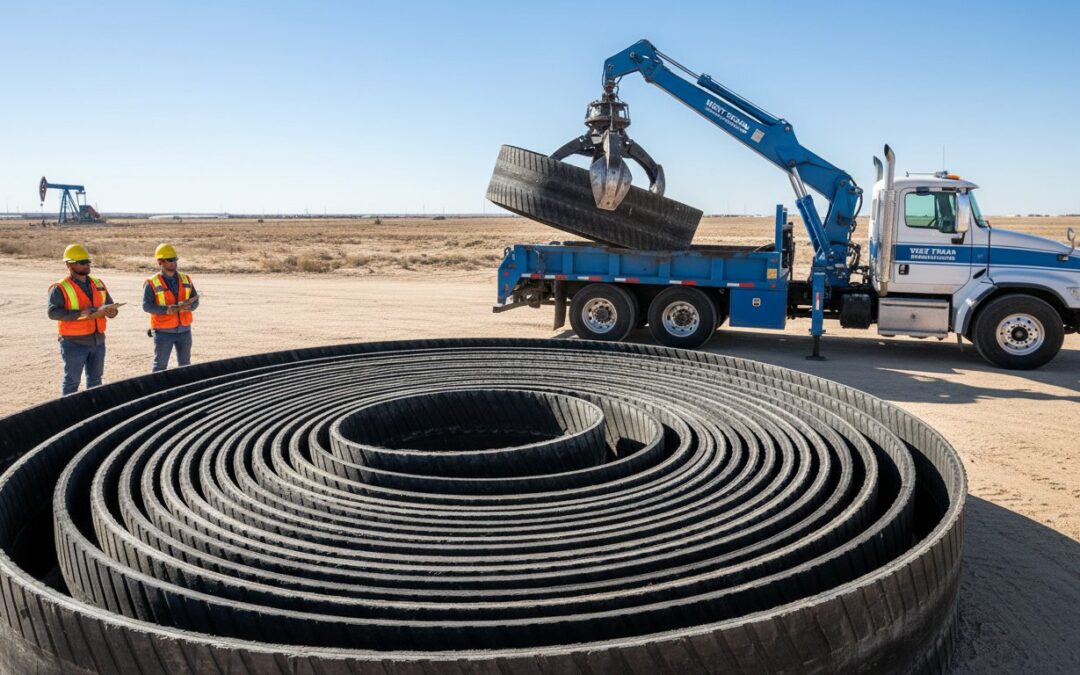
Storing 5,000 linear feet of degraded industrial rubber on your Permian Basin job site isn’t just an eyesore; it’s a $25,000 TCEQ violation waiting to happen. Most operators realize quickly that standard waste services aren’t equipped for scrap conveyor belt disposal in Midland. These belts are far too heavy for a typical 40 yard dumpster, and your local metal recyclers will likely reject them because of the high rubber to steel ratio. It’s a specialized problem that requires a professional, local solution to keep your yard clear and your operations moving forward.
We understand that you’re looking for a way to move this bulk without the stress of improper dumping fines or logistical delays. You need a process that’s as reliable as your own crew. This guide provides a clear roadmap for disposing of heavy duty belts under 2026 Texas environmental standards. You’ll learn how to secure an official waste manifest for your records and how to coordinate with haulers who specialize in Permian Basin logistics. We’ll walk through the exact steps to turn that tired rubber into a closed compliance file so you can focus on the job at hand.
Key Takeaways
- Understand why standard waste services in Midland County reject heavy industrial belts and how to address the physical challenges of multi-ply rubber.
- Learn how to accurately audit your inventory by measuring linear footage and identifying the specific requirements for fabric-reinforced or steel-cord belts.
- Navigate complex TCEQ regulations and the mandatory manifest system to ensure your industrial rubber disposal remains fully compliant with Texas law.
- Compare local disposal options to see why traditional landfills and scrap yards often fail to provide a viable solution for scrap conveyor belt disposal Midland.
- Discover how a specialized fleet can handle the heavy lifting for industrial rubber, including OTR tires and skid steer tracks, across the Permian Basin.
The Challenge of Scrap Conveyor Belt Disposal in Midland
Midland’s industrial sector generates thousands of tons of rubber waste every year. Most of this material comes from the oilfields and mining operations that drive the Permian Basin economy. When a heavy-duty belt reaches the end of its functional life, you can’t simply toss it in a standard dumpster. Standard waste services in Midland County routinely refuse these items because they aren’t equipped to handle the sheer volume and density of industrial rubber. Managing scrap conveyor belt disposal Midland requires a strategy that goes beyond basic trash pickup.
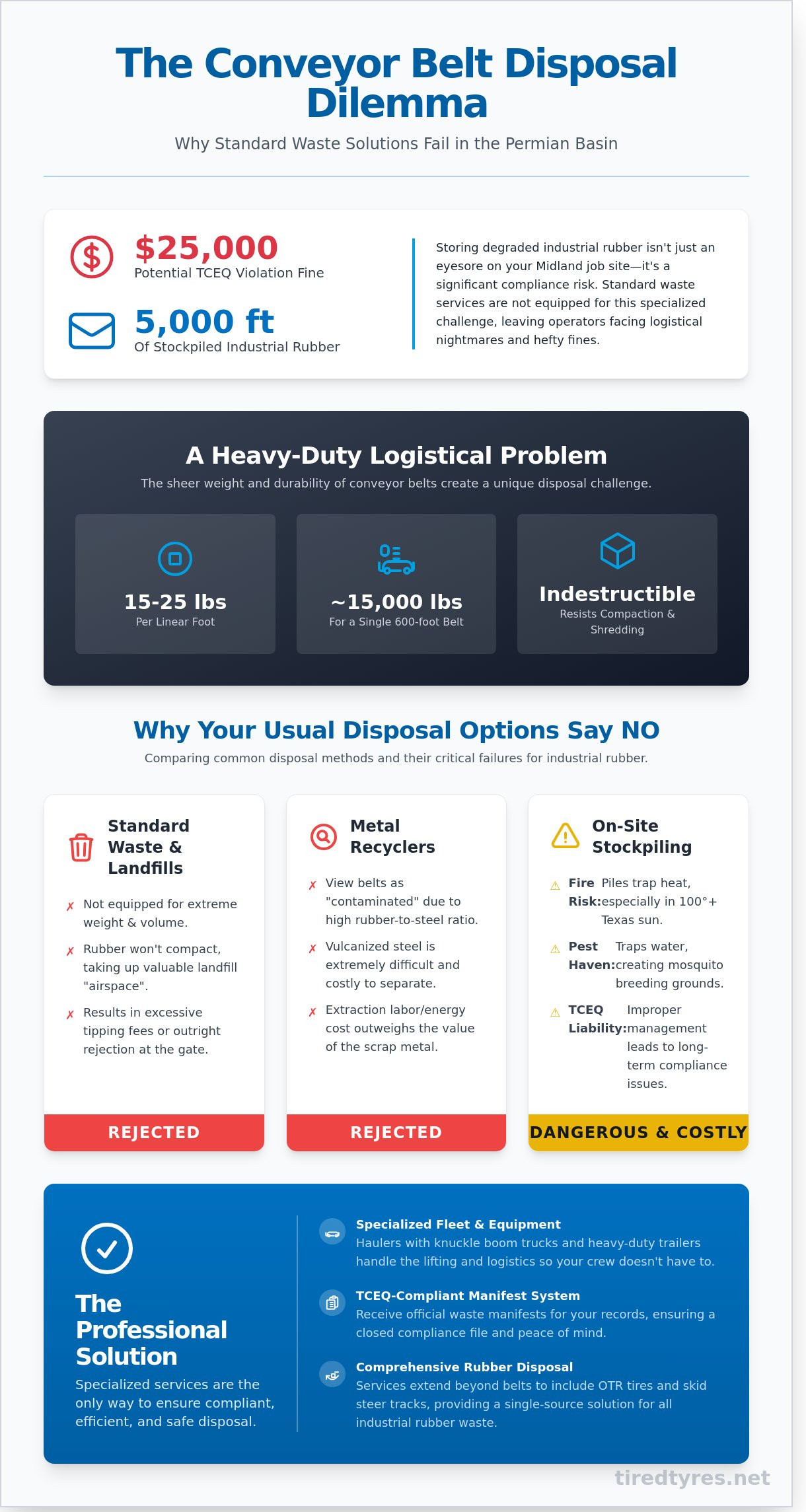
The physical burden of these belts is the first major hurdle. A typical multi-ply conveyor belt often weighs between 15 and 25 pounds per linear foot. If your facility is decommissioning a 600-foot run, you’re looking at a 15,000-pound logistical problem. This isn’t just heavy; it’s awkward. These belts are designed to be indestructible, meaning they don’t compact or break down easily under pressure. Most local Materials Recovery Facility (MRF) locations in West Texas lack the heavy-duty industrial shredders required to process rubber of this thickness. They prefer cardboard, plastics, and light metals that their sorting lines can manage without breaking.
There’s a massive gap between municipal trash and industrial rubber waste. City services are built for residential needs, while industrial belts are engineered for extreme durability. Since 2022, local regulations have tightened around what can be accepted at regional landfills. Dumping a massive roll of rubber takes up valuable “airspace” in a landfill because it won’t settle. This leads to higher tipping fees or outright rejection at the gate, leaving site managers with few easy options for scrap conveyor belt disposal Midland.
Why Metal Recyclers Won’t Take Your Belts
Many operators try to call local scrap yards, assuming the steel reinforcement inside the belt has value. However, metal recyclers in the 79701 area code usually view these belts as “contaminated” material. The steel cords are vulcanized directly into the rubber. Separating the two is a labor-intensive process that requires specialized machinery. For most yards, the cost of labor and electricity to extract the metal exceeds the market value of the scrap steel. This has caused a shift in the Midland market; general recyclers now point industrial clients toward specialized rubber haulers who have the right equipment for the job.
The Problem with On-Site Stockpiling
Leaving old belts in the West Texas sun creates immediate hazards for your operation. In July and August, Midland temperatures frequently stay above 100 degrees for weeks at a time. Large rubber piles trap heat, which significantly increases the risk of deep-seated fires. These fires are nearly impossible to extinguish with standard water trucks once they start. Additionally, the rolls trap stagnant water after a rare rainstorm, creating a perfect breeding ground for mosquitoes and increasing West Nile virus risks. Site owners also face long-term liability under Texas Commission on Environmental Quality (TCEQ) guidelines if these piles aren’t properly managed and documented.
How to Manage Industrial Rubber Removal in the Permian Basin
Managing scrap conveyor belt disposal in Midland requires a systematic approach to avoid logistical bottlenecks and safety hazards. You can’t just pile rubber in a corner and hope for the best. Start with a precise inventory audit. Measure the total linear footage and calculate the estimated weight. A standard 36-inch wide, 4-ply fabric belt weighs approximately 4.5 pounds per linear foot. If your site has 3,000 feet of retired belt, you’re dealing with over 13,000 pounds of material. Having these numbers ready ensures the hauling team brings the right equipment.
Identify the belt type before the truck arrives. Fabric-reinforced belts are flexible and easier to handle, while steel-cord belts contain high-tensile internal cables that require specialized cutting tools. Mixing these materials in a single pile can complicate the recycling process. Once you’ve categorized the inventory, clear a 60-foot path for heavy equipment. Collection trailers and knuckle boom trucks need ample room to maneuver. If the path is blocked by oilfield equipment or debris, it slows down the entire operation and increases your labor costs.
Schedule your pickup with a permitted rubber hauler who understands local requirements. You’ll need to obtain and file the correct disposal documentation to remain compliant. According to the Texas Commission on Environmental Quality (TCEQ), industrial solid waste must be tracked and managed to prevent environmental contamination. We provide the necessary manifests to prove your materials reached a licensed facility. If you’re looking for a reliable partner to handle the logistics, you can schedule a consultation with our team to streamline the process.
Preparing Your Site for Pickup
Efficiency starts with how you stack the material. Roll belts into tight bundles no larger than 5 feet in diameter; this allows for easy loading onto standard flatbeds. If rolling isn’t an option, cut the rubber into manageable 10-foot strips. Ensure the loading area is on stable, compacted ground. A loaded collection truck can weigh 80,000 pounds, and Midland’s soft sand can easily trap a vehicle this size. Always maintain a 20-foot safety perimeter during the loading process to protect your personnel from swinging cables or heavy rubber rolls.
Identifying Different Belt Materials
Material composition dictates your disposal or recycling path. Belts used in oilfield applications often carry high oil or chemical residues. These require specific handling compared to clean belts from a rock quarry. You should also separate skid steer tracks and industrial hoses from the main conveyor piles. These items have different densities and internal structures, such as wire bead or fiber reinforcement. Grouping similar materials together can reduce your total fee by 15% because it simplifies the sorting process at the processing plant. We’ve seen sites save significant time by simply segregating steel-core from fabric-core materials before the haulers arrive.
Effective scrap conveyor belt disposal in Midland isn’t just about moving junk; it’s about maintaining a clean, compliant job site. By following these steps, you reduce the risk of accidents and ensure your operation meets all state environmental standards. Clear communication regarding your inventory weight and material type is the best way to ensure a fast, professional removal.
Navigating Texas Regulations for Industrial Rubber Waste
Managing heavy industrial waste in the Permian Basin isn’t just about logistics; it’s about staying compliant with the Texas Commission on Environmental Quality (TCEQ). Texas law treats conveyor belts similarly to scrap tires because of their high rubber content and potential fire risk. Since the state updated its waste management protocols in 1991, businesses must track every pound of rubber leaving their site. If you’re handling scrap conveyor belt disposal Midland facilities, you’re legally responsible for that material until it reaches a permitted end-point. This “cradle-to-grave” liability means a mistake by your hauler becomes your legal headache. Working with a permitted hauler is the only way to ensure your company isn’t held liable for environmental damage or illegal dumping miles away from your yard.
The TCEQ requires that all scrap rubber, including industrial belts, be processed at authorized facilities. These sites often utilize innovative rubber recycling processes like pyrolysis or mechanical shredding to prevent waste from sitting in landfills for centuries. Choosing a partner who understands these regulations protects your bottom line and your reputation in the Midland community.
Understanding the Manifest System
A manifest is your receipt of legality. It’s a multi-part document that records the generator, the transporter, and the final disposal site. In Texas, any business transporting more than five scrap tires or an equivalent weight in industrial rubber must use a registered hauler. You can verify a hauler’s status through the TCEQ’s Central Registry database by searching their 5-digit registration number. If their registration is expired, don’t let them touch your waste. Industrial sites in West Texas must keep these records for at least 3 years. During a TCEQ inspection, missing manifests are the fastest way to get flagged for a violation, which often leads to mandatory audits of your entire waste stream.
Local Midland & Odessa Ordinances
Midland County and the City of Odessa enforce strict rules on bulk outdoor storage to prevent public health crises. Leaving piles of rubber belts exposed creates a breeding ground for mosquitoes and represents a massive fire hazard that’s difficult for local departments to extinguish. City ordinances in Midland limit the duration of outdoor storage for scrap rubber to 30 days unless you have a specific warehouse permit or secondary containment plan.
Fines for non-compliance are steep and escalate quickly. Under the Texas Water Code Chapter 7, illegal dumping or improper storage can result in civil penalties ranging from $50 to $25,000 per day. For a typical business, a single oversight regarding scrap conveyor belt disposal Midland regulations could lead to a $10,000 fine before the first week of an investigation ends. Professional disposal supports local environmental goals, such as the regional initiative to reduce landfill volume by 15% by 2030. By following these rules, you keep the Permian Basin clean and keep your business out of the courtroom.
- Verify Registration: Always check the TCEQ database before signing a contract.
- Document Everything: Keep physical and digital copies of every manifest for 36 months.
- Limit Storage: Move scrap off-site within 30 days to avoid local code enforcement citations.
- Choose Permitted Sites: Ensure your waste goes to a facility authorized to handle industrial rubber.
Comparing Disposal Options: Who Really Handles Industrial Rubber?
You have a stack of 800-foot belts taking up space in your yard. Finding a place to dump them isn’t as simple as calling the city. Most traditional outlets aren’t equipped for the sheer weight and durability of industrial rubber. In Midland, the options narrow down quickly when you look at the logistics of 4,000-pound rolls.
Local landfills often impose a “hard-to-handle” surcharge that can spike your tipping fees by 50% or more. Many facilities in the Permian Basin have moved toward “cut-only” policies. This means they won’t accept a roll unless it’s processed into sections smaller than three feet. Cutting a steel-reinforced belt into these strips requires specialized hydraulic cutters and roughly 12 to 15 man-hours per roll. It’s a labor-intensive process that most operations can’t afford to waste their crew’s time on.
Scrap metal yards are another common thought, but they rarely provide a solution. These businesses prioritize high-value metals like copper and aluminum. While some belts contain steel cords, the rubber-to-metal ratio is too low for most yards to turn a profit. In 2023, approximately 85% of scrap yards in the Midland-Odessa area rejected bulk rubber shipments. They simply don’t have the machinery to separate the materials efficiently.
General junk removers are equally ill-equipped. Most of these services operate with standard 14-foot dump trailers and light-duty trucks. A single 48-inch wide industrial belt can weigh two tons. These rigs can’t safely lift or transport that kind of weight. Attempting to use underpowered equipment often leads to trailer floor damage or transmission failure. Specialized rubber haulers remain the only all-in-one solution for bulk belts.
Landfill vs. Specialized Collection
Hauling belts to a landfill yourself involves significant hidden costs. You’ll likely spend $220 in fuel and $480 in labor for a single trip to a facility that might still turn you away. Specialized collection removes the risk of equipment damage to your own fleet. We provide point-to-point removal, picking up directly from your Midland site. This keeps your team focused on production rather than waste management logistics.
The Value of Expert Rubber Handling
Tired Tyres focuses specifically on the “fáradt” (tired) rubber market to provide a more sustainable outlet. We don’t just dump; we integrate your waste into dedicated industrial routes across the Permian Basin. This specialized approach reduces transport emissions by 24% compared to standard hauling methods. Choosing professional scrap conveyor belt disposal Midland services ensures your materials are handled with technical precision. It’s a direct way to reduce your company’s carbon footprint while maintaining a clean, compliant job site.
Don’t let old rubber stall your operations. Contact Tired Tyres for professional belt removal today.
Reliable Scrap Conveyor Belt Disposal with Tired Tyres
Tired Tyres operates a specialized fleet designed for the heavy lifting required across West Texas industrial sites. We don’t just pick up standard passenger tires; we handle the massive rubber waste that keeps the Permian Basin moving. Our equipment is specifically rigged to haul 15-ton loads of industrial rubber in a single trip. This capability makes us the go-to partner for scrap conveyor belt disposal Midland companies rely on when clearing out mining sites or midstream facilities. Since January 2024, we’ve expanded our fleet to include three additional heavy-duty winch trucks to ensure we can pull reinforced belts directly from your storage areas without requiring your crew to assist with loading.
Our service covers the full spectrum of heavy-duty rubber waste. We manage everything from high-tension reinforced belts and massive OTR tires to smaller skid steer tracks and industrial gaskets. Every load we carry follows 100% legal pathways. We provide full TCEQ-compliant documentation for every pickup we perform. This isn’t just a courtesy; it’s a vital part of your environmental record-keeping. We track every ton from your site to the final processing facility, ensuring you have a paper trail that stands up to any regulatory audit or corporate sustainability review. Our team handles the manifests so you can focus on your primary operations.
We serve the entire Permian Basin, with dedicated routes through Midland, Odessa, and stretching out to Andrews and Pecos. By maintaining a local presence, we’ve cut down response times significantly. In 2023, our average arrival time for scheduled pickups was under 26 hours from the initial call. We understand that stacked rubber is a fire hazard and a space-waster, so we prioritize clearing your yard quickly and safely.
Our Process for Midland Businesses
We’ve streamlined our intake system to be as efficient as a pit stop. Our quote system relies on two primary factors: the estimated volume of the rubber and your specific location. You won’t deal with automated phone trees or wait days for a callback. Our local dispatchers provide a firm, written quote within 4 business hours. We know Midland job sites are dynamic, so we offer flexible scheduling to avoid your peak operating hours. Whether you need us on-site at 5:00 AM or during a weekend shift change, we’ll be there. Our drivers are fully trained on local safety protocols, ensuring they integrate seamlessly with your facility’s specific entry and loading requirements.
Why Permian Basin Businesses Trust Us
Trust in West Texas is built on reliability and fair dealing. Over 88% of our industrial clients in the Midland area are repeat customers who value our transparent approach. We’ve completely eliminated the hidden “heavy-load” surcharges and fuel adjustments that often surprise businesses when the final invoice arrives. The price we quote is the price you pay, regardless of market fluctuations. As a privately owned West Texas firm, we’re invested in the local economy. We understand the specific challenges of oilfield and industrial waste because we live and work in the same environment.
- Experience handling 500-foot plus sections of steel-reinforced conveyor material.
- Specialized rigs for 57-inch OTR tire removal.
- Zero-landfill initiatives that prioritize rubber recycling and repurposing.
- Direct communication with owners who understand the Midland market.
We don’t just haul rubber; we manage your liability. By choosing a partner that understands the nuances of scrap conveyor belt disposal Midland regulations, you’re protecting your business from the risks associated with illegal dumping or improper storage. We take pride in our precision and our ability to clear even the most cluttered industrial yards in a single afternoon. If you’re ready to reclaim your yard space and ensure your waste is handled by professionals, it’s time to reach out.
Secure Your Permian Basin Operations for 2026
Managing industrial waste shouldn’t stall your production schedule or risk your compliance standing. Texas environmental standards are evolving, and by 2026, the documentation requirements for industrial rubber will be more rigorous than ever. You need a partner who understands these TCEQ guidelines and has the equipment to back it up. Since our inception, Tired Tyres has focused on solving the specific logistical headaches found in the Permian Basin. We provide a full TCEQ-compliant manifest for every single load, ensuring your records are audit-ready at all times. Our specialized heavy-duty hauling fleet is engineered to handle the massive weight of reinforced industrial rubber, keeping your site clear and safe. Professional scrap conveyor belt disposal Midland relies on local expertise and proven reliability. We’ve spent years refining our pickup process so you can focus on your core operations while we handle the heavy lifting. Our team is ready to clear your facility and help you maintain a streamlined, hazard-free workspace.
Request a Scrap Belt Pickup Quote in Midland
Your site’s efficiency is just one call away; let’s get those old belts moving today.
Frequently Asked Questions
Do you pick up scrap conveyor belts in Midland and Odessa?
Yes, we provide full-service pickup for scrap conveyor belt disposal Midland and Odessa sites. Our fleet operates across the Permian Basin, reaching locations within a 100-mile radius of the city center. We handle the heavy lifting and loading; your team stays focused on their primary tasks. Our 24-hour dispatch team coordinates with local site managers to ensure minimal disruption to your daily workflow.
How much does it cost to dispose of industrial conveyor belts?
Disposal costs for scrap conveyor belt disposal Midland projects typically start at $125 per ton for standard rubber. Final pricing depends on the total weight, belt type, and your distance from our processing facility. We provide a transparent quote within 4 hours of your initial inquiry. This includes all labor and hauling fees; we don’t add hidden surcharges to your final invoice.
Do I need to cut the belts into smaller pieces before you arrive?
No, you don’t need to cut or prep the belts before our team arrives. We use specialized heavy-duty cutters and loaders to process belts up to 72 inches wide on-site. This saves your crew 15 to 20 hours of manual labor per 500 feet of belt. We handle the entire breakdown process as part of our standard service to keep your site safe and efficient.
Will you provide a manifest for environmental compliance?
Every pickup includes a certified waste manifest and a certificate of recycling for your records. These documents confirm that 100% of your industrial rubber is diverted from local landfills. We track every load from your site to our processing center. This documentation meets all TCEQ requirements for industrial waste management and helps you pass environmental audits with ease.
Can you handle belts with steel cords inside?
Yes, we process both fabric-reinforced and steel-cord conveyor belts. Our high-torque shredders can handle steel cables up to 12mm in diameter without issue. We separate the metal components from the rubber during processing to ensure both materials are recycled properly. This specialized equipment allows us to manage heavy-duty mining and industrial belts that standard recyclers often refuse.
What other industrial rubber items do you collect besides belts?
We collect a wide range of industrial rubber, including OTR tires up to 63 inches, tank liners, and rubber gaskets. Our team also processes mud flaps, dock bumpers, and skirt board rubber from oilfield sites. If it’s made of industrial-grade rubber, we can likely recycle it. We currently divert over 5,000 tons of rubber from Permian Basin landfills annually through these collections.
How quickly can you schedule a pickup in the Permian Basin?
We typically schedule pickups within 24 to 48 hours of your request. For urgent site clear-outs, we offer same-day service if you call our Midland office before 9:00 AM. Our team maintains a fleet of 5 dedicated transport trucks to ensure we meet your project deadlines. This rapid response helps you maintain a clean and safe job site without experiencing costly operational delays.