
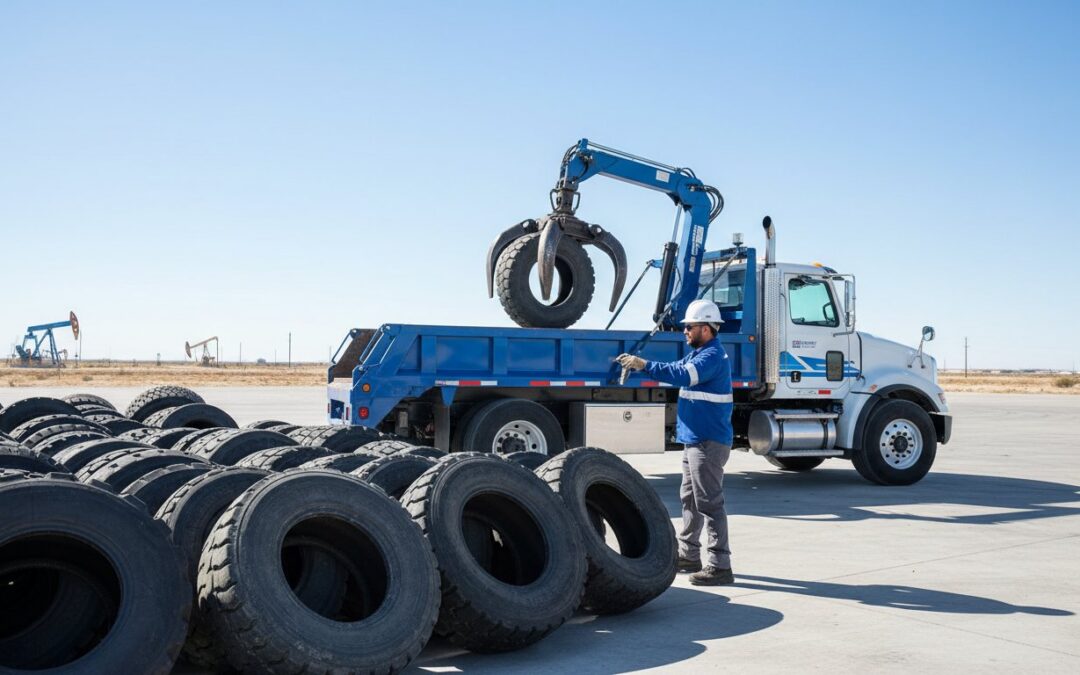
Last Tuesday, a warehouse manager in the Permian Basin loaded three 450-pound press-on tires into a pickup, only to be turned away at the gate of the local landfill. It’s a common story in West Texas because standard waste facilities simply aren’t equipped to handle high-density industrial rubber. Finding a reliable partner for solid forklift tire disposal Midland is no longer just about cleaning up the yard; it’s about avoiding the $25,000 daily fines associated with improper scrap tire storage under Texas law. We’ve seen local businesses struggle with these ‘Tired Tyres’ – the worn-out industrial rubber – for years, and the regulations have only tightened for the 2026 fiscal year.
You likely already know that hauling these massive weights yourself is a logistical nightmare that risks both your equipment and your back. We agree that the red tape of TCEQ scrap tire manifests often feels like a full-time job. This guide provides the exact 2026 pricing structures, legal requirements, and pickup options you need to clear your site without the headache. You’ll learn how to secure proper documentation and find a service that handles the heavy lifting so you can get back to your core operations with total peace of mind.
Key Takeaways
- Understand why industrial rubber requires specialized handling and how to navigate strict TCEQ “Scrap Tire Manifest” requirements to remain legally compliant.
- Analyze the hidden costs of self-hauling versus professional solid forklift tire disposal Midland to find the most cost-effective solution for your business.
- Learn how to properly stage press-on and resilient tires for pickup, including the logistical impact of leaving tires on their metal rims.
- Discover the environmental benefits of local recycling programs in the Permian Basin that convert industrial waste into reusable rubber powder.
- Identify the specific equipment and safety protocols needed to handle heavy solid tires compared to standard residential waste services.
The Challenge of Solid Forklift Tire Disposal in Midland
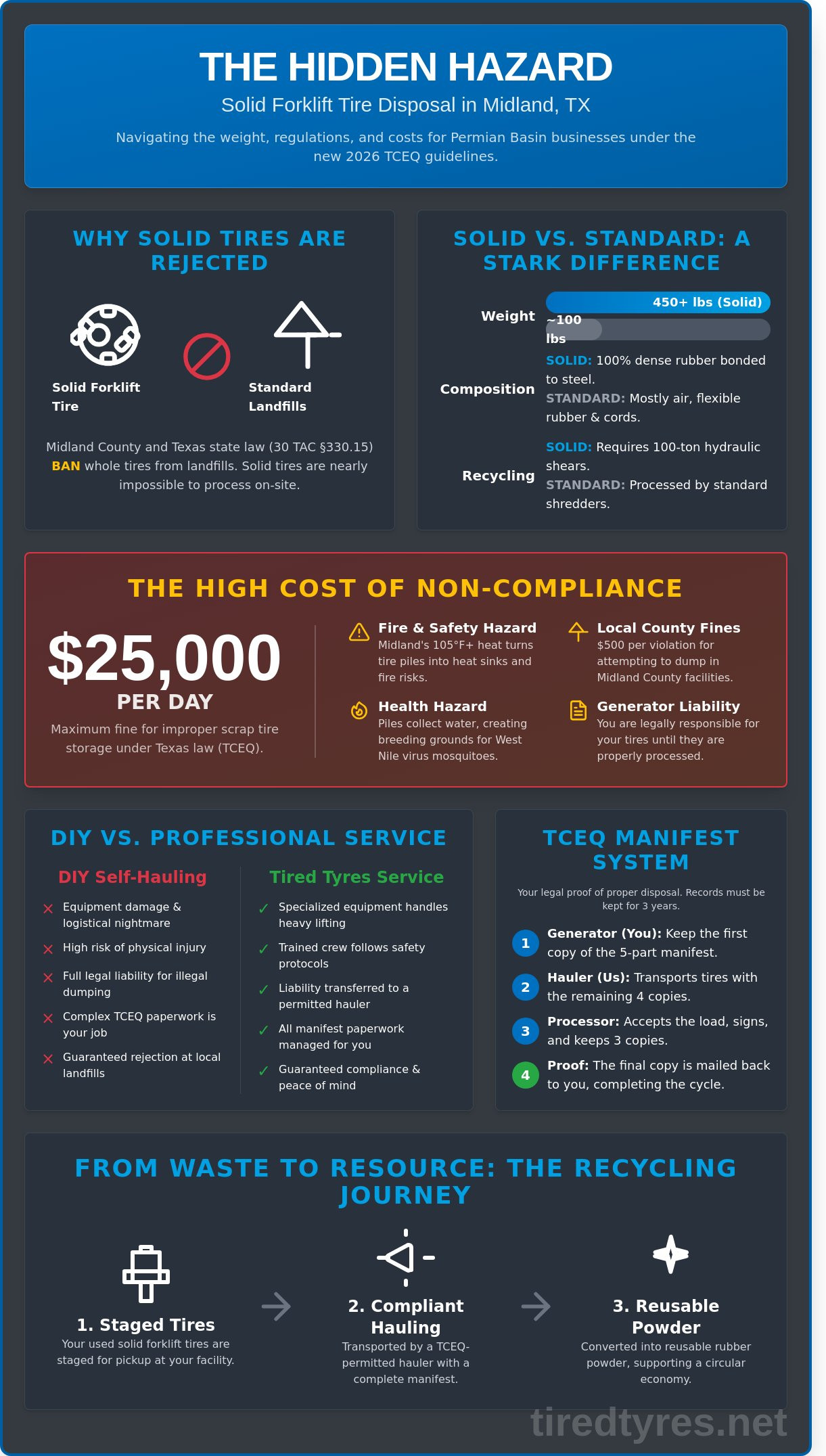
Solid forklift tires are industrial workhorses, but they become a massive liability once the tread wears down to the safety line. Unlike standard pneumatic tires, these are solid rubber. You’ll find two main types in Midland warehouses: press-on bands and resilient tires. Press-on tires consist of a rubber layer bonded to a steel ring, while resilient tires use multiple layers of rubber compounds. They don’t pop, but they do weigh a ton. A single mid-sized solid tire often exceeds 200 lbs. This extreme density is the primary reason why 100% of Midland’s residential trash services will reject them at the curb.
Managing these heavy assets requires a specialized strategy. The Challenge of Solid Forklift Tire Disposal stems from the fact that these aren’t just “big tires,” they are concentrated blocks of industrial waste. In the Permian Basin, leaving these tires in a yard is a safety risk. When temperatures hit 105°F in July, large rubber piles become heat sinks. They trap heat, create fire hazards, and provide breeding grounds for West Nile-carrying mosquitoes. Proper solid forklift tire disposal Midland isn’t just about cleaning up; it’s about local compliance and safety.
Why Solid Tires Differ from Standard EV or Truck Tires
Standard truck tires are mostly air. Solid tires are 100% material. They contain high-tensile steel bands that destroy standard shredding blades used for passenger cars. You can’t use a portable cutter on these. For a distribution center near Garden City Highway, a stack of 20 old tires represents 4,000 lbs of dead weight taking up 100 square feet of valuable dock space. This isn’t waste you can hide in a dumpster or process with standard shop tools.
Local Landfill Restrictions in Midland and Odessa
The City of Midland Landfill follows strict Texas Commission on Environmental Quality (TCEQ) rules. Under Texas state law, specifically 30 TAC §330.15, whole tires are banned from landfills because they don’t stay buried; they “float” to the surface over time. If you try to sneak industrial rubber into a standard bin, you face Midland County fines that can reach $500 per violation. Most local sites require tires to be split into quarters before acceptance, a task nearly impossible for solid rubber without a 100-ton hydraulic shear. For businesses in the Permian Basin, solid forklift tire disposal Midland requires a partner who understands these legal hurdles and has the equipment to handle the weight.
- Weight: Solid tires are 3 to 4 times heavier than pneumatic tires of the same size.
- Composition: High-density rubber bonded to steel makes standard recycling impossible.
- Legal: Texas law prohibits whole tire disposal in all municipal landfills.
- Climate: Midland’s 100°F+ summers turn scrap piles into significant fire risks.
Efficiently clearing out these tires keeps your facility safe and your business in compliance with Texas environmental regulations. Ignoring the pile only leads to higher costs and potential legal headaches later.
TCEQ Regulations and Scrap Tire Manifests in Texas
Managing solid forklift tire disposal Midland operations requires more than just a phone call to a local junk hauler. The Texas Commission on Environmental Quality (TCEQ) regulates every scrap tire under Title 30 of the Texas Administrative Code, specifically Chapter 328. Your business is legally defined as the “generator.” This isn’t just a label; it’s a legal burden. You remain responsible for the environmental impact of those tires until they reach an authorized processing facility. If an unpermitted hauler dumps your tires in a Permian Basin field, the state tracks the trail back to your warehouse. Using a permitted service like Tired Tyres ensures this chain of custody remains unbroken and your business stays out of the regulatory crosshairs.
Understanding the 5-Part Manifest System
The TCEQ uses a rigorous tracking document known as the 5-part manifest to monitor tire movement from cradle to grave. When we pick up your scrap tires, the paperwork starts moving immediately. The generator keeps the first copy for their files. The hauler carries the remaining four copies to the state-permitted processing facility. Once the processor accepts and weighs the load, they sign the documents and send a final copy back to the generator. Midland businesses must retain these records for exactly 3 years to pass a state audit. If you can’t produce these forms during a spot check, you face administrative penalties. Under Texas Water Code Section 7.052, these fines can reach $25,000 per day for each violation. Don’t risk your company’s reputation on unpermitted haulers who lack the proper state registration numbers.
TCEQ Region 7 Compliance for Permian Basin Businesses
Midland sits directly under the oversight of the TCEQ Region 7 office. This regional team monitors industrial rubber waste across the Permian Basin with high frequency, focusing on the 17 counties surrounding Midland and Odessa. Solid forklift tires are categorized as “special waste” because they don’t degrade in landfills and create significant fire hazards if stockpiled. Local inspectors look for specific evidence that you’re following the 1991 Texas tire laws. They don’t care about verbal promises or simple invoices. The completed scrap tire manifest serves as the only legal proof of proper disposal recognized by Texas regulatory authorities.
We maintain our State-permitted status to provide a firewall for your business. When Tired Tyres handles your solid forklift tire disposal Midland needs, we manage the manifest flow with precision. Our team understands that for a Midland warehouse manager, a tire isn’t just rubber; it’s a potential liability. We eliminate that risk by providing the exact documentation Region 7 inspectors demand. Our process ensures every scrap tire is tracked from your loading dock to a verified recycling site. This transparency protects your bottom line and keeps your operations compliant with the Texas Administrative Code.
- Generator Responsibility: You’re liable for the tires until the processor signs the manifest.
- Record Retention: Keep all signed manifests for 1,095 days (3 years) to stay audit-ready.
- Authorized Haulers: Only use companies with a valid TCEQ scrap tire hauler registration number.
- Industrial Categorization: Solid tires are treated as high-density rubber waste requiring specialized processing.
DIY vs. Professional Industrial Tire Collection
Deciding to handle solid forklift tire disposal in Midland internally often looks like a cost-saving measure on a spreadsheet. The reality at the warehouse floor level tells a much more expensive story. A single press-on solid tire for a mid-sized forklift weighs between 300 and 450 pounds. Most standard Ford F-150 or Chevy Silverado pickups used by local maintenance crews have a payload capacity that maxes out after loading just four or five of these dense rubber units. When you factor in the 15 to 20 miles of driving required to reach an approved industrial landfill site from central Midland, the logistics become a significant burden on your daily operations.
Safety is the primary concern for any fleet manager. Moving 400-pound tires without specialized hydraulic lifts or specialized rigging leads to roughly 25% of all warehouse back injuries reported in the Permian Basin. Your staff isn’t typically trained for heavy industrial rubber transport. If a high-density load shifts while driving 65 mph on I-20, the results are often catastrophic for the vehicle and other drivers. Professional collectors use specific weight-distribution techniques to prevent these accidents. They have the insurance to cover these risks; your standard business liability might not cover an accident involving improperly secured industrial waste.
The “Opportunity Cost” is the silent killer of DIY disposal. If a warehouse manager earning $38 an hour and a technician earning $26 an hour spend four hours loading, driving, and waiting at a landfill, you’ve spent $256 in direct wages alone. This figure doesn’t include the $1,500 in potential revenue lost because those employees weren’t fulfilling customer orders or maintaining the active forklift fleet. Professional solid forklift tire disposal Midland services allow your team to stay focused on the work that actually generates profit for your business.
Equipment and Logistics Requirements
Moving solid rubber isn’t like hauling scrap wood or standard car tires. You need a 10,000-pound capacity lift-gate truck or a heavy-duty flatbed with professional-grade tie-downs. Standard utility trailers often suffer axle failure or leaf spring snaps when loaded with 3,000 pounds of concentrated rubber weight. Securing these loads for the high winds and heavy traffic on I-20 requires specialized knowledge. Professional teams use industrial-grade ratcheting straps and specific loading patterns to ensure the high-density weight stays centered over the axles at all times.
Cost Analysis for Midland Businesses
Tipping fees at industrial waste sites in the Permian Basin currently range from $75 to $125 per ton for processed rubber. If you send two employees in a company truck, you pay for 5 hours of labor, $45 in fuel, and the disposal fees. Total internal costs often exceed $400 for a single trip. A “done-for-you” collection service like Tired Tyres eliminates these variables. We handle the loading, transport, and legal documentation for a predictable flat rate. You can compare these numbers in our Tire Disposal Costs in Midland: A Price Guide to see the exact breakdown for your fleet size. Using a professional service for solid forklift tire disposal Midland ensures you meet all environmental regulations without the headache of self-hauling.
Preparing Your Forklift Tires for Pickup
Preparing for your solid forklift tire disposal Midland service isn’t just about clearing floor space; it’s about bottom-line efficiency. If your team spends 20 minutes moving pallets to reach a tire stack, that’s labor cost wasted. Since January 2024, we’ve seen that sites with pre-staged loads reduce their collection time by 40%. Proper preparation ensures our team can get in and out without disrupting your daily operations.
Staging and Access for Heavy Loads
Don’t let your old rubber become a tripping hazard or a fire code violation. We recommend stacking solid tires no more than 5 units high. This prevents “tire towers” from leaning or collapsing during transit. Keep your staging area within 15 feet of a loading bay or a clear exterior gate. Our Tired Tyres collection vehicles require a minimum 12-foot vertical clearance and a 10-foot wide path to operate safely. At Midland warehouse docks, ensure the area is marked with high-visibility cones to separate the pickup zone from active forklift traffic. In 2023, 12% of delayed pickups in the Permian Basin area were caused by blocked access. Don’t park trailers in front of the designated tire zone on the morning of your appointment.
You also need to distinguish between standard black rubber and non-marking compounds. Standard tires contain carbon black, while non-marking versions use silica or chalk. These materials require different processing streams. Non-marking tires, often white or grey, are required in 65% of indoor Midland warehouses to prevent floor scuffing. If your inventory includes both types, place them in two distinct stacks. This level of organization allows us to provide a faster, more accurate service when we arrive on-site.
Dealing with Rims and Hubs
The biggest cost variable in the disposal process is the steel core. A standard 8.25-15 solid tire weighs roughly 150 pounds, but the metal rim adds significant weight and complexity to the recycling process. You’ll get a more accurate quote if you specify whether the tires are pressed off or still on the hubs. If your facility has the equipment to press them off, it’s usually the most cost-effective route. Rims can often be recycled as scrap metal separately, which can help offset your total disposal costs. Leaving them on requires specialized heavy-duty pressing equipment at our facility; this increases the per-unit disposal fee by approximately 18% to 25% depending on the hub size.
Keeping the on-site hydraulic presses and other heavy equipment needed for these tasks operational is a separate challenge. For businesses that need reliable mobile repair for their hydraulic systems, services from specialists like Ms. Hydraulics LLC are essential to prevent costly downtime.
Warehouse downtime is a profit killer, so timing is everything. We schedule solid forklift tire disposal Midland pickups during “trough hours,” typically between 10:00 AM and 2:00 PM. This avoids the morning and evening shipping rushes that clog most industrial parks. Providing a 48-hour notice ensures we can slot your facility into a route that minimizes fuel surcharges. Our goal is to handle the heavy lifting so your crew can stay focused on moving freight. If you’re ready to clear your warehouse floor, schedule your professional tire collection today and experience a seamless disposal process.
Why Tired Tyres is the Choice for Midland Industrial Rubber
Tired Tyres operates with a hyper-local focus inside the Midland-Odessa-Lubbock triangle. We don’t act as a middleman or a distant broker. We are the boots on the ground for Permian Basin industrial sites. Managing industrial waste requires a partner who understands the specific logistics of West Texas. We’ve built our infrastructure to handle the heavy-duty requirements of local warehouses and distribution centers. Our team knows the backroads and the busy industrial parks, ensuring we’re never lost when you need us most.
Our facility converts 90% of all incoming waste into recycled rubber powder. This high-efficiency process ensures that your scrap isn’t rotting in a landfill for the next century. Since January 2024, we’ve increased our processing capacity to handle larger volumes of press-on solids and resilient tires. This powder becomes the backbone for new manufacturing, creating a closed-loop system that benefits the entire region. It’s a practical solution that turns a liability into a resource.
Transparency is the core of our service. For every solid forklift tire disposal Midland operation, we provide a full TCEQ manifest. This documentation is vital for your internal audits and environmental compliance. You’ll know exactly where your tires went and how they were processed. We take the guesswork out of waste management so you can focus on your core operations. We believe that professional service starts with honest paperwork and ends with a clean facility.
Customization is another reason local pros choose us. High-volume Permian Basin operations often have unpredictable disposal needs. We offer flexible pickup schedules that fit your workflow. If your yard is getting crowded, we’ll be there. We don’t force you into a rigid, one-size-fits-all contract. We work around your facility’s peak hours to minimize disruption. Efficiency is our priority because we know time is money in the Midland industrial sector.
The Tired Tyres Recycling Mission
Our mission is centered on reducing the strain on West Texas landfills. Every year, thousands of tires are illegally dumped or buried. We provide a better alternative. The journey from a worn-out forklift tire to a horse stall mat or a section of rubberized asphalt is a testament to our commitment. We focus on three main goals:
- Diverting industrial rubber from overcapacity local landfills.
- Providing raw materials for agricultural products like durable horse stall mats.
- Contributing to regional infrastructure through rubber-modified asphalt for Texas roads.
By choosing us, you’re directly supporting the Keep Midland Beautiful initiative. We’re proud to play a role in keeping our local environment clean and productive. We’re turning industrial waste into local infrastructure one tire at a time.
Get a Custom Quote for Your Midland Facility
Precision matters when it comes to pricing. To get an accurate estimate for solid forklift tire disposal Midland, provide us with your total tire count and the specific sizes involved. Whether you have ten tires or two hundred, we’ll give you a fair, transparent quote. Our teams specialize in the I-20 and Hwy 191 corridors, ensuring we can reach your facility quickly. Most Midland businesses see a response within two business days. It’s the fastest way to clear your site and stay compliant with state regulations.
Secure Your Midland Operations with Compliant Tire Management
Managing industrial waste doesn’t have to be a logistical headache for your Midland facility. Staying compliant with 2026 TCEQ regulations requires accurate scrap tire manifests and a permitted hauler you can trust. Tired Tyres takes the weight off your shoulders by serving the Midland, Odessa, and Lubbock areas with a proven, professional system. We ensure that 90% of the rubber waste we collect is recycled, turning your old equipment into sustainable resources instead of landfill clutter. Choosing professional solid forklift tire disposal Midland services eliminates the liability of DIY transport and keeps your shop floor clear for daily operations. It’s about protecting your bottom line while meeting strict Texas environmental standards without the stress. Our team handles the heavy lifting and documentation so your crew can focus on what they do best. We’re ready to help you clear out the old and make room for the new. Let’s make your tire management efficient, safe, and eco-friendly starting right now.
Schedule Your Midland Solid Tire Pickup Today
Frequently Asked Questions
Can I take solid forklift tires to the Midland Citizens’ Collection Station?
No, the Midland Citizens’ Collection Station at 4100 Smith Road does not accept solid forklift tires. Their facility only handles passenger vehicle and light truck tires up to 20 inches in diameter. Local businesses must hire a registered private hauler to manage industrial rubber waste because municipal sites lack the equipment to process high density solid cores.
How much does it cost to dispose of a solid forklift tire in Midland?
The cost for solid forklift tire disposal Midland typically ranges from $0.45 to $0.75 per pound based on the total volume of the load. For example, a common 21x7x15 solid tire weighs about 115 pounds, which brings the disposal fee to approximately $65 per unit. We offer flat rate pricing for bulk pickups of 20 tires or more to help industrial sites manage their overhead.
Does Tired Tyres provide the TCEQ scrap tire manifest for my business?
Yes, we issue a completed Texas Commission on Environmental Quality (TCEQ) scrap tire manifest at the time of every pickup. This document is vital for your records since 30 TAC Chapter 328 requires businesses to prove their scrap tires reached a secondary processor. We maintain digital backups of these manifests for 3 years to ensure you’re protected during a state environmental audit.
What is the difference between pneumatic and solid tire disposal?
Pneumatic tires are air filled and easy to compress, but solid tires contain 100% dense rubber bonded to a steel ring. This density makes solid tires 3 times heavier than pneumatic tires of the same size. Because they’re so heavy, they require specialized industrial shredders that can handle the increased resistance without overheating the blades.
Can you pick up forklift tires that are still on the rims?
We pick up solid tires still pressed onto rims for an additional processing fee of $45 per wheel. Our team uses a 150 ton hydraulic press to separate the rubber from the steel core at our facility. This service saves your maintenance crew the 3 hours of transport and labor usually spent at a dedicated press shop.
What happens to the solid rubber after it is collected?
We recycle 92% of the solid rubber we collect into Tire Derived Fuel (TDF) or playground mulch. The high carbon content in forklift tires makes them an excellent energy source for cement kilns operating in North Texas. By choosing professional recycling, you’re preventing 2,000 pounds of rubber from entering the local landfill for every ton we process.
Do I need a permit to transport my own scrap forklift tires in Texas?
You must have a TCEQ transporter registration if you plan to haul more than 5 scrap tires on a Texas highway. Transporting these materials without a permit can lead to administrative penalties of $500 or more per violation. Most Midland operators prefer to use our registered fleet to avoid the liability and paperwork associated with state hauling regulations.
How quickly can Tired Tyres schedule a pickup in the Permian Basin?
We guarantee a pickup window within 48 hours for any warehouse or yard within the Midland and Odessa city limits. Our dispatchers can often coordinate same day service if you call us before 9:00 AM on weekdays. We operate 3 dedicated trucks across the Permian Basin to ensure your workspace stays clear of bulky industrial waste.