
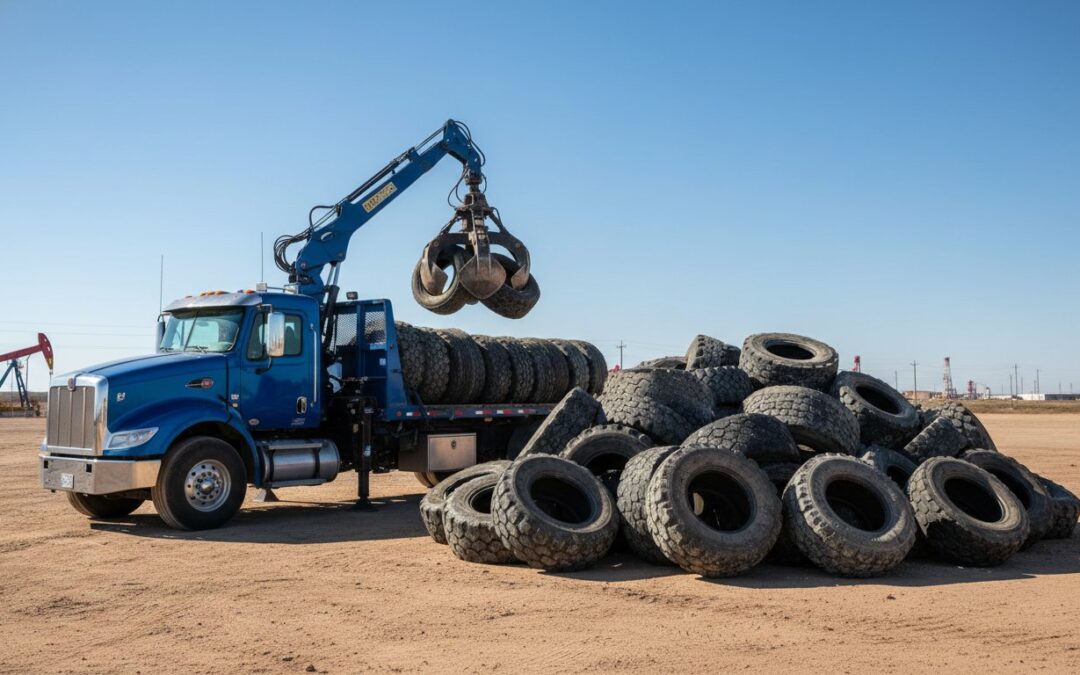
A single forgotten pile of semi-truck tires on your Midland lot isn’t just an eyesore; it’s a legal liability that could cost your business thousands in TCEQ penalties as we move into 2026. You likely understand the frustration of watching sun-baked rubber become a volatile fire hazard or a breeding ground for West Texas mosquitoes, yet the logistics of moving 150-pound OTR tires often feels impossible. Managing these scrap piles is no longer just about cleaning up. It’s about protecting your property from strict environmental audits and significant safety risks.
This guide offers a professional strategy for commercial property tire removal Midland managers can rely on to clear their sites safely and legally. You’ll learn how to secure the necessary disposal manifests for compliance and why choosing a local partner with specialized equipment is the only way to handle industrial-grade rubber waste. We will walk through a 5-point checklist to ensure your property remains clear, documented, and fully compliant with the latest disposal standards.
Key Takeaways
- Understand why scrap rubber is a high-risk liability in the West Texas heat and how to prevent spontaneous combustion on your lot.
- Learn the specific steps for a site assessment, including how to calculate Passenger Tire Equivalents (PTE) for accurate volume estimation.
- Identify non-standard industrial waste like oilfield hoses and skid steer tracks that require specialized disposal methods beyond standard recycling.
- Master the logistics of commercial property tire removal Midland to ensure you receive the legal manifests required for 2026 compliance.
- Discover professional staging techniques that minimize labor time and streamline bulk rubber pickups for your facility.
Why Commercial Tire Accumulation is a Liability in Midland
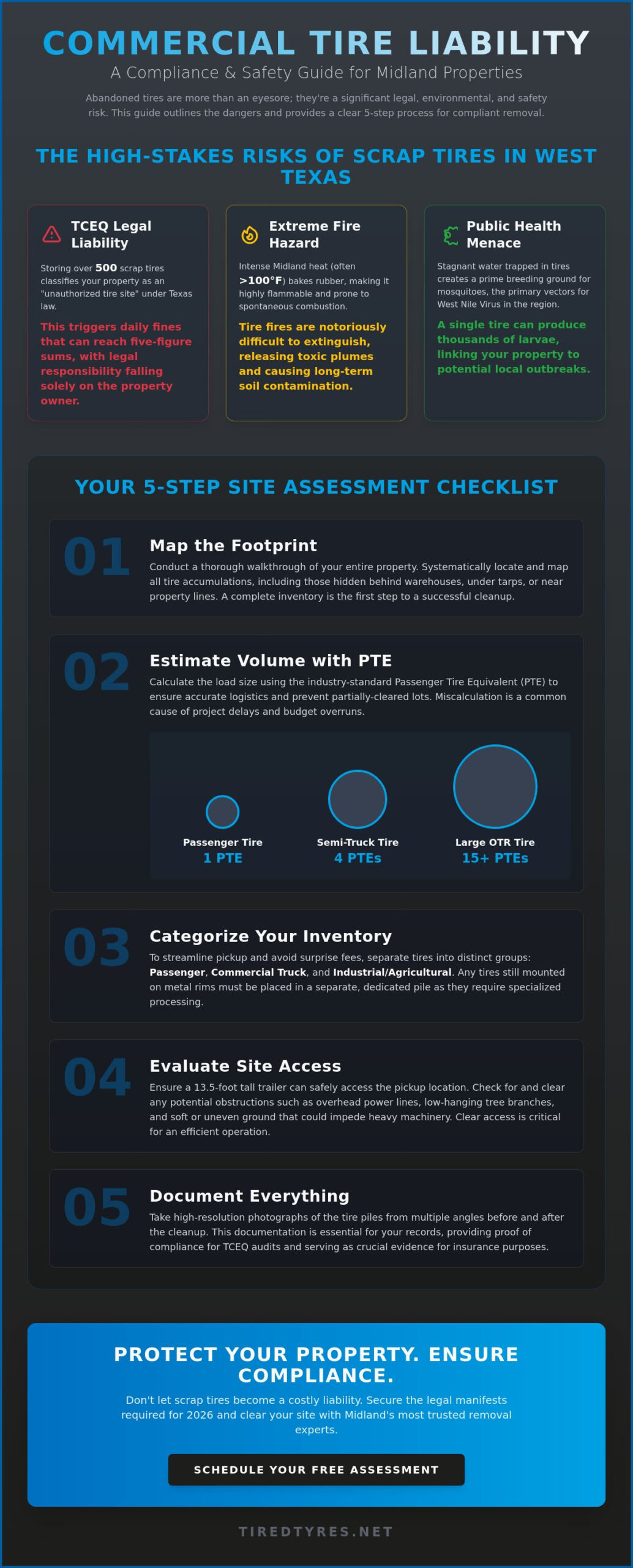
Stockpiling scrap rubber on a business lot in West Texas is a high-stakes gamble. While a few dozen tires might seem like a minor storage issue, they quickly evolve into a significant legal and financial liability. In the Permian Basin, these piles are more than an eyesore; they are active hazards that attract regulatory scrutiny and physical danger. Professional commercial property tire removal Midland services aren’t just about cleaning up. They are about mitigating risks that can shutter a business or result in massive lawsuits.
The Midland climate plays a direct role in these risks. During the summer of 2023, the region experienced 24 consecutive days with temperatures exceeding 100°F. This intense heat bakes rubber, causing it to off-gas and become highly flammable. Beyond the fire risk, tires are the primary breeding ground for mosquitoes in Ector and Midland counties. Even a small amount of stagnant water trapped inside a tire casing can produce thousands of larvae. This creates a public health hazard on your property, potentially linking your business to local outbreaks of West Nile virus.
TCEQ Compliance and Your Property
The Texas Commission on Environmental Quality (TCEQ) strictly monitors how businesses handle scrap rubber. Under Texas law, any site storing more than 500 scrap tires is classified as an “unauthorized tire site” unless it’s specifically registered. This threshold is lower than many property managers realize. Once you hit this limit, you face daily fines that can reach five figures. Understanding professional tire recycling methods is essential for staying on the right side of these regulations. It’s vital to remember that the legal responsibility for the cleanup falls entirely on the property owner, even if the tires were dumped illegally by a third party under the cover of night.
The Fire Risk in the Permian Basin
Tire fires are a nightmare for local emergency services. Because tires are designed to be durable and heat-resistant, they are incredibly difficult to extinguish once they ignite. Local fire departments in the Midland/Odessa area often have to use specialized foam or massive amounts of dirt to smother these blazes; water alone often fails to penetrate the pile. A commercial tire fire doesn’t just damage your structures. It creates a toxic plume of smoke and leaves behind a thick, oily residue. This runoff can lead to long-term soil contamination, requiring expensive remediation that insurance policies may not fully cover. Clearing your site now is the only way to eliminate this threat entirely.
The 5-Step Commercial Site Assessment for Scrap Rubber
Before scheduling a commercial property tire removal Midland project, a systematic assessment is required to prevent logistical delays. Don’t simply guess the size of the pile. A proper walkthrough ensures you have the right equipment and documentation ready for the haulers. Start by mapping the physical footprint of the accumulation. It’s common to find hidden stacks behind warehouses or tucked under tarps near the property line. Once the area is mapped, you can move to precise volume estimation.
Calculating Passenger Tire Equivalents (PTE) is the industry standard for determining load requirements. A standard passenger tire equals 1 PTE. However, a semi-truck tire typically counts as 4 PTEs, and large OTR (off-the-road) tires can exceed 15 PTEs. Accurate counting prevents the frustration of a half-cleared lot because the trailer reached its weight limit too early. During this walkthrough, take high-resolution photographs of every angle. These photos serve as essential proof of the environmental risks of tire accumulation being addressed, which is critical for insurance audits and TCEQ compliance records.
Categorizing Your Inventory
Organization saves time and labor. Separate your inventory into three main groups: passenger vehicles, heavy-duty commercial trucks, and agricultural or industrial rubber. If your stockpile contains tires still mounted on metal rims, move them to a separate area. Processing rims requires different equipment than standard rubber recycling. For more details on sorting specific types of industrial waste, consult our guide on commercial tire disposal in Midland. Clear categorization ensures the loading process is efficient and helps avoid unexpected handling fees.
Evaluating Site Access
Logistics can make or break a cleanup operation. Check for overhead clearances like power lines or low-hanging trees that might snag a 13.5-foot tall trailer. Ground stability is also a major factor in Midland. While the soil is often dry, a single rain event can turn a dirt lot into a trap for an 80,000-pound loaded truck. Ensure there’s enough room for a 53-foot trailer to turn around without damaging existing structures. Coordinate gate codes and staff availability ahead of time to keep the operation moving. If you’re managing a complex site, you can request a professional site assessment to identify these logistical hurdles before the crew arrives.
Identifying Industrial Rubber Waste on Midland Commercial Sites
Midland’s industrial landscape is unique. Unlike other Texas cities, commercial properties here often serve the oil, gas, and construction sectors. This means your rubber waste isn’t always round. Many property managers find themselves stuck with massive piles of skid steer tracks, solid forklift tires, and heavy-duty industrial hoses. These items are notoriously difficult to dispose of because standard junk haulers lack the permits or equipment to handle non-tire rubber. Effective commercial property tire removal Midland requires a partner who understands these specific oilfield waste streams.
Leaving industrial rubber to rot in the West Texas sun creates long-term problems. Solid rubber tracks and reinforced hoses don’t break down. They become permanent fixtures that trap heat and debris. Because these materials are often densely packed with steel cords or textile reinforcements, they require specialized processing. Most local landfills will refuse them outright or charge exorbitant “hard-to-handle” fees. We bridge this gap by identifying these materials during our initial assessment and ensuring they enter the correct recycling channels rather than taking up space in a dumpster.
Heavy-Duty OTR and Agricultural Tires
Off-the-Road (OTR) tires are a different breed of waste. A single tire from a front-end loader or a large tractor can weigh over 2,000 pounds. You can’t just roll these into the back of a pickup truck. Moving them requires heavy-duty winches, specialized trailers, and experienced operators who know how to secure oversized loads. In the Permian Basin, Tired Tyres provides the specialized equipment necessary to lift and transport these giants. We handle the heavy lifting so your crew can stay focused on their primary jobs, ensuring your yard remains clear of these massive safety hazards.
Scrap Conveyor Belts and Hoses
Conveyor belts and high-pressure industrial hoses are common leftovers from Midland’s industrial facilities. A single roll of scrap conveyor belt can weigh several tons and take up hundreds of square feet of valuable yard space. It’s vital for the local environment to keep this industrial rubber out of Midland landfills. These materials are highly durable, which makes them excellent candidates for repurposing in secondary industrial applications. We integrate these items into the recycling stream, stripping out metal components and processing the rubber for future use. This sustainable approach protects your property’s environmental standing while clearing the logistical nightmare of bulk rubber storage.
Scheduling and Logistics: Preparing for a Bulk Tire Pickup
Scheduling a commercial property tire removal Midland project requires more than just a phone call. It involves a coordinated logistics plan to ensure the transition from liability to compliance is seamless. Once you’ve completed your site assessment and categorized your waste, the next step is managing the physical removal and the paperwork that protects your business. A professional pickup is a synchronized operation that minimizes disruption to your daily commercial activities.
Preparation starts with staging. Arrange your tire stockpiles in a way that allows heavy collection trucks to pull alongside them without multiple maneuvers. If your tires are scattered across a five-acre lot, the labor time and costs will increase. We recommend grouping tires by size near your primary access point. This simple step can reduce loading time by as much as 40 percent. Before the truck arrives, verify that your chosen hauler is currently registered with the state of Texas. An unregistered hauler puts you at risk, as you remain legally responsible for the tires until they reach a permitted processing facility.
Understanding the Scrap Tire Manifest
The manifest process is your primary defense against regulatory fines. In Texas, a scrap tire manifest is a multi-part form that tracks the movement of tires from the generator (your property) to the final disposal site. This document is essentially your proof of legal disposal. If a TCEQ inspector visits your Midland facility, they will ask to see these records first. You can find more details on the specific forms and filing requirements in our guide to Texas tire disposal regulations. State law requires commercial entities to maintain these manifest records for at least three years to prove continuous compliance.
Logistics for Large-Scale Removals
For properties with significant accumulations, coordination with Midland County vector control may be necessary. If a pile has been sitting for months, it’s likely a public health nuisance due to mosquito activity. We often coordinate with local agencies to ensure the site is treated or cleared before it becomes a community-wide issue. Large-scale removals often take multiple days. A professional crew will provide a clear timeline and a completion report that includes final counts and photos of the cleared site. After the last trailer leaves, perform a final walkthrough. Ensure the ground is clear of small rubber debris, metal wires, and stagnant water pockets. To get your site cleared by professionals who handle the paperwork for you, schedule your commercial pickup today.
Why Tired Tyres is Midlands Top Choice for Commercial Removal
Choosing a partner for commercial property tire removal Midland projects shouldn’t involve calling a national call center that doesn’t know the difference between Big Spring and Gardendale. Tired Tyres is rooted in the Permian Basin. We’ve built our reputation on being the local expert that property managers trust when the stakes are high. While national junk removal brands might offer a generic pickup service, they often lack the permits and heavy-duty equipment required to handle large-scale industrial rubber waste. We don’t just pick up tires; we provide a comprehensive liability management solution tailored to the West Texas industrial sector.
Our approach is built on professional transparency and professional results. Every commercial job we handle comes with guaranteed TCEQ manifest documentation. This isn’t just a simple receipt. It’s your legal proof that your waste was handled according to 2026 Texas environmental standards. We understand that for a Midland business owner, reliability means more than just showing up on time. It means arriving with the right trailers, the right crew, and the right paperwork to keep your property compliant and your business protected from future audits. We’ve helped local businesses clear thousands of passenger tire equivalents while maintaining perfect safety records.
Our Permian Basin Service Area
We provide direct service to Midland, Odessa, Lubbock, and the surrounding industrial corridors. Our local presence gives us a distinct advantage over out-of-state competitors. We know the specific intake requirements of regional recycling centers and landfills, which allows us to optimize our routes and pass that efficiency on to our clients. If you’re looking for a deeper look at how we manage these logistics across the region, check out our reliable tire disposal guide for property managers in West Texas. Our knowledge of local terrain and weather patterns ensures we never get stuck or delay your project.
Get a Professional Site Clearance Quote
Requesting an estimate for your property is a straightforward, direct process. We start with a brief consultation to understand the volume and type of rubber on your site. Whether you’re dealing with a legacy pile of semi-truck tires or a warehouse full of scrap conveyor belts, we provide clear, itemized quotes that reflect the actual scope of work. Midland property managers prefer us because we don’t cut corners. We don’t leave debris behind. Don’t let a rubber stockpile become a permanent liability for your business. Schedule your commercial tire removal today and get your property back to full compliance with a partner you can trust.
Secure Your Midland Property and Maintain 2026 Compliance
Maintaining a clean, safe commercial site in West Texas requires more than just occasional cleanup; it demands a proactive approach to liability management. By implementing a systematic site assessment and ensuring every load is backed by a TCEQ manifest, you protect your business from the severe environmental penalties expected in 2026. Whether you’re clearing standard passenger tires or managing the heavy-duty logistics of OTR tracks and industrial hoses, professional removal is the only way to eliminate fire risks and pest hazards permanently.
Tired Tyres is your local, TCEQ-permitted partner for commercial property tire removal Midland projects. We specialize in the heavy industrial rubber and oversized OTR tires that standard haulers often refuse to touch. Serving the entire Permian Basin and South Plains, we bring the specialized equipment and local expertise needed to restore your property’s safety and value. Don’t wait for a regulatory site audit or a dangerous summer heatwave to address your stockpile. Our team handles the documentation and the heavy lifting so you can focus on your core operations.
Get a Commercial Tire Removal Quote for Your Midland Property and secure your facility today.
Frequently Asked Questions
Does the City of Midland landfill accept tires from commercial properties?
The City of Midland landfill typically doesn’t accept bulk scrap tire loads from commercial entities or professional haulers. While residential customers have limited disposal options, businesses are required to use TCEQ-permitted haulers to transport waste to authorized processing sites. This ensures that industrial volumes are managed according to state environmental standards rather than taking up valuable municipal landfill space.
How much does it cost to remove tires from a commercial site in Midland?
Costs for commercial property tire removal Midland depend on the total volume of rubber, the size of the tires, and the site’s accessibility. A pile of standard passenger tires requires different labor and equipment than a stack of 2,000-pound OTR tires. We provide itemized quotes based on the specific count and type of rubber found during our initial site assessment.
What is a scrap tire manifest, and why do I need one in Texas?
A scrap tire manifest is a state-mandated document that tracks waste rubber from your property to its final disposal or recycling destination. You need this paperwork to prove to the TCEQ that your business disposed of the tires legally. Without a manifest, your company remains legally liable for the tires even after they leave your lot, which could lead to significant fines if they are dumped illegally elsewhere.
Can you remove tires that are still on the rims?
Yes, we remove tires that are still mounted on metal rims. These are handled differently during the recycling process because the metal must be separated from the rubber casing. Staging these mounted tires in a separate area on your lot helps our crew load the trailers more efficiently. This organization ensures the metal enters the correct recycling stream while the rubber is processed for other uses.
How quickly can Tired Tyres clear a large commercial tire stockpile in Odessa?
Most large-scale removals in the Odessa and Midland area are completed within 48 to 72 hours of the scheduled start time. The exact duration depends on the total volume and how well the tires are staged for loading. We work closely with your facility managers to set a clear timeline that doesn’t disrupt your primary business operations or site traffic.
Do you handle industrial rubber waste like conveyor belts and skid steer tracks?
We specialize in heavy industrial rubber waste that standard junk haulers often refuse. This includes reinforced conveyor belts, solid forklift tires, and rubber tracks from skid steers or excavators. These materials are processed through specialized industrial recycling channels. We ensure these high-density rubber items are removed safely and kept out of local landfills where they would otherwise become permanent fixtures.
Is it illegal to store tires on my property in Midland County?
It’s illegal to store more than 500 scrap tires on a commercial site without a specific registration from the TCEQ. Even smaller piles can be cited if they are found to be a fire hazard or a breeding ground for mosquitoes. Property managers must prioritize commercial property tire removal Midland to stay within the legal limits and avoid public health nuisance citations from county officials.
What happens to the tires after they are removed from my property?
Tires removed from your property are transported to a permitted facility for processing and recycling. Most are shredded for use in tire-derived fuel or ground into crumb rubber for civil engineering projects and playground surfaces. This process turns a significant property liability into a sustainable raw material, ensuring that none of the rubber is left to rot or burn in a West Texas field.