
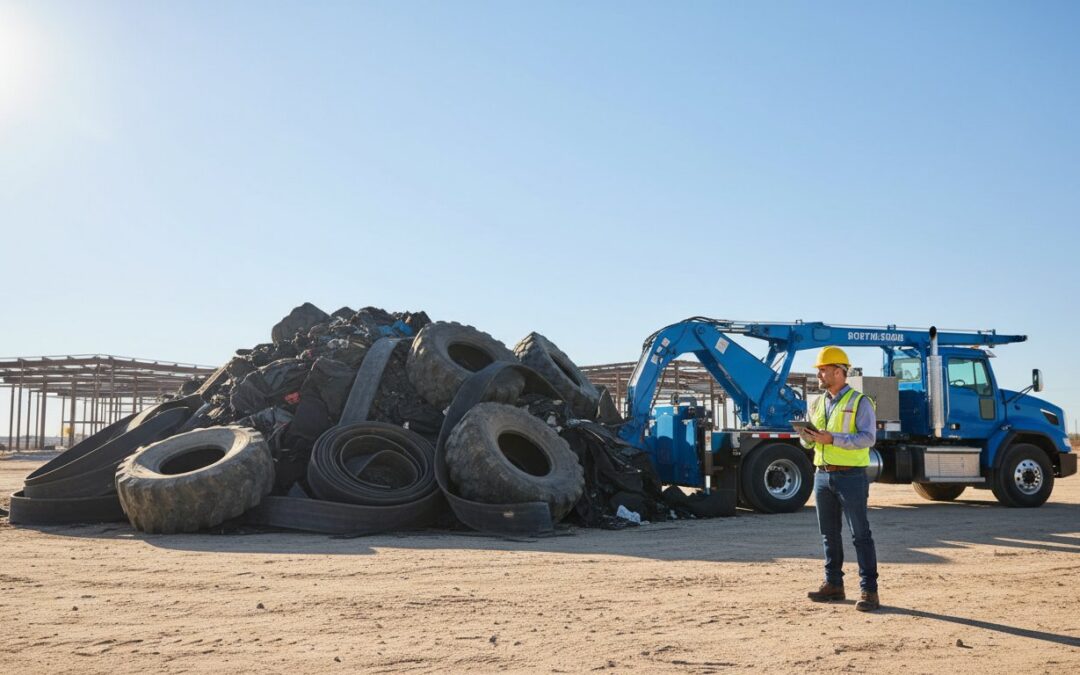
The Texas Commission on Environmental Quality issued over $2.4 million in penalties for improper scrap tire management in 2025. For a project manager in West Texas, those aren’t just numbers; they’re a direct warning that a messy site is a significant financial liability. You’ve probably already discovered that standard waste haulers refuse to touch massive OTR tires or scrap conveyor belts. It’s a common headache to see industrial rubber taking up valuable space while you’re trying to meet a strict deadline. Effective construction site tire cleanup in Lubbock requires more than just a trailer. It demands a professional strategy that keeps you compliant and your site clear.
We understand that your focus is on finishing the build, not navigating the fine print of TCEQ registration thresholds. This guide will show you how to manage bulk tire and industrial rubber removal while avoiding the $78.61 per ton special waste surcharges at local landfills. We’ll walk through the current reporting requirements for scrap tire generators and explain how to secure the manifest proof you need to protect your business from legal trouble. From skid steer tracks to heavy duty truck tires, you’ll learn the most efficient way to maintain a safe and productive work environment.
Key Takeaways
- Identify TCEQ registration thresholds to prevent your job site from facing significant penalties for improper stockpiling.
- Efficient construction site tire cleanup in Lubbock requires specialized handling for OTR tires and industrial tracks that standard waste services refuse.
- Learn how a professional site assessment helps categorize rubber waste, from scrap hoses to conveyor belts, for faster removal.
- Secure your project’s legal standing by using permitted haulers who provide the necessary manifest proof of legal disposal.
- Keep your workspace clear and safe by scheduling bulk rubber pickups that minimize disruption to your active construction phases.
The Challenge of Construction Site Tire Cleanup in Lubbock
Managing a project in West Texas means dealing with more than just dirt and steel. Construction site tire cleanup in Lubbock is a specialized logistics task that many project managers underestimate. It isn’t just about picking up trash; it’s about handling a regulated waste stream that standard junk removal companies won’t touch. Most general waste haulers in the area focus on wood, metal, and concrete. They aren’t equipped for the weight or the legal requirements of industrial rubber. Tires are problematic because they don’t stay buried in landfills. They trap gases and eventually “float” back to the surface, which is why local disposal sites have such strict intake rules.
Leaving rubber piles on your site creates immediate safety hazards. These piles collect rainwater and quickly become breeding grounds for mosquitoes, raising the risk of West Nile virus for your crew. There’s also the threat of fire. A tire fire is notoriously difficult to extinguish and produces toxic smoke that can shut down your project for weeks. When you research various Tire recycling methods, you’ll see that rubber requires specific processing to be handled safely and legally. If you discover “inherited” piles during excavation on a new plot, you become the responsible party in the eyes of the law. You need a partner who can clear that liability quickly.
Why General Roll-Offs Aren’t Enough
Lubbock landfills have specific restrictions regarding whole tires. You can’t simply toss a heavy duty truck tire into a standard roll-off bin and expect it to be hauled away. Most municipal facilities apply heavy surcharges for “special waste,” and many drivers will leave the bin behind if they see rubber inside. OTR (Off-the-Road) tires present a massive volume issue. A single earthmover tire can weigh over 2,000 pounds, which can easily exceed the weight limits of a standard commercial truck. Specialized hauling is the only legal way to transport bulk rubber from a job site to a permitted recycling facility while maintaining a clear paper trail for regulators.
Common Scenarios for Site Tire Accumulation
Many construction site tire cleanup in Lubbock projects start with a surprise during the clearing phase. New land purchases in Lubbock County often hide decades of illegal dumping that only becomes visible once excavation begins. Long-term infrastructure projects also generate their own waste through constant machinery maintenance. Skid steer tracks, scrap hoses, and heavy equipment tires wear down and need to be removed to keep the site organized. Clearing rural land for residential development frequently reveals old agricultural tire piles that have been abandoned for years. We step in to handle these scenarios so your timeline stays on track.
Types of Industrial Rubber Waste Found on Job Sites
Effective construction site tire cleanup in Lubbock requires a clear understanding of the materials present on your lot. Most people think of standard car tires, but industrial sites generate a diverse range of rubber debris. West Texas projects often involve heavy machinery that produces massive waste streams. Categorizing these items correctly is the first step toward a compliant and efficient removal process. It helps you determine the right equipment needed for hauling and ensures you aren’t surprised by disposal fees later.
Contractor trucks and site vehicles contribute a steady volume of passenger and light truck tires. While these are smaller, they accumulate quickly during long-term builds. It’s vital to address these piles before they grow too large. Researchers at the EPA have highlighted the environmental and health impacts of tires, noting that abandoned rubber can leach chemicals into the soil. Clearing these smaller units regularly prevents your site from becoming a regulatory target.
OTR and Heavy Equipment Tires
The real logistical challenge lies in Off-the-Road (OTR) tires. These are the massive units found on loaders, graders, and earthmovers. You can’t toss these into a pickup bed. Moving a single grader tire requires specialized lifting equipment and a trailer rated for heavy industrial loads. Because of their sheer size, these tires are often rejected by standard municipal services. If your project involves heavy earthmoving, you’ll need a dedicated strategy for commercial tire disposal to keep your site clear of these massive obstructions.
Scrap Skid Steer Tracks and Industrial Hoses
West Texas soil is notoriously hard on equipment. The rocky, caliche-heavy ground around Lubbock causes high replacement rates for rubber skid steer tracks. These tracks are often steel-reinforced, making them incredibly difficult to cut or compress for standard disposal. They take up significant space and pose tripping hazards for your crew. Similarly, industrial hoses and scrap conveyor belts from site-clearing operations add to the clutter. These items don’t fit the “tire” category but still require professional handling. If you’re struggling with a growing pile of tracks or hoses, our team at Tired Tyres can help you manage the entire rubber waste stream in one go.
We also frequently see scrap solid tires and conveyor belts on larger infrastructure projects. These materials are dense and heavy. They don’t compact, which means they quickly fill up any unauthorized dump areas on your site. By identifying these specific waste types early, you can plan for a professional construction site tire cleanup in Lubbock that addresses every piece of rubber, from the smallest hose to the largest earthmover tire.
Navigating Texas Tire Disposal Regulations and TCEQ Compliance
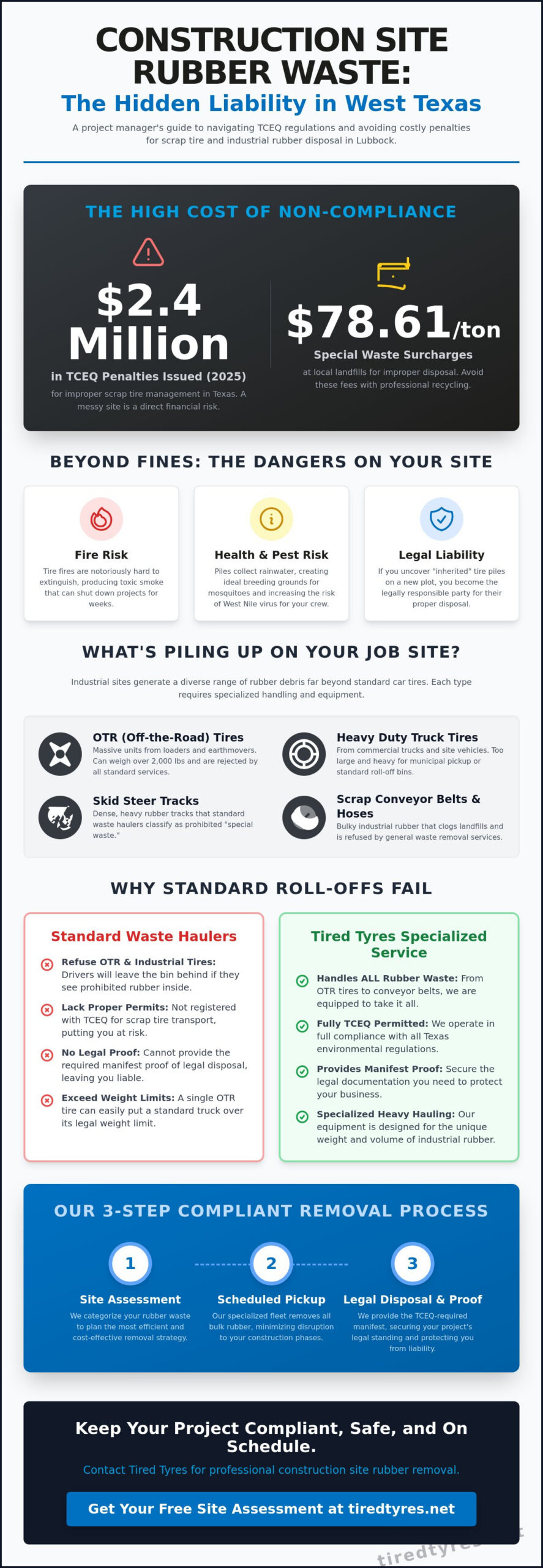
Compliance isn’t a suggestion in West Texas; it’s a legal requirement that directly impacts your project’s profitability. The Texas Commission on Environmental Quality (TCEQ) oversees every scrap tire generated at your site. In 2025, the TCEQ issued over $2.4 million in penalties for improper scrap tire management. This shows that the state is actively looking for violations. For construction site tire cleanup in Lubbock, you can’t simply hire an unpermitted hauler and assume your responsibility ends when the truck leaves. You’re responsible for those tires until they reach a licensed processing facility.
The state has clear thresholds for when a job site becomes a regulated storage facility. You must register with the TCEQ if you store more than 500 scrap tires on the ground or more than 2,000 in enclosed, lockable containers. If your project involves heavy clearing or you’ve inherited an old dump site, you might hit these numbers faster than you think. Once you’re registered, you’re also required to report your operational status annually. For the 2025 calendar year, that report was due by December 31st. Failing to track these dates or quantities leads to inspections and heavy fines that can stall your construction progress.
The Role of the Tire Manifest
A scrap tire manifest is your primary defense against legal liability. It’s a multi-part document that tracks the rubber from the moment it leaves your job site to its final disposal or recycling point. When we arrive for a pickup, we initiate this paperwork. It records the date, the hauler’s permit number, and the exact quantity of tires collected. You must keep these records on-site for at least three years. It’s a critical rule to remember: the generator remains liable for the waste until a manifest is signed by a permitted processor. This paper trail is the only way to prove to an inspector that you followed the law.
Avoiding Fines in Lubbock County
Local enforcement in Lubbock County is particularly focused on preventing illegal dumping in rural areas and canyons. Staying ahead of inspectors means being proactive about texas tire disposal regulations before your pile becomes a nuisance. The City of Lubbock applies significant surcharges that can blow your budget. While standard landfill fees are $41.00 per ton at the West Texas Regional Disposal Facility, tires are often classified as “special waste.” This adds a surcharge of $78.61 per ton for waste generated outside the city.
There’s also the risk of an unsecured load surcharge. Any commercial vehicle arriving at a local landfill with an uncovered load faces a $30.00 fee. Professional construction site tire cleanup in Lubbock eliminates these hidden costs by using permitted vehicles and established disposal routes. By scheduling regular pickups, you ensure your site stays below the 500-tire registration threshold and avoid the scrutiny that comes with large-scale stockpiling. It’s the most straightforward way to keep your site safe and your business compliant.
Our Process for Efficient Site Debris Removal
Our approach to construction site tire cleanup in Lubbock begins with a precise site assessment. We don’t guess at volumes or waste types. We identify exactly what’s in your pile, whether it’s standard passenger tires at $5.00 each or heavy duty truck tires at $11.00 each. By categorizing the rubber early, we ensure the right equipment is dispatched for the job. Loading massive OTR tires or 300/400 series HD truck tires requires more than just muscle. It requires specialized trailers and lifting tools that keep your crew safe and your project moving forward.
Scheduling and Site Logistics
We coordinate directly with site supervisors to manage gate access and staging areas. Our team understands that construction sites are high-traffic environments where every minute counts. We offer reliable tire disposal that fits your specific project timeline. For massive infrastructure builds, we can establish recurring removal schedules. For smaller residential developments, a one-time bulk pickup is often more efficient. We handle the loading and logistics so your operators can stay focused on their primary tasks. Our drivers also ensure every load is secured, preventing the $30.00 surcharge the City of Lubbock applies to uncovered commercial vehicles at the landfill.
Processing and Recycling
Once the rubber leaves your site, the process isn’t over. We transport the waste to a permitted processing facility where we finalize the TCEQ manifest. This document is your proof of legal disposal. Choosing professional tire recycling over landfilling has significant environmental benefits for West Texas. Instead of sitting in a pit, these tires are processed into materials for rubberized asphalt, mulch, or fuel. Over 90% of the waste collected by specialized firms is now recycled into useful products. This contributes to a circular economy and keeps our local canyons and rural lands free of industrial debris.
Don’t let a growing pile of rubber become a safety hazard or a regulatory nightmare. We provide the specialized equipment and the legal paperwork required for a clean, compliant job site. Contact Tired Tyres today to schedule your professional construction site tire cleanup in Lubbock and clear your site of industrial rubber waste.
Why Tired Tyres is Lubbock’s Choice for Site Cleanup
Choosing the right partner for construction site tire cleanup in Lubbock isn’t just about finding a truck. It’s about finding a team that understands the industrial reality of West Texas. Many general haulers in the Hub City will pick up your wood and metal but leave the heavy OTR tires and reinforced rubber tracks behind. We don’t do that. We specialize in the difficult loads that others refuse to touch. Whether you’re clearing a rural plot for a new subdivision or managing a large-scale infrastructure project, we provide the specific equipment needed to lift and haul heavy rubber waste safely. We take everything from scrap hoses and conveyor belts to massive earthmover tires.
Lubbock’s unique mix of agricultural history and rapid urban expansion means many job sites are located on land that has been used for decades to store old tractor tires or irrigation hoses. We have the local expertise to navigate these specific challenges. We know the intake rules at the West Texas Regional Disposal Facility and the Caliche Canyon Landfill. Our team ensures that your site stays compliant with TCEQ regulations without you having to spend hours on paperwork. We initiate the manifest, verify the legal disposal, and provide you with the records you need for environmental audits. Our priority is a rapid response that keeps your project on track and your workspace clear of hazards.
Serving Lubbock, Midland, and Odessa
Our deep roots in the South Plains and Permian Basin regions give us a distinct advantage. By serving Lubbock, Midland, and Odessa, we’ve built a regional network that understands the disposal logistics of West Texas. We’re committed to keeping our local communities professional and ensuring that industrial waste doesn’t end up in our canyons or on the side of rural roads. This local knowledge allows us to offer faster response times than out-of-state contractors who don’t understand the regional terrain or the specific surcharges applied to “special waste” in Lubbock County. We’re your neighbors, and we take pride in helping you maintain a clean, safe job site.
Get Your Site Quote Today
Requesting an estimate is a straightforward process that doesn’t waste your time. We provide transparent pricing based on the specific types of rubber waste you have on-site. You’ll know exactly what the costs are, from standard passenger tires to oversized farm machinery units at $45.00 plus $0.20 per pound. This clarity helps you manage your project budget while ensuring a safe work environment for your crew. Don’t let a growing pile of rubber delay your progress or invite unwanted inspections. Contact Tired Tyres for your Lubbock site cleanup today and let us handle the heavy lifting and the legal compliance.
Secure Your Site and Protect Your Bottom Line
Maintaining a safe and efficient job site requires more than just moving dirt. It requires a clear strategy for regulated waste. We’ve seen how improper stockpiling leads to significant TCEQ penalties and how specialized rubber waste like OTR tires can stall your progress. Professional construction site tire cleanup in Lubbock ensures you have the legal manifests needed for compliance while keeping your workspace clear of industrial hazards. It isn’t just about hauling; it’s about protecting your project from liability.
As a TCEQ Permitted Hauler, we specialize in the removal of the heavy materials others leave behind. Whether you’re dealing with scrap conveyor belts in Midland or massive earthmover tires in Odessa, we have the specialized equipment to handle the load. We prioritize your project’s timeline and your company’s regulatory standing. Our team handles the logistics and the paperwork so you can stay focused on the build. Serving the South Plains and Permian Basin, we understand the specific needs of West Texas contractors.
Clear your site and protect your business today. Get a Quote for Your Lubbock Construction Site Cleanup and experience the difference of working with local experts. We’re ready to help you finish your project on a clean, professional lot.
Frequently Asked Questions
Can I put tires in a standard construction dumpster in Lubbock?
No, you cannot toss whole tires into a standard roll-off dumpster. Most local waste services and landfills reject whole tires because they don’t compact and can damage landfill liners. If a driver spots rubber in your bin, they’ll likely leave it behind or charge a significant “special waste” fee. You need a permitted hauler to manage these items separately to ensure your project stays on schedule.
How much does it cost to remove OTR tires from a construction site?
The cost for OTR removal depends on the weight and dimensions of the specific units. Large earthmover tires require heavy duty trailers and specialized loading equipment, which impacts the final estimate. We provide clear, volume-based pricing after our initial site assessment. This ensures you aren’t surprised by hidden fees and allows you to budget accurately for your industrial rubber disposal needs.
What is a TCEQ tire manifest and why do I need one?
A TCEQ manifest is a multi-part legal document that tracks scrap rubber from your job site to a licensed recycling facility. You need this paperwork to prove you’ve followed state environmental laws. Without a signed manifest, your company remains legally liable for the tires even after they’ve been hauled away. Keeping these records for three years is your primary defense against potential environmental fines.
Does Tired Tyres remove rubber skid steer tracks?
Yes, we collect scrap skid steer tracks along with solid tires and industrial hoses. These steel-reinforced items are notoriously difficult to dispose of because standard junk removal companies lack the equipment to handle their weight. We specialize in these dense materials, ensuring they’re removed from your site and processed correctly. This helps maintain a clear, professional workspace for your heavy equipment operators.
How quickly can you clear a large stockpile of tires in Lubbock County?
We prioritize rapid response times to keep your project moving forward. Most construction site tire cleanup in Lubbock can be scheduled within a few business days of your request. Clearing a large stockpile quickly is vital if you’re approaching the 500-tire registration threshold. Our team works efficiently to remove the debris and complete the necessary manifest paperwork so you can stay focused on your build.
Are there fines for keeping old tires on my property during construction?
Yes, the TCEQ can issue substantial penalties for improper stockpiling or illegal storage. If your site accumulates more than 500 tires on the ground without proper registration, you’re at risk for environmental inspections. Regular construction site tire cleanup in Lubbock prevents these financial liabilities. It also eliminates fire hazards and pest breeding grounds, which can lead to additional local code enforcement citations or project delays.
What happens if we find an illegal tire dump during excavation?
If you discover an old tire dump during excavation, you unfortunately become the party responsible for its legal removal. You should document the find immediately and contact a permitted hauler to clear the area. We handle the loading and transportation of these “inherited” piles, providing the manifest proof you need to show the waste was handled properly. This protects your project’s legal standing from the start.