
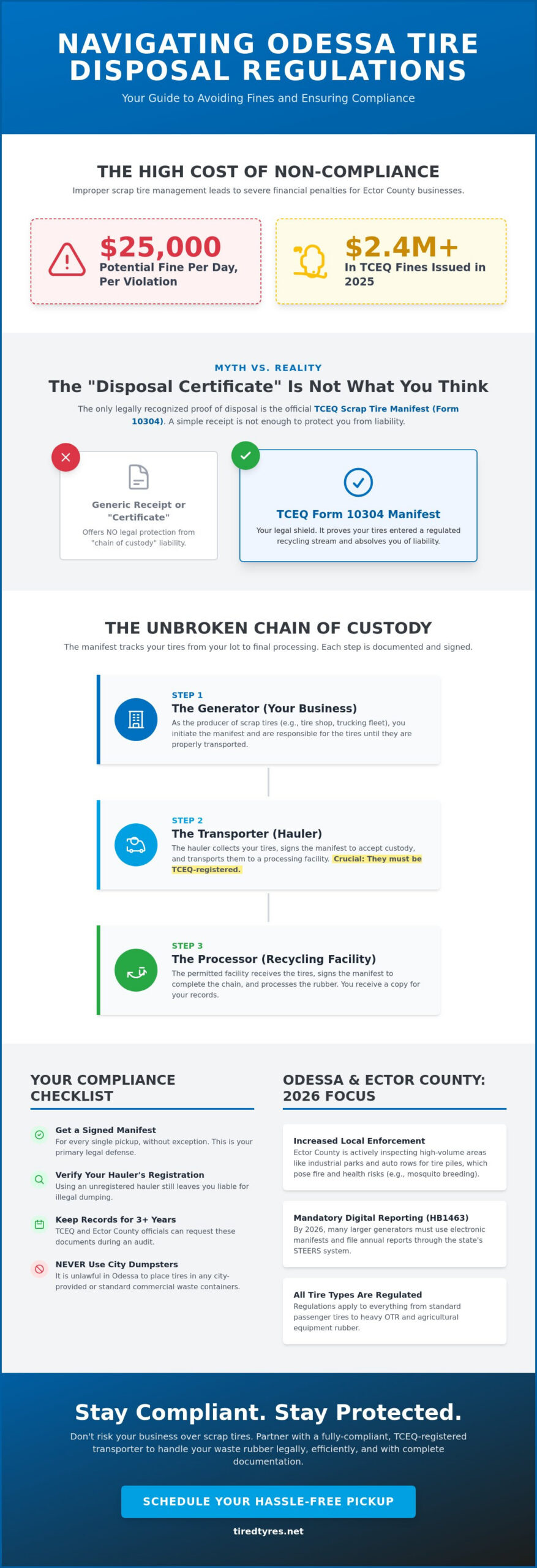
In 2025, the Texas Commission on Environmental Quality (TCEQ) issued over $2.4 million in penalties for improper scrap tire management. For business owners in Ector County, a single abandoned tire or an unauthorized storage site can lead to fines of up to $25,000 per day. You likely know that keeping your lot clear is essential, but the paperwork often feels like a legal minefield. If you’re searching for how to get a tire disposal certificate Odessa, it’s important to understand that the “certificate” you need is actually a five-part TCEQ Scrap Tire Manifest, known as Form 10304.
We understand the anxiety that comes with potential liability and the confusion surrounding new electronic reporting mandates like HB1463. This guide shows you exactly how to secure a valid manifest to protect your business from heavy fines and ensure your rubber waste is handled legally. We’ll walk through the current TCEQ requirements and explain how to clear your lot of everything from passenger tires to heavy OTR rubber while staying fully compliant with state and city ordinances.
Key Takeaways
- Understand why the TCEQ Form 10304 manifest is the only legal document that satisfies your search for how to get a tire disposal certificate Odessa.
- Learn how to avoid liability for illegal dumping and potential $25,000 daily fines by verifying hauler registrations.
- Discover the latest 2026 Odessa city ordinances regarding tire disposal and the specific restrictions for commercial waste containers.
- Identify the correct inventory categories for your scrap rubber, from standard passenger tires to heavy OTR and agricultural equipment.
- Find out how to automate your compliance through electronic manifest systems required by Texas state law HB1463.
Understanding the Tire Disposal Certificate: The TCEQ Manifest
When local business owners search for how to get a tire disposal certificate Odessa, they’re usually looking for a specific legal document to prove they haven’t dumped their waste in a West Texas pasture. In the eyes of the Texas Commission on Environmental Quality (TCEQ), this document isn’t called a certificate; it’s officially known as the Whole Used or Scrap Tire Manifest, or Form 10304. While the name might seem like a minor detail, the distinction is vital for your legal protection.
In the Permian Basin, any business that produces scrap tires through its operations is classified as a “Generator.” This includes tire shops, trucking fleets, and construction companies. You might think a standard landfill receipt is enough to stay compliant, but it isn’t. A receipt only proves you paid a fee. A manifest proves that your tires entered a regulated tire recycling process and reached a permitted destination. Without this form, you remain legally responsible for those tires forever, regardless of who hauled them away.
What is TCEQ Form 10304?
The manifest is a multi-part tracking form that documents the movement of tires from your lot to a final processor. It’s divided into three primary sections: the Generator (you), the Transporter (the hauler), and the Processor (the facility that shreds or recycles the rubber). Each party must sign the document to create an unbroken chain of custody. For Odessa businesses in 2026, the law requires you to keep these records on file for at least three years. The manifest is the only legal proof of tire recycling that the state of Texas recognizes during an audit.
Why Odessa Businesses Need This Documentation
The primary reason you need a manifest is to shield yourself from “chain of custody” liability. If a hauler takes your tires and dumps them illegally in Ector County, the TCEQ will trace those tires back to your business. If you can’t produce a signed manifest, you’re the one facing the $25,000 daily fines. These documents are also becoming a standard requirement for local business permit renewals. Ector County officials often check disposal records to ensure local companies aren’t contributing to the region’s illegal dumping problem. Think of the manifest as an insurance policy. It’s a simple piece of paper that prevents environmental lawsuits and keeps your operations running without regulatory interference.
Odessa and Ector County Tire Regulations in 2026
Industrial growth in the Permian Basin has transformed Odessa into a massive logistics hub. With this expansion comes much stricter oversight of industrial waste. Ector County Environmental Enforcement now monitors local tire piles with increased frequency to prevent illegal dumping and public health hazards. While the TCEQ sets the state-wide framework, local officials perform the actual boots on the ground site visits. They specifically look for the paper trail discussed in the previous section. If you’re wondering how to get a tire disposal certificate Odessa inspectors will accept, you must ensure your hauler provides a signed TCEQ manifest during every pickup.
Landfill restrictions within the city limits have also tightened. It’s unlawful to place any tire in city-provided containers or standard garbage receptacles. Commercial loads are often diverted, and businesses must prove their tires are going to a permitted processor rather than a local dump. This is where Ector County Tire Regulations come into play, as they outline the specific local penalties for non-compliance. Coordination between state and local agencies means an inspection by a county deputy can quickly trigger a larger TCEQ audit if your records are missing.
Local Enforcement Hotspots in Odessa
Inspectors focus on high-volume areas like industrial parks in West Odessa, auto rows along Business 20, and local salvage yards. During a random inspection, officials check for proper storage to prevent fire risks and mosquito breeding. Standing water in a single tire can host thousands of larvae, making scrap tire documentation a public health priority. Keeping your lot clear through professional scrap rubber collection ensures you stay off the enforcement radar and remain in good standing with the county.
The STEERS Reporting System for 2026
By 2026, the transition to digital reporting is mandatory for many larger tire generators. The State of Texas Environmental Electronic Reporting System (STEERS) requires annual filings of tire volumes to track the state’s total scrap rubber output. Many Odessa businesses make the mistake of thinking digital reporting replaces physical manifests. In reality, your physical Form 10304s are the source data for your STEERS filing. If your digital numbers don’t match your physical records during an audit, you face significant liability. Accuracy is key to maintaining your operational status in Ector County.
The Risks of DIY Tire Disposal in West Texas
Many Odessa business owners fall into the “back of the truck” trap. A person with a trailer offers a cheap price to haul away a stack of semi-truck tires. It sounds like a deal. However, if that hauler isn’t TCEQ-registered, you haven’t actually disposed of the tires. You’ve just paid someone to commit a crime. Under the Texas Water Code, the generator remains responsible for the waste until it reaches a permitted facility. If those tires end up in a ditch or an empty lot in West Odessa, the authorities will trace them back to you. The lack of a paper trail is the first thing investigators look for.
Stockpiling rubber on your own lot is just as dangerous. The West Texas heat turns tire piles into fire hazards that are nearly impossible to extinguish. These piles also serve as the perfect breeding ground for mosquitoes, which Ector County officials monitor closely. If you’re looking for how to get a tire disposal certificate Odessa, you’re likely trying to avoid these exact headaches. Without that manifest, you’re sitting on a liability that can trigger TCEQ fines of up to $25,000 per day. One unauthorized dump site is all it takes to attract state-level scrutiny.
Why Landfills Aren’t Always the Answer
Landfills in Ector County often impose heavy surcharges for scrap tires. Even if you pay the fee, a standard landfill receipt doesn’t provide the five-part manifest required for state compliance. There are also strict limits on how many tires a private citizen can haul without a commercial permit. If you see an offer for “free” disposal in Odessa, it’s almost certainly a red flag. Legitimate processing costs money. Anyone offering it for free is likely dumping the rubber illegally, leaving you to face the legal fallout when the tires are discovered.
The Cost of Non-Compliance
The math of illegal disposal never works out in your favor. A professional pickup for your passenger or agricultural tires is a manageable business expense. In contrast, the TCEQ issued over $2.4 million in penalties for improper management in 2025 alone. A single “lost” load of 50 scrap tires can lead to a $10,000 daily liability. For a small Odessa auto shop, these fines aren’t just a setback; they’re a bankruptcy event. Beyond the money, the reputational damage of an environmental citation can kill your standing in the local community. It’s always cheaper to do it right the first time.
Step-by-Step: How to Secure Your Disposal Certificate
Securing the right paperwork doesn’t have to be a headache if you follow a standardized process. Many West Texas business owners feel overwhelmed by the legalities, but it boils down to five clear steps. If you’re focused on how to get a tire disposal certificate Odessa inspectors will approve, you must start with an accurate inventory. Group your waste into categories: Passenger and Light Truck, Semi-Truck, Agricultural, or OTR (Off-the-Road) rubber. Having a clear count before the hauler arrives prevents discrepancies on the final manifest.
Once you’ve categorized your inventory, follow these steps to ensure full compliance:
- Verify the Hauler: Ask for the hauler’s TCEQ registration number. A legitimate professional will have this ready.
- Witness the Loading: Stay present while the tires are loaded. This ensures the count on the manifest matches what’s actually leaving your lot.
- Sign the Manifest: You and the hauler must both sign the document. This transfers the physical custody of the waste.
- Take Your Copy Immediately: Never let a truck leave with all five copies of the form. You need the “Generator” copy for your records before the driver pulls away.
- File for Three Years: Store the document in a secure location. Texas law requires you to produce these records upon request for at least 36 months.
If you’re ready to clear your lot without the paperwork stress, you can schedule a professional collection to ensure every step is handled correctly.
What to Look for on a Valid Manifest
A valid manifest must be legible and complete. Check that the hauler’s TCEQ registration number is printed clearly in the transporter section. You should also verify the “Destination” field. This tells you exactly which permitted facility will be processing your tires. An Odessa business is still liable if the destination is left blank or listed as an unpermitted site. A manifest without a destination signature is incomplete and won’t protect you during an environmental audit.
Organizing Your Compliance Records
Keeping your records organized is just as important as getting them signed. We recommend maintaining a physical binder for the original paper copies and scanning them for digital backup. This dual-storage method ensures you’re prepared if an Ector County official visits your site. You should also watch for “Return to Generator” copies. Some processing facilities mail a final copy back to you once the tires are shredded. Attach these to your original manifest to prove the cycle is complete. Creating a simple disposal log to track dates and volumes will help you stay ahead of your annual STEERS reporting requirements.
Partnering with Tired Tyres for Legal Odessa Disposal
Managing the paperwork is often the most stressful part of waste management for businesses in Ector County. You don’t have to spend hours figuring out how to get a tire disposal certificate Odessa inspectors will accept when you work with a professional hauler. At Tired Tyres, we automate the manifest process for every pickup. Our team handles the documentation from the moment we arrive on your lot until the rubber reaches a permitted processor. This ensures your business stays compliant without requiring you to become a regulatory expert.
As a TCEQ-registered transporter, we provide the safe choice for companies operating in the Permian Basin. We understand the specific needs of the local industrial sector, from oilfield service providers to agricultural operations. We don’t just pick up standard passenger tires. Our collection services are comprehensive and include:
- Passenger and Light Truck Tire Collection
- Semi-Truck Tire Collection
- Agricultural and OTR (Off-the-Road) Tire Collection
- Scrap skid steer track and solid tire collection
- Scrap hose, conveyor belt, and industrial rubber collection
By serving both Odessa and Midland, we offer reliable scheduling that keeps your facility clear of debris and fire hazards. Our direct-to-processor relationship means your tires never sit in an unauthorized lot, which protects you from the chain-of-custody liabilities discussed earlier in this guide.
The Tired Tyres Compliance Guarantee
We ensure every tire or rubber component is tracked from your lot to a licensed recycler. This tracking is essential for your annual STEERS reporting and any random site audits conducted by Ector County Environmental Enforcement. If you’re facing an inspection, having our signed manifests on file provides immediate proof of your legal disposal practices. We assist Odessa businesses by providing clear, legible records that satisfy both state and local requirements, making the audit process straightforward and stress-free.
Get Your Odessa Tire Pickup Scheduled
Getting your lot cleared is a simple, efficient process. When you contact us for a quote, we’ll need to know the types of rubber you have, an estimated count, and your specific location in the Odessa area. Whether you need a one-time cleanup for a pile of OTR tires or recurring service for a trucking fleet, we provide a professional solution that keeps you on the right side of the law. Don’t leave your business vulnerable to $25,000 daily fines. Secure your legal tire disposal certificate today with Tired Tyres and let our experienced team handle the compliance for you.
Protect Your Business with Compliant Tire Disposal
Staying on the right side of environmental laws in West Texas doesn’t have to be a source of anxiety. You’ve learned that the document you need is actually the five-part TCEQ manifest. This paper trail is your only reliable shield against the $25,000 daily fines associated with unauthorized dump sites. By following the steps in this guide, you now know how to get a tire disposal certificate Odessa inspectors require for legal operation. Maintaining these records for three years ensures your business remains in good standing during any local audit or permit renewal.
Tired Tyres is a TCEQ-permitted scrap tire hauler serving Odessa, Midland, and Lubbock. We provide the expertise in Texas tire disposal regulations needed to keep your lot clear and your paperwork valid. Whether you’re dealing with standard passenger tires or heavy OTR rubber, we’ll handle the manifest process from start to finish. Don’t risk the liability of an unpermitted hauler. Request a Quote for Legal Tire Disposal in Odessa today to secure your facility’s compliance. It’s the simplest way to protect your reputation and your bottom line.
Frequently Asked Questions
What is a tire disposal certificate in Texas?
A tire disposal certificate is officially known as a TCEQ Scrap Tire Manifest, specifically Form 10304. This five-part document tracks the transfer of tires from the generator to the transporter and finally to the permitted processor. If you are researching how to get a tire disposal certificate Odessa businesses can use for audits, you must ensure you receive this specific manifest from your hauler.
How long must I keep tire disposal manifests in Odessa?
You must keep all scrap tire manifests for a minimum of three years from the date of the pickup. This record-keeping rule applies to all commercial generators in Ector County and across the state of Texas. Keeping these files organized protects your business from liability if tires are later discovered at an unauthorized dump site or during a random county inspection.
Can I get a manifest if I take my tires to the Odessa landfill?
No, the Odessa landfill typically provides a disposal receipt rather than a five-part TCEQ manifest. While a receipt proves you paid a disposal fee, it doesn’t satisfy the state’s requirement for tracking the full scrap tire chain of custody. Businesses need a manifest from a registered hauler to remain fully compliant with Texas Commission on Environmental Quality regulations.
What happens if I lose my tire disposal records?
Losing your records leaves your business vulnerable to heavy fines if a state or county inspection occurs. You should immediately contact your registered hauler to request copies of their records for your files. Many modern haulers use digital systems that allow them to regenerate your documentation quickly, ensuring you have the proof needed to satisfy local environmental enforcement officers.
Do I need a certificate for just five tires?
Yes, commercial businesses need documentation regardless of the quantity of tires they are disposing of. While private citizens have different limits for personal disposal, any business generating scrap tires must use a manifest to prove legal handling. Even five tires can lead to significant penalties if they are found in an unauthorized location without a corresponding paper trail.
Is a digital copy of a tire manifest legally valid in Ector County?
Yes, digital manifests are legally valid and are becoming the standard for the industry. Texas law HB1463, which became effective in 2025, mandates electronic submission for transporters to improve accountability. Most Odessa businesses now prefer digital storage because it’s easier to search and produce during a site audit compared to traditional carbon-copy paper forms.
How do I verify if a tire hauler in Odessa is TCEQ-registered?
You can verify a hauler by checking the TCEQ Central Registry online or asking the hauler for their specific registration number. A legitimate professional will have this number printed on their vehicle and all official paperwork. Never hire a hauler who cannot provide a valid registration number, as this is a major red flag for potential illegal dumping.
Are there different certificates for OTR or semi-truck tires?
No, the same TCEQ Form 10304 is used for all tire types, including agricultural and off-the-road rubber. However, you must clearly list the quantities for each specific category on the manifest itself. Correct categorization is essential for your annual STEERS reporting and for understanding how to get a tire disposal certificate Odessa inspectors will accept as accurate and complete.