

If you think your biggest fleet expense is fuel, you haven’t seen the bill for a Texas Commission on Environmental Quality (TCEQ) enforcement action. A single oversight in your scrap pile can lead to administrative penalties reaching $25,000 per day under Texas Water Code regulations. We know that managing hundreds of casings is a logistical headache that often sits at the bottom of your to-do list. It’s frustrating to deal with mounting piles, confusing manifests, and the constant fear of an unexpected audit. You need a way to make compliant tire disposal for fleets a routine part of your operation rather than a recurring source of stress.
This article provides a comprehensive 2026 checklist designed specifically for West Texas fleet managers who want to eliminate liability and stop overpaying for bulk removal. We’ll show you how to secure your documentation and ensure every pickup is fully legal. You’ll learn the exact steps to manage everything from semi-truck and agricultural tires to specialized scrap like conveyor belts and skid steer tracks. By the end of this guide, you’ll have a repeatable process that guarantees zero risk of illegal dumping fines and keeps your yard clean.
Key Takeaways
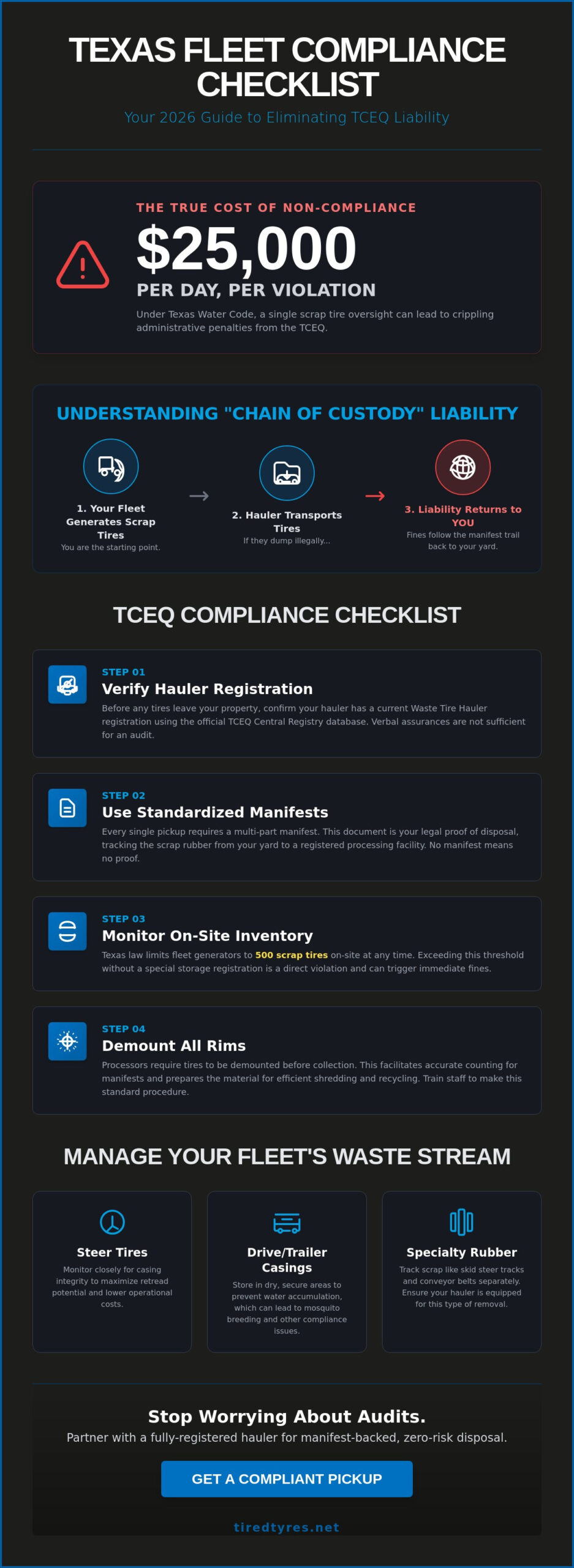
- Protect your fleet from $25,000 daily TCEQ penalties by understanding how the “chain of custody” principle keeps you liable for scrap tires even after they leave your lot.
- Establish a foolproof manifest system that simplifies compliant tire disposal for fleets and ensures every pickup is properly documented for future audits.
- Verify your hauler’s registration status using the TCEQ database to ensure they are authorized to transport semi-truck, OTR, and agricultural casings.
- Optimize your on-site operations by designating secure storage areas and training shop staff on the specific paperwork required for legal rubber removal.
- Streamline the disposal of diverse waste streams, including skid steer tracks and conveyor belts, through a single, manifest-backed collection partner.
The Fleet Manager’s Liability Checklist: Why Compliance Matters in 2026
Liability in the transportation sector usually focuses on road safety, but the real financial traps often hide in the back of the shop. In Texas, the concept of “Chain of Custody” means your company remains legally responsible for every casing until it reaches a registered processing facility. If a hauler dumps your tires in a ravine outside Odessa, the TCEQ doesn’t just go after the driver; they follow the manifest trail back to your yard. This makes compliant tire disposal for fleets a core risk management strategy rather than a simple maintenance task. You can’t just hand off the problem and assume it’s solved.
Modern fleet management in 2026 requires a sharp focus on Environmental, Social, and Governance (ESG) scores. Large shippers and logistics brokers now audit their partners’ environmental records before signing long-term contracts. A clean, documented disposal history protects your reputation and can even influence insurance premiums for Class 8 fleets. Carriers with documented, compliant waste streams are viewed as lower-risk entities by underwriters who want to avoid environmental cleanup claims and legal entanglements.
Identifying Your Fleet’s Tire Waste Stream
Efficient management starts with clear categorization. Your shop should separate drive, trailer, and steer tires to identify which are viable retreadable cores and which are true end-of-life scrap. High-volume operations in the Permian Basin often struggle with the sheer scale of waste, but mixing high-value cores with scrap rubber is a waste of resources. Under Texas Health and Safety Code Chapter 361, fleet managers bear cradle-to-grave responsibility for the legal disposal of every tire generated by their operations.
- Steer Tires: Monitor these closely for casing integrity to maximize retread potential.
- Drive/Trailer Casings: Ensure these are stored in dry, secure areas to prevent water accumulation and mosquito breeding.
- Specialty Rubber: Track the volume of scrap skid steer tracks and conveyor belts separately to ensure your hauler has the right equipment for removal.
The True Cost of Non-Compliance
The financial impact of a “shortcut” is severe and immediate. TCEQ enforcement actions can result in administrative penalties of up to $25,000 per day for unpermitted storage or illegal disposal. Beyond the cash, the reputational blow of being linked to an illegal stockpile can end your relationship with major oilfield clients who demand strict compliance from their vendors. Using the Texas Tire Disposal Regulations as your roadmap helps mitigate these corporate risks. It’s about protecting your bottom line through verified, legal channels that stand up to any state audit.
TCEQ Compliance Checklist: Texas Rules for Fleet Operators
Adhering to Texas Commission on Environmental Quality (TCEQ) standards isn’t just about checking a box; it’s about protecting your yard from administrative shutdowns. The state’s regulatory framework, specifically 30 TAC Chapter 328 Subchapter M, dictates how every scrap casing must be handled. To maintain compliant tire disposal for fleets, your shop must move beyond casual arrangements and implement a rigorous verification sequence. This checklist ensures your operation stays on the right side of state law.
- Step 1: Verify Hauler Registration. Never let a trailer leave your lot without checking the TCEQ Central Registry. Every legitimate transporter must hold a current Waste Tire Hauler registration. A simple verbal assurance isn’t enough to protect you during an audit.
- Step 2: Use Standardized Manifests. Every pickup requires a multi-part manifest. This document tracks the movement of scrap rubber from your lot to the final processor. Without it, you have no proof of legal disposal.
- Step 3: Watch Your Inventory. Texas law generally limits fleet generators to 500 scrap tires on-site at any time. Exceeding this number without a specialized Scrap Tire Storage Site registration can trigger immediate fines.
- Step 4: Demount All Rims. Most compliant processors require tires to be demounted before collection. This allows for accurate counting and ensures the material is ready for shredding or recycling.
- Step 5: Archive Your Records. You must retain all signed manifests and disposal receipts for a minimum of three years. TCEQ inspectors often request these records during unannounced site visits to verify your disposal history.
Mastering the Texas Scrap Tire Manifest
The manifest is the most critical piece of paper in your shop. It must include the generator’s ID, the hauler’s registration number, and the total count of tires by type. All three parties-the generator, the transporter, and the authorized facility-must sign the document. While paper forms are still common, digital tracking is becoming the gold standard for 2026. Digital records are harder to lose and much easier to organize when an auditor asks for three years of history on short notice. Ensuring your team understands how to fill these out correctly prevents your company from being linked to illegal dumping sites.
On-Site Storage Regulations in West Texas
In the heat of Midland and Odessa, proper storage is a public health necessity. TCEQ requires strict vector control to prevent mosquito breeding; this means tires must be kept dry or treated with approved larvicides. Local fire codes also play a significant role. Large piles of semi-truck or OTR tires represent a massive fuel load for fires, which are notoriously difficult to extinguish. Keep your scrap area organized and away from structures to stay compliant with local Midland and Odessa fire department ordinances. If your current pile is approaching the 500-tire limit, it’s time to schedule a professional collection to clear the space and reset your compliance clock.
Vetting Your Hauler: The Procurement Checklist
Procurement for fleet services often focuses on the lowest cost per unit, but with scrap rubber, the cheapest option is frequently the most expensive in the long run. Choosing a partner for compliant tire disposal for fleets requires a thorough vetting process that goes beyond a simple quote. You need a vendor who understands the geography of West Texas and the specific heavy-duty waste streams of your industry. A hauler who lacks the right equipment for OTR or agricultural tires will only cause delays and safety risks on your lot.
- TCEQ Registration: Demand a copy of their current Waste Tire Hauler registration. Don’t take their word for it; verify the number against the state database to ensure it’s active for 2026.
- Specialized Equipment: Ensure they have the loaders and trailers necessary for large-scale OTR and semi-truck collections. Standard box trucks aren’t efficient for bulk agricultural tire removal.
- Transparent Pricing: Look for clear pricing models. Whether it’s per tire, per ton, or per load, the structure should be predictable and free of hidden environmental fees.
- Service Footprint: Confirm they can reach remote yard sites in Lubbock or deep in the Permian Basin without charging exorbitant mobilization fees.
Questions to Ask Potential Disposal Partners
Ask specifically where the tires go once they leave your facility. A reputable partner should name a specific, permitted processing plant or recycling center. Inquire about their typical lead time for a scheduled fleet pickup; in high-activity areas like Midland and Odessa, a 48-hour response time is the industry standard. Additionally, ask if they can handle non-tire rubber waste. Many fleets also need to dispose of scrap skid steer tracks, hoses, and conveyor belts. Consolidating these waste streams with one provider simplifies your paperwork and reduces the number of vendors on your site.
Comparing Full-Service Hauling vs. Self-Drop-Off
Some managers consider having shop staff haul tires to the landfill to save money. However, a labor cost analysis usually proves otherwise. When you factor in driver hourly rates, fuel, and the opportunity cost of taking a technician off a billable job, the savings vanish. There’s also a significant liability advantage to using a permitted tire hauler in Texas. If an employee is involved in an accident while hauling a load of scrap tires, your corporate insurance may not cover the environmental cleanup costs if you aren’t a registered hauler yourself. Working with a bonded and insured professional eliminates this risk entirely.
Operationalizing Disposal: On-Site Management Checklist
Setting up a system for compliant tire disposal for fleets requires more than just knowing the rules; it requires a workflow your shop floor can follow. Start by designating a specific, secure area for scrap accumulation. This area should be clearly marked with signage to prevent staff from mixing general trash or hazardous waste with the rubber. In West Texas, keeping this area dry is a constant battle against sudden storms, so use covered trailers or indoor bays whenever possible. A dry storage area isn’t just about compliance; it keeps your yard professional and reduces the risk of vector-borne issues.
Training your shop staff is the next hurdle. Every technician should know where the manifest folder is kept and how to verify the tire count before a hauler departs. Errors on these forms are often the first thing TCEQ inspectors flag during audits. Schedule your pickups to align with your fleet’s tire replacement cycles. If you replace 15% of your tires every quarter, your pickup frequency should reflect that volume to prevent exceeding the 500-tire storage limit. Managing “difficult” rubber waste like OTR tires and conveyor belts requires advance notice to your hauler so they can bring the correct loading equipment.
Best Practices for On-Site Tire Storage
Proper stacking is vital for safety and space management. Avoid random piles which trap water and create fire hazards. Use the “lacing” or “weaving” method for passenger and light truck tires, and stack semi-truck tires vertically on their treads if space allows. Integrating your disposal records into your fleet maintenance software allows you to track the lifecycle of every casing. This digital trail simplifies reporting and ensures you never lose track of a manifest. Clear signage in both English and Spanish helps maintain order in the yard and ensures all staff follow the same protocol without constant supervision.
Handling Industrial Rubber Beyond Tires
West Texas fleets often generate waste that doesn’t fit the standard tire mold. Disposing of scrap skid steer tracks, solid tires, and industrial hoses requires a different logistical approach. These items are often heavier and more difficult to load than pneumatic tires. Preparing conveyor belts for collection involves rolling and securing them to prevent unravelling during transport. Commercial Tire Disposal requires specialized equipment because industrial rubber has a higher density and different recycling requirements than standard passenger rubber. If your yard is currently cluttered with a mix of semi-truck casings and old conveyor belts, you can request a specialized rubber waste assessment to determine the most efficient pickup schedule for your specific volume.
The Tired Tyres Solution: Streamlining Fleet Disposal in West Texas
Tired Tyres understands that West Texas logistics demand a different level of reliability. We don’t just pick up scrap; we provide a professional shield against environmental liability. Our service for compliant tire disposal for fleets is built on transparency and precision. Whether you’re operating out of a central yard in Lubbock or a remote site in the heart of the Permian Basin, we ensure your scrap rubber is handled according to 2026 TCEQ standards. We provide a complete paper trail for every load, ensuring your business is audit-ready at a moment’s notice.
We specialize in the “heavy stuff” that standard haulers often avoid. Our equipment is specifically designed to handle OTR (Off-the-Road) casings, massive agricultural tires, and bulk semi-truck loads. Beyond tires, we collect the miscellaneous rubber waste that accumulates in industrial shops, including scrap conveyor belts, solid tires, and skid steer tracks. Every pickup is backed by a fully executed manifest. This document proves that your waste reached a permitted facility, effectively ending your “chain of custody” liability the moment our trailer leaves your lot.
Why West Texas Fleets Trust Tired Tyres
West Texas fleets face unique geographic challenges that out-of-state providers don’t understand. Site access in oilfield environments can be difficult, but our drivers are experienced with Permian Basin terrain and local safety protocols. We offer flexible scheduling to match your operational rhythm. You can choose one-time cleanups for neglected stockpiles or set up recurring pickups to keep your inventory well below the 500-tire storage limit. Our goal is to take the burden of manifest management off your desk. We handle the documentation so you can focus on moving freight and maintaining your fleet’s uptime.
Get Started with a Compliant Disposal Plan
Getting started is straightforward and designed to respect your time. We provide custom quotes based on your specific tire volume, types of rubber waste, and location. During your first scheduled pickup, our team will verify the counts, load the material efficiently, and provide the initial manifest documentation on-site. This immediate feedback ensures your records are accurate from day one. We believe in honest, direct communication and reliable service that keeps West Texas moving safely. Secure your fleet’s compliance today with a professional tire pickup quote.
Protect Your Fleet with Professional Rubber Management
Managing a scrap pile shouldn’t be a source of legal anxiety. You now have the tools to navigate the “chain of custody” and maintain perfect TCEQ records. By implementing a standardized manifest system and verifying your hauler’s registration, you eliminate the risk of $25,000 daily fines under the Texas Water Code. Professional compliant tire disposal for fleets is a strategic move that preserves your ESG rating and keeps your yard audit-ready throughout 2026. Tired Tyres has served the Permian Basin and South Plains since our inception, specializing in the heavy industrial rubber that standard haulers often can’t manage.
As a TCEQ Registered Waste Tire Hauler, we handle everything from OTR casings to scrap conveyor belts with total transparency. Don’t let old rubber create a new liability for your operation. Request a Fleet Tire Disposal Quote for Midland, Odessa, or Lubbock today to clear your lot and reset your compliance clock. Your fleet is built for the road; let us handle the waste that’s holding you back. You’ve got enough on your plate, so let a professional team take this weight off your shoulders.
Frequently Asked Questions
What is a TCEQ scrap tire manifest and why does my fleet need one?
A TCEQ scrap tire manifest is a legal document that tracks the movement of tires from your yard to a registered processing site. Your fleet needs these for every pickup to prove you haven’t engaged in illegal dumping. Under Texas Health and Safety Code 361.112, these forms protect you during state audits. Without a signed manifest, you remain legally liable for the tires even if a hauler has already removed them from your property.
How many scrap tires can I legally store on-site in Texas without a permit?
Most fleet operators can legally store up to 500 scrap tires on their property without obtaining a specialized storage permit from the TCEQ. If your inventory exceeds this 500-tire limit, you must register as a Scrap Tire Storage Site. Maintaining a lower count helps you avoid the complex reporting requirements and higher insurance risks associated with large stockpiles. Regular pickups are the most effective way to stay under this regulatory threshold.
Does it matter if my tire hauler is permitted if I’m just a small fleet?
Yes, the size of your fleet doesn’t change your liability under Texas “chain of custody” laws. Even a small operation with five trucks must use a registered hauler to ensure compliant tire disposal for fleets. If an unpermitted hauler dumps your tires, the TCEQ can hold your business responsible for the cleanup costs and administrative penalties. Always verify a hauler’s registration number in the TCEQ Central Registry before allowing them to load your scrap.
Can I dispose of commercial truck tires in a standard West Texas landfill?
Most West Texas landfills won’t accept whole commercial truck tires because they don’t compact well and tend to “float” to the surface of waste cells. To dispose of them at a landfill, the tires must typically be split, quartered, or shredded first. This requirement makes professional collection a more efficient choice for fleet managers. A registered hauler takes the tires to a processing facility where they’re properly recycled or prepared for authorized disposal.
What happens to the tires after Tired Tyres picks them up?
After collection, we transport the tires to a TCEQ-permitted processing facility. Here, the rubber is often shredded for use in Tire-Derived Fuel (TDF) or repurposed for civil engineering projects like road base and embankment fill. This process ensures that your waste contributes to a circular economy rather than sitting in a landfill. We provide the final manifest signature once the tires reach their authorized destination, closing your liability loop for 2026.
Do you provide disposal services for skid steer tracks and industrial hoses?
Yes, we provide comprehensive collection services for industrial rubber waste beyond standard tires. This includes scrap skid steer tracks, solid tires, industrial hoses, and conveyor belts. These items are often difficult for standard waste services to handle due to their weight and material composition. We use specialized equipment to load and transport these heavy materials, ensuring your entire shop remains clear of rubber waste and fully compliant with local environmental standards.
How often should a fleet schedule tire pickups to remain compliant?
Most West Texas fleets find that quarterly pickups or scheduling by replacement cycle works best. You should monitor your scrap pile weekly to ensure you don’t approach the 500-tire storage limit set by state law. If your shop replaces 40 tires a month, a semi-annual pickup might be sufficient. However, high-volume operations in the Permian Basin often require monthly collections to maintain a safe and organized workspace throughout the year.
What are the specific penalties for illegal tire dumping in Lubbock County?
Illegal dumping in Lubbock County can result in administrative penalties of $25,000 per day per violation under the Texas Water Code. Beyond fines, the Texas Health and Safety Code classifies illegal dumping of over 200 pounds of tires as a state jail felony. This can lead to significant jail time and permanent damage to your corporate reputation. Using compliant tire disposal for fleets is the only way to guarantee protection against these severe state and local enforcement actions.