
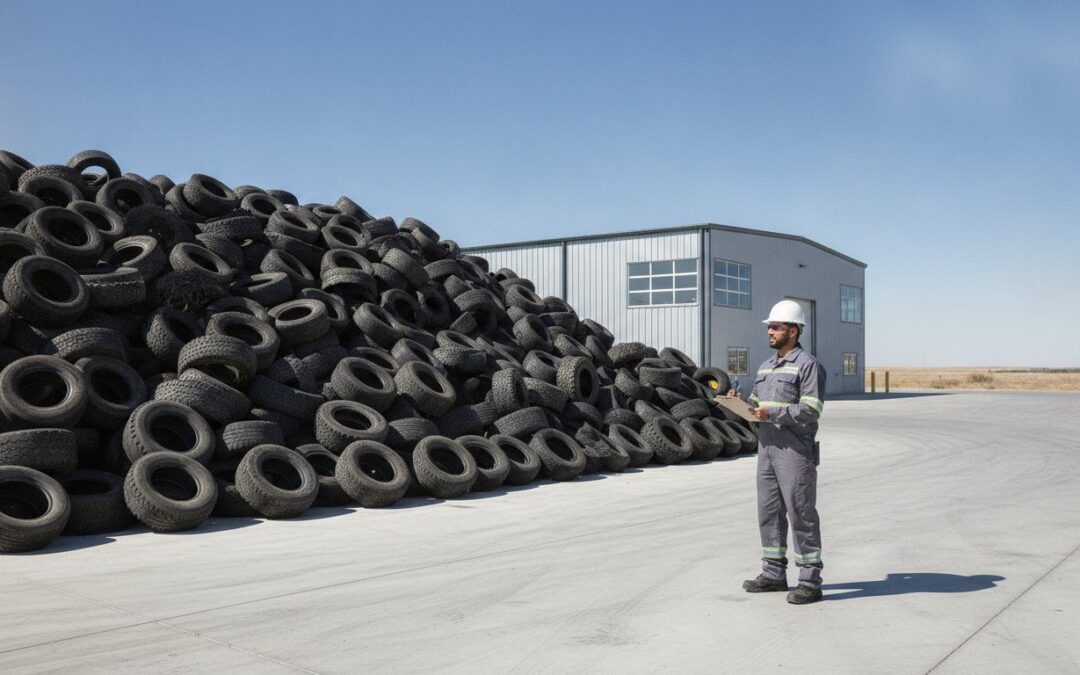
In the intense heat of West Texas, a stack of old tires isn’t just waste. It’s a massive fuel source waiting for a single spark to trigger a million dollar liability. You likely worry about the terrifying speed of a chemical fire and the crushing weight of TCEQ fines that follow. It’s frustrating to juggle conflicting Lubbock fire marshal codes while watching your storage costs climb. Effective fire hazard prevention for tire piles Lubbock businesses need goes far beyond just having a few extinguishers on hand.
We understand that keeping your facility safe and compliant feels like a full time job. You’ll learn how to protect your property from catastrophic incidents by moving from passive storage to a proactive removal strategy. This 2026 guide breaks down the specific steps to navigate local safety inspections and manage climate risks. We also look at how professional collection of passenger, semi truck, and OTR tire piles can clear your site permanently. Let’s get your business back to a zero risk environment and ensure you pass your next inspection with confidence.
Key Takeaways
- Understand how the “chimney effect” and high-energy rubber fuel make tire fires uniquely dangerous and difficult to suppress.
- Navigate the specific Lubbock Fire Marshal and TCEQ storage permits required to maintain legal compliance and avoid liability.
- Identify the unique West Texas environmental triggers, such as extreme summer heat and static electricity, that increase ignition risks.
- Implement immediate on-site safety protocols, including vegetation clearance and strict ignition-free zones, to protect your facility.
- Learn why professional collection is the only foolproof strategy for fire hazard prevention for tire piles Lubbock business owners can rely on.
Understanding the Combustion Risk of Scrap Tire Piles
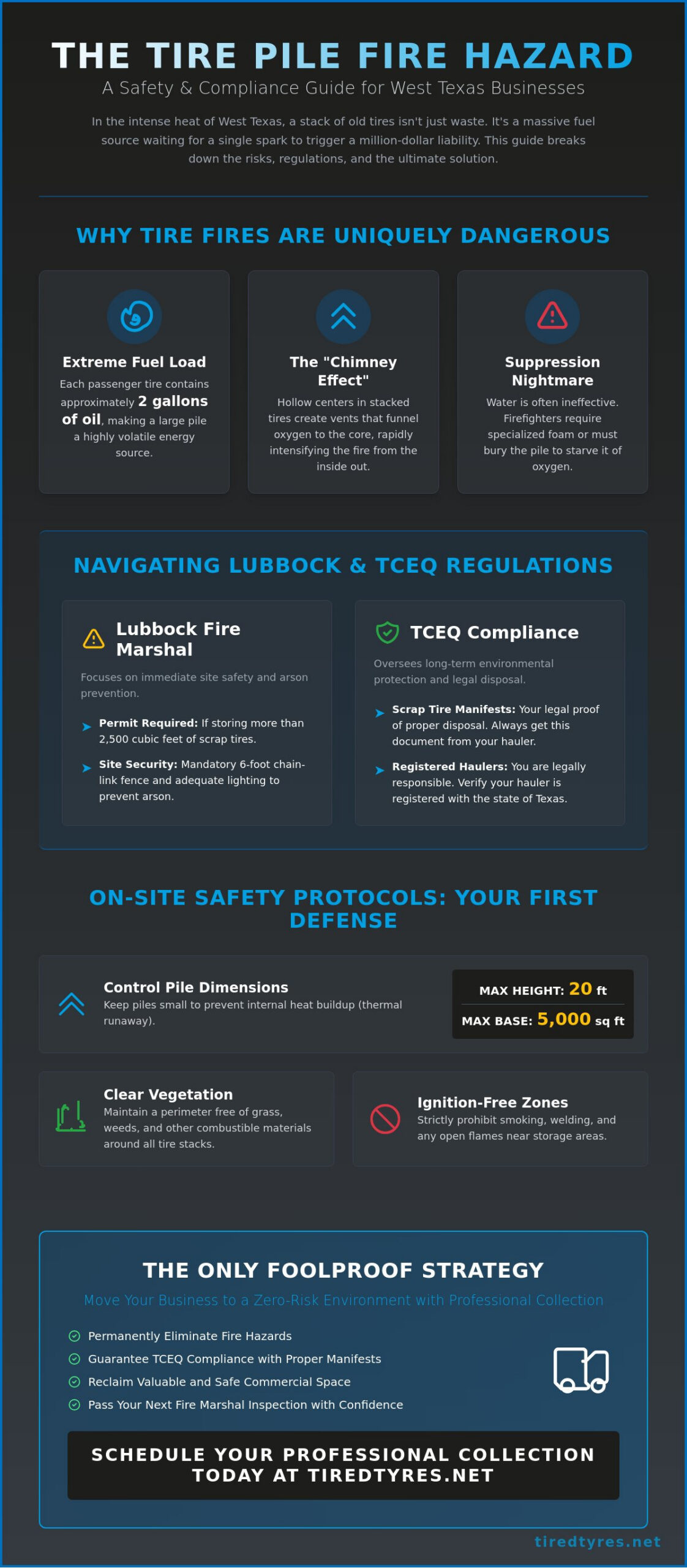
Scrap tires are essentially solid fuel. Each passenger tire contains about two gallons of oil, which makes a large pile a high-energy fire risk. While rubber is difficult to ignite, once it reaches a specific temperature, it becomes nearly impossible to stop. This is why effective fire hazard prevention for tire piles Lubbock businesses implement must focus on inventory control and early detection. You aren’t just storing waste; you’re managing a volatile energy source.
The “chimney effect” is a major reason these fires spread with such intensity. When tires are stacked, the hollow centers create natural vents. Air flows through these gaps, feeding oxygen to the core of the fire just like a bellows in a furnace. This internal airflow allows the fire to burn from the inside out, often staying hidden from view until the entire stack is engulfed. Because of this airflow, a small spark can turn into a massive blaze in minutes.
Suppressing these incidents is a nightmare for local fire departments. Water often fails because it can’t reach the deep-seated heat inside the pile. Instead, the water turns to steam or carries toxic oils into the ground. In many cases, firefighters must use specialized foam or bury the pile in dirt to starve it of oxygen. The combustion risk of scrap tires is so severe that some fires have been known to burn for months underground, even after the surface flames are out.
Thermal Runaway and Internal Heating
Deep tire piles create their own dangerous microclimate. Inside a large, dense stack, the biological decomposition of organic matter trapped in the rubber can generate significant heat. If the pile is too large, this heat cannot dissipate into the air. Eventually, the core reaches a “critical mass” where spontaneous combustion occurs. To keep your facility safe, keep piles shallow and organized. Spreading tires out prevents heat from building up to these dangerous levels.
The Environmental Impact of Tire Fire Runoff
A burning tire doesn’t just produce black smoke; it melts. This process creates a thick, pyrolytic oil byproduct that flows across the ground. This runoff is a toxic cocktail of heavy metals and chemicals that can seep into Lubbock’s soil or contaminate local groundwater. The cost of cleaning up a site after a tire fire is often astronomical. Remediation liabilities can easily exceed the value of the property itself, making professional fire hazard prevention for tire piles Lubbock’s most cost-effective business strategy.
Lubbock Fire Code and TCEQ Storage Requirements
Managing a commercial site in Lubbock County means following two distinct sets of rules. You have the local Lubbock Fire Marshal and the state-level TCEQ. Compliance isn’t just about avoiding fines. It’s the foundation of fire hazard prevention for tire piles Lubbock businesses must prioritize. Local authorities focus on immediate safety, while the state focuses on long-term environmental protection. Both are essential for your liability management.
The Lubbock Fire Marshal has clear expectations for commercial scrap storage. If your facility stores more than 2,500 cubic feet of scrap tires, you are required to obtain a specific permit. This process involves a site inspection where officials check for arson prevention measures. Arson remains a leading cause of tire fires in Texas. Because of this, a secure, 6-foot chain-link fence and adequate lighting are often mandatory. If you can’t secure the site, you can’t safely store the rubber.
TCEQ Compliance for West Texas Businesses
The Texas Commission on Environmental Quality (TCEQ) oversees the environmental side of rubber waste. You must follow TCEQ scrap tire storage requirements to stay legal. One of the most important documents you’ll handle is the scrap tire manifest. This document tracks the tires from your site to the final disposal facility. It’s your legal proof that the tires were handled correctly. If your hauler doesn’t provide these manifests, you remain legally responsible for where those tires end up. Always verify that your hauler is registered with the state before they pull onto your property. Many businesses find that scheduling a professional scrap tire collection is the easiest way to keep their manifest records clean and up to date.
Pile Dimensions and Access Lanes
Physical pile layout is critical for fire suppression. Lubbock code generally limits outdoor tire piles to a maximum height of 20 feet and a base area of 5,000 square feet. Keeping piles small ensures that heat can’t build up in the core, as we discussed in the previous section. More importantly, you must maintain 50-foot fire breaks between stacks. These wide access lanes serve two purposes. They prevent radiant heat from a fire in one pile from igniting the next. They also ensure the Lubbock Fire Department can get heavy equipment between piles if they need to respond to an emergency. Without these lanes, a single ignition point will likely consume your entire inventory and potentially spread to neighboring properties.
Best Practices for On-Site Tire Pile Management
Maintaining a safe facility requires more than just following the law. It demands active, daily oversight of your inventory. Effective fire hazard prevention for tire piles Lubbock operators implement relies on controlling the environment around the rubber. You must treat your storage lot as a high-risk zone where every potential spark is a threat. Safety starts with clear policies and consistent enforcement.
Start with strict ignition source control. A total smoking ban within 50 feet of any tire stack is mandatory, not optional. If your facility performs “hot work” like welding or grinding, these activities must happen in a designated zone far away from your scrap inventory. Check your electrical systems regularly. Frayed wiring or overloaded circuits near a pile can easily ignite a fire that goes unnoticed until it’s too late. Small sparks are the most common cause of preventable disasters.
Lubbock’s environment adds unique challenges. Dry weeds and wind-blown tumbleweeds are major fire catalysts. These light fuels ignite easily and can carry a small grass fire directly into your tire stacks. Keep a 10-foot perimeter around all piles completely clear of vegetation. Similarly, manage standing water within the tires. While mosquitoes are a health concern, keeping tires dry also prevents the internal heating issues mentioned earlier. Regular inspections should look for signs of vandalism or internal “hot spots” that indicate a problem is brewing.
Segregation of Materials
Proper organization limits the scale of a potential incident. You should always store OTR (Off-the-Road) tires and semi-truck tires separately from smaller passenger tires. Different sizes have different fuel loads and airflow characteristics. Material segregation is the primary barrier against fire escalation. Never mix your rubber waste with other combustibles like wooden pallets, scrap paper, or oil drums. Keeping these materials in isolated blocks ensures that if a fire starts, it stays contained to a single, manageable area.
Emergency Response Preparation
Your staff is your first line of defense. Every employee must understand the “observe and report” protocol. They shouldn’t attempt to be heroes. Instead, they need to know exactly where fire extinguishers are located and how to use them for small, surface-level ignitions. For rubber fires, sand or dirt is often more effective than water. Keeping a dedicated pile of clean fill dirt and a front-end loader nearby can save your property. Water often just spreads the toxic oil runoff, but smothering a small flare-up with dirt can stop it before it reaches the core of the pile.
Weathering the West Texas Heat: Environmental Fire Triggers
Lubbock’s climate is one of the harshest in Texas for rubber storage. When ambient temperatures hit 100°F, the dark surface of a tire can reach significantly higher levels. This heat doesn’t stay on the surface. It penetrates the core of the stack and stays there. Fire hazard prevention for tire piles Lubbock businesses rely on must account for these extreme thermal loads. You aren’t just fighting potential sparks; you’re fighting the Texas sun.
Static electricity is another silent threat on the South Plains. Our region has notoriously low humidity. In these bone-dry conditions, static can build up quickly, especially if tires are being moved or dragged across the ground. A single static discharge near a pile of rubber dust or dry debris can be enough to start a smoldering fire. It’s a risk that most operators overlook until it’s too late.
Lightning strikes are a common reality during our spring and summer storms. Outdoor tire piles act as large, grounded targets in an otherwise flat landscape. While you can’t stop the weather, you can ensure your piles aren’t the most attractive targets on your property. Keeping stacks low and away from tall metal structures or trees reduces the likelihood of a direct hit. If a strike occurs, the lower height helps prevent the fire from becoming unmanageable.
Arid Climate and Spontaneous Combustion
Lubbock’s long dry spells make the rubber more susceptible to ignition. During these periods, fine dust and organic matter settle deep into the tire treads. This dust acts as tinder. If a small spark lands in a dusty tread during a drought, it finds immediate fuel. Shading your piles or using industrial fans to maintain airflow can help lower the core temperature during July and August. Keeping the rubber as cool as possible is your best defense against spontaneous events.
Wind-Driven Fire Spread in Lubbock
Our high winds are the biggest danger once an ignition occurs. These winds turn a small incident into a firestorm in seconds. Burning rubber pieces, known as “flying brands,” can be lifted by the wind and carried hundreds of feet. This creates a massive risk for your neighbors and adjacent buildings. A 30mph Lubbock gust can bypass standard fire suppression efforts by pushing flames horizontally across fire breaks. If your fire breaks aren’t wide enough to account for West Texas wind patterns, they won’t protect you. Don’t leave your facility at the mercy of the weather; schedule a professional tire pile cleanout to remove the fuel source before the next heatwave hits.
Professional Collection: Eliminating Fire Risks at the Source
Management protocols are necessary, but they don’t remove the fuel. The only foolproof method of fire hazard prevention for tire piles Lubbock businesses can truly rely on is maintaining a “zero inventory” status. If there are no tires on your site, there is no risk of a chemical fire. Professional collection transforms your property from a high-risk storage site into a clean, compliant workspace. It’s the most effective way to eliminate liability before a crisis occurs.
Many businesses struggle with the logistics of moving large-scale rubber waste. Tired Tyres takes the heavy lifting out of your hands. We handle everything from standard passenger and light truck tires to massive OTR (Off-the-Road) and agricultural tires. Our team also specializes in semi-truck tire collections, ensuring that even the largest commercial inventories are cleared quickly and safely. You don’t need to worry about the equipment or the manpower; we bring the professional solutions to you.
The legal aspect of tire disposal is just as important as the physical removal. As mentioned in our section on TCEQ rules, you need a paper trail. We provide the mandatory scrap tire manifests that prove your waste was handled according to Texas law. This documentation protects you from future liability if the tires are ever found in an unauthorized dump site. It’s the legal peace of mind that every business owner needs to pass local inspections without stress.
The Tired Tyres Advantage in Lubbock
Our expertise goes beyond standard tires. We understand the industrial needs of West Texas, which is why we also collect scrap skid steer tracks, industrial hoses, and conveyor belts. These items often accumulate alongside tires and present similar combustion risks. By clearing all rubber waste in one visit, we help you achieve total site safety. For more details on our regional reach, see our guide on Commercial Tire Disposal in Midland, Odessa & Lubbock.
Taking the First Step Toward a Fire-Safe Property
Getting started is a straightforward process. You can request a bulk tire pickup quote specifically for your Lubbock site through our website. During a collection visit, our professional team arrives with the right equipment to load and transport your inventory efficiently. We offer both scheduled routes for high-volume shops and on-call pickups for one-time cleanouts. Choosing the right frequency depends on how quickly your scrap accumulates. Don’t wait for a heatwave or a random spark to test your fire hazard prevention for tire piles Lubbock strategy. Contact Tired Tyres for professional tire disposal in Lubbock today to clear your site and secure your business.
Protect Your Lubbock Facility Today
Effective fire hazard prevention for tire piles Lubbock business owners need requires a combination of strict regulatory compliance and active site management. You’ve seen how the “chimney effect” and West Texas wind can turn a small spark into a catastrophe. While following pile separation rules and clearing dry vegetation reduces risk, the only way to completely eliminate the threat is to remove the fuel source from your property.
Our team provides the specialized equipment and TCEQ-compliant hauling required to clear your lot safely. We serve the entire South Plains and Permian Basin, handling everything from standard passenger tires to heavy OTR and agricultural collections. You’ll receive the necessary manifests to ensure your business stays protected and compliant. Don’t leave your safety to chance during the next summer heatwave.
Get a Quote for Professional Tire Removal in Lubbock
Take control of your facility’s safety and enjoy the peace of mind that comes with a clean, risk-free property. We’re here to help you clear the way for a safer, more professional workspace.
Frequently Asked Questions
How many tires can I legally store on my property in Lubbock without a permit?
You must obtain a permit from the Lubbock Fire Marshal if your outdoor scrap tire storage exceeds 2,500 cubic feet. This volume typically equals about 500 to 1,000 passenger tires depending on how they are stacked. For smaller quantities, you don’t need a specific permit, but you must still follow local safety and vector control rules. Exceeding these limits without proper authorization can lead to significant fines and legal liability.
Why are tire fires so much harder to put out than wood fires?
Tires act as a high-energy fuel source that burns at much higher temperatures than wood or paper. The hollow shape of stacked tires creates a “chimney effect” that feeds oxygen directly into the core of the fire. This internal airflow makes it nearly impossible for water to reach the seat of the blaze. Often, firefighters must use specialized foam or heavy soil to smother the oxygen supply completely.
Does the Lubbock Fire Marshal conduct regular inspections for scrap tire piles?
Yes, the Lubbock Fire Marshal performs inspections to ensure businesses follow local safety codes. They specifically look for mandatory fire breaks, proper pile dimensions, and secure fencing to prevent arson. Maintaining a clear strategy for fire hazard prevention for tire piles Lubbock businesses can implement helps you pass these inspections without delays. Regular compliance checks are a standard part of operating a commercial facility in the region.
Can lightning strikes really cause a tire pile fire in West Texas?
Lightning strikes are a verified cause of tire fires in the South Plains. Because tire piles are often the tallest objects on a flat commercial lot, they act as grounded targets during West Texas thunderstorms. A direct hit can ignite the core of a pile instantly. Reducing pile height and keeping rubber away from metal structures are the best ways to lower this specific environmental risk during storm season.
What is a TCEQ scrap tire manifest and why does my Lubbock business need one?
A TCEQ scrap tire manifest is a legal document that tracks your tires from the moment they leave your site until they reach a registered disposal facility. Your business needs these records to prove you didn’t illegally dump the waste. If a hauler dumps tires in a field, the manifest is your only protection against being held responsible for the environmental cleanup costs and state penalties.
How does Tired Tyres ensure my scrap tires are disposed of legally?
We operate as a registered scrap tire transporter and provide full documentation for every pickup we perform. Our team follows all state requirements for hauling and disposal, ensuring your tires reach a permitted facility. We handle the paperwork and provide you with a completed manifest for your records. This process ensures your fire hazard prevention for tire piles Lubbock plan includes a legally sound exit strategy for all rubber waste.
What should I do immediately if I notice smoke coming from my tire pile?
Call 911 immediately. Don’t attempt to fight a tire fire yourself unless it’s a very small surface flare-up that you can quickly smother with dirt. Because tire fires release toxic gases and intense heat rapidly, your primary job is to evacuate staff and provide clear access for the Lubbock Fire Department. Early reporting is the only way to prevent a small smolder from becoming a total property loss.
Is it cheaper to pay for tire removal or install a fire suppression system?
Professional removal is almost always more cost-effective than installing specialized fire suppression systems. High-capacity foam systems and industrial-grade monitoring equipment require significant upfront capital and ongoing maintenance costs. By contrast, regular pickups eliminate the fuel source entirely. Removing the tires removes the need for expensive suppression hardware and lowers your overall insurance liability on the property.