

Did you know that storing as few as 50 unregistered scrap tires on your property can lead to TCEQ fines of $10,000 per day? In April 2026 alone, the TCEQ approved more than $1.4 million in fines against entities for various environmental violations. For West Texas shops, tire disposal compliance for businesses is now a critical part of protecting your bottom line from heavy penalties.
It’s understandable if the manifest system feels like a mountain of paperwork while you’re trying to manage a busy operation. You shouldn’t have to worry about whether an unpermitted “solar cowboy” hauler is actually registered or if they’re leaving you vulnerable to illegal dumping liability. This guide will help you master the current Texas regulations and stay within legal storage limits. We’ll show you how to handle Form 10311 correctly and how to find a reliable partner to take the compliance burden off your shoulders for good.
Key Takeaways
- Understand your “cradle-to-grave” liability and why tire disposal compliance for businesses remains your responsibility even after tires leave your shop.
- Learn how to properly manage TCEQ Form 10311 to ensure you have the only legal proof of disposal recognized by Texas regulators.
- Identify the specific storage thresholds and vector control requirements to keep your site safe and compliant with West Texas environmental standards.
- Use our step-by-step checklist to verify hauler permits and maintain accurate monthly tire counts to prevent surprise audits.
- Discover how professional collection services for scrap tires and rubber materials can automate your paperwork and eliminate the risk of illegal dumping fines.
Why Tire Disposal Compliance is Critical for Texas Businesses
Tire disposal compliance for businesses is a strict legal framework designed to track every scrap tire from the moment it’s removed from a rim until it reaches its final destination. In Texas, this process is governed by the Texas Commission on Environmental Quality (TCEQ). Compliance isn’t just about keeping your shop clean or clearing out space in your yard. It’s about maintaining a documented paper trail that proves you’re following state law. If you can’t produce the right paperwork during an audit, the state assumes the tires were disposed of illegally.
Texas operates under a “Cradle-to-Grave” liability model. This means you, the waste generator, are legally responsible for those tires until they’re officially processed or recycled. If you hire an unpermitted hauler who dumps your scrap in a West Texas arroyo, the state won’t just go after the driver. They’ll come after your business. Understanding the tire recycling process and ensuring your waste reaches a legitimate facility is the only way to legally sever that liability and protect your assets.
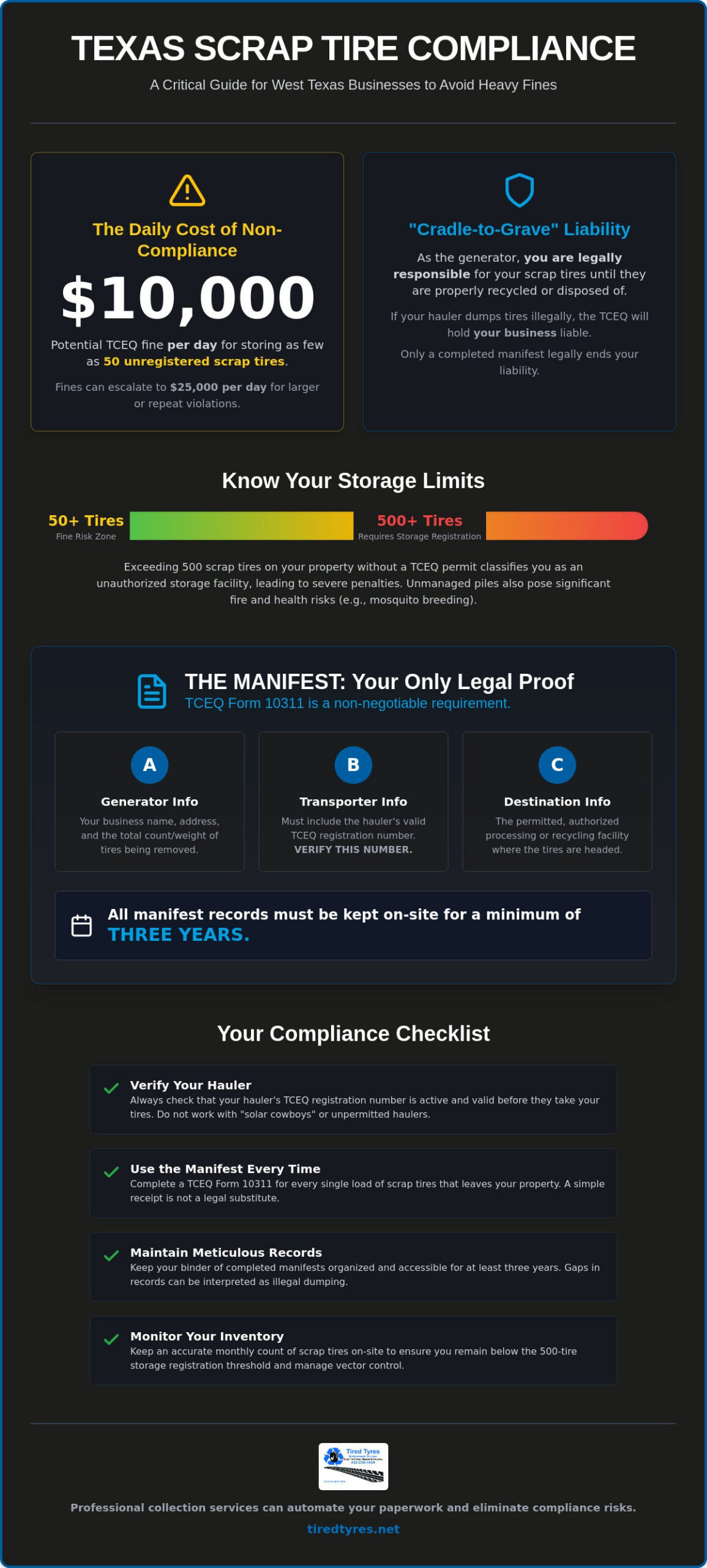
The financial stakes are high. As of 2026, the TCEQ continues to enforce heavy penalties for improper management. Storing as few as 50 tires without the proper registration can trigger fines of $10,000 per day. For larger violations or repeat offenders, those penalties can climb to $25,000 daily. Beyond the money, stockpiles are a massive fire risk in the dry Permian Basin heat. They also collect stagnant water, creating perfect breeding grounds for mosquitoes that carry West Nile and Zika in Lubbock and Midland communities.
The Role of the TCEQ in West Texas
The TCEQ monitors scrap tire generators through regional offices. In West Texas, Region 7 (Midland) and Region 2 (Lubbock) offices are particularly active in monitoring industrial sites and tire shops. They perform inspections to ensure that tire disposal compliance for businesses is being met through proper record-keeping. You’re held liable for the “grave” part of the tire’s life cycle. If your tires end up in an illegal scrap pile, your business remains the primary target for enforcement unless you have a completed manifest to prove otherwise.
Common Compliance Pitfalls for Auto Shops and Industrial Sites
Many businesses fall into the trap of thinking a simple landfill receipt is enough. It’s not. Only a five-part TCEQ manifest counts as legal proof of disposal. Another major error is failing to check a hauler’s TCEQ registration number before they load your tires. If they aren’t in the state database, the haul is illegal. Finally, stay mindful of the 500-tire rule. If you store more than 500 scrap tires on the ground at your site, you must register as a storage facility. Exceeding this limit without a permit is a fast way to get flagged during a routine inspection.
Understanding the TCEQ Manifest System for Scrap Tires
In Texas, the paper trail is your only real shield against liability. TCEQ Form 10311, officially known as the Scrap Tire Manifest, is the backbone of tire disposal compliance for businesses. It’s not a simple receipt or a bill of lading. It’s a specialized five-part document designed to create a closed-loop tracking system. This form follows your scrap tires from the moment they’re loaded onto a truck in West Texas until they reach a permitted processing facility. Without a fully executed manifest, you have no legal way to prove that your waste was handled according to state law.
Texas law requires business owners to maintain these records for at least three years. If a TCEQ inspector visits your shop in Midland or Odessa, the first thing they’ll ask for is your manifest binder. Each entry must be complete and accurate. If you’re missing forms or have gaps in your records, the state may assume tires were disposed of illegally. This can lead to the heavy daily fines mentioned earlier. Keeping organized records isn’t just a suggestion; it’s a mandatory part of staying in business.
The Anatomy of a Legal Manifest
A valid manifest is divided into specific sections that identify every party involved in the transaction. Section A contains your generator information, including your business name, physical address, and the total count or weight of the tires being removed. Section B is for the transporter. This is where you must verify their TCEQ registration number. Never let a hauler take your tires if this section is blank. Section C identifies the destination facility. For a deeper look at what qualifies as an authorized site, you can review the Scrap Tire Facility Requirements on the TCEQ website. This section ensures the tires are going to a processor equipped to handle them safely.
Your Responsibilities During a Tire Pickup
Don’t just sign the form and walk away. You’re responsible for verifying the data entered by the driver. Count the tires yourself or check the weight scale before signing. All parties, including you and the transporter, must sign the document before the truck leaves your property. Once signed, you’ll keep one copy for your records immediately. However, the process doesn’t end there. The manifest system requires “closing the loop.”
You must receive a completed “Return Copy” from the disposal facility within 60 days of the pickup. This copy proves the tires actually arrived at the permitted site. If 60 days pass and you haven’t received that final copy, Texas law requires you to file an exception report with the TCEQ. Managing this cycle for every pickup can be time-consuming for busy fleet managers. Partnering with a reliable service like Tired Tyres can help ensure your documentation is always audit-ready and filed correctly, allowing you to focus on your daily operations without the fear of compliance gaps.
Storage and Transport: Meeting Texas Environmental Standards
Maintaining tire disposal compliance for businesses involves more than just filling out forms. You must also manage the physical footprint of your scrap pile to meet Texas environmental standards. In West Texas, where sudden seasonal rain can fill upright tires quickly, vector control is a major priority. Tires must be stored in a way that prevents standing water. This is usually achieved by stacking them properly, covering them with a tarp, or using an enclosed container. If an inspector finds mosquito larvae in your pile, you’re looking at a violation regardless of your paperwork status.
Fire safety is another non-negotiable factor for shops in the Permian Basin. Texas law requires specific setbacks from property lines and buildings to prevent a small fire from becoming a catastrophe. You can’t simply stack scrap tires against your warehouse wall. Additionally, Midland and Odessa local ordinances prohibit mixing scrap tires with general commercial waste. Tires must be kept in a separate, dedicated area to ensure they don’t end up in a landfill that isn’t permitted to take them. Mixing these waste streams can lead to your entire dumpster being rejected at the gate.
On-Site Storage Limits and Permits
The 500-tire threshold is the line in the sand for every shop. Once you hit 501 tires on your property, you’re no longer just a generator; you’re a regulated storage site. This requires a separate registration with the TCEQ. In Lubbock County, indoor storage is often preferred to protect tires from the elements and pests. If you’re managing OTR or semi-truck tires, organization is key. These larger units should be stacked in rows with enough space for fire equipment to pass through. This ensures you remain compliant during a surprise visit and keeps your site safe for your crew.
The Dangers of Using Unregistered Haulers
Using an unregistered hauler is a gamble with your business’s future. These unpermitted transporters often engage in “fly-tipping,” which is the illegal dumping of tires in remote areas or roadside ditches. Since you’re legally tied to those tires until they reach a processor, any fly-tipped tires found with your shop’s markings lead the TCEQ straight back to you. You can check a hauler’s status on the TCEQ’s Central Registry online to ensure they’re legitimate. Tired Tyres maintains full state permitting for all West Texas operations, providing a secure and legal link in your disposal chain. We ensure every load is tracked correctly so you don’t have to worry about the legal risks of unpermitted transport.
Avoiding Fines: A Compliance Checklist for West Texas Businesses
Staying compliant requires a proactive approach rather than a reactive one. Waiting for a TCEQ inspector to show up before checking your records is a recipe for disaster. To maintain tire disposal compliance for businesses, you need a system that catches errors before they become expensive violations. This checklist provides a clear path for shop owners and fleet managers to follow every month.
- Perform a monthly tire count: Document exactly how many tires are on your property. This helps you stay below the 500-tire limit and proves you aren’t stockpiling waste.
- Verify the TCEQ permit: Before any truck arrives, confirm your hauler’s registration is active. A quick check on the state registry ensures you aren’t handing your liability to an unpermitted transporter.
- Supervise the signing: Ensure the hauler signs the manifest in your presence. Confirm the tire count matches the number written on the form before the truck leaves your yard.
- File the generator copy: Place your initial copy in a dedicated compliance folder immediately. Don’t leave it on a clipboard where it can be lost or damaged.
- Audit your records annually: At the end of every year, cross-reference your generator copies with the return copies from the processor. If any return copies are missing, you must address the gap to stay legal.
Special Rules for Industrial Rubber Waste
In the West Texas oil field, standard passenger tires aren’t the only concern. Scrap conveyor belts and skid steer tracks are common industrial waste products. While they aren’t always counted in the same category as passenger units, they still fall under strict disposal standards. Handling scrap hoses and solid rubber products requires a different approach to manifest documentation. You must ensure these materials are sent to facilities specifically permitted to handle industrial rubber waste. Mixing oil-contaminated hoses with standard scrap can lead to environmental liability that extends far beyond a simple paperwork fine.
Local Landfill and County Regulations
Navigating landfill rules for tires in Midland & Odessa is essential because city and county rules often differ. Within city limits, you might face stricter vector control inspections compared to unincorporated county land. However, Lubbock County has increased enforcement against illegal dumping on rural properties. Regardless of where your business is located, the state’s manifest rules apply. If you’re unsure about your current paperwork status, it’s time to schedule a compliance audit or pickup with a team that understands West Texas regulations. We can help you organize your records and ensure your industrial rubber waste is handled legally.
Partnering with a Permitted Tire Hauler in West Texas
Partnering with a permitted hauler is the final step in securing tire disposal compliance for businesses. Tired Tyres operates with a clear focus on Midland and Odessa, providing a service that handles the physical labor and the complex paperwork simultaneously. We don’t just pick up tires; we manage your risk. By setting up scheduled pickups, auto shops and fleet managers can prevent their on-site totals from ever approaching the 500-tire threshold. This consistency keeps your property clean and your business out of the TCEQ’s spotlight.
Our process is built around the TCEQ manifest system. We provide the necessary Form 10311 for every load, ensuring Section B and C are filled out with our valid registration and the destination facility’s details. This gives you the immediate generator copy you need for your audit binder. Whether you have a stack of passenger tires or a collection of OTR and agricultural units, we provide specialized equipment to handle the weight and volume safely. We also offer solutions for industrial rubber waste, including scrap conveyor belts, skid steer tracks, and scrap hose collections, which are often difficult to dispose of through traditional channels.
Why Local Expertise Matters in the Permian Basin
The Permian Basin presents unique waste challenges, especially for companies in the oil and gas sector. Industrial operations often generate scrap rubber that standard haulers won’t touch. Our coverage area extends from the South Plains of Lubbock down to the heart of the Permian, allowing us to serve diverse industrial and commercial clients. We understand that your time is better spent on operations than on tracking down return copies of manifests. Our rigorous documentation process ensures that every load is accounted for, protecting you from the liability of illegal dumping. Tire disposal compliance for businesses is easier when your hauler knows the local landscape and the specific regional TCEQ requirements.
Get a Compliance-First Quote Today
Starting a service is straightforward and transparent. When you reach out for a quote, we’ll ask for your location, the types of tires or rubber materials you have, and your estimated monthly volume. This information allows us to provide an accurate commercial quote tailored to your specific needs. We’ll also help you set up your manifest folder so you’re compliant from the very first pickup. Don’t leave your business vulnerable to five-figure fines or environmental liability. You can request a reliable tire disposal quote for your business today to start your path toward total compliance and a cleaner job site.
Secure Your Business with TCEQ-Compliant Disposal
Protecting your operation from fines starts with a commitment to accurate record-keeping and proper storage. You’ve seen how the TCEQ manifest system acts as your primary defense against liability. By staying under the 500-tire threshold and verifying every hauler’s permit, you maintain full control over your environmental footprint. Mastering tire disposal compliance for businesses isn’t just about following rules; it’s about ensuring the long-term stability of your shop or industrial site in the Permian Basin.
Since 2026, we’ve served Midland, Odessa, and Lubbock as a fully TCEQ-registered hauler. We specialize in the tough loads that others might avoid, including OTR units and industrial rubber waste like conveyor belts and skid steer tracks. Our team handles the heavy lifting and the complex paperwork so you don’t have to worry about the next surprise inspection. You can Get a Professional Tire Disposal Quote for Your Business today and let us simplify your compliance process. We’re here to help you keep West Texas clean and your business running smoothly.
Frequently Asked Questions
What is a TCEQ scrap tire manifest and why does my business need one?
The TCEQ scrap tire manifest, or Form 10311, is a five-part document that tracks tires from your business to an authorized processor. You need this form because it’s the only legal proof that you’ve met tire disposal compliance for businesses. If an inspector visits your site, this manifest proves you aren’t responsible for illegal dumping or improper waste management.
How long must a business keep tire disposal records in Texas?
You’re required to maintain all scrap tire manifests and related records for at least three years. It’s best to keep these in a dedicated compliance binder. This long-term record-keeping ensures you can prove a clean “cradle-to-grave” trail for every tire that has left your property during an audit.
Can I take my business scrap tires to a local landfill myself?
You generally cannot take commercial scrap tires to a landfill yourself unless you’re a registered transporter. Most West Texas landfills in Midland and Odessa have strict permitting requirements and won’t accept tires from unregistered commercial generators. Using a permitted hauler ensures your tires reach a facility authorized to process them correctly.
What happens if I use a tire hauler who isn’t registered with the TCEQ?
You remain legally liable for those tires even after they leave your property. If an unpermitted hauler dumps them in a field or alley, the TCEQ can hold your business responsible. This can lead to fines of up to $25,000 per day for environmental violations because you failed to verify the hauler’s legal status.
Is there a limit to how many scrap tires I can store at my shop in Odessa?
Yes, you can store up to 500 scrap tires on the ground without needing a specific storage site registration. If you use enclosed and lockable containers, that limit increases to 2,000 tires. Exceeding these limits without a permit is a major violation that can lead to daily penalties.
Does compliance apply to OTR and agricultural tires the same way as car tires?
Yes, the manifest system and storage rules apply to all scrap tires regardless of size. This includes large OTR, agricultural, and semi-truck tires. Managing tire disposal compliance for businesses also extends to industrial rubber like skid steer tracks and conveyor belts, which require specialized handling and documentation to stay legal.
How can I verify if a tire disposal company is legal in Texas?
You should check the TCEQ Central Registry online to confirm a company’s registration status. A legitimate hauler will have an active registration number as a “Scrap Tire Transporter.” Don’t hesitate to ask for a copy of their current TCEQ certificate before you sign any paperwork or allow them to load your waste.
What are the penalties for illegal tire dumping in Lubbock County?
Penalties are severe and can reach $25,000 per day for improper disposal. Storing as few as 50 unregistered scrap tires can result in fines of $10,000 per day. Lubbock County and the TCEQ Region 2 office actively enforce these rules to prevent fire hazards and mosquito-borne illnesses in the South Plains.