
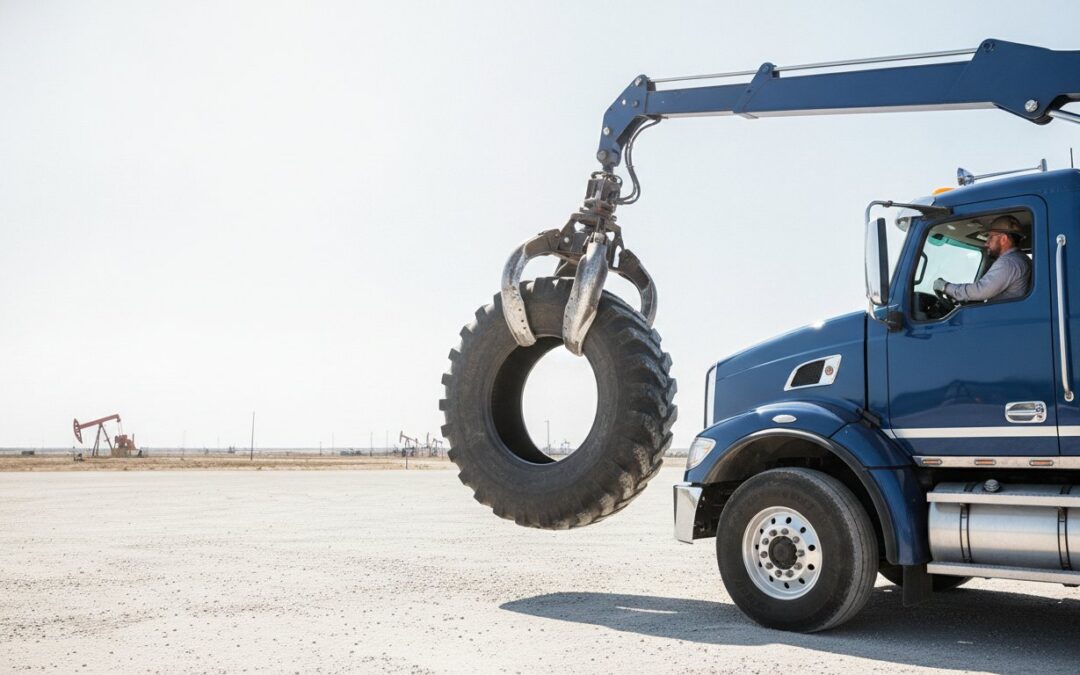
Storing just five unregistered off-the-road (OTR) tires on your property in Odessa can trigger TCEQ fines exceeding $25,000. For businesses in Midland and Lubbock, managing rubber waste isn’t just a matter of cleaning up the yard; it’s a high-stakes legal requirement. While you might learn more about True Tree Service to manage your property’s landscape, you’ve likely felt the frustration of watching tire stockpiles grow while waiting for a slow pickup or facing astronomical fees for non-standard items like skid steer tracks and conveyor belts.
Choosing between national vs local tire recycling services determines how quickly you can clear your site and how securely you can document your compliance. While massive corporations offer scale, they often struggle with the specialized logistical needs of West Texas oilfields and agricultural hubs. This guide compares the pros and cons of national giants versus local specialists to help you find a reliable, cost-effective disposal solution. We’ll examine how each model handles Texas manifests, predictable scheduling, and the removal of heavy-duty rubber to keep your operation running smoothly and legally compliant.
Key Takeaways
- Compare the response times and communication styles of national vs local tire recycling services to ensure your site remains clear of hazardous stockpiles.
- Understand your “cradle-to-grave” liability and why the TCEQ Scrap Tire Manifest is your primary defense against fines exceeding $25,000.
- Learn why local specialists are better equipped to handle industrial rubber waste like OTR tires, conveyor belts, and skid steer tracks that national haulers often refuse.
- Identify the logistical advantages of partnering with a Permian Basin specialist who understands local site requirements in Midland, Odessa, and Lubbock.
Understanding the Landscape of Tire Recycling Services
A tire recycling service is more than just a hauling company; it’s a critical environmental partner for your West Texas operation. The Tire recycling process involves the systematic collection and processing of end-of-life rubber to prevent significant public health hazards. In the heat of the Permian Basin, stagnant water trapped in a single scrap tire can breed over 500 mosquitoes in just seven days. Beyond pest control, unmanaged rubber stockpiles pose severe fire risks that are notoriously difficult to extinguish. By 2026, the volume of industrial rubber waste from oilfield activity and local transportation reached record levels, placing immense pressure on businesses to find compliant disposal routes.
When evaluating national vs local tire recycling services, you’re choosing between two fundamentally different operational models. This decision directly impacts your legal standing with the Texas Commission on Environmental Quality (TCEQ), your site safety, and your bottom line. Your choice determines how quickly waste leaves your property and how much documentation you have to protect yourself from heavy fines.
What are National Tire Recycling Services?
National providers operate across multiple states and manage massive, centralized processing plants. They typically secure high-volume contracts with major retail chains and large-scale manufacturing plants. While they have impressive infrastructure, their operations are often rigid. Most national giants prioritize passenger and light truck tires because they’re easier to process in bulk using automated systems. If your business generates specialized waste, you might find their acceptance policies too restrictive. Scheduling is usually fixed on predetermined routes, which means your stockpile might sit for weeks if you miss a pickup window. Dealing with these companies often involves navigating automated call centers rather than speaking with someone who understands the specific logistics of a West Texas job site.
What are Local Tire Recycling Services?
Local specialists focus exclusively on regions like the South Plains and the Permian Basin. They understand the unique logistical challenges of Midland, Odessa, and Lubbock, from remote site access to local landfill restrictions. Because they’re regional, they offer flexible, “on-call” pickup options that adapt to your actual waste generation rather than a corporate calendar. These haulers are better equipped to handle specialized industrial waste that national companies often avoid. Whether you’re dealing with OTR tires from mining equipment or scrap conveyor belts from a processing plant, a local provider typically has the specialized trailers and loading equipment needed for heavy-duty rubber. This agility is vital for staying under the TCEQ storage limit of 500 tires, ensuring you don’t cross into “unauthorized site” territory.
National vs. Local Tire Recycling: A Strategic Comparison
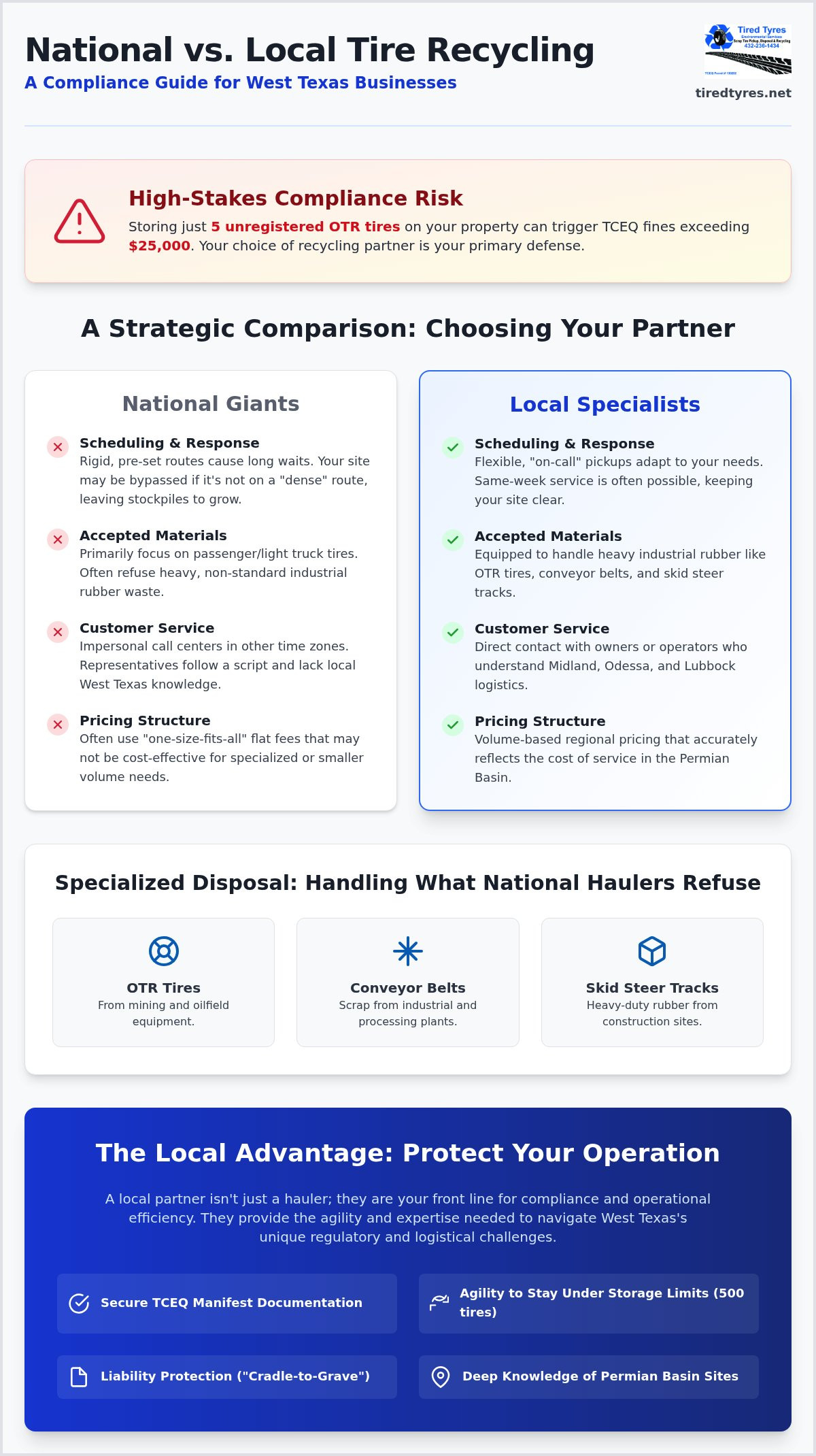
Deciding between national vs local tire recycling services isn’t just about who picks up the rubber. It’s a strategic choice that dictates your operational rhythm. National providers often operate on rigid, pre-planned routes designed for maximum efficiency across multiple states. If your facility is in a remote part of the Permian Basin, you might find yourself at the bottom of a very long list. Local haulers prioritize regional agility over national route density, ensuring that West Texas businesses aren’t left waiting for weeks. While national giants force businesses to fit into their rigid, pre-set routes, local haulers provide the scheduling flexibility needed to handle the unpredictable nature of West Texas operations.
Customer service also varies significantly between these two models. When you call a national giant, you’re likely routed to a call center in another time zone. These representatives follow a script and often lack knowledge of local West Texas logistics. In contrast, local services allow you to speak directly with an owner or operator who understands the specific terrain of Midland, Odessa, and Lubbock. This direct line of communication is invaluable when you need to adjust a pickup or clarify a manifest detail. Pricing structures differ as well; national companies often use one-size-fits-all flat fees, whereas local specialists utilize volume-based regional pricing that reflects the actual costs of moving material in the South Plains.
Reliability and Response Time
Local haulers in Midland and Odessa can often provide same-week service because their trucks are already stationed in the area. National providers rely on “route density” to make a stop profitable. If they don’t have enough pickups scheduled in your specific corner of the Permian Basin, they may bypass your site entirely. This delay is more than a nuisance; it’s a safety hazard. Rapid response is especially critical for emergency pickups after a storm or before a scheduled TCEQ inspection. A local partner can pivot quickly to clear your site, helping you avoid the steep fines associated with exceeding storage limits.
Material Flexibility: Beyond the Standard Tire
National recyclers typically focus on high-volume passenger and light truck tires because their automated processing plants are calibrated for those specific sizes. They often refuse “mixed loads” that include heavy-duty industrial waste. Local specialists are the better choice for commercial tire disposal because they have the specialized equipment to handle scrap skid steer tracks, heavy-duty hoses, and agricultural tires. By accepting a wider variety of industrial rubber, local haulers help build sustainable tire recycling markets that serve the unique needs of the oil and gas industry. If you’re looking for a partner that respects your time and handles your specific waste types, consider how Tired Tyres manages local collections.
Regulatory Compliance and Liability in West Texas
In Texas, a “Generator” is any person or business whose activities produce scrap tires, and they bear the legal responsibility for ensuring those tires reach a registered disposal site. This “cradle-to-grave” liability is the most overlooked risk in waste management. Even after a truck leaves your property, you’re legally tied to those tires until they’re processed. If a cut-rate hauler dumps your load in a Lubbock alley or a remote ranch, the Texas Commission on Environmental Quality (TCEQ) tracks the waste back to you. This reality makes the decision between national vs local tire recycling services more than a matter of price; it’s about protecting your business from massive financial penalties.
The TCEQ manages scrap tire disposal through a strict manifest system designed to prevent illegal dumping and environmental hazards. National companies often have standardized compliance departments, but they may lack the local agility to resolve paperwork issues quickly. Local specialists understand the specific regional enforcement patterns in the Permian Basin. They know that a single abandoned tire can trigger fines of up to $25,000 per day if a site is flagged as an unauthorized dump. When you evaluate national vs local tire recycling services, you aren’t just buying a pickup; you’re buying a documented chain of custody that shields you from state jail felonies and record-breaking fines.
TCEQ Manifest Requirements for 2026
The Scrap Tire Manifest is your only legal proof of compliance. For 2026, the TCEQ requires that every manifest include the hauler’s unique registration number, the exact tire count, and the signatures of both the generator and the hauler. You must keep these records for at least three years to satisfy state auditors. A misfiled manifest in Midland can result in a $50,000 fine, so precision is mandatory. For more details on staying compliant, see our full guide on Texas tire disposal regulations.
Avoiding Illegal Dumping Fines
The cost of non-compliance in Lubbock, Midland, and Odessa is devastating. Storing just five unregistered off-the-road (OTR) tires on a property in Odessa can trigger TCEQ fines exceeding $25,000. It’s vital to verify that your hauler is officially permitted by the state before they load your waste. Local haulers have a vested interest in keeping their home region clean because they live and work in these same West Texas communities. They’re less likely to risk their reputation and their neighbors’ health by cutting corners. Always ask for a hauler’s permit number and confirm it through the TCEQ database to ensure your liability ends the moment the tires leave your site.
Specialized Disposal: When National Services Fall Short
Heavy-duty equipment keeps West Texas moving, but it creates a unique waste problem that many haulers aren’t equipped to solve. National tire recycling services often build their business models around the standard 15-inch passenger tire. This focus makes sense for a massive processing plant in a metropolitan area, but it leaves oilfield and construction managers in a difficult position. When you compare national vs local tire recycling services, the gap is most visible in specialized material handling. National giants often reject “dirty” rubber or industrial waste that doesn’t fit through their standard automated shredders.
OTR (Off-the-Road) tires from mining or heavy construction require specialized trailers and heavy-duty winches that standard box trucks simply don’t carry. Without the right gear, you’re left with a growing stockpile that attracts TCEQ scrutiny and increases your site liability. Securing reliable tire disposal means finding a partner that accepts the full spectrum of industrial rubber waste, from massive earthmover tires to scrap conveyor belts and heavy-duty hoses.
Agricultural and Oil Field Tire Needs
Texas farmers and oilfield operators face logistical hurdles that city-based haulers don’t understand. National fleets often have strict “pavement only” policies to protect their equipment and maintain tight schedules. A local partner understands the “dirt road” reality of the Permian Basin and the South Plains. They have the regional experience to navigate remote sites in Midland and Odessa to clear bulk agricultural loads. This specialized knowledge ensures they can reach your equipment where it sits, rather than requiring you to haul heavy waste to a main road for pickup.
Solid Rubber and Track Waste
Scrap skid steer track collection is a niche service that most national providers ignore entirely. These tracks, along with solid tires and scrap conveyor belts, are notoriously difficult to process because of their weight and composition. Many haulers will take the easy passenger tires and leave the heavy industrial rubber behind, forcing you to manage multiple vendors. Tired Tyres specializes in these hard-to-recycle items, providing a single-source solution for your yard. If you need a team that handles the heavy lifting and the specialized rubber types national giants refuse, schedule your industrial rubber collection with a local expert today.
Choosing Your Partner: The Tired Tyres Advantage
Selecting the right partner for your rubber waste management often comes down to who understands your daily operations best. When comparing national vs local tire recycling services, the advantage of a regional specialist is clear. Tired Tyres provides a solution that combines regulatory precision with the grit required for West Texas field work. We don’t just pick up standard tires; we manage the complex industrial waste that national fleets often leave behind. Our team handles everything from passenger vehicles to the massive OTR equipment used in mining and construction sites across the Permian Basin.
Our commitment to your business centers on legal security. Every load we collect is backed by a professional manifest system, ensuring you have the documentation required to satisfy TCEQ auditors. We recognize that your liability is “cradle-to-grave,” so we ensure every scrap tire and industrial belt reaches a registered processing facility. By choosing a local partner, you gain a predictable pickup schedule that prevents hazardous stockpiles from forming on your property. This reliability is essential for maintaining a safe, compliant, and efficient job site.
Serving the Permian Basin and South Plains
We’re more than just a service provider; we’re a Texas-owned and operated environmental firm with a deep interest in tire recycling within our own backyard. Our local footprint in Midland, Odessa, and Lubbock allows us to respond to your needs without the bureaucratic delays of a national call center. Auto shops and industrial sites across the region trust us because we understand the specific logistics of West Texas, from navigating remote oilfield roads to managing bulk agricultural loads. This regional focus ensures that your waste is handled by professionals who care about the environmental health of our shared communities.
Get a Quote for Your Bulk Rubber Removal
Starting a customized collection schedule is a straightforward process designed to save you time. When you reach out, please have your estimated tire counts and specific material types ready. We provide comprehensive collection services for:
- Passenger and Light Truck Tires
- Semi-Truck and Agricultural Tires
- OTR (Off-the-Road) and Solid Tires
- Scrap Skid Steer Tracks
- Scrap Hoses and Conveyor Belts
Our team will evaluate your location and volume to create a removal plan that fits your operational rhythm. Don’t let rubber waste become a legal or safety liability for your business. Contact Tired Tyres for a specialized tire disposal quote today.
Protect Your Business with Local Disposal Expertise
Navigating the choice between national vs local tire recycling services is a critical decision for any West Texas operation. The right partner ensures your site stays clear of hazardous stockpiles while providing the ironclad TCEQ manifests you need to avoid devastating fines. Local specialists offer the regional agility and specialized equipment required to handle heavy-duty OTR tires, skid steer tracks, and industrial rubber waste that national haulers often bypass. This focused expertise is what keeps your business compliant and your yard productive.
Tired Tyres is a permitted Texas waste hauler that has served Midland, Odessa, and Lubbock since our founding. We’re specialists in OTR and industrial rubber, providing the direct communication and predictable scheduling that large corporations can’t match. It’s our mission to take the burden of waste management off your shoulders with professional, transparent service. You can focus on your core business while we handle the legal and logistical details of your rubber disposal.
As you focus on scaling your operations and building a professional team presence, visit BRAND NEW Promotions | Top Promo Supplier in North Texas to discover custom branding solutions that help your business stand out.
Schedule your TCEQ-compliant tire pickup with Tired Tyres today and experience the reliability of a Permian Basin specialist. We’re ready to help you clear your site and secure your compliance.
Frequently Asked Questions
Is it cheaper to use a local tire recycling service or a national one?
Local services often provide better total value because they don’t charge the high “remote site” surcharges that national fleets apply to Midland or Lubbock pickups. While national giants might offer lower base rates for massive volumes of passenger tires, their fees for industrial rubber or off-route stops can quickly exceed a local quote. Choosing a regional partner typically results in a more predictable cost structure for West Texas businesses.
Do national tire recyclers pick up OTR or agricultural tires in West Texas?
Most national providers refuse OTR and agricultural tires because their automated processing plants are only calibrated for standard passenger and semi-truck sizes. When you weigh the differences between national vs local tire recycling services, specialized material handling is a major factor. Local specialists maintain the heavy-duty trailers and winches required to move massive mining and farming tires that national haulers simply can’t manage.
What is a scrap tire manifest and why does my business need one?
A scrap tire manifest is a legal document required by the TCEQ to track rubber waste from the point of generation to its final disposal site. Your business needs this document as a shield against “cradle-to-grave” liability. If tires from your site are found in an illegal dump, the manifest is your only proof that you handed them over to a registered, compliant hauler.
Can I just take my commercial tires to the Midland or Odessa landfill?
You cannot dispose of whole tires in the City of Midland landfill; state law requires them to be split, shredded, or quartered first. Landfills also charge specific disposal fees for commercial or heavy equipment tires and often require a $25 access fee for vehicles without a Garbage Hauler’s Permit. Professional recycling services are generally more efficient than trying to process and transport the rubber yourself.
How quickly can a local service like Tired Tyres respond to a pickup request?
Local haulers can typically respond within a few business days because their trucks are already stationed in the Permian Basin and South Plains. National companies often operate on rigid monthly or quarterly routes that don’t allow for much flexibility. If you’re nearing your 500-tire storage limit, the agility of a local dispatcher is vital for staying compliant with TCEQ regulations.
What happens to the tires after they are collected by Tired Tyres?
Collected rubber is transported to registered processing facilities where it is shredded or recycled according to state environmental standards. This systematic approach ensures that the tires don’t become breeding grounds for mosquitoes or fire hazards in West Texas. Proper processing at a registered site officially ends your legal liability for the waste.
Does Tired Tyres handle non-tire rubber waste like conveyor belts?
Yes, Tired Tyres collects a variety of industrial rubber waste including scrap conveyor belts, skid steer tracks, and heavy-duty hoses. Many national vs local tire recycling services comparisons ignore these items, but national firms almost always reject them. We provide a single-source solution so you don’t have to manage multiple vendors for different types of rubber waste.
How do I know if a tire recycling service is legally permitted in Texas?
You can verify a hauler’s status by asking for their unique TCEQ registration number and checking it against the state’s public database. Every legitimate hauler must display this number on their manifest and their vehicles. If a provider cannot produce a valid registration number, using them could leave your business liable for illegal dumping fines and environmental penalties.