
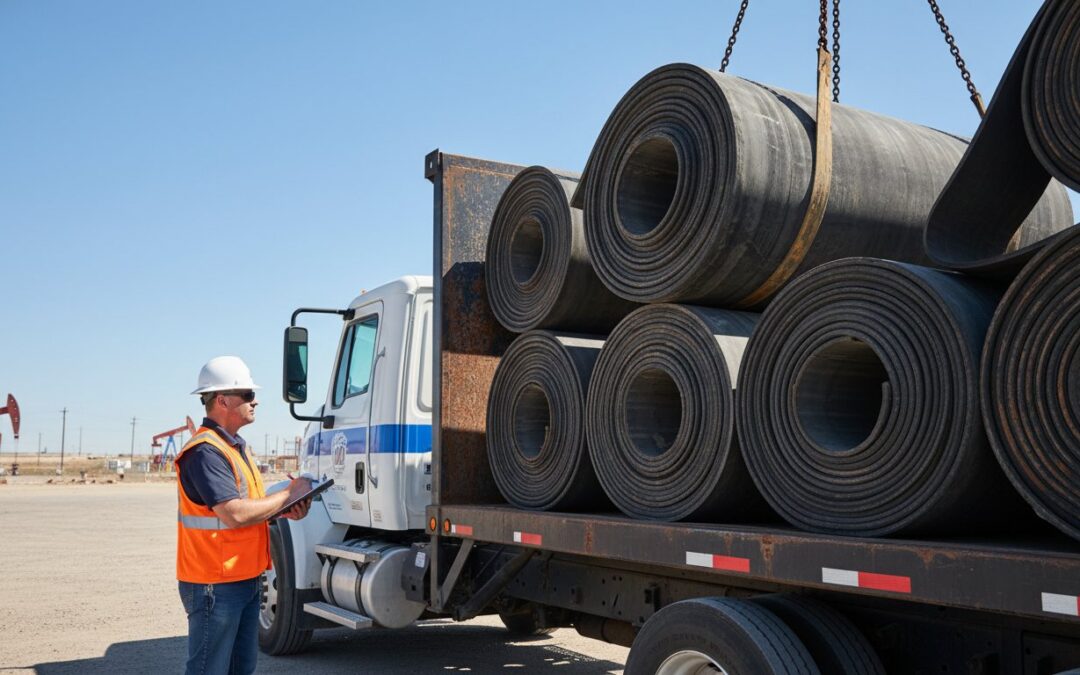
A single misclassified roll of industrial rubber in your yard isn’t just an eyesore; it’s a $10,000 liability waiting for a TCEQ inspector to find it. Most West Texas operators know the frustration of watching valuable space disappear under stockpiles of steel-reinforced belts because they aren’t sure where the material can legally go. Staying compliant with commercial conveyor belt disposal regulations is no longer just about being tidy. It’s about protecting your business from aggressive environmental audits and the rising costs of improper waste management.
You’re right to be cautious about whether a local landfill will accept your specific waste stream. We’ve designed this 2026 guide to help you navigate the complexities of industrial solid waste classifications and ensure your disposal process is fully documented. You’ll learn exactly how the TCEQ distinguishes between different grades of rubber waste and discover a reliable way to clear your site using a local hauling partner. We’ll break down the legal requirements for your scrap rubber collection so you can focus on your operations instead of worrying about potential fines.
Key Takeaways
- Understand how the TCEQ classifies conveyor belts as industrial solid waste to ensure your facility remains in full legal compliance.
- Identify the specific commercial conveyor belt disposal regulations that prevent costly fines and legal liabilities for West Texas operators.
- Master a simple two-step checklist for inventorying scrap rubber and verifying the registration of your disposal partner.
- Learn how professional hauling services in Midland and Odessa simplify the documentation process for your next environmental audit.
Understanding Commercial Conveyor Belt Disposal Regulations in Texas
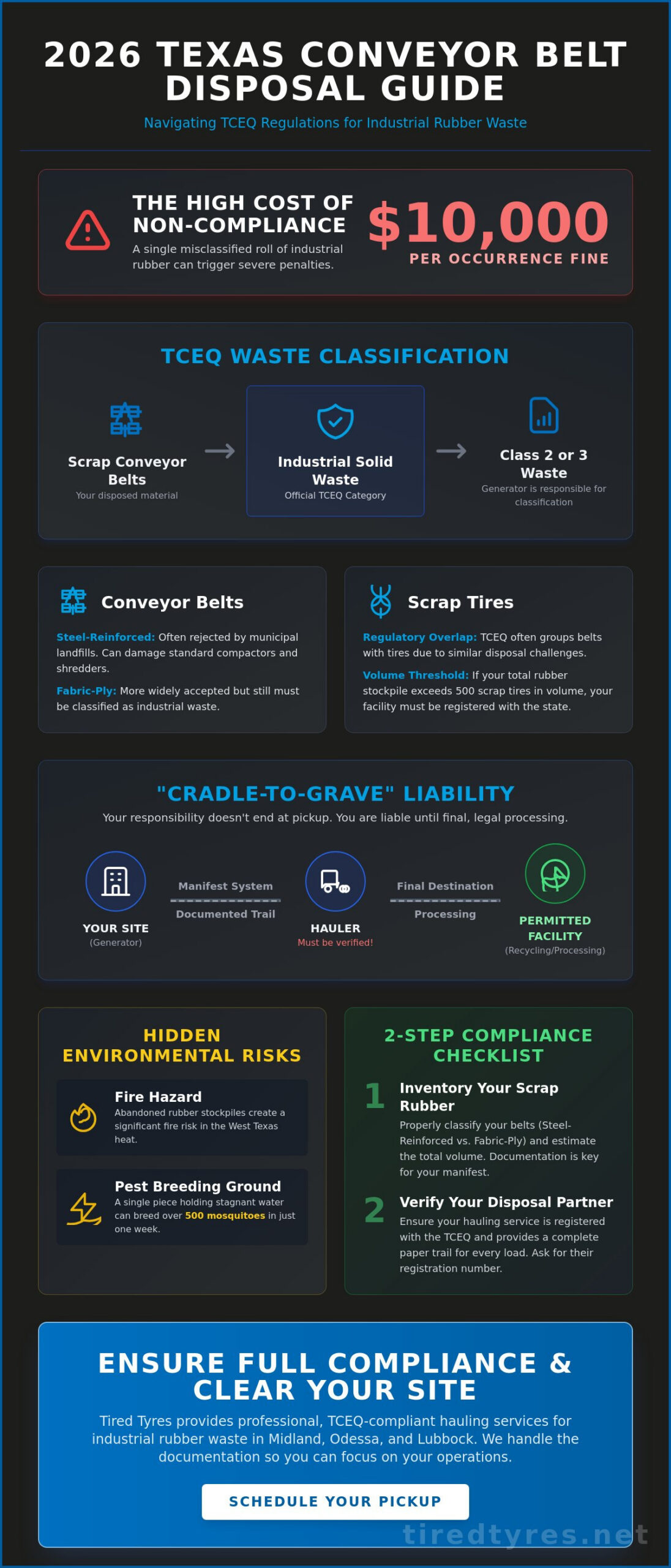
Managing large-scale industrial operations in the Permian Basin requires more than just operational efficiency. It demands a strict adherence to environmental law. In Texas, scrap conveyor belts aren’t treated like standard office trash. They’re classified as industrial solid waste. This classification places them under the direct oversight of the Texas Commission on Environmental Quality (TCEQ). Treating these heavy-duty materials as general waste is a dangerous mistake. It can lead to massive financial penalties. Abandoned rubber in the West Texas sun creates more than just a cluttered yard. It’s a fire hazard and a breeding ground for pests. According to March 2026 data, a single piece of rubber waste holding stagnant water can breed over 500 mosquitoes in just one week. Following commercial conveyor belt disposal regulations is the only way to protect your business and the local environment.
The Legal Definition of Industrial Rubber Waste
Texas law draws a clear line between what you throw in a dumpster and what requires specialized handling. Under Title 30 of the Texas Administrative Code, industrial scrap is categorized based on its potential risk to the environment. For a deeper look at how these materials are categorized globally, you can review this Industrial Waste Overview. Conveyor belts are prioritized by regulators because of their massive volume and nearly indestructible nature. They don’t break down in landfills like organic matter does. Most belts are classified as Class 2 or Class 3 industrial waste. The generator is responsible for this classification. You must document whether the belt is inert or potentially harmful to stay within the legal bounds of commercial conveyor belt disposal regulations.
Why Regulations Have Tightened in 2026
The regulatory environment in 2026 has shifted toward a “Cradle-to-Grave” liability model. This means your business is responsible for that rubber from the moment it’s removed from the machine until it’s officially processed at a permitted facility. You can’t simply hand it off to an unverified hauler and assume your liability has ended. If that hauler dumps the material illegally, the TCEQ can trace it back to your site. Fines for these violations can reach $10,000 per occurrence. There’s also a growing push for circular economy practices across Midland and Odessa. Local authorities are encouraging businesses to move away from stockpiling and toward documented recycling. This shift ensures that the heavy steel and rubber components are recovered rather than left to rot in the desert heat. Keeping your West Texas site clean isn’t just about aesthetics anymore. It’s a core part of your risk management strategy.
TCEQ Guidelines: Is a Conveyor Belt Classified as a Scrap Tire?
Businesses often ask if conveyor belts fall under the same rules as scrap tires. The answer depends on the volume you store and the material composition. While they are distinct industrial products, the TCEQ often groups them under a similar environmental umbrella because they share disposal challenges. If your rubber stockpile exceeds the volume of 500 scrap tires, you’re required to register your facility with the state. You can find detailed guidance on these specific volume thresholds through TCEQ Compliance Resources to ensure your site stays within legal limits. Ignoring these limits can lead to your business being classified as an unauthorized waste site.
There’s a common “loophole” where belts are treated as tires during the processing phase. If a belt is shredded or mixed with tire-derived fuel, it must follow a strict manifest system. This means you need a documented paper trail for every pound of material leaving your yard. You can’t just hope the material ends up in the right place. Failing to provide these records during a state audit is a fast track to a violation. Following commercial conveyor belt disposal regulations ensures that your manifest matches the actual material weight, protecting you from liability if the waste is handled improperly downstream.
Steel-Reinforced vs. Fabric-Ply Belting
Steel-reinforced belts are a different beast for disposal. Most municipal landfills in West Texas will reject them outright. The high-tensile steel cords are designed for durability, which means they easily damage standard landfill compactors and shredders. Fabric-ply belts are sometimes more widely accepted, but they still require classification as industrial waste. You need to know exactly what’s inside your belts before you schedule a pickup. If your belts contain heavy steel reinforcement, you’ll need a partner with specialized equipment to process the material correctly.
The Role of the Permitted Tire Hauler
You should only trust permitted tire haulers in Texas to move your industrial rubber. These professionals are vetted by the TCEQ and carry the credentials required to transport bulk scrap. If you hire an unpermitted contractor with a trailer, you haven’t actually disposed of the waste in the eyes of the law. You’re still legally responsible for that rubber until it reaches a permitted facility. It’s much safer to partner with a team that offers a dedicated scrap conveyor belt collection service to keep your records clean. Verifying a hauler’s registration is the simplest way to keep your business fine-free and compliant with all commercial conveyor belt disposal regulations.
The Financial and Legal Risks of Improper Disposal
Cutting corners on waste management is a high-stakes gamble for West Texas industrial operators. While a “cheap” disposal option might look good on this month’s balance sheet, it often triggers catastrophic long-term costs. The TCEQ doesn’t take illegal dumping lightly. Fines for violating commercial conveyor belt disposal regulations can reach $10,000 per violation. In cities like Midland, local authorities add their own penalties. Fines for illegal dumping in the Permian Basin start at $500 for even minor offenses. These numbers don’t include legal fees or the damage to your company’s reputation during a public enforcement action. Your environmental compliance record is a key asset for securing future contracts. One major violation can disqualify your business from high-value industrial projects.
Consider the cost of site remediation versus proactive disposal. If a stockpile of rubber is left to degrade or catches fire, the cleanup costs are astronomical. You’ll face soil testing, hazardous material removal, and potential groundwater monitoring. Proactive disposal is always the more economical choice. It removes the risk before it becomes a legal emergency. A clean yard isn’t just about organization; it’s about financial self-defense.
Avoiding Illegal Dumping Charges in Lubbock and Midland
Local law enforcement in Lubbock and Midland counties has increased patrols in rural industrial areas. They aren’t just looking for unsightly trash. They’re looking for public health hazards. Standing water trapped in the grooves of abandoned belts breeds over 500 mosquitoes in a single week. This transforms a simple waste issue into a public health violation. Depending on the scale of the mismanagement, penalties can shift from civil fines to criminal charges. Corporate officers can be held personally liable if they knowingly bypass state laws to save on hauling costs.
Long-term Liability: The “Cradle-to-Grave” Rule
Texas follows a strict “Cradle-to-Grave” rule for industrial waste. Your business owns the liability for that conveyor belt until it’s officially processed at a permitted facility. This is why “Free Pickup” offers from unregistered scrappers are so dangerous. These individuals often dump the heavy steel-reinforced cores in ravines or abandoned lots to avoid landfill fees. Since the waste is traceable, the TCEQ will come looking for the original generator. Always protect your business by demanding a Certificate of Disposal. This document is your only shield during an environmental audit. It proves you followed all commercial conveyor belt disposal regulations and successfully transferred the liability to a registered professional.
Compliance Checklist for West Texas Industrial Sites
Staying on the right side of the law doesn’t have to be a guessing game. A structured checklist helps you manage your site without fear of a surprise TCEQ audit. Your first move is creating an accurate inventory. You need to know the total weight of your scrap and whether your belts are steel-reinforced or fabric-ply. This data determines if your waste is Class 2 or Class 3, which dictates how it must be handled. Next, always verify the TCEQ registration of your chosen collection service. Never take a hauler’s word for it; ask to see their current credentials before any rubber leaves your property. This is a critical step in following commercial conveyor belt disposal regulations.
Once the material is ready for transport, you must complete the required industrial rubber manifest. This document is your proof of legal transfer and your primary defense against liability. You’re legally required to retain these records for at least three years. If an inspector visits your Midland or Odessa site, these papers are the first thing they’ll ask to see. Finally, don’t let waste sit until it becomes a mountain. Schedule regular pickups to ensure you never exceed the 500-tire equivalent threshold for on-site storage. If you’re ready to clear your yard and secure your documentation, you can schedule a scrap conveyor belt collection today to stay fully compliant.
Manifesting 101: What Every Manager Needs to Know
A Texas waste manifest isn’t just a receipt. It’s a legal document that requires three specific signatures: the generator (you), the hauler, and the final processor. Common mistakes that lead to audit failures include missing dates, incorrect waste classification codes, or using a hauler whose registration has expired. Ensure every field is legible and matches the actual weight of the material being moved. If the numbers don’t add up during a state review, your business could face a “failure to document” violation, even if the rubber was disposed of correctly.
On-Site Storage Regulations
Outdoor storage of bulk rubber is strictly regulated in West Texas to prevent fires and public health crises. You must maintain clear fire lanes between stockpiles to allow emergency vehicle access. Vector control is also a mandatory requirement. Because stagnant water in rubber belts can breed 500 mosquitoes in just seven days, the TCEQ requires active pest management for any outdoor scrap. If your stockpile becomes an infestation source, you’ll face public health violations on top of environmental fines. Keep your storage areas dry, organized, and below the state’s volume limits to avoid these unnecessary legal risks.
Professional Conveyor Belt Removal in Midland, Odessa, and Lubbock
Tired Tyres provides a direct solution for businesses struggling with the weight of West Texas environmental laws. We understand that managing heavy-duty rubber isn’t your primary job. Our team specializes in simplifying commercial tire disposal and industrial rubber removal for operators across the Permian Basin and South Plains. We’ve built our service to address the specific challenges of commercial conveyor belt disposal regulations, ensuring that every pound of material we haul is processed at a fully permitted facility. You don’t have to worry about where your waste ends up. We provide the legal paper trail required to keep your business fine-free.
Handling oversized industrial belts requires more than just a standard trailer. These materials are incredibly heavy and often reinforced with high-tensile steel cords. Our specialized equipment is designed to load and transport these bulky items safely from your yard or project site. We serve Midland, Odessa, and Lubbock with a commitment to 100% legal processing and recycling. By choosing a local partner who knows the local landfill restrictions and state mandates, you eliminate the risk of accidental non-compliance. We’ve been serving this region since day one, and we’ve seen how quickly a small oversight can turn into a major liability.
Our Seamless Collection Process
We’ve refined our logistics to be as efficient as possible for industrial sites. The process starts with a straightforward quote based on your material type and volume. Once you’re on the schedule, our team arrives at your location with the right tools for the job. We’re experienced in managing the unique logistics of remote mining sites and oilfield locations where access can be difficult. After the collection is complete, we handle the manifest signatures and provide you with the final documentation. We also offer customized pickup schedules for high-volume industrial clients who need to keep their on-site storage below state limits.
Why West Texas Businesses Trust Tired Tyres
Local expertise matters when the TCEQ is involved. We know the specific waste requirements for Midland, Odessa, and Lubbock; this means we can anticipate issues before they become violations. Our transparent documentation process ensures you’re always audit-ready. You won’t find any hidden fees or unrecorded disposal methods here. We take the burden of compliance off your shoulders so you can focus on your core operations. Get a custom quote for your conveyor belt disposal today and let us handle the heavy lifting for your facility.
Protect Your Business with Proactive Waste Management
Managing industrial rubber doesn’t have to be a source of stress for your West Texas operation. By now, you know that following commercial conveyor belt disposal regulations is about more than just keeping a tidy site; it’s about avoiding $10,000 TCEQ fines and maintaining your company’s professional reputation. Proper waste classification and meticulous manifest documentation are your best tools for passing environmental audits without a hitch. You don’t have to navigate these complex requirements alone or risk your site’s safety by stockpiling old materials indefinitely.
As a TCEQ-registered hauler serving the entire Permian Basin, Tired Tyres is here to take the logistics off your plate. We provide full manifest documentation for every load, ensuring you have a permanent record of legal disposal for your files. Don’t let old rubber rolls become a fire hazard or a legal liability for your facility. Schedule your TCEQ-compliant conveyor belt pickup with Tired Tyres today and get back to focusing on your core business. You’ve done the hard work of understanding the law; now let us handle the heavy lifting for you.
Frequently Asked Questions
Are conveyor belts considered hazardous waste in Texas?
Conveyor belts are typically classified as non-hazardous industrial solid waste rather than hazardous waste. Under TCEQ guidelines, they usually fall into Class 2 or Class 3 categories depending on whether the material is inert and uncontaminated. It’s the responsibility of the waste generator to document this classification and prove the rubber doesn’t pose a threat to the environment or human health.
Do I need a special permit to transport my own old conveyor belts to a landfill?
You don’t need a specific hauler’s permit for small amounts of your own waste, but you must still follow industrial waste manifesting rules. If the volume of rubber you’re moving exceeds state thresholds, the TCEQ requires you to register as a generator and document the transport. Many West Texas businesses use a registered professional to ensure the paperwork is handled correctly and avoid registration fees.
Can I burn old rubber conveyor belts on my property in West Texas?
No, burning rubber conveyor belts is strictly prohibited under Texas air quality regulations. Open burning of industrial waste can result in heavy civil penalties and environmental citations from the state. The thick black smoke produced by burning rubber releases toxic chemicals into the atmosphere, making it a major public health violation in any Permian Basin county.
What is the fine for illegal tire or rubber dumping in Ector County?
Fines for illegal dumping in Ector County and the surrounding Permian Basin start at $500 for local violations. On a state level, the TCEQ can issue much larger penalties that reach $10,000 per violation. These costs quickly exceed the price of legal disposal, making it financially risky to bypass commercial conveyor belt disposal regulations.
Will local landfills in Midland or Odessa accept steel-cord conveyor belts?
Most local landfills in Midland and Odessa have strict restrictions against accepting steel-reinforced belts because they damage shredding and compaction equipment. The mixed composition of rubber and high-tensile steel makes these items difficult to process in standard municipal facilities. You’ll usually need to find a specialized industrial waste processor that can handle reinforced rubber safely.
How do I verify if a waste hauler is TCEQ-permitted?
You can verify a hauler’s status by searching the TCEQ Central Registry database for their specific registration number. Every legitimate hauler must be able to provide their current certificate upon request before they load any material. It’s your responsibility to ensure their permit is active, as using an unregistered service can leave you legally liable for any improper dumping.
How long do I need to keep my scrap rubber manifests on file?
You’re required to keep all industrial waste manifests and disposal records for a minimum of three years. These documents are your primary defense during an environmental audit or a surprise site inspection. Keeping organized files ensures you can prove exactly where your material went and that you followed all commercial conveyor belt disposal regulations during the removal process.
Is recycling conveyor belts more expensive than landfill disposal?
Recycling is often more cost-effective than landfilling when you factor in the high tipping fees for heavy industrial rubber and the risk of landfill rejection. While landfill prices in the Midland area can range from $3.00 to $7.00 per tire equivalent, recycling avoids these fees and protects your company from future liability. It’s a more sustainable and financially stable choice for long-term waste management.