
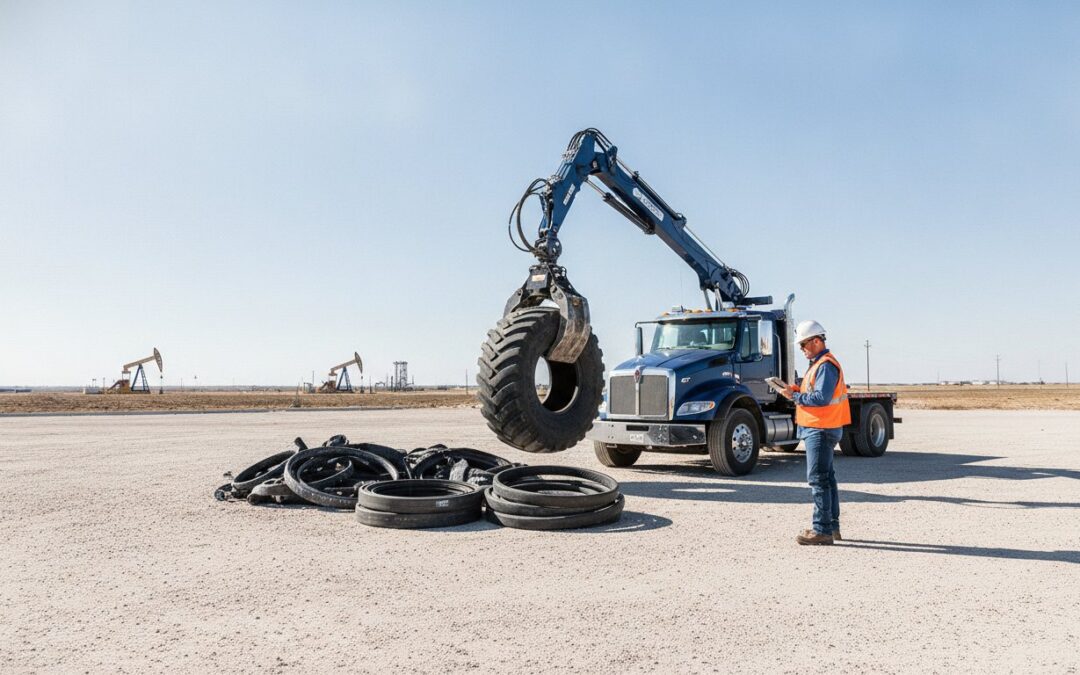
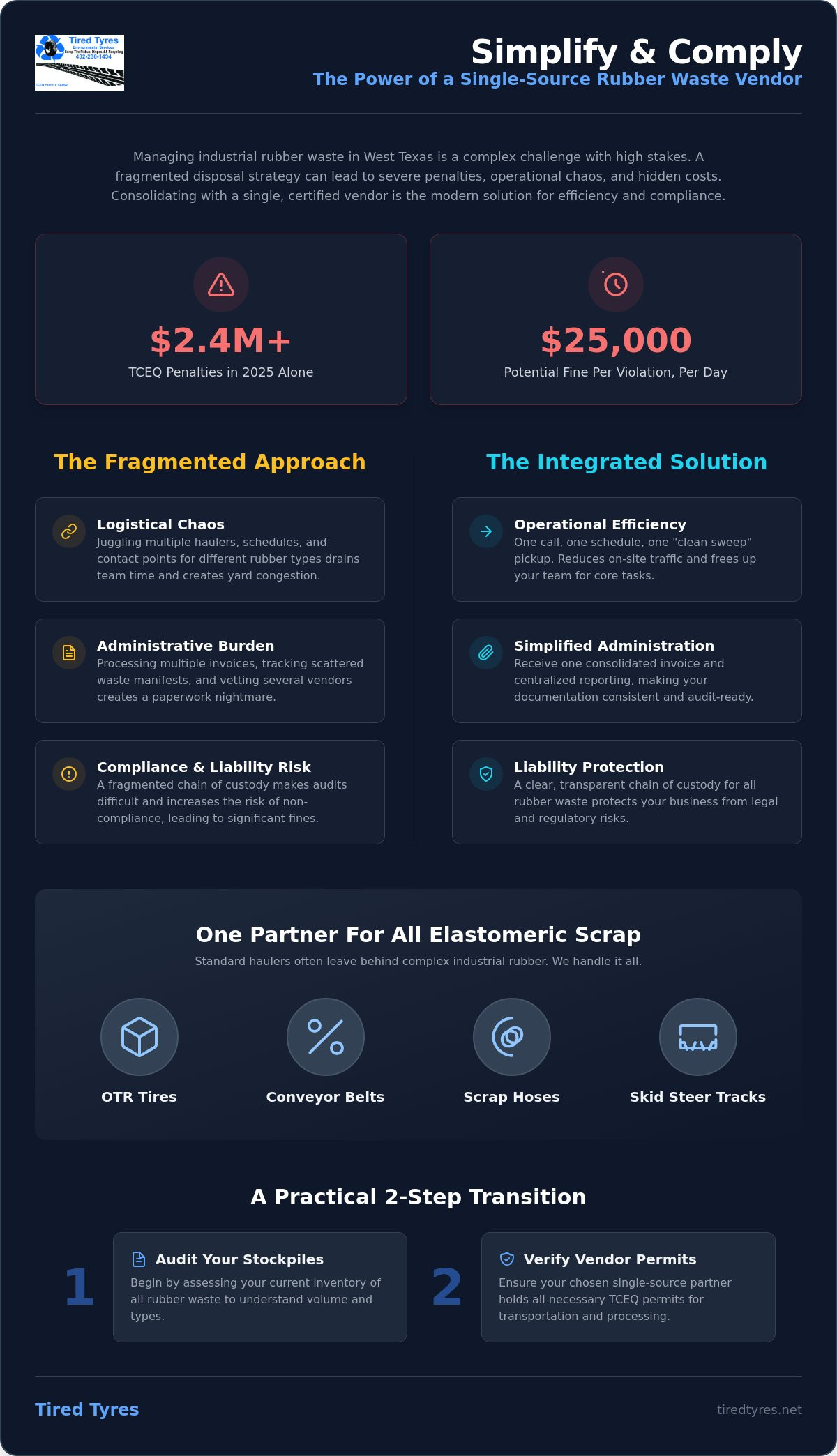
Did you know the TCEQ issued over $2.4 million in penalties for improper scrap tire management in 2025 alone? For a West Texas operation, a single oversight in your waste manifest can lead to fines of up to $25,000 per day. Understanding the benefits of a single-source rubber waste vendor is no longer just about convenience; it’s a necessary shield against rising regulatory risks and the complexities of environmental compliance.
We know that managing a yard full of OTR tires, scrap conveyor belts, and tangled hoses is a logistical nightmare that drains your team’s time. You’re likely tired of juggling different haulers for different materials while worrying if every manifest is actually compliant. This guide shows you how consolidating your disposal under one partner eliminates those administrative headaches and protects your bottom line. We’ll explore how one scheduled pickup can clear your yard, satisfy TCEQ requirements, and significantly cut your operational costs.
Key Takeaways
- Learn how to simplify your operations by replacing multiple haulers with one integrated solution for tires, tracks, and industrial belts.
- Understand the specific benefits of a single-source rubber waste vendor in maintaining perfect TCEQ compliance and avoiding costly penalties.
- Protect your West Texas business from legal liability with a tighter, more transparent chain of custody for all elastomeric scrap materials.
- Discover a practical two-step process for auditing your current rubber waste stockpiles and verifying essential vendor permits.
- Reduce your administrative burden and operational costs through coordinated, high-volume pickups that clear your yard in one visit.
The Complexity of Rubber Waste Management in West Texas
West Texas businesses, especially those operating in the Permian Basin, face a unique logistical challenge. Managing rubber waste isn’t just about tossing a few passenger tires into a bin. It involves massive OTR tires from drilling sites, miles of scrap conveyor belts, and heavy skid steer tracks. Single-source rubber waste management is the practice of consolidating all these elastomeric materials under one specialized vendor. Instead of the fragmented approach where you call three different haulers for three different types of rubber, the integrated approach uses one partner to handle everything.
Many companies end up with a fragmented system by accident. As a business grows, it might start with a simple tire pickup service. Later, they add heavy machinery that requires OTR tires or industrial equipment that uses conveyor belts. When the original tire hauler says they can’t take the belts, the company hires a second vendor. Over time, this creates a disorganized yard and a massive administrative burden. Understanding the benefits of a single-source rubber waste vendor starts with recognizing that your rubber waste is a single category, not a collection of unrelated problems.
Beyond Tires: The Industrial Rubber Challenge
Standard tire haulers typically focus on high-volume, easy-to-handle items like passenger or semi-truck tires. They often lack the specialized equipment needed for scrap hoses or heavy conveyor belts. Tire recycling for massive OTR tires is even more complex, as these items can weigh thousands of pounds and require heavy-duty loaders just to move. When these materials are left behind, they create mixed stockpiles. In the intense West Texas heat, these piles aren’t just an eyesore; they’re significant fire hazards and breeding grounds for pests.
The “Hidden Costs” of Multiple Waste Vendors
Choosing multiple vendors might seem like a way to find the best price for each material, but it often backfires. The administrative overhead is the first hidden cost. Your team has to manage multiple invoices, coordinate several different scheduling calls, and vet the permits of every single hauler. If one vendor is unreliable during a peak season, your yard becomes cluttered and unsafe. Tracking environmental compliance also becomes a nightmare when your waste manifests are scattered across different platforms and formats. Consolidating these services is one of the primary benefits of a single-source rubber waste vendor, as it provides a single point of accountability and a clear paper trail for every piece of rubber that leaves your site.
This principle of streamlining specialized waste streams is common across many sectors; for instance, many commercial kitchens rely on Cash 4 Waste Oil to handle their used oil collections, ensuring the same level of professional accountability and environmental compliance.
Operational Efficiency: How Consolidation Saves Time and Money
Efficiency in West Texas is often measured by how little time is wasted on non-core activities. When your facility manager spends three hours a week calling different haulers for OTR tires, skid steer tracks, and scrap hoses, that’s time taken away from production. One of the primary benefits of a single-source rubber waste vendor is the immediate return of those labor hours. You move from managing a complex network of vendors to managing a single, reliable relationship. This transition turns a logistical headache into a predictable line item.
Simplified Scheduling and Yard Management
Industrial sites in the Midland-Odessa area are high-traffic environments. Every truck that enters your yard represents a potential safety risk and a disruption to your workflow. By consolidating your disposal, you significantly reduce the number of vehicles on-site. A single vendor can coordinate a “clean sweep” pickup. This means one team clears your entire inventory of mixed rubber waste, from passenger tires to heavy conveyor belts, in a single visit. Instead of having a tire truck on Tuesday and a belt hauler on Friday, you get a coordinated schedule that fits your operational rhythm. If you are looking to clear your space quickly, you can schedule a comprehensive rubber waste assessment to see how consolidation works for your specific site.
Administrative and Accounting Benefits
The paperwork involved in rubber disposal is often more exhausting than the physical labor. Texas regulations require strict documentation for every scrap tire that leaves your facility. When you use multiple vendors, your office staff must track separate invoices, manifest forms, and payment terms. This fragmentation makes quarterly environmental audits far more difficult than they need to be. Centralized reporting ensures that your environmental data is consistent and easily accessible whenever a compliance officer asks for it.
Centralizing your reporting through one provider allows you to maintain an audit-ready system where every material type is accounted for in one place. This streamlined approach cuts down the hours spent on vendor vetting and payment processing. Priority service is another advantage that is often overlooked. When you are a “total account” client, you aren’t just another stop on a tire route. You are a strategic partner. This status often leads to more flexible scheduling and faster response times during peak production periods when your yard space is at a premium. Choosing to consolidate is a financial strategy to protect your most valuable resource: time.
This philosophy of integrated management is shared by leading waste professionals globally; for those managing broader commercial facilities, you can check out Greenline Environmental to see how comprehensive waste solutions are implemented in other major markets.
Regulatory Compliance and Liability Protection in Texas
The Texas Commission on Environmental Quality (TCEQ) maintains strict oversight of scrap rubber disposal. For West Texas businesses, compliance isn’t optional; it’s a financial necessity. In 2025, the TCEQ issued over $2.4 million in penalties for improper waste management. Violations such as unauthorized storage can lead to fines of up to $25,000 per day. One of the most significant benefits of a single-source rubber waste vendor is the consolidation of your legal liability. When you use multiple haulers, you’re only as compliant as your least professional vendor. A single, permitted partner ensures that every scrap tire, skid steer track, and industrial hose follows a documented path to a registered facility.
TCEQ Manifests and the Paper Trail
Texas law operates on a “cradle-to-grave” liability model. This means you’re responsible for your rubber waste until it’s properly processed at a permitted site. If a fly-by-night hauler dumps your OTR tires in a ravine, the TCEQ will trace those tires back to you. A single-source vendor provides a tighter chain of custody. They manage the entire manifest system, ensuring that your 60-month registration stays valid and your annual operational status reports are accurate. This is vital since the deadline for the 2025 calendar year report is December 31, 2025.
If you store more than 500 scrap tires on the ground or 2,000 in enclosed containers, you must register with the state. Managing these thresholds across different material types is difficult without a centralized partner. For a deeper look at these requirements, see our guide on Texas Tire Disposal Regulations. Using one vendor avoids the “split liability” trap, where a lack of documentation from one small hauler triggers a full-scale audit of your entire facility.
Environmental Stewardship and Brand Reputation
Proper rubber disposal is about more than just avoiding fines. It’s a core part of modern ESG (Environmental, Social, and Governance) goals. West Texas communities are increasingly sensitive to illegal dumping and the fire hazards associated with rubber stockpiles. By using a single-source vendor, you ensure that 100% of your elastomeric waste is handled responsibly. This protects your brand from the PR nightmare of being linked to an illegal dump site. Consistent, professional disposal demonstrates to your partners and stakeholders that you prioritize environmental safety. It turns waste management from a risk into a clear indicator of corporate responsibility and professional excellence.
Evaluating and Transitioning to a Single-Source Vendor
Moving from a fragmented disposal system to a consolidated one requires a systematic approach. It isn’t just about changing who you call; it’s about upgrading your entire waste management strategy. By following a structured transition plan, you can realize the benefits of a single-source rubber waste vendor without disrupting your daily operations. This process ensures that no material is left behind and that your new partner is fully equipped for the specific demands of the West Texas industrial landscape.
The Audit Process: Identifying Your Waste Streams
The first step is a comprehensive rubber waste audit. Walk your yard and inventory every material type. Don’t just look for piles of passenger tires. Identify “problem materials” like scrap skid steer tracks or heavy hoses that previous vendors may have refused to take. Estimating tonnage is crucial for scheduling. A standard semi-truck tire weighs about 100 lbs, while a large OTR tire can exceed 4,000 lbs. Identifying these high-volume or heavy-weight areas helps you establish a baseline for disposal frequency. If you’re unsure how to categorize your inventory, you can request a professional site audit from Tired Tyres to get an accurate tonnage estimate.
What to Look for in a Permian Basin Partner
West Texas presents unique logistical hurdles. A vendor based in Dallas or Houston might struggle with the rapid response times needed in Midland, Odessa, or Lubbock. You need a partner with a local presence and specialized equipment. Verify that they can handle 100 ft conveyor belts and have the loaders necessary for massive OTR tires. Beyond physical capability, permit verification is non-negotiable. Ensure your vendor holds all relevant TCEQ waste codes for every material stream they collect from your site.
Once you’ve identified a capable partner, follow these five steps to finalize the transition:
- Step 1: Conduct the full inventory of all tires, tracks, and industrial rubber.
- Step 2: Verify the vendor’s TCEQ permits and registration status for the current year.
- Step 3: Confirm they have the specialized trucks and loaders to handle your heaviest OTR equipment.
- Step 4: Review their insurance and liability coverage specifically for on-site collection activities.
- Step 5: Negotiate a service agreement that covers all rubber streams under a single, predictable billing structure.
A successful transition relies on transparency. Your new vendor should provide a clear timeline for clearing existing stockpiles and a recurring schedule for future pickups. This proactive planning is one of the key benefits of a single-source rubber waste vendor, as it prevents waste from accumulating to illegal levels again. By consolidating your disposal, you replace a reactive, stressful process with a professional service that runs in the background of your business.
Tired Tyres: Your Integrated Rubber Disposal Solution in West Texas
Tired Tyres serves as the practical partner for businesses looking to move away from fragmented waste management. We provide a single point of contact for every type of rubber scrap your facility generates. Our operation is designed specifically for the West Texas industrial landscape, where a single yard might hold everything from semi-truck tires to heavy-duty conveyor belts. By choosing a partner that handles the entire spectrum of elastomeric waste, you realize the full benefits of a single-source rubber waste vendor while supporting a locally owned firm that understands the Permian Basin’s unique demands.
Our Full Range of Collection Services
We don’t limit our services to standard tire sizes. Our expertise in Commercial Tire Disposal covers everything from light truck fleets to specialized agricultural equipment. We maintain the heavy-duty loaders and transport equipment necessary to remove 4,000 lb OTR tires and miles of scrap conveyor belts. Our comprehensive collection list includes:
- Industrial Materials: Scrap conveyor belts, industrial hoses, and solid rubber tires.
- Specialized Equipment: Scrap skid steer tracks and massive OTR tire collections.
- Fleet Management: Semi-truck, agricultural, and light truck tire collections.
- Mixed Rubber: General scrap rubber collections that standard haulers often refuse.
The Tired Tyres Advantage: Reliability and Compliance
Our West Texas roots are the foundation of our reliability. We live and work in the same communities as our clients, from Midland and Odessa to Lubbock. This local presence allows us to offer more responsive scheduling than national vendors who only pass through the region occasionally. We take the complexity out of the TCEQ manifest process. Our team handles the documentation from the moment of pickup to the final disposal at a permitted facility. This ensures your business remains audit-ready and protected from the “cradle-to-grave” liability risks discussed earlier in this guide.
The primary benefits of a single-source rubber waste vendor are peace of mind and operational clarity. You no longer have to wonder which vendor handles which material or if your manifests are being filed correctly. We provide a transparent, professional service that keeps your yard clear and your business compliant. Ready to simplify your waste management? Get a tire pickup quote in Midland today and experience a more efficient way to handle your rubber waste.
Secure Your Compliance and Streamline Your Yard
Consolidating your disposal process is more than a convenience. It’s a strategic shield against the rising regulatory risks in West Texas. By moving away from fragmented haulers, you gain a transparent chain of custody and a single point of accountability. The benefits of a single-source rubber waste vendor extend from your accounting office to your operational floor, saving your team hours of administrative work while reducing on-site truck traffic.
Tired Tyres is a TCEQ-permitted hauler serving Midland, Odessa, and Lubbock. We specialize in the heavy OTR, agricultural, and industrial rubber streams that other haulers often leave behind. Every pickup includes full manifest documentation, ensuring your records are always audit-ready. It’s time to stop juggling vendors and start focusing on your core operations. We’re ready to help you build a cleaner, safer, and more efficient facility.
Contact Tired Tyres for a Comprehensive Rubber Waste Assessment today.
Frequently Asked Questions
What is a single-source rubber waste vendor?
A single-source rubber waste vendor is a specialized partner that manages all categories of elastomeric scrap under one contract. This service includes everything from passenger tires to heavy industrial conveyor belts and scrap hoses. Consolidating your waste streams is one of the primary benefits of a single-source rubber waste vendor, as it replaces multiple uncoordinated haulers with a single point of accountability.
Can one vendor really handle both passenger tires and industrial conveyor belts?
Yes, an integrated vendor maintains the diverse fleet and equipment needed for both lightweight tires and heavy industrial rubber. While standard haulers often lack the loaders for massive OTR tires or the specialized trucks for 100 ft conveyor belts, a single-source partner is equipped for both. This ensures that no “problem materials” are left behind in your yard during a scheduled pickup.
How does using one vendor help with TCEQ compliance?
Using one vendor simplifies TCEQ compliance by centralizing your manifest documentation and annual reporting. Instead of tracking paperwork from three different companies, you maintain a single, audit-ready trail for all your rubber waste. This oversight is critical for meeting the December 31 deadline for status reports and ensuring your 60-month registration remains in good standing.
Is it more expensive to use a single-source vendor?
Consolidation typically reduces your total operational costs even if individual material fees remain competitive. You realize the benefits of a single-source rubber waste vendor through a massive reduction in administrative hours spent on invoicing and vendor vetting. Additionally, fewer truck visits to your West Texas facility mean less operational disruption and more efficient yard management.
Do you provide disposal for OTR tires and skid steer tracks in Lubbock?
Yes, we provide comprehensive collection for OTR tires, agricultural tires, and skid steer tracks throughout Lubbock and the South Plains. Our equipment is specifically designed to handle the extreme weight and size of machinery tires used in local farming and construction. We ensure these heavy materials are removed safely and transported to permitted Texas facilities.
What happens if a vendor is not properly permitted by the TCEQ?
If a hauler isn’t properly permitted, the legal liability for any mismanagement falls directly on your business as the waste generator. Texas law uses a “cradle-to-grave” model, meaning you’re responsible for the rubber until it’s processed at a registered site. Using an unpermitted vendor puts you at risk for TCEQ penalties, which exceeded $2.4 million in 2025.
How do I know if my industrial rubber waste is being disposed of legally?
You can verify legal disposal by requesting a copy of the completed scrap tire manifest for every load that leaves your property. A professional vendor provides this documentation as a standard part of their service. This paper trail proves that your industrial rubber waste reached a TCEQ-registered facility and wasn’t dumped at an unauthorized site.
What areas of West Texas do you serve for bulk rubber collection?
We provide bulk rubber collection services throughout the Permian Basin and the surrounding regions. Our primary service areas include Midland, Odessa, and Lubbock, along with the industrial and agricultural hubs that support them. This local focus ensures faster response times and a deeper understanding of the specific regulatory requirements facing West Texas businesses.