
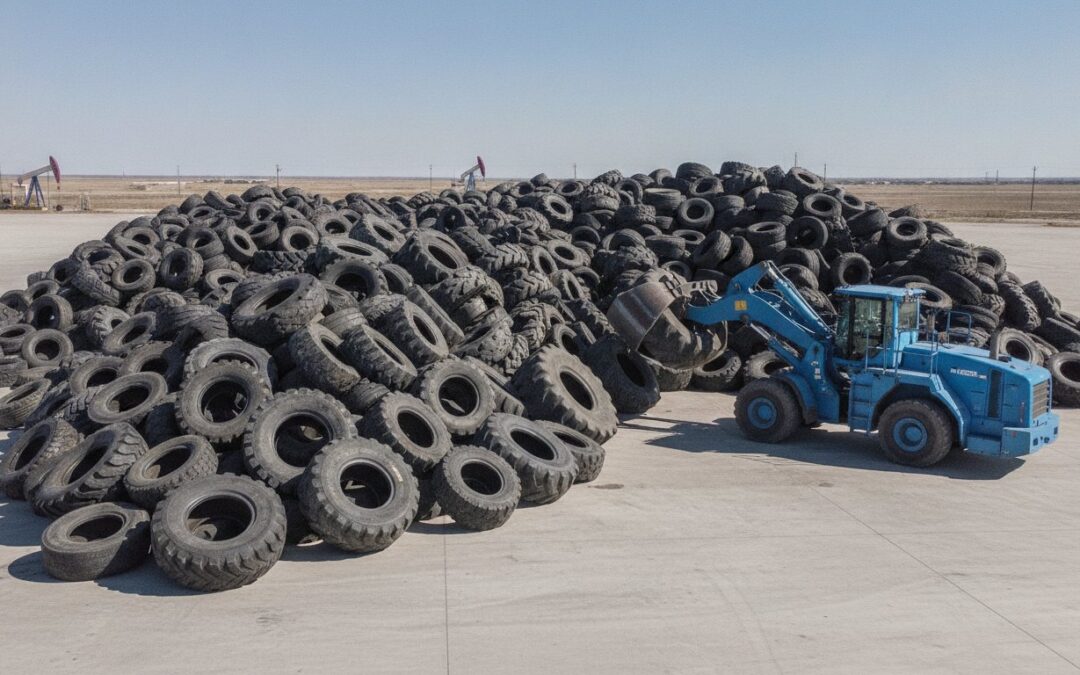
Did you know the TCEQ issued over $2.4 million in penalties for improper scrap tire management in 2025? In the Permian Basin and South Plains, waste tire problems can escalate from a minor nuisance to a $25,000 per day legal nightmare almost overnight. Whether you’re dealing with a few dozen passenger tires or a massive stack of OTR casings, the risks are real and immediate.
It’s understandable why business owners feel overwhelmed by the strict storage and disposal rules in West Texas. You want to keep your property clean and avoid heavy fines, but the logistics of hauling bulk rubber are complicated. This guide provides a clear path forward. You’ll understand the critical environmental, health, and legal risks of scrap tires and learn how to manage them safely. We’ll examine current 2026 regulations, the dangers of spontaneous tire fires in the West Texas heat, and how to find a reliable local pickup service that keeps you compliant with Texas law.
Key Takeaways
- Learn to identify what qualifies as a scrap tire and why West Texas faces unique challenges with rubber accumulation.
- Discover how to mitigate serious health and safety risks, including mosquito infestations and high-intensity tire fires.
- Understand the strict TCEQ regulations and reporting requirements necessary to resolve waste tire problems and avoid legal liability.
- Explore how discarded rubber is transformed into valuable resources through tire-derived fuel and civil engineering applications.
- Identify reliable, permitted collection solutions for bulk industrial, agricultural, and OTR tires in Midland, Odessa, and Lubbock.
The Scope of Waste Tire Problems in West Texas
Waste tires, often called scrap tires, are casings that can no longer serve their original purpose. Whether due to tread wear, structural damage, or rubber degradation, these items transition from essential equipment to a regulated waste stream the moment they’re removed from the rim. In West Texas, waste tire problems aren’t just about passenger cars. The sheer scale of industrial and agricultural operations in the Permian Basin creates a volume of rubber waste that standard municipal systems simply can’t handle.
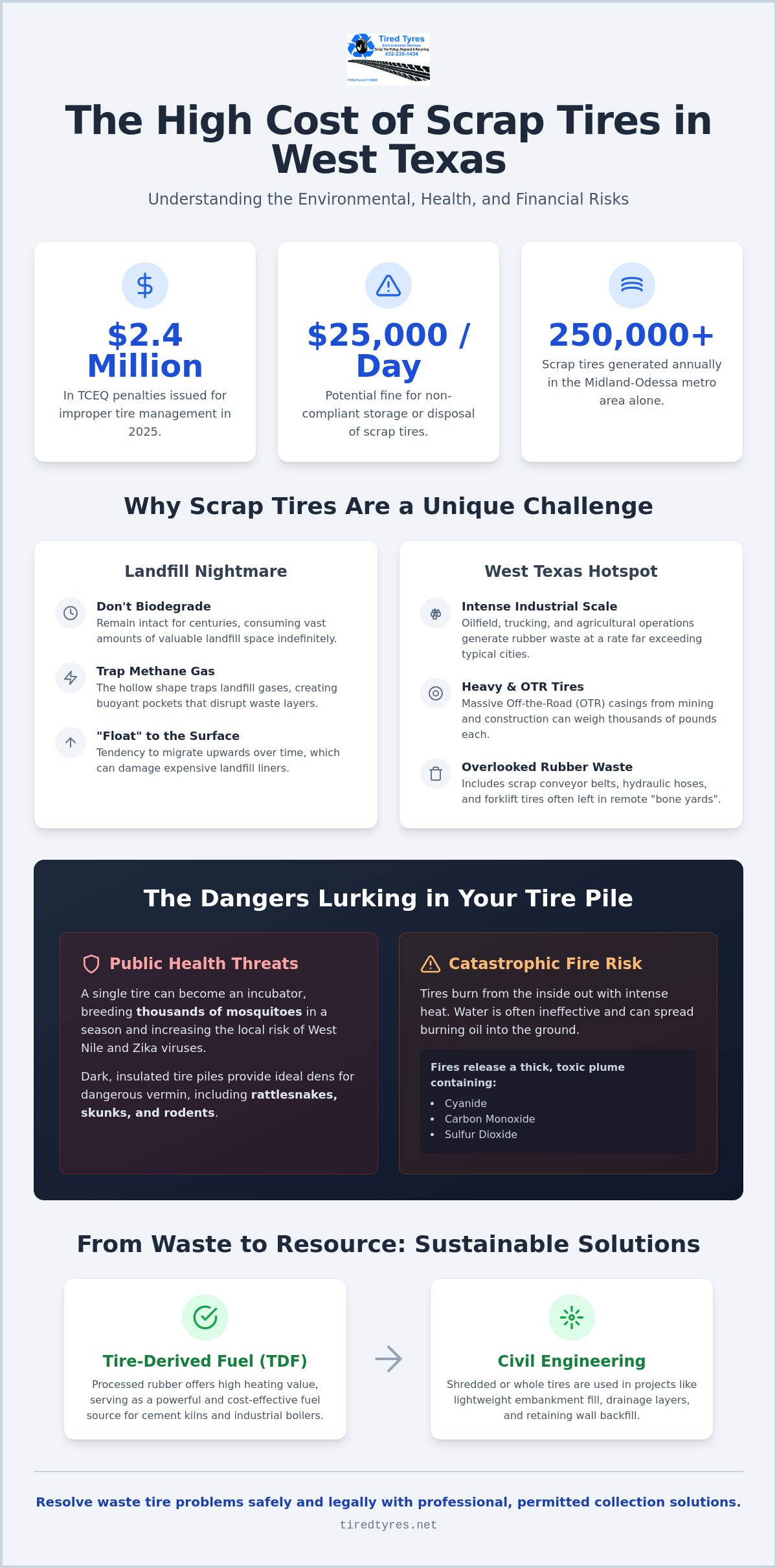
A common industry benchmark is the “one tire per person” rule. On average, every resident in the United States generates one scrap tire annually. For the Midland and Odessa metro areas, this means over 250,000 tires enter the local waste stream every year. When you add the intense demands of the oilfield and large-scale farming, that number climbs significantly. West Texas is a hotspot for rubber accumulation because our economy relies on heavy-duty trucking, drilling rigs, and massive tractors, all of which consume rubber at a much higher rate than a typical city.
Why Tires are a ‘Problem’ Waste Stream
Rubber is designed to be indestructible. This durability is a benefit on the road but a disaster in a landfill. Tires don’t biodegrade. While some estimates suggest they take centuries to break down, the reality is that they remain functionally intact indefinitely, occupying massive amounts of valuable landfill space.
Their physical structure creates unique logistical headaches. Tires are “bouncy” and hollow. In traditional landfills, whole tires trap methane gas and have a tendency to “float” or migrate back to the surface over time. This movement can puncture expensive landfill liners and disrupt the entire waste management cell. Because tires are bulky but relatively light for their size, transporting them is expensive. You’re often paying to haul “trapped air” unless the tires are processed or managed by a professional service. You can find more details on these challenges in this global tire recycling overview.
Industrial Rubber Waste in the Permian Basin
In the Permian Basin and the South Plains, waste tire problems extend far beyond the local tire shop. We deal with OTR (Off-the-Road) tires used in construction and mining that can weigh thousands of pounds each. These massive casings require specialized equipment just to move, let alone dispose of properly.
Industrial sites also generate secondary rubber waste that often gets overlooked until a regulatory inspection occurs. This includes:
- Scrap conveyor belts from midstream and industrial facilities.
- Used hydraulic and industrial hoses.
- Solid tires from forklifts and skid steer tracks.
Environmental and Public Health Hazards of Scrap Tires
Leaving scrap piles on your property creates immediate biological threats that extend far beyond aesthetics. In the heat of West Texas, stagnant water trapped inside a tire becomes a perfect incubator. A single discarded tire can produce thousands of mosquitoes in a single season, significantly increasing the local risk of West Nile and Zika viruses. Because tires are engineered to shed water while moving, their curved shape becomes a highly efficient trap for rainwater when they are stationary. Much like how specialists such as T.M. Drainage address residential water pooling issues, removing these artificial catchments is vital for public health. This transformation makes waste tire problems a community health issue that requires prompt attention.
Beyond insects, tire piles are ideal dens for dangerous vermin. The dark, insulated cavities provide protection from the intense sun and predators, attracting rattlesnakes, skunks, and rodents. For property owners, this turns a simple cleanup task into a hazardous encounter with local wildlife. These infestations often migrate from the tire pile toward nearby homes or industrial offices, creating a persistent safety risk for employees and families alike.
Tire Fires: A West Texas Nightmare
The chemistry of a tire fire is a specific nightmare for first responders and landowners. Tires are composed of high-grade petroleum products and oils. Once they ignite, they generate incredible heat and trap oxygen within the center of the pile, allowing the fire to burn from the inside out. Water alone won’t put them out. In many cases, spraying water on a large tire fire only spreads the burning oil and pushes contaminants deeper into the ground.
These fires release a thick, black plume of smoke containing cyanide, carbon monoxide, and sulfur dioxide. The air quality impact can trigger mandatory evacuations for miles downwind. If a fire occurs on private property, the owner is often held responsible for the massive costs of emergency response and soil remediation. It’s much safer to arrange a permitted tire collection than to risk a spontaneous combustion event during a summer heatwave.
Groundwater and Soil Contamination
Environmental damage from rubber waste isn’t always visible to the naked eye. According to EPA data on rubber waste, tires contain various heavy metals and chemical stabilizers that break down over time. One specific compound, 6PPD-quinone, has been identified as highly toxic to aquatic life and can migrate into local water tables.
For West Texas farmers and ranchers, this contamination is a major concern. Toxic runoff can settle into the soil, potentially affecting crop health and the safety of livestock water sources. Leachate is a toxic liquid formed when water filters through waste, picking up heavy metals, polycyclic aromatic hydrocarbons, and petroleum stabilizers from the rubber. These long-term waste tire problems can devalue your land and lead to expensive environmental cleanup orders from state regulators.
The Legal Risks: Texas Regulations and Illegal Dumping
In Texas, the management of scrap rubber is strictly governed by the Texas Commission on Environmental Quality (TCEQ). If you ignore waste tire problems on your land, you’re inviting state-level scrutiny that carries heavy financial weight. The TCEQ has the authority to issue fines of up to $25,000 per day for improper scrap tire management. These penalties aren’t reserved for major industrial players. Storing as few as 50 scrap tires on the ground without registration can trigger significant daily fines. Landowners often assume they aren’t liable for tires dumped illegally by third parties on their property. Unfortunately, Texas law places the burden of remediation squarely on the property owner. If it’s on your land, it’s your responsibility to clear it through legal, permitted channels.
The most critical document for any business handling tires is the scrap tire manifest. This paper trail proves your waste was handed over to a permitted hauler and reached a legitimate disposal or recycling site. Without a manifest, you have no legal defense if those tires are later found in a ditch or an illegal dump. State regulators require these records to be maintained for at least three years. If an auditor visits your site and you can’t produce these manifests, your business faces immediate liability, regardless of your intentions.
Avoiding Illegal Dumping Fines in Lubbock and Midland
Local enforcement is just as aggressive as the state. In Odessa, for example, illegal dumping carries municipal fines of up to $2,000. It’s important to distinguish between temporary storage and illegal stockpiling. Texas law generally requires formal registration and financial assurance if you store more than 500 tires on the ground or 2,000 in enclosed containers. For businesses in the Permian Basin, staying compliant means understanding the specific Texas Tire Disposal Regulations that govern our region. Most municipal landfills in Midland and Lubbock won’t accept whole tires; they must be split, shredded, or quartered before they can be legally landfilled.
The Role of Permitted Tire Haulers
Hiring an unpermitted hauler is a major liability risk. If that individual dumps your tires illegally to save on disposal fees, the TCEQ can trace the waste back to your business. Always verify a hauler’s credentials before they load a single casing. A professional service provides the necessary manifests and ensures your operational status is reported correctly. Since September 1, 2024, all scrap tire generators are required to report their operational status annually to the TCEQ. Keeping precise records isn’t just good business; it’s your primary shield against the waste tire problems that can lead to a shutdown or bankruptcy.
Sustainable Solutions: From Waste to Resource
Solving waste tire problems isn’t just about moving rubber from one place to another. It’s about reintegrating these materials into the economy through high-value applications. In 2024, approximately 1.57 million scrap tires were recycled in Texas, while another 643,000 were diverted for beneficial use in construction and agriculture. This “waste to resource” trend is gaining momentum in the Permian Basin as businesses realize that scrap rubber has significant industrial value when processed correctly.
One of the most effective solutions is Tire-Derived Fuel (TDF). Scrap tires have a higher heating value than many types of coal. Industrial facilities, such as cement kilns and paper mills, use TDF as a cleaner-burning alternative to traditional fossil fuels. The extremely high temperatures in these kilns ensure that the rubber is consumed completely, leaving behind minimal residue and providing a sustainable disposal path for millions of casings annually.
Beyond fuel, crumb rubber is repurposed for a variety of community and industrial products. You’ll find recycled tires in:
- Shock-absorbent playground surfaces and athletic tracks.
- Durable livestock mats for West Texas ranches.
- Lightweight fill for civil engineering embankments.
- Industrial floor mats designed for heavy oilfield equipment.
The Benefits of Rubberized Asphalt
Rubberized asphalt is particularly well-suited for the West Texas climate. By mixing finely ground tire rubber with traditional asphalt, engineers create a pavement that is more flexible and resistant to thermal cracking. The intense summer heat in Midland and Odessa often causes standard roads to rut or crack, but rubberized surfaces hold up better under extreme temperatures. These roads are also quieter and provide better traction during the rare but hazardous West Texas rainstorms. For a deeper look at how this process works locally, read The Full Guide to Tire Recycling.
Agricultural and Industrial Repurposing
Repurposing offers a secondary life for tires before they hit the shredder. Many West Texas farmers use tire sidewalls to weight down silage covers, which is a cost-effective way to manage feed bunkers. In the oilfield, used OTR tires are often transformed into heavy-duty mats that protect the ground from drilling equipment. While these “upcycling” methods are helpful, they don’t solve waste tire problems at a regional scale. True sustainability requires large-scale shredding, which reduces the volume of rubber by up to 75% and eliminates the hollow spaces where water and pests collect.
Ready to clear your property and ensure your scrap rubber is handled sustainably? Schedule a professional tire collection today to stay compliant and protect the environment.
Professional Disposal Solutions for Midland, Odessa, and Lubbock
Solving waste tire problems in West Texas requires more than just a truck and a trailer; it requires a partner who understands the specific regulatory landscape of the Permian Basin. Tired Tyres provides permitted scrap tire collection services designed to take the burden of compliance off your shoulders. We serve Midland, Odessa, and Lubbock with a focus on reliability and professional integrity. Our team ensures that every casing we collect is handled according to TCEQ standards, protecting your business from the liabilities discussed throughout this guide.
Our capabilities extend far beyond standard passenger tires. We specialize in the heavy-duty rubber waste that powers the West Texas economy. This includes specialized OTR (Off-the-Road) tire collection for construction and mining, as well as agricultural tire collection for local farming operations. We also manage semi-truck tire collections for transport fleets. By providing a single point of contact for all rubber waste, we help you maintain a clean, safe, and organized workspace without the need for multiple vendors.
The collection process is straightforward and efficient. We work with your schedule to provide timely pickups, ensuring that scrap piles don’t have the chance to become pest havens or fire hazards. Every pickup is backed by the necessary manifest documentation. This paper trail is your proof of legal disposal, which is essential for your annual environmental reporting and any potential state audits. We’re committed to keeping our local communities environmentally safe by providing a professional alternative to illegal dumping.
Tailored Solutions for Industrial and Commercial Clients
Industrial operations often generate unique types of rubber waste that standard disposal services won’t touch. Tired Tyres handles scrap skid steer tracks, industrial hoses, and scrap conveyor belts. These items are common on drilling leases and midstream facilities but require specialized handling due to their weight and composition. Whether you’re managing a trucking fleet or a massive agricultural spread, we provide bulk removal services that fit your operational scale. For more specific information on these high-volume services, view our guide on Commercial Tire Disposal.
Get Started with Tired Tyres
Requesting a quote for bulk tire removal is the first step toward clearing your property and securing your legal standing. We provide transparent communication and dependable service that gives you peace of mind. You don’t have to worry about the “guy with a truck” dumping your liability in a ditch. With Tired Tyres, you’re choosing a permitted professional who values the safety of West Texas as much as you do. Contact Tired Tyres for a pickup quote in Midland or Odessa and resolve your rubber waste issues today.
Securing Your Property and Compliance in 2026
Managing rubber waste in West Texas is no longer just a matter of housekeeping; it’s a critical legal and safety requirement. The combination of intense summer heat and strict TCEQ oversight makes unmanaged stockpiles a liability that no business should carry. By choosing professional remediation, you protect your land from toxic contamination and ensure that every casing is tracked through a legal manifest. Addressing waste tire problems promptly prevents a minor nuisance from escalating into a $25,000 per day fine.
Tired Tyres provides the local expertise needed to handle everything from standard passenger tires to specialized OTR and industrial rubber disposal. We’re permitted by the TCEQ for legal hauling, ensuring your business stays fully compliant with state regulations across the Permian Basin and South Plains regions. Don’t let scrap rubber accumulate and attract pests or regulatory scrutiny. Our team is ready to provide the efficient, reliable service you need to keep your operations running smoothly and safely.
Schedule your scrap tire pickup in Midland, Odessa, or Lubbock today and gain the peace of mind that comes with professional waste management.
Frequently Asked Questions
Why are waste tires considered a special waste stream in Texas?
Texas classifies scrap tires as a special waste stream because they don’t biodegrade and pose significant fire and public health risks. Their hollow structure makes them difficult to manage in standard landfills, as they tend to trap gases and “float” to the surface over time. Consequently, state law requires specific processing, such as shredding or splitting, before they can be legally landfilled.
Can I legally bury old tires on my ranch in West Texas?
No, burying whole tires is illegal under Texas environmental regulations. State law requires that all scrap tires be processed or disposed of at a facility permitted by the TCEQ. Burying rubber on private land can lead to heavy fines and creates long term environmental liabilities that can complicate future land sales or agricultural operations.
What are the specific health risks associated with scrap tire piles?
Scrap tire piles create ideal habitats for disease carrying pests and dangerous wildlife. Stagnant water inside the casings breeds mosquitoes that carry West Nile and Zika viruses. These piles also provide shaded, insulated cover for rattlesnakes and rodents, creating immediate physical safety hazards for employees or residents on the property.
How do waste tires contribute to the spread of West Nile Virus in Lubbock?
Waste tires are highly efficient at trapping rainwater, which remains stagnant and protected from the wind. In Lubbock and the surrounding South Plains, this creates the perfect nursery for the Culex mosquito, the primary carrier of West Nile Virus. Eliminating these waste tire problems is a key part of regional public health efforts to reduce local infection rates.
What happens if I don’t have a manifest for my tire disposal?
If you don’t have a scrap tire manifest, you lack legal proof that your waste was disposed of properly. If those tires are later found in an illegal dump, the TCEQ can hold your business responsible for the cleanup costs and issue daily fines. Texas law requires businesses to maintain these records for at least three years to prove compliance during audits.
Are tire fires common in the Permian Basin?
The risk of tire fires is exceptionally high in the Permian Basin due to intense summer heat and frequent lightning strikes. Once a stockpile ignites, the petroleum based rubber burns with incredible intensity and is nearly impossible to extinguish with water alone. These events often result in massive soil remediation costs and air quality violations for the landowner.
Can scrap conveyor belts and industrial hoses be recycled like tires?
Yes, industrial rubber waste like conveyor belts and hydraulic hoses can be processed for recycling or tire derived fuel. These materials share many of the same chemical properties as tires and contribute to waste tire problems when left to accumulate on industrial sites. Professional collection services can manage these bulk items alongside your standard scrap tire inventory.
How much does it cost to dispose of OTR tires professionally?
Professional disposal costs for OTR (Off-the-Road) tires depend on the weight of the casings and the total volume of the collection. Because these massive tires require specialized heavy equipment for loading and hauling, pricing is typically determined on a project by project basis. Property owners should request a quote from a permitted hauler to understand current regional rates for industrial rubber removal.