
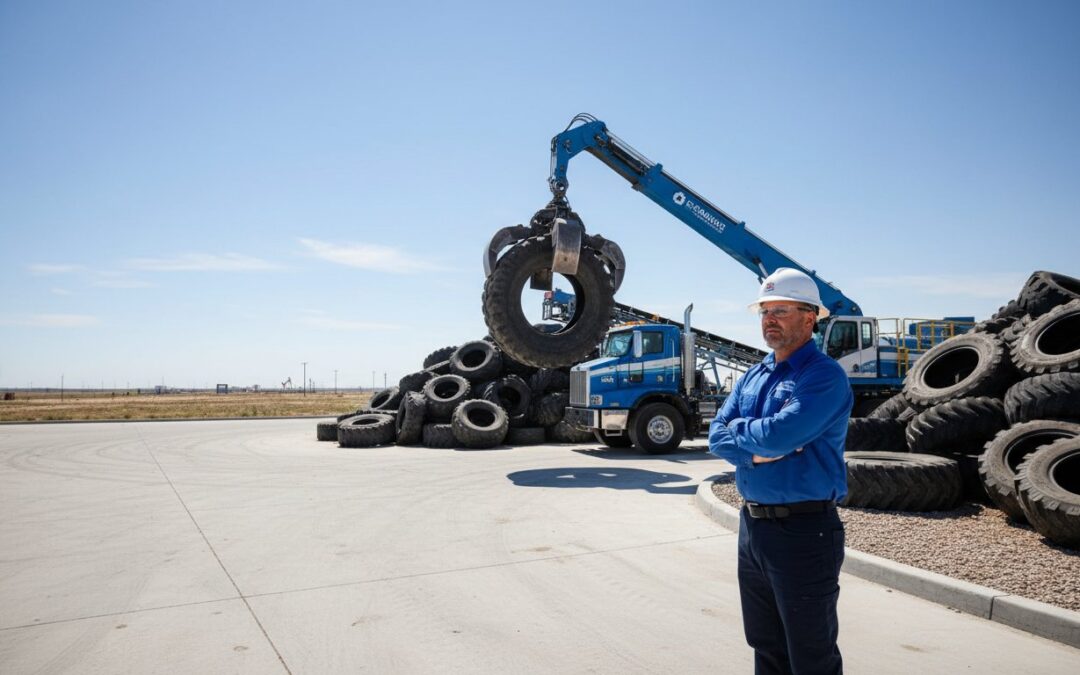
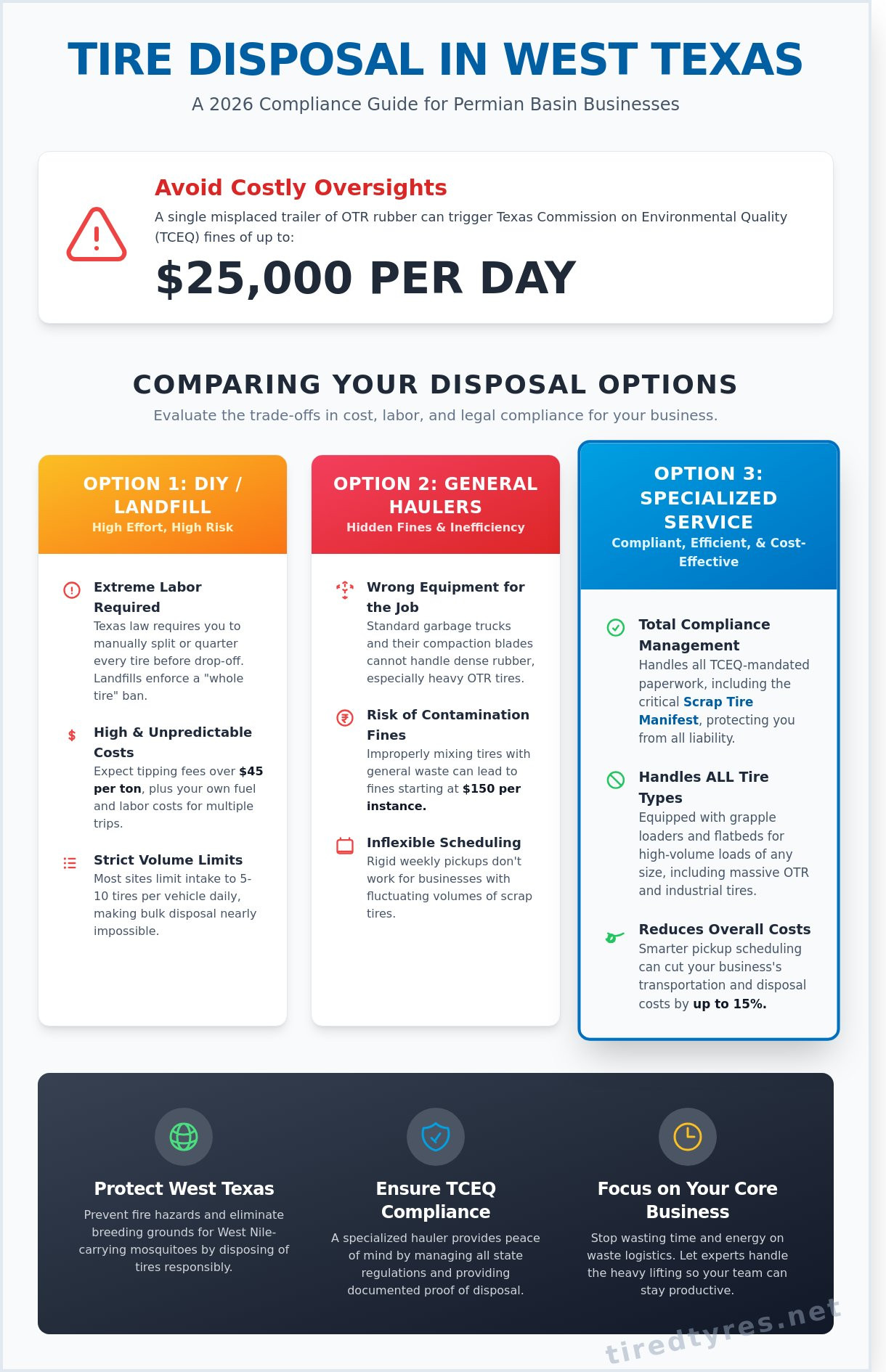
A single misplaced trailer of OTR rubber can trigger TCEQ fines of up to $25,000 per day. For businesses in Midland and Odessa, finding a reliable tire disposal service isn’t just about clearing yard space; it’s about protecting your bottom line from heavy regulatory oversight. You already know that managing industrial waste is a logistical headache that drains your team’s energy and budget. We agree that your focus should stay on your core operations, not on tracking down haulers who might disappear when the manifest paperwork gets complicated.
This guide compares the most efficient disposal options across the Permian Basin and South Plains for 2026. You’ll learn how to choose a partner that handles the heavy lifting for OTR and industrial tires while managing every state-mandated document on your behalf. We’ll break down current landfill fees in Lubbock, evaluate local hauler response times, and show you how to cut transportation costs by 15% through smarter pickup scheduling. It’s time to turn your rubber waste into a streamlined, compliant process that works for your business.
Key Takeaways
- Understand why the Permian Basin’s industrial growth and arid climate demand a more strategic approach to managing bulk rubber waste.
- Learn how to evaluate a tire disposal service based on their ability to handle specialized OTR and industrial-grade tires that standard landfills often reject.
- Discover the essential TCEQ compliance steps and why the Scrap Tire Manifest is critical for protecting your business from legal liability.
- Identify the specific permits and insurance coverages required to ensure your waste disposal partner meets all Texas state regulations.
- Compare the efficiency and long-term cost-effectiveness of specialized haulers versus traditional general waste management options in West Texas.
The Growing Challenge of Scrap Tire Disposal in West Texas
West Texas is booming. Industrial growth in the Permian Basin means more vehicles on the road than ever before. More trucks mean more rubber waste. Lubbock, Midland, and Odessa now face a massive accumulation of scrap tires that our local infrastructure wasn’t designed to handle. These aren’t just eyesores. In our arid climate, a single tire pile creates a dangerous micro-environment for pests. Even during dry spells, the interior of a tire traps small amounts of moisture from morning dew or rare rain showers. This stagnant water becomes a primary breeding ground for mosquitoes carrying the West Nile virus. By 2026, Texas will implement much stricter mandates that shift the focus from simple dumping to mandatory, regulated recycling. Understanding the process of recycling waste tires is the first step for any fleet manager or resident looking to stay compliant with these upcoming changes.
The Scale of the Problem in the Permian Basin
Oil field operations and large-scale agriculture generate a staggering volume of heavy-duty tires. A standard 18-wheeler often requires a full set of 18 tires every 100,000 miles. Most municipal trash services in Lubbock and Midland refuse bulk tire loads because they don’t compress in standard landfills. They tend to “float” to the surface over time, which can tear expensive landfill liners. This leaves many business owners with growing piles of rubber that pose a significant fire hazard. In 2022, West Texas fire departments responded to several tire-related blazes that were nearly impossible to extinguish because of the high oil content in vulcanized rubber.
Why “Business as Usual” is No Longer an Option
You can’t just toss tires in a dumpster anymore. Local municipal landfills have tightened restrictions, often limiting residents to only four tires per year. If you’re a business owner in Ector or Midland counties, illegal dumping carries heavy fines and potential legal action under the Texas Health and Safety Code. Law enforcement has increased patrols in rural areas to catch “midnight dumpers” who leave tires on the side of county roads. You need a reliable tire disposal service to handle the logistics and the required state paperwork. Professional frameworks ensure your old rubber is tracked from the moment it leaves your lot until it’s processed into tire-derived fuel or rubberized asphalt. Using a vetted tire disposal service protects your business from liability and keeps our West Texas landscape clean for the next generation.
Comparing Your Options: Landfills, General Haulers, or Specialized Services?
Choosing a tire disposal service in West Texas involves more than just picking the cheapest quote. You’ve got three main routes: hauling it yourself to a landfill, using your regular trash provider, or hiring a specialist. Each has distinct trade-offs in labor, cost, and legal compliance. Self-hauling seems cheap until you factor in 2024 fuel prices and the manual labor of loading a trailer. Most municipal sites won’t touch whole tires because of the environmental and health impacts of scrap tires, which include fire risks and pest breeding grounds.
The Reality of Local Landfills in Midland and Odessa
Texas law strictly regulates how landfills handle rubber. Most facilities in the Lubbock and Midland-Odessa corridor enforce a “whole tire” ban to prevent casings from “floating” to the surface of waste cells. You’ll need to split or quarter every tire before they’ll accept them. Tipping fees for processed rubber often exceed $45 per ton, and many sites limit daily intake to 5 or 10 tires per vehicle. For a shop with 50 casings, that’s five separate trips and hours of manual cutting.
General Waste Haulers vs. Specialized Rubber Recyclers
Standard garbage trucks aren’t built for rubber. Their compaction blades can’t handle the density of a 400-pound OTR tire or a reinforced conveyor belt. If you try to toss these into a standard bin, you’ll likely face “contamination” fines starting at $150 per instance. General haulers also stick to rigid weekly schedules that don’t account for a sudden influx of inventory.
A specialized tire disposal service provides the equipment needed for heavy lifting. These teams use grapple loaders and flatbeds designed for high-volume loads. They offer on-call pickups, which is vital for clearing out “hard-to-move” items that regular trash crews leave behind. These items include:
- Skid steer and excavator tracks
- Industrial conveyor belts
- Solid forklift tires
- Large OTR (Off-the-Road) tires
If you’re managing a busy shop or fleet, the right disposal partner saves you about 12 hours of labor per month compared to self-hauling. You avoid the physical strain of loading and the logistical headache of landfill compliance. The cost-benefit is clear: professional pickup replaces high tipping fees and potential fines with a predictable, efficient solution.
Key Criteria for Evaluating a Tire Disposal Service in the Permian Basin
Selecting a partner for scrap rubber management requires more than just finding a truck. In West Texas, the Texas Commission on Environmental Quality (TCEQ) maintains strict oversight on how scrap tires move from your shop to a processing facility. You must verify that any tire disposal service you hire holds a valid scrap tire transporter registration. Ask for their specific TCEQ registration number and proof of at least $1 million in commercial liability insurance. Without these documents, your business remains legally liable for where those tires eventually land.
Transparency in documentation is the only way to protect your bottom line. Every pickup should generate a manifest that tracks the count and type of tires removed. This paper trail is your primary defense during environmental audits. If a provider cannot offer immediate, clear pricing based on tire size or weight, keep looking. Hidden fees for “fuel surcharges” or “handling” often inflate invoices by 15% or more in rural areas outside Lubbock.
Specialized Equipment for Heavy-Duty Rubber
Standard pickup trucks aren’t enough for industrial operations. OTR (Off-the-Road) tires used in Permian Basin oil fields can weigh over 2,500 pounds and stand 6 feet tall. These require specialized knuckle-boom cranes and reinforced flatbeds for safe transport. A professional tire disposal service must also handle industrial scrap like steel-reinforced conveyor belts and heavy-duty hydraulic hoses. Before signing a contract, ask the provider: “Do you have the capacity for 100+ semi-truck tires at once?” If they lack the heavy-duty fleet to move that volume in a single afternoon, they’ll likely cause bottlenecks in your yard.
Reliability and Local Logistics
Distance kills efficiency in West Texas. A service based in Midland or Odessa reacts faster to the needs of Lubbock businesses than a company hauling from North Texas. For high-volume auto shops, a pile of 200 tires is a fire hazard and a breeding ground for pests. Reliable service is defined as one that provides a 48-hour pickup window in West Texas. This speed ensures your workspace stays clear and compliant with local fire codes. We’ve seen shops face fines of $500 per day for improper outdoor storage, so a local provider with a consistent route is an investment in your company’s security.
- Daily or Weekly Routes: Essential for shops processing 50+ tires per week.
- On-Call Flexibility: Critical for construction sites with fluctuating waste levels.
- Manifest Accuracy: Ensures 100% compliance with state environmental records.
Navigating Texas Tire Regulations: Compliance and Preparation
Texas law doesn’t treat old rubber as simple trash. The Texas Commission on Environmental Quality (TCEQ) enforces strict rules under 30 TAC Chapter 328 to prevent illegal dumping and fire hazards. As a business owner in Lubbock, you’re classified as a “generator.” This means you’re legally responsible for every casing until it reaches an authorized processing facility. Failing to follow these state mandates can lead to administrative penalties or fines that often exceed $10,000 per day of violation. Staying compliant isn’t just about the environment; it’s about protecting your bottom line.
The Scrap Tire Manifest System
The manifest is your primary defense during an environmental audit. This document tracks the “cradle-to-grave” journey of every load, recording the count, date, and the registration numbers of both the hauler and the processor. Texas law requires you to keep these records on-site for at least 3 years. If a rogue hauler dumps your tires in a West Texas canyon, a signed manifest is the only thing proving you isn’t liable. Tired Tyres provides a full, TCEQ-compliant manifest for every pickup, ensuring your records stay spotless and your business remains protected.
Best Practices for On-Site Tire Storage
Efficient tire storage prevents safety hazards and speeds up your tire disposal service. In the Lubbock heat, stagnant water inside tires becomes a breeding ground for mosquitoes within 48 hours. We recommend lacing tires or stacking them in tight columns to minimize water accumulation and fire risks. Follow these staging rules for a smooth experience:
- Maintain Clearance: Keep tire piles at least 10 feet away from buildings and property lines to comply with local fire codes.
- Ensure Accessibility: Stage tires in an area where a 20-foot collection truck can easily maneuver without hitting overhead lines or narrow gates.
- The Clean Load Rule: Ensure tires are free of heavy mud, rocks, and general trash. Approximately 12% of loads in West Texas are delayed because tires are caked in caliche or debris, which can damage processing equipment.
- Rim Policy: Unless you’ve specifically requested rim-on removal, all tires should be demounted before the crew arrives.
Common mistakes in the South Plains often involve improper record-keeping or using unregistered haulers. Roughly 15% of local shops fail to verify a transporter’s TCEQ credentials, which can lead to shared liability if those tires are mishandled. Don’t risk your reputation on a cut-rate provider who skips the paperwork. You can schedule a compliant tire disposal service with our team to ensure every regulation is met with precision.
Tired Tyres: Your Local Partner for Specialized Rubber Waste
Tired Tyres provides a specialized tire disposal service designed for the heavy demands of West Texas. We’ve built our reputation on solving the rubber waste problems that others find too difficult or bulky to handle. Whether you’re managing a fleet in Lubbock or an industrial site in Odessa, we provide the logistical muscle needed to clear your yard. Our team understands that rubber waste isn’t just a space issue; it’s a compliance and safety concern for your daily operations. We’ve helped local businesses clear over 500 tons of scrap rubber in the last twelve months alone.
Built for the Permian Basin
We’re rooted at 1210 S Midkiff Rd, Midland, TX. This location puts us at the heart of the Permian Basin, allowing us to respond quickly to service calls across the region. We’ve spent years working alongside oil field service companies that generate unique, high-volume waste streams. Our expertise goes beyond standard passenger tires. We handle the heavy stuff that requires specialized equipment. Our inventory of handled materials includes:
- Massive OTR (Off-The-Road) units from mining and construction sites.
- Industrial conveyor belts from aggregate processing plants.
- High-wear skid steer tracks and solid industrial tires.
- Reinforced hydraulic hoses and specialized rubber gaskets.
Our “no-hassle” approach means we don’t cherry-pick the easy jobs. We take the complex rubber waste that local landfills often reject due to size or material composition. We’re the partner you call when the job is too big for a standard trash haul. We understand the specific regulatory requirements for disposal in the Permian Basin, ensuring your company stays compliant with Texas environmental standards.
Get Started with a Reliable Pickup
Scheduling your first collection is straightforward. We’ve streamlined the process so you can get back to your core business without worrying about logistics. To provide an accurate quote for your tire disposal service, we need three specific details: the type of rubber waste (passenger, OTR, or industrial), the estimated quantity or weight, and your exact site location. Most quotes are finalized within 24 hours to ensure your project stays on schedule. We’ve maintained a 98% on-time pickup rate throughout 2023 and 2024.
You can Schedule your West Texas tire pickup with Tired Tyres today. We’ll handle the loading and transport, providing you with a clean site and the necessary documentation for your environmental records. Don’t let old rubber stack up and create a fire hazard; we’re ready to move when you are.
Protect Your Permian Basin Operations in 2026
Managing scrap rubber in West Texas requires more than just a dump site. By 2026, local businesses must prioritize TCEQ-compliant manifest documentation to avoid regulatory penalties. While standard landfills often struggle with OTR and industrial sizes, a specialized tire disposal service provides the heavy-duty equipment needed for large-scale industrial casings. Choosing a local partner ensures your waste doesn’t become a long-term liability for your Midland or Odessa facility.
Tired Tyres is locally owned and operated in Midland, TX. We provide specialized equipment for OTR and industrial rubber that general haulers can’t manage. Our team delivers full manifest documentation with every pickup, so you’re always ready for a state audit. Don’t let old rubber pile up and create safety hazards or compliance risks at your job site. We make the process fast, professional, and entirely transparent for every client we serve.
Get a Bulk Tire Disposal Quote for Your West Texas Business
We’re ready to help you clear your site and stay compliant.
Frequently Asked Questions
Is it illegal to dump tires on my own property in Texas?
Yes, it’s illegal to dump tires on your property under Texas Health and Safety Code Chapter 361. Storing over 500 scrap tires without a specific permit violates state environmental laws. You could face administrative penalties reaching $10,000 per day for these unauthorized sites. We help you stay compliant by providing a professional tire disposal service that follows all TCEQ regulations and safety standards.
How much does a tire disposal service cost in Midland, TX?
Standard passenger tire disposal in Midland typically costs between $3.50 and $7.00 per unit. For larger commercial or semi-truck tires, prices generally start at $25.00. These rates cover the labor for loading and the state-mandated recycling fees. We provide transparent quotes based on your specific inventory count to ensure you don’t face any hidden surcharges or surprise fees after the pickup.
Does Tired Tyres handle large OTR and agricultural tires?
We specialize in hauling large Off-The-Road (OTR) and agricultural tires with rim sizes up to 63 inches. Our fleet includes heavy-duty trailers designed to transport these 2,000-pound units safely. Whether you have tractor tires or earthmover rubber, our team has the specialized equipment to load and remove them from your site. We understand the unique challenges of industrial waste and provide the heavy lifting required.
What is a TCEQ tire manifest and why do I need one?
A TCEQ tire manifest is a five-part tracking document, specifically Form TCEQ-10304, used to monitor the movement of scrap tires. You need this because Texas law requires generators to prove their tires reached an authorized site. We provide a signed copy for your records; you must keep this for 3 years to remain compliant during state inspections. It’s your primary defense against illegal dumping liability.
Can I dispose of tires with rims still attached?
You can dispose of tires with rims attached, though this usually incurs an additional processing fee of $5.00 to $15.00 per wheel. Separating the metal from the rubber requires specialized hydraulic de-rimming equipment. We handle the entire breakdown process at our facility. After separation, we transport the steel or aluminum to a local scrap metal recycler to ensure every part of the assembly is repurposed.
Do you provide tire collection services in Lubbock and Odessa as well?
We provide full tire collection services across Lubbock, Odessa, and the surrounding Permian Basin area. Our route trucks operate within a 150-mile radius of our main hubs five days a week. This wide coverage ensures that local shops and industrial sites get their scrap piles cleared within 48 hours of a service request. We’re committed to keeping West Texas clean and free of rubber waste.
What happens to the tires after they are collected?
After collection, 90% of the tires are processed into tire-derived fuel or crumb rubber for asphalt. We transport the material to authorized processors where high-speed shredders break them down into smaller pieces. This prevents the tires from sitting in landfills for 100 years. It also reduces the risk of West Nile virus by eliminating mosquito breeding grounds that often form in stagnant water inside tire piles.
How do I schedule a bulk tire pickup for my business?
You can schedule a bulk tire disposal service by calling our dispatch office or using our digital booking portal. We respond to all commercial requests within 24 hours to confirm a pickup window. Please provide an estimated count of your inventory so we can dispatch the right equipment, like a 14-foot trailer or a 53-foot van, to clear your site in one efficient trip.