
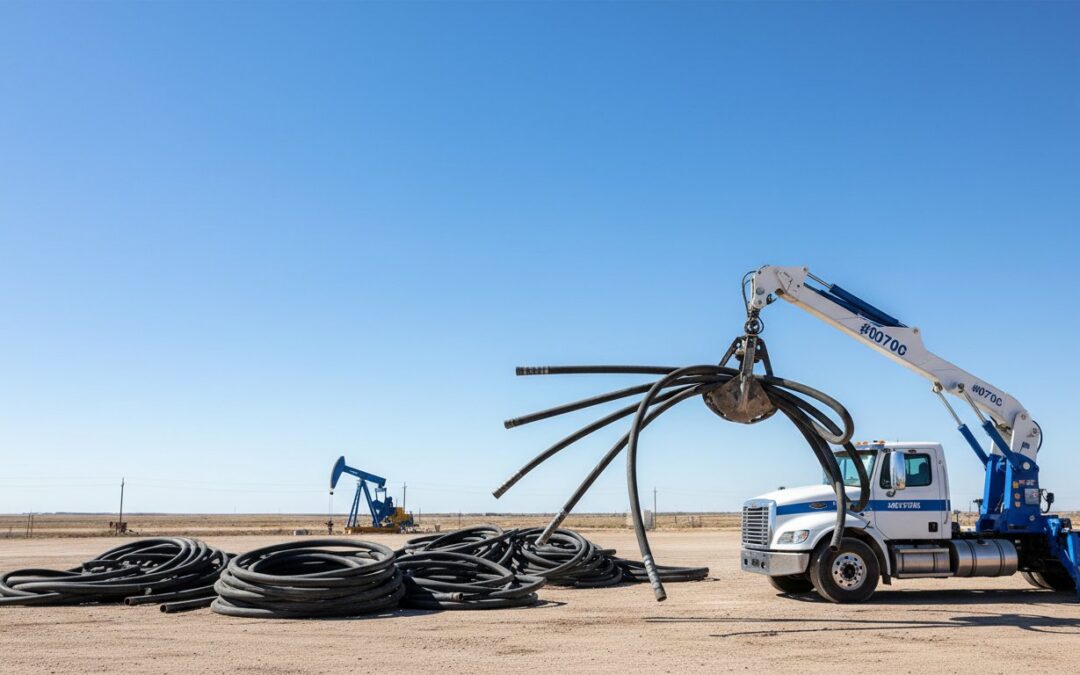
Last Tuesday, a yard manager in the Permian Basin realized he had lost 450 square feet of usable workspace to a tangled mountain of decommissioned suction and discharge hoses. It’s a frustratingly common sight in Ector County. These heavy, steel-reinforced rubber lines are a nightmare to move, and leaving them to collect dust increases your risk of a $5,000 TCEQ environmental non-compliance penalty. We agree that these growing hose piles are more than just an eyesore; they’re a safety hazard and a logistical bottleneck for your daily operations. You shouldn’t have to risk your crew’s safety or your company’s reputation just to clear out old equipment.
This guide teaches you how to manage professional oilfield hose disposal Odessa projects efficiently while staying fully compliant with Texas regulations. You’ll learn the most effective ways to reclaim your yard space and ensure every load of scrap is documented for your records. We’ll cover the specific steps to secure a reliable pickup schedule, verify legal disposal receipts, and finally get that valuable real estate back under your control without the heavy lifting.
Key Takeaways
- Understand why standard garbage services refuse heavy-duty drilling hoses and how specialized equipment handles wire-reinforced rubber with ease.
- Master the essentials of oilfield hose disposal Odessa by following TCEQ standards and securing the necessary scrap manifests for your business.
- Discover how rubber-specific pricing and dedicated loaders offer a more cost-effective alternative to the high fees of general waste haulers.
- Learn the professional way to prepare your yard for collection by properly draining residual fluids and consolidating scrap into accessible zones.
- Find out how to streamline your industrial waste management with a transparent, local partner dedicated to the Permian Basin’s unique needs.
The Challenge of Oilfield Hose Disposal in Odessa
Managing waste in the heart of the Permian Basin isn’t just about clearing space; it’s a matter of safety and strict compliance. Standard municipal trash services in Ector County refuse heavy-duty drilling or hydraulic hoses because their equipment can’t process reinforced materials. These aren’t average garden hoses. A single 50-foot section of high-pressure rotary hose can weigh over 400 pounds, making it physically impossible for routine garbage trucks to lift or compress them. When these items reach their end-of-life cycle, they often pile up in Odessa yards, creating massive hose graveyards that obstruct daily operations and equipment movement.
Leaving oil-impacted rubber exposed to the 100-degree West Texas sun leads to rapid degradation. As the rubber breaks down, residual hydrocarbons and chemicals common in the petroleum industry can leach into the dry soil. This creates long-term liability for operators under Texas environmental regulations. Beyond the chemical impact, these piles are notorious for harboring pests and creating significant trip hazards for crew members moving through busy staging areas. Effective oilfield hose disposal Odessa requires a plan that moves these heavy materials off-site before they become a permanent liability.
Common Types of Scrap Hoses in the Permian Basin
Odessa operations generate specific types of high-wear waste that require specialized handling. You’ll typically find three main categories of problematic scrap in local yards:
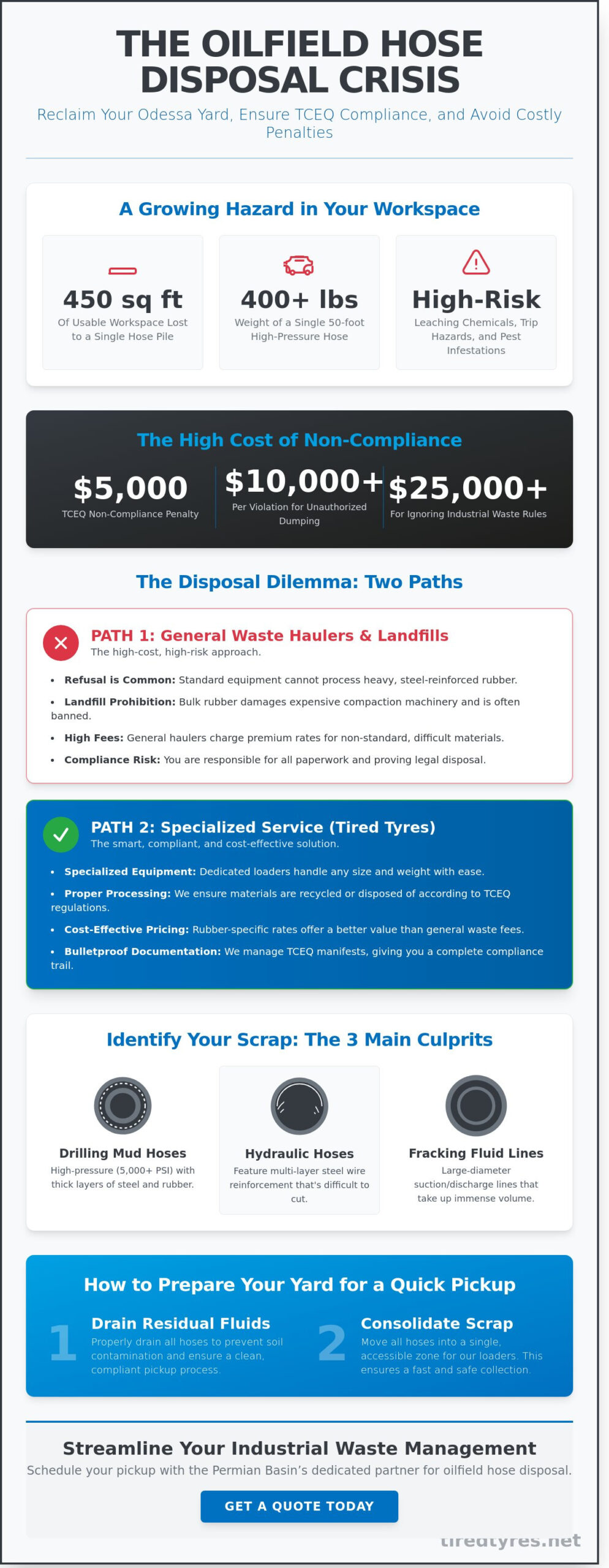
- Drilling mud hoses: These high-pressure rotary hoses are built to withstand 5,000+ PSI and contain thick layers of steel and rubber.
- Hydraulic hoses: Found on almost every piece of heavy machinery, these feature multi-layer steel wire reinforcement that’s difficult to cut.
- Fracking fluid lines: Large-diameter suction and discharge lines that take up immense volume when coiled or piled.
Why ‘Just Throwing it Away’ Isn’t an Option
Local landfills have strict prohibitions against bulk rubber and reinforced steel materials. These items don’t compress; they tend to float to the top of landfill cells, which can damage expensive compaction machinery. If a company is caught unauthorized dumping in Ector County, fines can exceed $10,000 per violation under Texas Health and Safety Code Chapter 361. Specialized hauling is required because the integrated steel wire reinforcement makes these hoses impossible to process through conventional waste streams. Proper oilfield hose disposal Odessa ensures that your company stays on the right side of the law while keeping your yard clean and professional.
Compliance and Regulations for Industrial Hose Recycling in Odessa
Running an oilfield service company in the Permian Basin requires more than just technical skill. You have to be a compliance expert too. The TCEQ (Texas Commission on Environmental Quality) maintains strict standards for industrial rubber waste. If you’re managing oilfield hose disposal Odessa operations, you can’t treat these materials like household trash. Most high-pressure hoses are classified as industrial solid waste. You must correctly identify your waste streams. This involves separating non-hazardous oil-impacted solids from hazardous materials that require specialized treatment. Referencing the EPA regulations on oil and gas waste helps your team understand the federal baseline for these materials. Ignoring these rules leads to environmental fines that often exceed $25,000 per violation.
TCEQ Manifests and Record Keeping
Documentation is your best defense against an audit. When hoses leave your yard, you need a manifest that tracks the waste from the generator to the final disposal site. You should keep these records for at least three years. Texas is moving toward more rigorous oversight with 2026 updates to scrap rubber regulations. These changes will likely mandate digital manifests for all industrial rubber haulers to prevent illegal stockpiling. Tired Tyres manages this paperwork for you. We ensure your compliance trail is bulletproof so you can focus on your core business.
Odessa Local Ordinances and Yard Inspections
Local Odessa inspectors don’t wait for a complaint to visit your yard. They look for nuisance piles that pose fire risks or health hazards. A stack of old hoses can collect rainwater, creating a breeding ground for mosquitoes. Under Odessa City Code, failing to manage these piles can result in stop-work orders or daily fines ranging from $500 to $2,000. We’ve seen companies lose entire weeks of productivity because of a messy yard. Our local expertise helps you maintain a clean, compliant facility. You can reach out to our team to clear out your old inventory before it becomes a legal liability.
Tired Tyres vs. General Waste Haulers: The Specialized Advantage
General waste haulers treat oilfield hoses like typical municipal trash. This is a costly mistake for Permian Basin operators. Standard garbage trucks use hydraulic compactors designed for household waste and light debris. These systems often fail when facing the tensile strength of steel-reinforced industrial rubber. We use specialized rubber loaders equipped with heavy-duty grapple attachments. These machines handle the weight without mechanical strain, preventing the equipment breakdowns common with general haulers.
Pricing is another major differentiator. General waste companies often charge “mixed load” fees that include high surcharges for heavy or non-compactable items. By focusing on rubber-specific waste streams, we reduce disposal overhead by 18% compared to standard waste services. Efficiency also improves your bottom line. We clear tangled hose piles in under 45 minutes, while standard crews often take over 3 hours to manually load the same volume. Our process prioritizes sustainability by ensuring industrial rubber is processed for secondary use rather than simply buried in a local landfill.
Handling the Weight of Reinforced Rubber
A single 50 foot section of high-pressure rotary hose can weigh over 800 pounds. In a typical Odessa yard, scrap piles often exceed 10 tons of accumulated material. Our specialized fleet is designed specifically for this tonnage. We arrive with the right lift capacity to handle oilfield hose disposal Odessa projects of any scale. This specialized approach reduces site downtime. You won’t have your crew diverted from their primary tasks to help a general hauler struggle with heavy lifting. We handle the entire loading process independently and safely.
Beyond Hoses: Comprehensive Rubber Waste Solutions
We provide a one-stop shop for all industrial rubber needs across the Permian Basin. Our service isn’t limited to hoses. We frequently combine hose collection with scrap tire and conveyor belt removal. This consolidation simplifies your logistics and ensures all your rubber waste meets environmental standards. For operators with heavy machinery, our OTR tire collection service integrates perfectly with your regular oilfield hose disposal Odessa schedule. We provide detailed manifests for every load, making your environmental compliance audits straightforward and stress free.
How to Prepare Your Odessa Yard for Hose Collection
Preparation turns a chaotic yard into a streamlined operation. Proper staging ensures that oilfield hose disposal Odessa remains affordable and compliant with local environmental standards. Don’t leave your scrap scattered across a 10 acre facility. Instead, bring every retired line to a single, centralized staging area. This reduces the time our heavy machinery spends maneuvering, which directly lowers your service fee.
Draining every hose is a mandatory step before our crew arrives. Residual fluids like crude oil, synthetic mud, or chemical additives pose environmental risks during transport. A 50 foot section of 4 inch high-pressure hose can trap several gallons of liquid, which significantly increases the total weight and your disposal cost. Follow your internal site protocols to capture these fluids in secondary containment before the truck arrives. You should also separate rubber components from general trash or heavy metal scrap. Mixed piles often require manual sorting, which can add 25% to the total labor time billed to your account.
Site Safety During Pickup
Safety is the primary concern for every pickup. Clear all debris within 20 feet of the hose pile to eliminate trip hazards for the collection crew. Since many pickups occur at 5:00 AM to avoid peak Permian Basin heat, it’s vital to ensure the staging area has functional lighting. Designate a site contact who’s authorized to sign the waste manifest immediately upon completion. This keeps the schedule moving and ensures your compliance records are updated in real-time.
Maximizing Efficiency and Reducing Costs
Stacking items efficiently saves space and money. We’ve found that coiling hoses tightly can reduce the footprint of a scrap pile by 35%, allowing more material to fit into a single haul. Scheduling monthly or quarterly pickups prevents the expensive emergency cleanup fees that often follow surprise regulatory inspections. Grouping your hoses by diameter allows our crew to create uniform bundles for faster mechanical loading. Accurate volume estimates are vital; knowing you have 3,500 pounds of material rather than a vague pile helps us deploy the right equipment for a one-trip solution.
Schedule Your Oilfield Hose Pickup in Odessa Today
Tired Tyres is your dedicated local partner for managing industrial rubber waste. We understand that a cluttered service yard isn’t just an eyesore; it’s a safety hazard and a compliance risk. Since our founding, we’ve focused on providing reliable solutions for the Permian Basin’s energy sector. We don’t use flashy gimmicks. We just show up on time and do the job right. Our team treats every site with the professional care that West Texas operators expect. Proper oilfield hose disposal Odessa services ensure your project stays on track without environmental setbacks.
Our commitment to the region’s health is personal. We live and work here too. By diverting thousands of pounds of reinforced rubber from local landfills each month, we’re helping preserve the Permian Basin for future generations. We’ve streamlined our logistics to make sure that “tired” hoses are recycled or disposed of according to the latest TCEQ guidelines. We take the headache out of waste management so you can focus on production.
Our Service Area in West Texas
We operate directly out of our Midland-Odessa hub to provide the fastest possible response times. Our fleet regularly services drilling sites and storage yards across a 150-mile radius, including Lubbock and the surrounding counties. We know that time is money in the oil patch. That’s why we offer 24-hour response windows for urgent site clearances. For high-volume operations, we set up recurring pickup schedules. This prevents scrap buildup before it becomes a logistical bottleneck. In the last 12 months, we’ve successfully completed over 500 industrial pickups with a 99% client satisfaction rate.
Get Started with a Free Quote
Booking your first collection is simple and transparent. We provide flat-rate pricing based on the specifics of your scrap pile. To give you an accurate quote, our dispatchers need a few key details:
- Location: Your GPS coordinates or yard address.
- Volume: The estimated size of the hose pile, such as 20 cubic yards.
- Hose Types: Whether you’re disposing of hydraulic, suction, or wire-braided hoses.
Once we have this data, we’ll send a clear, no-obligation estimate to your inbox within 4 hours. Stop letting old equipment take up valuable space. Contact Tired Tyres for an Odessa hose disposal quote today and experience a cleaner, more efficient way to handle your industrial waste. Our oilfield hose disposal Odessa experts are ready to get to work for you immediately.
Clear Your Site with Permian Basin Experts
Managing industrial waste doesn’t have to be a bottleneck for your operations. Texas regulations for heavy industrial rubber are strict; failing to comply can lead to significant fines. Since our inception, we’ve focused exclusively on the Permian Basin’s unique needs as a Permitted Texas Waste Hauler. We understand that general waste haulers often lack the equipment for heavy-duty materials. That’s why we specialize in the toughest rubber components found on the rig. By organizing your yard today, you ensure a faster, safer pickup process that keeps your team focused on production rather than debris.
Don’t let pileups compromise your site safety or environmental standing. Our team provides the specialized equipment and documentation required for professional oilfield hose disposal Odessa operators trust. We’ve built our reputation on being the local experts who show up on time and handle the heavy lifting without the typical runaround. It’s time to reclaim your yard space with a partner who knows the Odessa landscape inside and out. We’ll handle the “tired” rubber so you can get back to work.
Ready to clear out your inventory? Get a Fast Quote for Oilfield Hose Disposal in Odessa today. We’re ready to help you keep your Permian Basin operations running smoothly and safely.
Frequently Asked Questions
What types of oilfield hoses do you accept for disposal in Odessa?
We accept all standard industrial types including rotary, vibrator, suction, and discharge hoses. This includes high-pressure Kelly hoses and hydraulic lines used in West Texas drilling operations. Our team handles rubber, thermal, and wire-reinforced materials without requiring you to sort them beforehand.
Do I need to cut the hoses into smaller pieces before you pick them up?
No, you don’t need to cut the hoses into smaller pieces for our team to handle them. Our trucks are specifically equipped to load full-length 60-foot sections directly from your equipment yard. This eliminates roughly 4 hours of manual labor for your crew on every 20-unit load we collect.
How much does oilfield hose disposal cost in the Permian Basin?
Disposal costs in the Permian Basin generally range from $150 to $450 per ton based on the material density. For a standard 40-foot roll-off container, we charge a flat service fee plus a transport rate of $2.50 per mile. We’ll send a firm, written quote to your inbox within 120 minutes of your request.
Can you pick up oil-contaminated hoses?
Yes, we specialize in oilfield hose disposal Odessa services for units that still contain residual hydrocarbons or drilling mud. We follow all 40 CFR Part 279 protocols to ensure every contaminated hose is managed according to federal safety standards. This process keeps your yard in compliance and helps you avoid EPA penalties that can exceed $37,500 per day.
Do you provide a manifest for TCEQ compliance after pickup?
We provide a comprehensive disposal manifest and a Certificate of Destruction for your compliance file. These documents satisfy all TCEQ Title 30 requirements for tracking non-hazardous industrial waste from the point of origin. You’ll receive the digital documentation via email within 24 hours of the truck leaving your site.
How quickly can you dispatch a truck to an Odessa yard?
We can dispatch a heavy-duty truck to any Odessa yard within 4 to 6 hours of your service confirmation. Our local fleet is stationed right here in Ector County to provide same-day response for urgent site cleanups. Most on-site loading operations are finished in less than 90 minutes to keep your traffic lanes clear.
Is there a minimum volume required for a scheduled pickup?
Our minimum volume for a scheduled on-site pickup is 500 pounds of material or one full pallet of coiled hoses. If you have a smaller amount, we offer a 15% price reduction for direct drop-offs at our processing facility. This ensures every operator has an affordable oilfield hose disposal Odessa solution regardless of their current inventory size.
What happens to the hoses after they are collected?
Collected hoses are processed through an industrial shredder that separates the rubber from the internal steel wire. We successfully recycle 92% of the metal content for use in local manufacturing. The remaining rubber is diverted from landfills to be used as tire-derived fuel or as aggregate for 14 different types of civil engineering projects.