
A single stack of 50 scrap tires behind your Midland shop isn’t just an eyesore; it’s a potential $10,000 per day liability waiting for a TCEQ inspector to find it. You probably already realize that managing old rubber is one of the most frustrating parts of running an automotive business in West Texas. Between the 100 degree heat turning casings into spontaneous fire hazards and the constant threat of West Nile virus from stagnant water in tire piles, the pressure to clear space is intense. However, cutting corners leads directly to the strict penalties associated with illegal tire dumping texas, which can bankrupt a small operation overnight.
We’ve built this guide to give you total peace of mind and a clear path to compliance. You’ll learn exactly how to manage your scrap tire manifests and satisfy the 2024 TCEQ reporting requirements without the usual confusion. We’ll walk through a five point checklist designed specifically for businesses in Odessa and Lubbock, ensuring your tired inventory is handled by a registered hauler who takes the legal risk off your shoulders. By the end of this article, you’ll have a professional plan to keep your shop clean, your records straight, and your business protected from heavy environmental fines.
Key Takeaways
- Understand the specific legal definitions under the Texas Health and Safety Code to ensure your storage practices never qualify as illegal tire dumping texas.
- Learn how to navigate the 500-tire storage threshold and the mandatory “cradle to grave” manifest system required for TCEQ compliance.
- Follow a practical two-step checklist to verify your disposal services and maintain a compliant monthly scrap tire inventory.
- Identify specific disposal limitations at Midland and Odessa landfills to avoid unexpected turn-aways and local ordinance violations.
- Discover how professional manifest management can remove the administrative burden of legal compliance from your West Texas business.
What Qualifies as Illegal Tire Dumping in Texas?
Under Chapter 365 of the Texas Health and Safety Code, illegal tire dumping texas occurs when anyone disposes of, or receives for disposal, scrap tires at any location not officially permitted by the Texas Commission on Environmental Quality (TCEQ). Many business owners in the Permian Basin mistakenly believe they’re safe if they keep tires on their own private land. This is a legal trap. If you store more than 500 scrap tires without a specific TCEQ registration, you’re operating an unauthorized site. Even smaller piles are subject to strict rules regarding “nuisance” conditions.
The TCEQ monitors disposal through a manifest system. In Midland and Odessa, companies often create “temporary” stockpiles while waiting for a hauler to arrive. If those tires aren’t moved within 30 days or aren’t stored in a way that prevents water from pooling inside them, the state considers it a violation. There is no grace period for “waiting on a truck” if the storage conditions don’t meet Title 30 of the Texas Administrative Code.
The Legal Risks and Fines
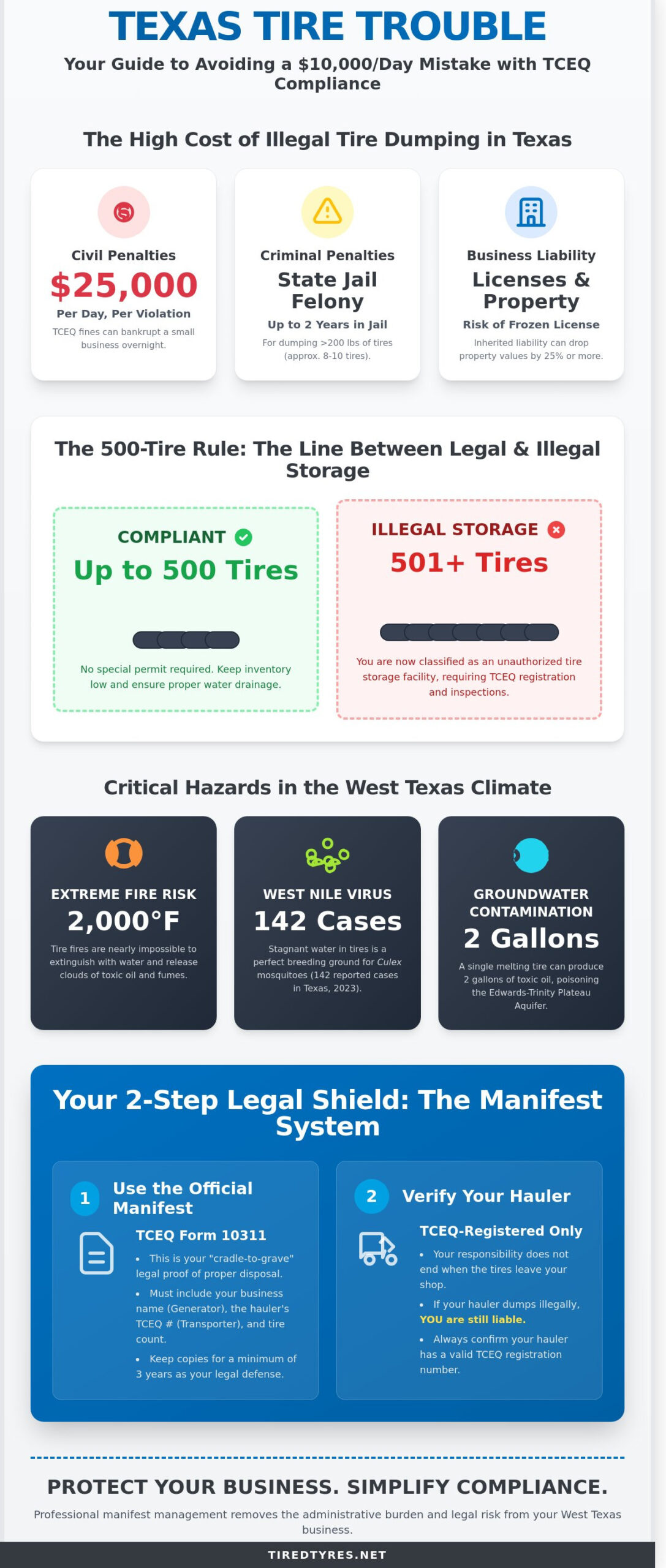
Violations carry heavy weight. Dumping more than 200 pounds or 200 cubic feet of tires is classified as a state jail felony. This can lead to 180 days to 2 years in jail and fines reaching $10,000. For businesses, civil penalties are even more aggressive; the TCEQ can assess fines of $50 to $25,000 per day per violation. Property owners also face “inherited liability.” If you buy a commercial lot in West Texas with an existing pile, you’re legally responsible for the cleanup costs. These violations can freeze your business license or drop property values by 25% or more instantly.
Environmental and Health Hazards in West Texas
Our local climate makes illegal tire dumping texas especially dangerous. Consider these three specific risks:
- Fire Hazards: In Midland’s dry, hot climate, tire fires are a nightmare. They burn at 2,000 degrees Fahrenheit and are nearly impossible to extinguish with water; they often require specialized foam or massive amounts of dirt to smother.
- Vector Control: Stagnant water inside tires creates the perfect breeding ground for Culex mosquitoes. These insects carry West Nile Virus, which saw 142 reported cases in Texas during 2023.
- Contamination: A single melting tire can produce two gallons of toxic oil. This oil seeps into the soil and can reach the Edwards-Trinity Plateau Aquifer, contaminating water sources for miles.
Decomposing rubber also releases heavy metals like zinc and lead into the ground. These toxins stay in the soil for decades, making future land use difficult and expensive. Managing your scrap tires isn’t just about following the law; it’s about protecting the West Texas land we all rely on.
The Texas Legal Framework: § 361.112 and the 500-Tire Rule
Texas Health and Safety Code § 361.112 sets the ground rules for scrap tire management. It’s the primary tool the state uses to prevent environmental hazards and public health risks. If you run an automotive business or a fleet in West Texas, ignoring these rules leads to more than just a warning. The law is designed to be clear, but the administrative requirements catch many business owners off guard. For a comprehensive breakdown of the latest regulatory changes and compliance requirements, see our detailed guide to texas tire disposal regulations for West Texas businesses.
The 500-Tire Threshold Explained
The state defines a storage site based on a specific volume. You can store up to 500 scrap tires on your property without a special permit. The moment you stack tire number 501, your legal status shifts. You’re then classified as a scrap tire storage facility. This requires formal registration with the Texas Commission on Environmental Quality (TCEQ) and subjects your business to stricter fire safety and vector control inspections.
There are narrow exceptions for agricultural use. Farmers can use tires for silage covers or to secure tarps, but they must ensure the tires don’t hold water. Stagnant water in tires attracts mosquitoes and violates vector control laws. Most West Texas shops find it safer to keep their inventory low and move stock quickly. If you’re struggling with overflow, professional tire management services can help keep your counts within legal limits.
The Manifest System: Your Best Legal Defense
To stop illegal tire dumping texas, the state uses a “cradle-to-grave” tracking system. This is managed through the scrap tire manifest, specifically TCEQ Form 10311. This document isn’t just a receipt; it’s your legal shield. A valid manifest must include the generator’s name, the transporter’s TCEQ registration number, and the total tire count. It also requires the final signature of the authorized disposal site operator.
Don’t trust a hauler who offers a low price but lacks a TCEQ registration card. If they dump those tires in a Permian Basin ditch, the state tracks them back to the original generator. You’re liable for the cleanup costs and civil penalties. Verify every hauler through the TCEQ Central Registry database before they load a single casing. Once the tires leave your lot, keep your copy of the manifest for exactly 3 years. This paper trail is your only proof that you followed the law. It’s a simple record-keeping task that prevents five-figure legal headaches.
- Daily Inventory: Track your counts to stay under the 501-tire limit.
- Hauler Checks: Always ask for a current TCEQ registration certificate.
- Document Storage: Keep all manifests organized by date for at least 36 months.
The Ultimate Texas Tire Compliance Checklist
Staying ahead of TCEQ regulations requires a systematic approach. If your business handles even a small volume of scrap rubber, you must implement these five steps to prevent illegal tire dumping texas penalties. Fines for mismanagement can reach $50,000 per day under Texas Water Code Section 7.051. Follow this protocol to keep your shop compliant and your liability low.
- Step 1: Conduct a monthly inventory. Every 30 days, count every scrap tire on your property. Compare this to your sales records to ensure no “ghost” tires are leaving your site through unauthorized channels.
- Step 2: Verify transporter registration. Before any truck leaves your lot, check the TCEQ Central Registry. Ensure your chosen disposal service holds a current scrap tire transporter registration. Using an unregistered hauler makes you liable for where those tires end up.
- Step 3: Eliminate water accumulation. Texas weather can be unpredictable. You must store tires under a roof, use tarps, or ensure they are professionally shredded to prevent standing water. Even one tablespoon of water can host 200 mosquito larvae.
- Step 4: File manifests for every pickup. Never let a tire leave without a signed TCEQ-0103 manifest. You must keep these records for at least 3 years to prove legal disposal during a state audit.
- Step 5: Audit storage limits weekly. Most retail sites are limited to 500 scrap tires on-site without a specific registration. Check your pile size every Friday to ensure you don’t cross this threshold.
Storage and Safety Standards
West Texas winds often exceed 50 mph, making loose tire piles a safety hazard. Use a “laced” stacking method to interlock tires, which prevents them from blowing into roadways or neighboring properties. For collections exceeding 500 tires, Texas law requires a 40-foot fire break between piles and buildings. This gap provides a critical buffer for emergency vehicles. To stop mosquito breeding, apply a CDC-approved larvicide every 14 days if tires are exposed to rain.
Documentation and Record Keeping
Create a dedicated “Compliance Folder” for your shop. This physical or digital binder should contain your transporter’s registration, your monthly inventory logs, and all signed manifests. While the TCEQ allows digital manifest storage, you must be able to produce these records within 24 hours of a request. Conduct a self-audit every 90 days. Check your manifests for missing signatures from the end-processor; this is the most common violation found during state inspections.
Local Disposal Options in Midland, Odessa, and Lubbock
Most West Texas landfills refuse whole tires due to the 1991 Texas tire disposal ban. When buried whole, tires trap methane gas and “float” to the surface, eventually piercing landfill liners. To stay compliant and avoid illegal tire dumping texas penalties, businesses must ensure tires are processed before they ever reach the scale house. This usually means tires must be quartered, shredded, or split into specific pieces to be accepted as municipal solid waste.
Midland and Odessa Landfill Requirements
The City of Midland Landfill on Highway 349 requires all passenger and light truck tires to be split into at least four pieces or shredded. If you show up with whole tires, the site staff will turn you away. Current tipping fees for processed tires in the Permian Basin range from $42 to $58 per ton. For many local shop owners, the cost of labor to manually split 40 tires often outweighs the expense of hiring a professional hauler. The regional infrastructure is currently strained by the high volume of heavy OTR tires from oil field operations, which require specialized industrial shredders that most municipal sites don’t own. For detailed information about current gate fees, loading requirements, and permit regulations, check our comprehensive guide to city of midland landfill tires disposal requirements.
Lubbock and South Plains Disposal Routes
Lubbock County maintains strict oversight on caliche pits and private land to prevent unauthorized scrap piles. Small-volume generators, defined as those producing fewer than 50 tires annually, can occasionally use municipal drop-off points during city-sponsored “cleanup” events. However, agricultural tires used in South Plains farming operations present a massive logistical hurdle. A single rear tractor tire can weigh over 600 pounds. Hauling these without a hydraulic lift or specialized trailer is dangerous and inefficient for a small crew. Following these local rules prevents illegal tire dumping texas citations that can reach $50,000 per day for serious violations.
Regional recycling facilities eventually turn these “faded” tires into Tire Derived Fuel (TDF) or crumb rubber for rubberized asphalt. Handling the TCEQ manifests and transport logs yourself is a paperwork headache that eats into your shop’s billable hours. We manage the entire process from pickup to the final recycling stage, keeping your business clean and compliant.
Schedule a professional tire pickup today to take the weight of disposal off your shoulders.
How Tired Tyres Simplifies Your Legal Compliance
Managing scrap rubber shouldn’t be a headache for your operation. We provide a straightforward, professional solution for West Texas businesses to eliminate the risks associated with illegal tire dumping texas. As a fully permitted TCEQ tire hauler, we follow every state regulation to the letter. This isn’t just about picking up junk. It’s about protecting your company from civil and criminal penalties that can exceed $50,000 per violation. We handle everything from standard passenger tires to the massive industrial rubber found on Permian Basin job sites.
Our Professional Collection Process
Our team doesn’t just toss tires in a truck and drive away. Every pickup follows a rigorous documentation trail. We manage the end-to-end manifest process using official TCEQ forms. This creates a paper trail that proves your business disposed of its waste at a licensed facility. We have the specialized equipment needed for large-scale removals, including skid steers for heavy lifting and high-capacity trailers for OTR (Off-the-Road) tires. Whether you’re in Midland, Odessa, Lubbock, or the surrounding rural counties, we arrive on time and clear your lot efficiently. You receive a signed copy of the manifest for your compliance files before we leave the property.
Why West Texas Businesses Trust Us
Local expertise is vital in the Permian Basin industrial landscape. We understand the unique waste needs of auto shops, heavy equipment fleets, and large-scale farms. Our service isn’t a one-size-fits-all model. We offer customized pickup schedules that match your volume, whether that’s a weekly stop or a monthly cleanout. We’re committed to 100% legal, environmentally sound tire processing. You won’t find our tires in a ditch or an unauthorized landfill because we value our reputation and yours. We’re experts at handling the “hard stuff” like semi-truck tires and shredded industrial rubber that standard waste haulers often refuse to touch. Stop worrying about illegal tire dumping texas and let us handle the logistics.
Ready to clear your lot and stay compliant? Get a free tire disposal quote for your Midland or Odessa business today!
Protect Your West Texas Business with Compliant Disposal
Managing scrap tires requires more than just moving them off your lot. Texas Health and Safety Code § 361.112 and the 500-tire storage limit set strict boundaries for every shop in the Permian Basin. Staying compliant means keeping accurate records and working with verified partners. Tired Tyres serves as a TCEQ Registered Hauler, specifically helping businesses in Midland, Odessa, and Lubbock avoid the severe penalties associated with illegal tire dumping texas. We provide a signed manifest for every single load we pick up, giving you the concrete proof needed for state audits. It’s the simplest way to ensure your facility meets every environmental standard without slowing down your daily operations. You’ve built a reputation for quality service; don’t let a disposal oversight put that at risk. Our professional team handles the logistics and the paperwork, so your focus stays on the road ahead. Schedule your legal tire pickup in West Texas now and rest easy knowing your compliance is handled by local experts who value your time.
Frequently Asked Questions
Is it illegal to keep old tires on my property in Texas?
Yes, it’s illegal to store tires in a way that creates a public health nuisance or fire hazard. Under Texas Health and Safety Code Section 361.112, you must ensure tires don’t collect water or harbor pests. If you’re a business, you can’t just pile them up indefinitely. Local West Texas ordinances often require disposal within 30 days to prevent fires. Keeping 50 tires outside without cover is enough to trigger a citation.
How many tires can I legally store without a permit in Texas?
You can store up to 500 scrap tires on your business premises without a TCEQ scrap tire facility registration. Once you hit tire 501, you’re legally required to register as a storage site. Exceeding this 500-tire limit without a permit can lead to daily fines. Most West Texas shops keep their inventory below 100 to avoid strict vector control inspections. It’s safer for your insurance premiums too.
Can I take whole tires to the Midland or Odessa landfill?
No, you cannot dispose of whole tires at the City of Midland or Odessa landfills. Texas Administrative Code Title 30, Part 1, Chapter 330 prohibits whole tires in landfills to prevent floating and trapped methane. You must have them split, quartered, or shredded first. Most local businesses find it cheaper to hire a professional hauler than to pay for industrial shredding services. We handle this transport so you don’t have to.
What is a TCEQ tire manifest and why do I need one?
A TCEQ tire manifest is a five-part tracking form, specifically Form 00309, that documents the movement of scrap tires from your business to a processing site. It’s your legal proof that you aren’t engaging in illegal tire dumping texas law enforcement tracks. You must keep these records for 3 years. If an inspector visits your shop in Midland, they’ll ask for these specific papers first. Don’t lose them.
What are the fines for illegal tire dumping in Texas?
Fines for illegal tire dumping in Texas can reach $10,000 per day per violation under the Texas Water Code. If the dumping is deemed a criminal act, you could face state jail felony charges and fines up to $50,000. In 2023, Texas authorities increased enforcement to protect groundwater. Avoiding these costs is simple; just keep your disposal records current and use permitted haulers. We make sure your paperwork is always perfect.
How can I tell if a tire hauler is legally permitted?
You can verify a hauler by asking for their TCEQ registration number and checking it against the Central Registry database. Every legal hauler must display a current registration sticker on their vehicle’s windshield. Don’t take their word for it. If they can’t produce a valid manifest or a registration ID, they’re likely operating illegally. This puts your business at risk for generator liability. Always demand to see the physical permit.
Does Texas have a free tire disposal program for businesses?
No, Texas does not offer a permanent free tire disposal program for commercial businesses. While some West Texas counties host Amnesty Days for residential scrap tires, businesses are responsible for all disposal costs. Budgeting approximately $2 to $5 per passenger tire is a standard practice for local shops. This fee covers the labor, transport, and recycling costs required by state law. It’s a small price for total legal compliance.
What happens to the tires after Tired Tyres picks them up?
We transport your scrap tires to a permitted processing facility where 90 percent of the material is recycled. These tires are often shredded for Tire-Derived Fuel or used in civil engineering projects like road subgrade. By choosing us, you ensure your waste doesn’t contribute to illegal tire dumping texas residents want to stop. We handle the manifest so your compliance is guaranteed. Every tire we haul is tracked from start to finish.