
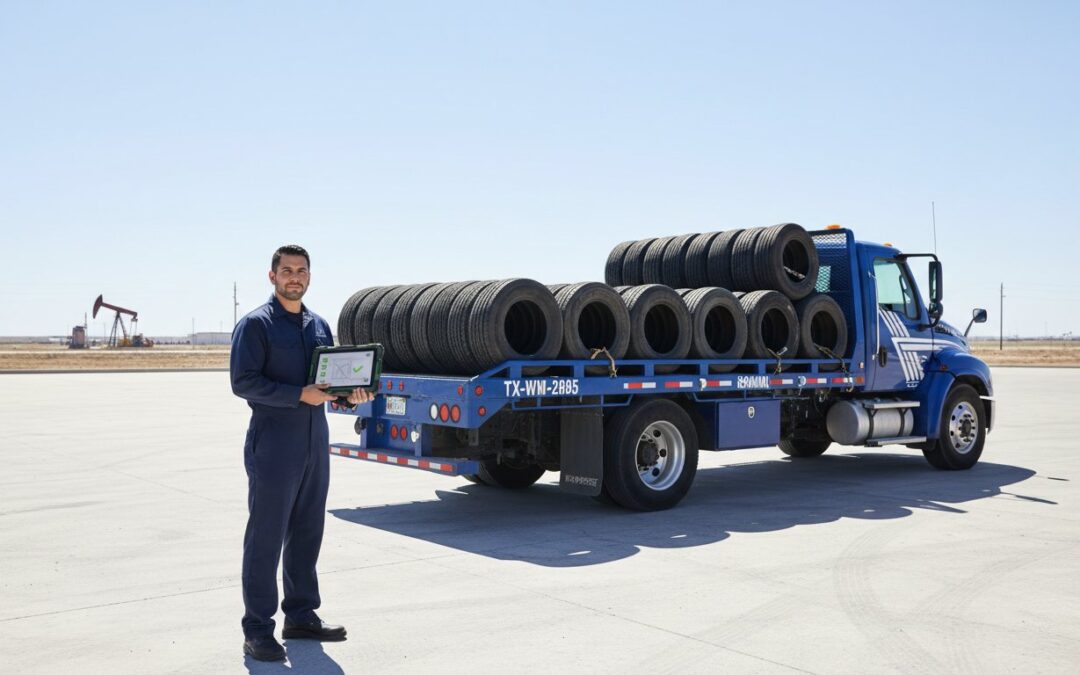
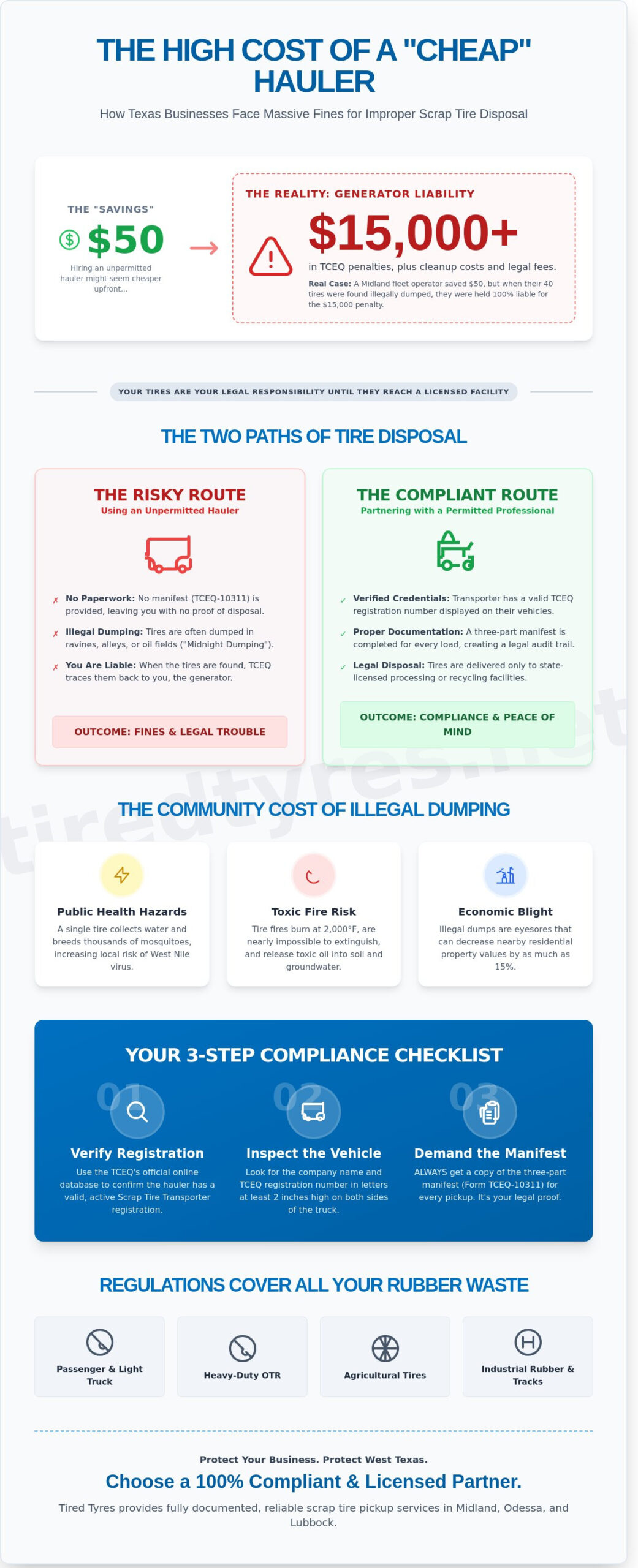
On May 14, 2023, a fleet operator in Midland discovered that saving $50 on scrap disposal could lead to a $15,000 TCEQ penalty. Their “budget” hauler skipped the paperwork and dumped forty tires in a local ravine, leaving the business owner legally liable for every cent of the cleanup. This scenario happens more often than you think when you don’t use a permitted tire hauler Texas to manage your waste. If the hauler doesn’t have a valid registration number, the state views those tires as your responsibility until they reach a licensed processing site.
We understand that managing old rubber is a logistics hurdle you’d rather not deal with. It’s frustrating to track manifests while trying to run a shop or a fleet. This article explains the legal requirements for scrap tire transport and how hiring a professional protects you from aggressive environmental audits. We’ll show you how to master the paperwork and find reliable, daily pickup services in Midland, Odessa, and Lubbock that actually show up on time.
Key Takeaways
- Understand the strict TCEQ regulations governing scrap tire transport and what it truly means to be a registered transporter in Texas.
- Discover why your business remains legally responsible for scrap tires even after they leave your site and how to avoid costly generator liability fines.
- Learn how to use official TCEQ tools to verify a permitted tire hauler Texas registration and what specific markings to look for on their equipment.
- Master the three-part manifest system (TCEQ-10311) to ensure your paperwork provides a foolproof audit trail for every tire you discard.
- Find out how partnering with a licensed professional guarantees 100% compliance and transparent disposal for specialized OTR and agricultural tires.
What is a Permitted Tire Hauler in Texas?
In Texas, a permitted tire hauler Texas isn’t just a person with a trailer. Under TCEQ Title 30 Chapter 328, a registered scrap tire transporter is a professional entity authorized by the state to collect and move scrap tires. The Texas Commission on Environmental Quality (TCEQ) strictly regulates this process to prevent illegal dumping and fire hazards. They act as the primary watchdog for rubber waste across the state, ensuring that every piece of discarded rubber follows a legal path.
The law creates a clear distinction between your business and the hauler. You are the “Generator,” the person or company that produces the scrap tire. The hauler is the “Transporter.” Texas tracks every tire from “cradle to grave.” This means the state requires a manifest for every shipment. If a tire leaves your shop, there must be a paper trail showing exactly where it went, who took it, and which permitted facility processed it. This system exists because discarded tires are breeding grounds for mosquitoes and pose massive toxic fire risks if they aren’t managed correctly.
TCEQ Registration Requirements
Legal transporters must follow strict identification rules. Every vehicle used for hauling must display the company name and the TCEQ registration number in letters at least two inches high on both sides. These professionals don’t just drive; they document. Registered haulers must submit detailed annual reports to the TCEQ by March 1st each year. A standard “junk removal” license or a general hauling permit is not enough. In fact, hauling more than five scrap tires at once without this specific registration is a direct violation of state environmental laws.
Types of Tires Covered Under Texas Law
Texas regulations don’t stop at car tires. A permitted tire hauler Texas handles a wide range of rubber waste including:
- Standard passenger car and light truck tires.
- Heavy-duty Off-the-Road (OTR) tires used in mining and construction.
- Large-scale agricultural tires from tractors and harvesters.
- Industrial rubber waste, such as solid forklift tires, skid steer tracks, and rubber conveyor belts.
Whether it’s a small fleet of delivery vans or heavy earth-moving equipment, any business generating these waste items must use a registered professional to remain compliant with state standards.
The Hidden Risks of Using Unpermitted Tire Transporters in West Texas
In Texas, the law is clear: you own your scrap tires until they reach a state-approved disposal site. This is known as generator liability. If you hire a guy with a trailer who isn’t a permitted tire hauler Texas requires, you’re still legally responsible for those tires. When an unpermitted hauler dumps 50 tires in a Midland alleyway, the Texas Commission on Environmental Quality (TCEQ) follows the trail back to your shop. You pay the price, not the driver who disappeared.
The “Midnight Dumping” problem in the Permian Basin has surged by 12 percent since early 2023. Unscrupulous transporters take your money and then toss the load in remote oil field locations or drainage ditches. This leaves you vulnerable to criminal charges under the Texas Health and Safety Code. You can consult with local disposal experts to ensure your manifest records are always audit-ready and compliant.
Legal Consequences for Midland and Odessa Businesses
The financial stakes are high for businesses in the Permian Basin. TCEQ can issue administrative penalties reaching $25,000 per day for improper disposal. In 2023, several West Texas entities faced thousands in fines because they couldn’t provide manifest records proving their tires went to a licensed processor. Unpermitted haulers often provide no paperwork and use fake names. When investigators arrive, these operators vanish, leaving you to face environmental cleanup lawsuits alone. It’s a risk that can bankrupt a small tire shop or fleet service.
Environmental and Community Impact
Illegal tire piles are more than just eyesores; they’re public health bombs. A single tire sitting in the sun can breed thousands of mosquitoes, increasing the local risk of West Nile virus. In the dry climate of the South Plains, tire fires are a recurring nightmare. These blazes burn at 2,000 degrees Fahrenheit and are nearly impossible to extinguish with water. They release toxic pyrolytic oil that seeps into the groundwater, contaminating the soil for decades. Illegal dumping sites in residential areas can decrease nearby Midland property values by as much as 15 percent.
Protecting your business starts with verifying credentials. Choosing a permitted tire hauler Texas trusts ensures your scrap inventory is handled according to 2024 environmental standards. This keeps your business safe and your local community clean.
How to Verify a Scrap Tire Hauler’s Permit and Registration
Protecting your business starts with a simple verification process. You can’t rely on verbal promises when the Texas Commission on Environmental Quality (TCEQ) holds you responsible for where your scrap tires end up. A legitimate permitted tire hauler Texas will always have their credentials ready for inspection.
Using the TCEQ Database
The TCEQ Central Registry Query is your primary tool for due diligence. Visit the TCEQ website and select the ‘Search Central Registry’ option. You can search by the company’s legal name or their 5-digit registration number. Look specifically for an ‘Active’ status. If the permit shows as ‘Inactive,’ ‘Expired,’ or ‘Revoked,’ the hauler cannot legally transport your tires. For businesses in West Texas, ensure the hauler is authorized to operate within your specific county. Since January 2024, TCEQ has increased field inspections by 15 percent, making it even more vital to confirm your hauler’s current standing before they pull onto your lot.
What to check on the vehicle:
- The truck must display the business name and TCEQ registration number on both sides.
- Numbers must be at least 2 inches high and clearly legible from a distance.
- The trailer should match the description listed in their registration documents.
Documenting the Verification
Verification isn’t a one-time task. You should request a physical copy of the hauler’s current TCEQ registration certificate and keep it in your compliance file. Update these records every 12 months to ensure no lapses in coverage. It’s also your responsibility to verify the destination. Ask the hauler exactly which registered scrap tire facility they use. Under Texas Administrative Code Title 30, Part 1, Chapter 328, you must maintain copies of all tire manifests for at least 3 years. If a hauler refuses to provide a multi-part manifest or demands cash-only payments, these are immediate red flags. Professional permitted tire hauler Texas services provide clear, numbered paperwork that tracks the tires from your door to the final processing site.
Don’t sign a contract until you’ve asked these three questions:
- What is your TCEQ scrap tire transporter registration number?
- Which authorized West Texas facility receives your loads?
- Can you provide a 5-part manifest for every single pickup?
Unmarked trailers or drivers who can’t produce a registration card are risks you don’t need. Taking five minutes to check the database saves you from potential fines that often exceed $5,000 per violation.
Managing Scrap Tire Manifests and Compliance in Midland and Lubbock
The TCEQ-10311 manifest is your most important document. It acts as a legal birth certificate for every scrap tire leaving your facility. In Texas, the law requires a three-part tracking system involving the generator, the transporter, and the processor. When you hire a permitted tire hauler Texas, they take responsibility for the tires once they sign that form. You must retain these records for exactly 3 years to remain compliant with 30 Texas Administrative Code §328.63. If a TCEQ inspector visits your Midland or Lubbock shop, they will ask to see your manifest binder immediately. Having a gap in your records can lead to administrative penalties that reach $25,000 per day per violation.
The Anatomy of a Legal Manifest
Never sign a blank or incomplete TCEQ-10311 form. You must verify that the tire count on the paper matches the physical count loaded onto the truck. Ensure the hauler’s registration number is clearly visible and valid. Your job isn’t done until you receive the “Return Copy” from the authorized disposal site. This must arrive within 60 days of the initial pickup. If it doesn’t, you’re legally required to notify the TCEQ that your tires haven’t been accounted for properly.
Storage Rules for Generators
Texas law allows you to store up to 500 scrap tires on-site without a specific storage permit. Once you hit tire 501, you face much stricter registration requirements. In the West Texas climate, vector control is a major focus for inspectors. Standing water in tires is a breeding ground for mosquitoes that carry the West Nile virus. Since 2023, health departments in Ector and Lubbock counties have increased scrutiny on outdoor storage. You should keep tires under a waterproof cover or inside a locked container. If you store them outside, you must apply a TCEQ-approved larvicide every 14 days to prevent infestations.
Tired Tyres: Your Licensed Partner for Legal Tire Disposal in West Texas
Tired Tyres operates with a clear mission: keeping West Texas clean while protecting your business from legal liability. We maintain 100% compliance with Texas Commission on Environmental Quality (TCEQ) regulations. Every pickup we perform includes a detailed manifest. This document serves as your primary proof that your scrap rubber was handled by a legitimate permitted tire hauler Texas businesses can rely on. We don’t just move tires; we manage your environmental risk through total transparency.
Local Midland and Odessa businesses trust us because we understand the specific demands of the Permian Basin. We’ve built our reputation on being a reliable partner for companies that can’t afford the fines associated with improper disposal. Our team handles the heavy lifting, ensuring your site remains safe, organized, and compliant with all state statutes.
Our Permitted Hauling Services
Auto shops in Midland and Odessa often face piles of passenger tires that create fire hazards and attract pests. We provide scheduled pickups to keep your service bays clear and productive. For our industrial partners, we utilize specialized heavy-duty equipment designed for OTR (Off-the-Road) and agricultural tires. These massive units from oilfield sites or construction zones require specific loading techniques that standard haulers simply can’t provide.
- Passenger and light truck tire collection: Ideal for retail tire shops and local dealerships.
- Bulk OTR and industrial rubber removal: Specialized trailers for 15+ ton loads from industrial sites.
- Full manifest documentation: We provide completed TCEQ forms at the point of service for every single pickup.
Contact Us for a Compliance-First Quote
Managing rubber waste shouldn’t be a headache for your office staff. We help you streamline environmental record-keeping by providing digital and paper trails for every transaction. Our service area covers the entire Permian Basin and South Plains, including Lubbock and the surrounding rural counties. Whether you need a one-time clearing of a 500-tire stockpile or a monthly service agreement, we deliver a 48-hour response time for most requests. Partnering with a permitted tire hauler Texas authorities recognize ensures your business stays ahead of inspections.
Ready to clear your lot and secure your records? Get a quote for permitted tire hauling today and experience the professional difference of a local West Texas partner.
Protect Your West Texas Business with Legal Tire Disposal
Operating a commercial shop or industrial site in West Texas requires strict adherence to TCEQ Title 30 Texas Administrative Code Chapter 328. Choosing a permitted tire hauler Texas prevents your company from facing civil penalties that often exceed $10,000 per violation. Proper manifest management ensures your scrap tires are tracked from your lot in Midland to a licensed recycling facility. This documentation is your only shield during a state audit. It’s the most effective way to eliminate the risk of illegal dumping charges and environmental liabilities.
Tired Tyres serves the Midland, Odessa, and Lubbock areas with specialized OTR and industrial rubber equipment designed for heavy-duty removals. We’re a fully TCEQ-permitted transporter, meaning we take the legal weight off your shoulders with every load. Don’t let scrap piles become a liability or a fire hazard on your property. Schedule your permitted tire pickup in West Texas with Tired Tyres to ensure your disposal process is fast, professional, and fully compliant. We’re ready to help you clear the way for more productive work.
Frequently Asked Questions
Is it illegal to transport my own scrap tires in Texas?
It’s legal to transport your own tires without registration only if you haul 5 or fewer at a time. If your business moves more than 5 scrap tires to a disposal site, 30 Texas Administrative Code §328.57 requires you to register as a transporter. Most local shops hire a permitted tire hauler Texas to avoid the $500 annual registration fees and strict vehicle marking requirements mandated by the state.
How do I know if a tire hauler is registered with the TCEQ?
You can verify a hauler’s status by checking the TCEQ Corporate Database or asking to see their current registration certificate. Every permitted tire hauler Texas must display a valid TCEQ registration decal on their vehicle windshield. We provide our registration credentials to every client because transparency is a core part of our professional service and your legal protection.
What are the fines for illegal tire dumping in Midland County?
Illegal tire dumping is a criminal offense in Texas with fines ranging from $500 to $10,000 per violation. Under Texas Health and Safety Code Chapter 365, dumping waste weighing over 5 pounds can also lead to 180 days in jail. Midland County law enforcement uses these strict penalties to prevent tire fires and stop the spread of mosquito-borne illnesses like West Nile virus.
Do I need a manifest for agricultural or OTR tires?
Yes, you must have a manifest for all scrap tires, including large agricultural and Off-The-Road (OTR) tires. The TCEQ requires a multi-part manifest, specifically Form TCEQ-10304, to track the movement of these tires from your shop to the final processing site. This documentation proves your business didn’t contribute to illegal stockpiles and protects you during environmental inspections.
How long am I required to keep scrap tire records in Texas?
You must keep all scrap tire manifests and disposal records for at least 3 years from the date of service. These documents must be available for inspection by TCEQ or local health officials at any time. Understanding the complete scope of Texas tire disposal regulations and proper documentation requirements is essential for maintaining compliance. We recommend organizing these by date in a dedicated compliance folder so you’re always ready for a random state audit or local code enforcement check.
What happens to the tires after Tired Tyres picks them up?
We transport your tires to a licensed processing facility where they’re shredded or repurposed for industrial use. Approximately 45% of Texas scrap tires become Tire-Derived Fuel (TDF), while others are turned into rubber mulch or asphalt. Our process ensures that 100% of the tires we collect stay out of West Texas landscapes and away from illegal dumping pits.
Can I take my scrap tires to the Midland or Odessa landfill myself?
You can take tires to the landfill, but you’ll face strict limits and high tipping fees. Understanding the city of midland landfill tires disposal requirements and current gate fees is essential before making the trip. The City of Midland Landfill charges $105 per ton for scrap tires and requires you to split or quarter them before arrival. Most Midland businesses save 30% on total costs by using our pickup service rather than paying for staff labor, fuel, and landfill surcharges.
Why do I have to pay a fee for tire disposal if the tires are recycled?
Disposal fees cover the costs of specialized transportation, labor, and industrial shredding machinery. While recycling creates new products, the market price for crumb rubber doesn’t cover the $3 to $8 cost of processing a single heavy tire. Your fee supports a regulated system that keeps 100% of tires out of illegal West Texas stockpiles and protects local groundwater from contamination.