
Last October, a Midland fleet owner discovered that hauling just 11 scrap tires without a registered permit can trigger state-level fines starting at $500. It is a stressful reality because the regulations for the city of midland landfill tires disposal often feel like a moving target. You likely want your shop floor cleared of heavy OTR or semi-truck tires without the physical strain of manual loading or the fear of a surprise citation at the gate. We agree that managing waste shouldn’t require a law degree or a trip to the chiropractor. This 2026 guide gives you the latest gate fees, per-ton rates, and specific loading requirements to ensure a smooth trip.
You’ll learn exactly how to stay within the legal limit for permit-free hauling and when it’s time to call in the experts. We will cover the mandatory state manifest rules, current disposal costs for different tire sizes, and how professional pickup services can handle the logistics for you. By the end of this article, you’ll have a clear plan to dispose of your “tired” rubber safely and legally.
Key Takeaways
- Identify the specific cleanliness requirements and location details needed to ensure your scrap tires are accepted at the 7901 E. Garden City Highway facility.
- Compare the $500 annual hauler permit against the $25 one-time access fee to determine the most budget-friendly way to manage your waste.
- Master the TCEQ registration process and manifest requirements to keep your business fully compliant with Texas environmental laws.
- Learn how the latest rules for the city of midland landfill tires aim to reduce Permian Basin fire hazards through new recycling partnerships.
- Find out how to bypass landfill fees and permit applications entirely by utilizing a professional pickup service that handles the logistics for you.
What Are the Rules for Disposing of Tires at the City of Midland Landfill?
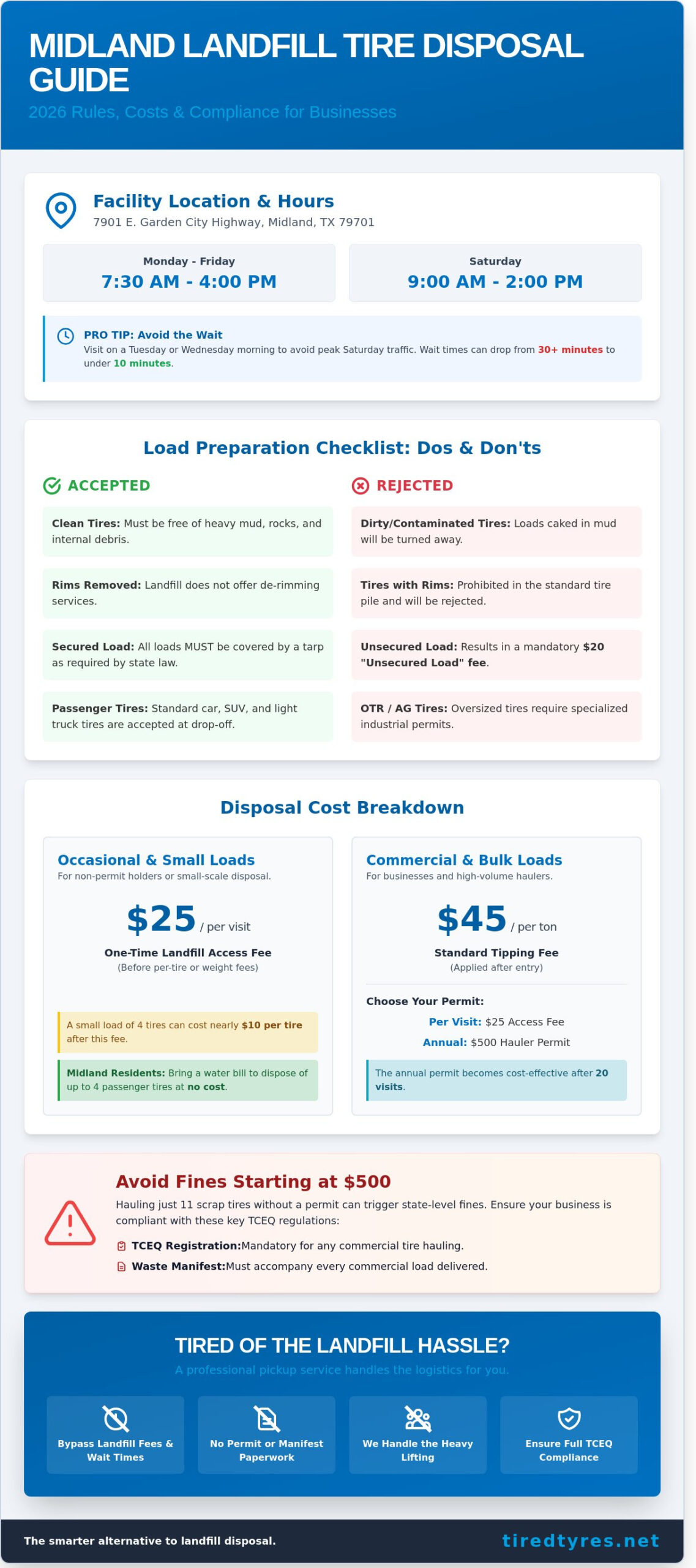
Properly managing city of midland landfill tires starts with understanding the strict intake protocols at the 7901 E. Garden City Highway facility. The city prioritizes recycling for rubber waste, which means your old tires must meet specific cleanliness standards. They must be free of heavy mud, rocks, or internal debris. If a tire is caked in West Texas caliche, the scale house staff might reject it. Cleanliness ensures the shredding equipment stays functional. You must also remove all rims before arrival. The landfill doesn’t offer de-rimming services, and tires with metal inserts are classified as prohibited items in the standard tire pile.
Location and Hours of Operation
The landfill is situated at 7901 E. Garden City Highway, Midland, TX 79701. For 2026, the operating hours remain Monday through Friday from 7:30 a.m. to 4:00 p.m., and Saturday from 9:00 a.m. to 2:00 p.m. Don’t wait until Saturday morning to clear out your garage. Site data indicates that residential traffic peaks between 10:00 a.m. and 1:00 p.m. on Saturdays, often resulting in 30-minute wait times at the scales. If you visit on a Tuesday or Wednesday morning, you’ll likely finish the process in under 10 minutes.
Tire Limits and Load Restrictions
Residential accounts have different privileges than commercial haulers. If you pay a City of Midland water bill, you’re generally allowed to drop off up to 4 passenger tires per visit at no additional cost, provided you bring a copy of your most recent statement. Commercial entities or residents with bulk loads must pay by weight. The city of midland landfill tires policy excludes oversized OTR (Off-the-Road) or heavy agricultural tires from standard public drop-offs. These require specialized industrial permits.
- Tarp your load: Texas state law requires all loads to be covered. If your tires aren’t secured under a tarp, you’ll face a $20 “unsecured load” fee.
- Rim removal: Separate your rubber from the metal. Take the rims to a local scrap yard instead of the landfill.
- Passenger tires only: Limits apply to standard car, SUV, and light truck tires.
Following these rules keeps the facility running smoothly and keeps your costs down. The staff is there to help, but they won’t bend the rules on cleanliness or rim removal. Prepare your load at home so you don’t have to turn around at the gate.
Calculating the Cost: Landfill Fees and Hauler Permits in Midland
Disposing of city of midland landfill tires requires a clear understanding of the local fee structure to avoid surprises at the gate. The City of Midland utilizes a dual-tier pricing system based on whether you are a registered commercial hauler or an occasional user. For businesses, the primary requirement is the Annual Garbage Hauler Permit. You must apply for this permit at the Solid Waste office located at 600 N. Carver. This document is mandatory for any vehicle used to transport waste for hire or as part of commercial operations within city limits.
If you don’t have this permit, you’ll face the $25 Landfill Access Fee for every visit. This flat fee applies before the city calculates the weight or quantity of your load. Payment at the window is straightforward; the landfill accepts cash, major credit cards, and local checks. However, staff members require exact documentation, including a valid driver’s license and, for commercial loads, a detailed manifest of the waste being delivered. Missing paperwork often results in being turned away at the scale house.
The Cost of Small Loads
For a Midland resident hauling a standard set of 4 passenger tires, the math quickly adds up. While the tipping fee per tire is approximately $3.50 in 2026, the mandatory $25 access fee brings the total to $39. This means you’re paying nearly $10 per tire for a single trip. Because of this high entry cost, small loads are significantly more expensive than expected. Residents often find it more economical to use local recycling drop-off points or wait until they have a larger load to justify the $25 gate charge. If you are unsure if your current set needs replacing, you can check your tire tread depth with a professional to avoid unnecessary disposal trips.
Commercial Hauling Costs
Commercial entities from Odessa or Lubbock frequently use the Midland facility for bulk rubber waste. For these high-volume users, the $45 per ton tipping fee is the standard metric for industrial loads. As of January 1, 2026, the Garbage Hauler Permit fee is set at $500 per year for all commercial vehicles. While this $500 upfront cost is substantial, it eliminates the $25 per-visit access fee, making it a logical investment for businesses making more than 20 trips annually. Large-scale operations involving semi-truck tires or industrial equipment rubber must also account for additional surcharges based on the difficulty of processing oversized items.
The Environmental Impact: Why West Texas is Moving Away from Tire Landfilling
West Texas is undergoing a major shift in how it handles scrap rubber. The old method of burying rubber is fading. Today, the city of midland landfill tires strategy emphasizes high-tech diversion. Waste Energy Corp is the primary driver here. They successfully move 100,000 tires every year away from traditional landfill pits. This transition is essential for public safety and long-term land health.
Permian Basin summers regularly see triple-digit temperatures. Large tire stockpiles are a massive fire hazard in these conditions. A tire fire is nearly impossible to douse with water. It produces toxic runoff that can poison local groundwater and releases thick, acrid smoke. Additionally, scrap tires are a primary vector for disease. They trap stagnant water, creating ideal nurseries for mosquitoes that carry West Nile and Zika. By removing these tires from the environment, Midland County directly reduces these public health risks.
Innovation is also changing the financial side of disposal. Local recyclers now use a patent-pending blockchain system to track tire processing. This platform generates verified carbon credits. It allows West Texas businesses to offset their emissions with 100% transparency, turning a waste product into a digital asset.
Tire Recycling vs. Landfilling
When you take a tire to a Midland recycling plant instead of the city of midland landfill tires drop-off, it enters a circular economy. Landfilling simply buries a resource. Recycling breaks the tire down into tire-derived fuel (TDF), high-grade steel, and carbon materials. TDF provides a more efficient energy source for industrial kilns than traditional coal. This process supports the West Texas economy by creating local jobs and reducing the need for raw material extraction.
The Problem with Illegal Dumping
Illegal dumping remains a persistent issue in the Permian Basin. Many residents see “free tire disposal” signs and assume the service is legitimate. Often, these tires end up in desert scrubland or Midland alleyways. Texas authorities take this seriously. Businesses caught using unauthorized haulers face heavy environmental penalties. Fines often exceed $10,000 per violation. To stay compliant, you should review our guide on Avoiding Illegal Tire Dumping in Texas. Proper disposal protects your business and the local landscape.
Compliance Checklist: TCEQ Regulations for Midland & Odessa Businesses
Operating a tire-related business in the Permian Basin involves more than just inventory management. You’re legally responsible for the “cradle-to-grave” journey of every casing. If you’re planning to use the city of midland landfill tires program or a private hauler, you must adhere to Texas tire disposal regulations under Texas Commission on Environmental Quality (TCEQ) Title 30 TAC Chapter 328. Any business hauling more than five scrap tires on a public road must possess a state-issued registration number. This rule prevents illegal dumping and ensures that old rubber doesn’t end up in West Texas bar ditches.
Storage rules are equally strict. Midland businesses can store up to 500 loose tires or 2,000 “laced” tires on-site without a specific scrap tire facility permit. However, vector control is a non-negotiable requirement. You must keep tires dry or treat them with larvicide every 14 days. A single tire holding stagnant water can breed 1,000 mosquitoes in less than a week. TCEQ inspectors frequently conduct unannounced visits to verify these conditions are met.
Understanding the Manifest System
The manifest is your primary defense during an audit. It’s a three-part document that creates a paper trail between the generator (your shop), the hauler, and the authorized receiver. The generator keeps the first copy, the hauler carries the second, and the receiver signs the third. Midland businesses must retain these disposal records for at least three years. If you can’t produce a manifest for a pickup that happened in 2024, you’re liable for fines that often start at $1,000 per violation per day. Don’t risk your license by using an unpermitted hauler to save a few dollars.
Permitted Haulers in West Texas
Before a truck leaves your lot, verify the hauler’s TCEQ registration. A legitimate professional will have their registration number clearly displayed on the side of their vehicle. You can find more details in our guide on Why Hiring a Permitted Tire Hauler is Critical. Tire Tyres maintains full TCEQ compliance for all Permian Basin pickups, handling all the paperwork so you don’t have to worry about the city of midland landfill tires regulations or state audits.
Stay compliant and protect your business from heavy fines. Book a professional scrap tire pickup with our TCEQ-registered team today.
Tired Tyres: A Smarter Alternative to the Midland Landfill
Loading a trailer and heading to the city of midland landfill tires drop-off point often sounds easier than it is in practice. A typical round trip from a local shop can consume 2.5 hours of labor when you account for loading, transit, and the inevitable wait times at the scales. Tired Tyres eliminates this “landfill run” entirely. We bring the disposal solution to your doorstep, saving your team from heavy lifting and keeping your trucks on the road where they belong.
Compliance is another hurdle we clear for you. Texas regulations are strict; hauling more than five scrap tires without a registered hauler permit can lead to heavy fines. We manage the $500 annual hauler permits and all associated landfill tipping fees. When we pick up your rubber, the legal responsibility for its proper recycling shifts to us. You don’t have to navigate complex municipal codes or worry about whether your load meets daily volume limits.
Our fleet is built for the heavy stuff that municipal sites often struggle to manage. We handle more than just passenger car tires. Our specialized equipment easily manages:
- Large OTR (Off-the-Road) tires from mining and construction equipment.
- Agricultural tires from tractors and harvesters.
- Semi-truck tire sets in bulk quantities.
- Industrial rubber waste, including 100-foot conveyor belts and worn skid steer tracks.
Our Seamless Collection Process
Scheduling a pickup is a direct, three-minute process. Whether your inventory is in Midland, Odessa, or Lubbock, we coordinate a time that fits your operational flow. You don’t need to wait for a specific “cleanup day” or window. We provide a completed manifest on-site the moment the tires are loaded. This document is vital for your business records, proving that you’ve met all environmental compliance standards. We offer flexible scheduling, ranging from weekly service for high-volume shops to one-time bulk cleanups for industrial yards.
Get a Quote for Your Midland Tire Disposal
We provide transparent pricing based on your specific tire types and total volume. Most Permian Basin businesses find that our service costs less than the hidden expenses of DIY disposal, such as fuel, hourly wages, and vehicle wear. Choosing a professional partner means you’re investing in a reliable supply chain rather than a chore. We make sure your “fáradt” or tired tires are recycled responsibly without you ever leaving your office. Contact Tired Tyres for a Midland tire pickup quote today.
Simplify Your Midland Tire Disposal Strategy
Managing scrap rubber doesn’t have to be a logistical headache for your business. While the city of midland landfill tires program offers a basic disposal route, the 2026 TCEQ compliance standards demand strict hauler permits and precise manifests for every load. You’re facing rising landfill tipping fees and a growing regional movement to keep West Texas landscapes free of bulk waste. Instead of navigating these complex municipal rules and hauling heavy loads yourself, you can choose a more efficient path. Tired Tyres is a TCEQ Permitted and Compliant Hauler that’s served the Midland, Odessa, and Lubbock regions since our inception. We’re specialists in OTR and agricultural tire removal, meaning we handle the massive equipment tires that standard city facilities often reject. We’ll ensure your site stays 100% compliant while you focus on your daily operations. It’s time to clear out your yard without the stress of landfill lines or permit paperwork. Get a Hassle-Free Tire Pickup Quote in Midland and let’s get your workspace cleaned up today.
Frequently Asked Questions
Can I take tires to the Midland landfill for free?
No, the City of Midland Landfill doesn’t offer free tire disposal for residents or businesses. Every tire dropped off at the facility incurs a specific environmental handling fee. You’ll need to pay at the scale house before unloading. If you’re looking for the most cost-effective way to handle city of midland landfill tires, check for annual city “Clean Up” events. These events typically happen in April and October and sometimes offer discounted rates.
How much does the City of Midland charge for tire disposal?
The City of Midland charges $3.00 per passenger tire and $10.00 per semi-truck tire as of the 2026 fee schedule. These prices apply to standard sizes without rims. Larger tractor tires or off-road equipment tires are billed at a higher rate of $160 per ton. Always bring a debit or credit card; the scale house has moved away from cash transactions to speed up the entry process for all visitors.
Do I need a permit to haul my own tires to the landfill?
You don’t need a special permit to haul your own personal tires to the landfill in a private vehicle. However, commercial businesses or individuals hauling more than five tires must register with the Texas Commission on Environmental Quality. If you’re a local resident cleaning out your garage, just show your valid Texas driver’s license at the gate to prove residency. This keeps the process simple for homeowners while maintaining strict state regulations.
What is the address and phone number for the Midland Landfill?
The Midland Landfill is located at 7901 Garden City Hwy, Midland, TX 79701. You can reach the office directly at (432) 685-7310 for current wait times or specific bulk pricing. The facility operates Monday through Friday from 7:30 AM to 4:00 PM and Saturday from 7:30 AM to 2:00 PM. It’s best to arrive at least 30 minutes before closing to ensure the staff can process your load before the gates lock.
Will the landfill accept tires still on the rims?
No, the landfill won’t accept tires that are still mounted on metal rims. You must remove the rubber from the rim before arrival or the staff will turn you away at the scale. Most local tire shops in Midland charge a small $5 to $10 fee to de-mount tires if you don’t have the equipment to do it yourself. This rule helps the facility process city of midland landfill tires for recycling more efficiently.
How many tires can I legally transport in Texas without a manifest?
You can legally transport up to 5 scrap tires in Texas without a professional transporter’s manifest. Once you hit 6 or more tires, the state requires a formal scrap tire manifest to track the waste from its origin to the disposal site. Transporting more than this limit without the proper paperwork can result in immediate impoundment of your vehicle and heavy administrative fines. It’s a strict rule designed to prevent mass illegal dumping across the county.
Are there tire recycling centers in Midland that pay for old tires?
There are currently no recycling centers in Midland that pay individuals for old tires. In fact, almost every reputable shop or scrap yard will charge you a disposal fee ranging from $5 to $25 to take them off your hands. Tires are considered a liability due to fire risks and mosquito breeding. You’re better off paying the small fee at a certified shop to ensure they’re recycled properly rather than sitting in a backyard.
What happens if I get caught illegally dumping tires in Midland County?
Illegal dumping in Midland County is a serious crime that carries fines up to $4,000 and potential jail time. Under Texas Health and Safety Code 365.012, dumping even a single tire can lead to a Class C misdemeanor. If the total weight of the dumped material exceeds 5 pounds, the charge upgrades to a Class B misdemeanor. Local authorities use hidden cameras in known dumping “hot spots” to catch and prosecute offenders to the full extent of the law.