
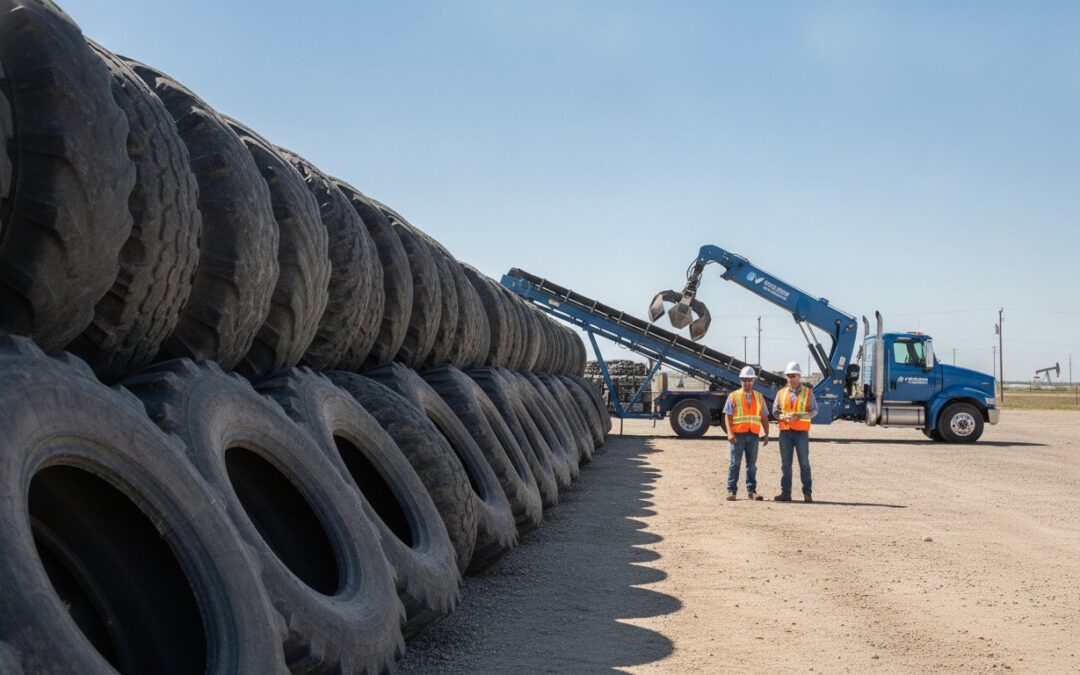
Your business is legally responsible for every scrap tire that leaves your property, even after a hauler drives out of sight. If you’re managing a fleet, a farm, or an industrial site in West Texas, you’ve seen how quickly bulky OTR tires and industrial rubber can take over your yard. It’s a massive headache that eats up valuable space and carries the constant risk of heavy TCEQ fines. Securing reliable commercial tire disposal Lubbock is about more than just clearing floor space; it’s about protecting your operation from the legal fallout of improper waste management.
We know that finding a partner to handle non-standard items like conveyor belts, hoses, or heavy agricultural tires is often harder than it should be. This 2026 guide is designed to simplify that process. You’ll discover how to efficiently manage bulk scrap while staying fully compliant with the latest Texas regulations. We’ll walk through the current manifest requirements, explain the strict 500-tire storage limit for generators, and show you how to turn a logistical bottleneck into a clean, professional disposal routine that keeps your business running smoothly.
Key Takeaways
- Learn the critical 2026 TCEQ manifest requirements to ensure your business remains legally compliant and protected from environmental fines.
- Discover how to efficiently manage non-tire industrial waste, including scrap conveyor belts and skid steer tracks, that standard haulers often reject.
- Understand why specialized commercial tire disposal Lubbock is the only reliable solution for high-volume logistics and agricultural operations.
- Explore the benefits of professional OTR and agricultural tire collection designed to clear your property without interrupting your workflow.
- Identify the specific storage limits for scrap tires that determine when your business must register as a generator with the state.
Why Lubbock Businesses Need Specialized Commercial Tire Disposal
Lubbock’s business district and surrounding logistics hubs generate rubber waste at an incredible rate. Whether you’re managing a fleet of semi-trucks or a large agricultural operation, scrap tires don’t just sit there; they accumulate. Standard municipal waste services in Lubbock are built for household trash and small-scale debris. They aren’t equipped to handle bulk industrial loads. Most local trash haulers will simply leave commercial tires behind because they require specialized processing at authorized facilities. This is exactly Why Lubbock Businesses Need Specialized Commercial Tire Disposal to maintain a clean and efficient workspace.
Shifting from a “waste problem” to a “managed disposal” mindset is essential for local operations. When tires pile up, they stop being a minor inconvenience and start being a logistical bottleneck. Professional commercial tire disposal Lubbock ensures that your site stays clear, allowing your team to focus on their core tasks rather than navigating around piles of rubber. We understand the specific needs of West Texas businesses, providing a direct and reliable path for removing bulk waste before it becomes a liability.
Lubbock Landfill Restrictions for Commercial Entities
The City of Lubbock landfill has clear rules that separate residential users from commercial entities. While residents might enjoy certain disposal privileges, businesses face strict volume limits and specific tipping fees. If you’re attempting to move fifty semi-truck tires or a single massive OTR tire from a tractor, self-hauling is rarely the best use of your resources. You have to account for:
- The cost of specialized loading equipment for heavy agricultural or OTR tires.
- Fuel and labor hours spent in transit and waiting at disposal sites.
- The risk of rejection if your load doesn’t meet specific landfill criteria.
A professional collection service removes these hurdles. We bring the right equipment to your site, handle the heavy lifting, and manage the paperwork, making it a far more cost-effective choice than trying to manage bulk hauling in-house.
Environmental Risks of Tire Stockpiles in West Texas
Leaving rubber exposed to the West Texas elements creates significant hazards. Our region’s intense summer heat increases the risk of toxic tire fires. These fires are notoriously difficult to extinguish; they can burn for weeks and release hazardous chemicals into the air and soil. Beyond fire risks, scrap tires are a primary breeding ground for mosquitoes and rodents. In Lubbock, standing water in tire piles is a direct public health concern linked to West Nile virus. By maintaining a clean, rubber-free site through regular commercial tire disposal Lubbock, you protect your property value and ensure a safer environment for your employees and the surrounding community.
Comprehensive Collection for Semi, Agricultural, and OTR Tires
Lubbock’s diverse economy demands more than a one-size-fits-all approach to waste. A logistics hub managing hundreds of semi-truck tires has very different needs than a South Plains cotton farm with a dozen massive tractor tires. Most general waste services simply aren’t equipped to lift or transport these heavy-duty items. Effective commercial tire disposal Lubbock relies on having a specialized fleet to handle everything from light truck casings to the largest OTR rubber used in construction and heavy industry.
Auto shops and fleet centers in the Hub City also require consistency. If scrap piles grow too large, they block loading docks and create safety hazards for technicians. We offer customized pickup schedules that match your generation rate. This keeps your shop floor clear and your operations moving without the stress of managing a growing wall of rubber. Professional collection ensures that every casing is tracked and disposed of through the proper legal channels.
Handling Heavy-Duty Agricultural Rubber
South Plains farming operations face unique challenges with oversized tractor and harvester tires. These items are incredibly heavy and difficult to move without specialized machinery. We provide on-site collection strategies for remote farm locations; you don’t have to worry about the logistics of hauling massive casings yourself. Proper disposal of these tires is critical for land health. Research into the environmental and health impacts of tires shows that large-format rubber requires specific processing to prevent long-term soil contamination. Our process ensures agricultural tires are handled according to all state environmental standards.
Logistics for Semi-Truck Fleet Managers
Fleet managers at Lubbock’s logistics hubs know that loading dock congestion is a profit killer. When scrap tires take up space meant for active freight, your efficiency drops immediately. We provide standardized pickup for high-volume semi-truck tire waste to keep your facility organized. Beyond the physical space, corporate environmental social responsibility (ESR) goals are becoming a priority for many West Texas companies. We provide the documentation you need to prove your waste is being handled responsibly. If your facility is reaching its storage limit, reaching out for professional scrap tire collection is the most efficient way to maintain compliance and operational flow.
Beyond Tires: Disposing of Industrial Rubber Waste in West Texas
Lubbock’s industrial sector relies on heavy-duty equipment that generates more than just standard tire waste. Manufacturing plants and construction sites often find themselves stuck with piles of reinforced rubber that standard trash services won’t touch. This is where specialized commercial tire disposal Lubbock services become essential for maintaining a safe, organized job site. Unlike residential junk haulers who focus on furniture or appliances, we specialize in high-density industrial rubber that requires specific handling and transportation equipment.
Managing these materials is about more than just aesthetics. Heavy industrial rubber is difficult to move and even harder to process. Most local facilities aren’t equipped to shred or recycle steel-reinforced products. We bridge that gap by providing a direct route for specialized waste removal. Shifting from a cluttered yard to a managed disposal plan allows your team to focus on production rather than navigating around piles of scrap rubber. Our service is built to handle the unique demands of West Texas industries, ensuring that every piece of industrial waste is accounted for and legally processed.
Managing Scrap Conveyor Belts and Hoses
Conveyor belts are built to be indestructible. They are often steel-reinforced and incredibly heavy, making them nearly impossible for a standard crew to cut or haul away without the right tools. Industrial manufacturing plants in the Hub City produce significant amounts of this waste during maintenance cycles. We provide specialized scrap conveyor belt collection and scrap hose collection, ensuring these materials don’t clutter your facility. By removing these bulky items, we help you turn a storage nightmare into a manageable stream. Our team handles the heavy lifting, preventing injuries that often occur when inexperienced staff try to move heavy rubber rolls or reinforced hoses.
Skid Steer and Solid Tire Removal
Solid rubber tires and skid steer tracks present a different set of challenges than pneumatic tires. Because they lack an air-filled cavity, they are much denser and require different handling techniques at processing facilities. Local contractors often struggle to find a reliable partner for scrap skid steer track collection. These tracks are awkward to stack and take up massive amounts of yard space. We offer efficient removal for worn-out tracks and scrap solid tire collection, reducing the footprint of your heavy equipment maintenance waste. This keeps your equipment yard clear for active machinery and ensures you stay compliant with local property maintenance standards. Using a dedicated commercial tire disposal Lubbock partner ensures these high-density materials are handled correctly from start to finish.
Navigating Texas Tire Regulations and TCEQ Compliance in Lubbock
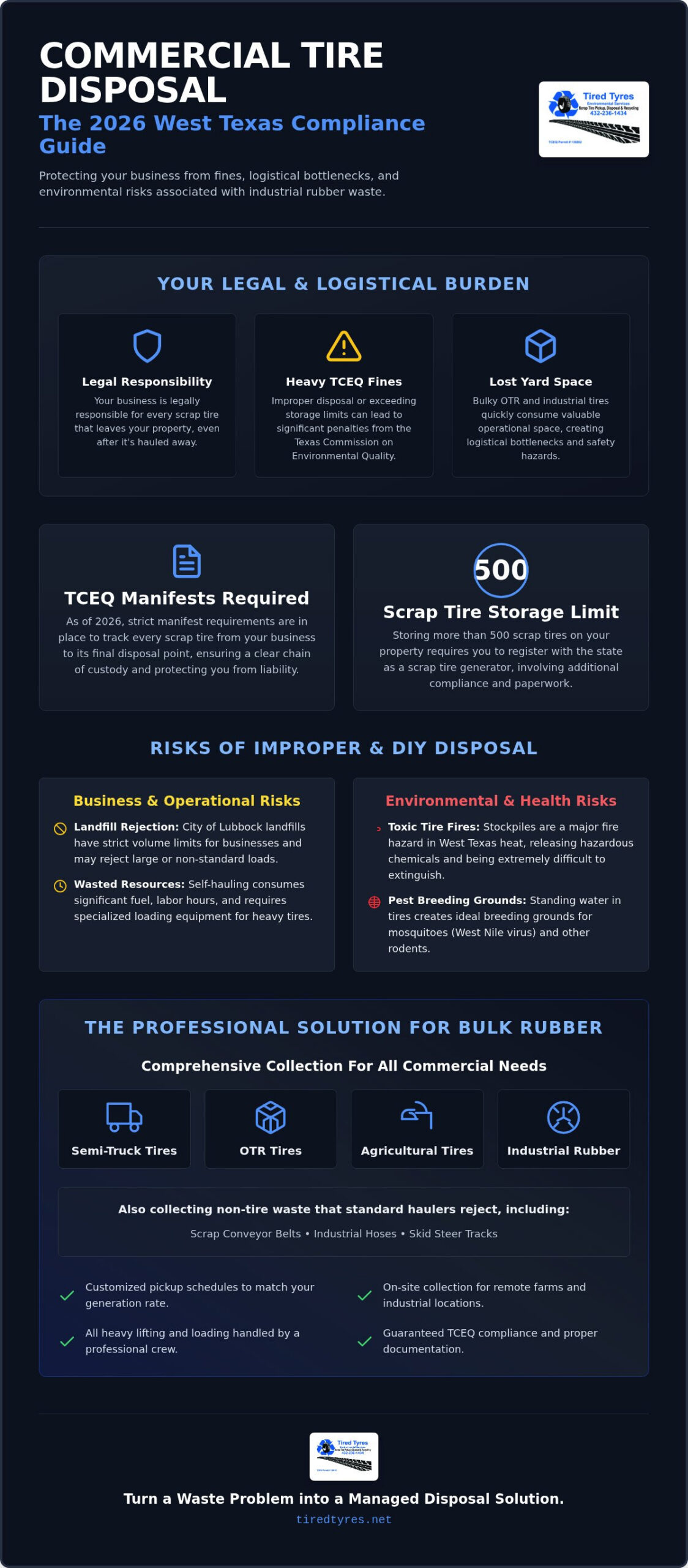
The Texas Commission on Environmental Quality (TCEQ) acts as the primary regulatory authority for all scrap rubber management. They utilize a cradle-to-grave tracking system to ensure that every tire is accounted for from removal to recycling. For your business, this means legal liability doesn’t end when the truck leaves your yard. If an unpermitted hauler dumps your waste in a West Texas field, state investigators will trace it back to the point of origin. This creates a high risk of heavy fines and litigation. Proper commercial tire disposal Lubbock relies on following these state mandates to the letter to protect your operation.
Avoid the temptation of “cheap” haulers who operate without state oversight. These individuals often lack the registration required to legally transport scrap rubber. Using a professional service ensures your business stays on the right side of the law and avoids the environmental hazards associated with illegal stockpiles.
The Importance of a Permitted Tire Hauler
A permit is your first line of defense against legal trouble. When you hire a permitted tire hauler Texas, you’re partnering with a business that the TCEQ has vetted and registered. This permit ensures the hauler has the equipment and authorized destination sites to handle your waste properly. Before signing any collection contract, always verify their registration status. A legitimate hauler will provide their TCEQ registration number without hesitation. This transparency is a hallmark of professional service. It gives you the peace of mind that your tires won’t end up in an illegal stockpile that could eventually cause a fire or pest problem.
Record Keeping and Manifest Requirements
The manifest system is the paper trail that proves your compliance. Every time a load of tires leaves your site, a manifest must be generated. This document records the number of tires, the transporter’s information, and the final destination. As a generator, you must receive a completed copy of this manifest within 60 days of the tires being removed. If you don’t receive it, you’re required to notify the TCEQ immediately. Standardizing your process for commercial tire disposal Lubbock ensures you never miss a compliance deadline or lose a critical document.
Lubbock business owners should keep these records for at least three years to stay prepared for a state environmental audit. Additionally, if you store more than 500 tires on the ground or 2,000 in locked trailers, you must register as a generator and submit annual reports through the STEERS system by December 31st. Managing these details is easier when you have a partner who understands the nuances of commercial tire disposal. If you need help clearing your inventory while staying compliant, schedule a consultation with our disposal experts today.
Partnering with Tired Tyres for Efficient Bulk Rubber Removal
Tired Tyres understands the unique pressure of managing an industrial site or fleet center. We’ve designed our services to be the most reliable option for commercial tire disposal Lubbock. Our specialized fleet is built to handle the region’s toughest waste, from heavy OTR tires to reinforced conveyor belts. We don’t just pick up rubber; we provide a professional logistics solution that keeps your business moving. Our service area covers the critical West Texas triangle, extending from Lubbock to Midland and Odessa to support the backbone of our local economy.
Choosing a local partner means you get a team that respects your time and your property. We focus strictly on collection and disposal, which allows us to maintain a high standard of efficiency. Every load we carry is tracked and managed according to state law, giving you the peace of mind that comes with total compliance. We’re committed to professionalism and punctuality, ensuring that your scrap rubber is removed without dragging down your daily productivity.
The Tired Tyres Collection Process
We follow a structured approach to ensure every job is handled with precision. Our process is transparent and designed to be as hands-off as possible for the business owner.
- Initial consultation: We start by assessing your specific volume and the types of rubber you need removed. This ensures we bring the right equipment for the task.
- Scheduled pickup: Punctuality is a core value. We coordinate with your team to minimize disruption to your loading docks or field operations.
- Final documentation: Once the collection is complete, we provide the necessary paperwork, including manifests, to ensure your business records are accurate.
Why West Texas Chooses Us
Our team has deep local knowledge of tire recycling in Midland, Odessa, and Lubbock. We aren’t a distant national conglomerate; we’re a West Texas partner committed to keeping the South Plains clean and compliant. This local focus means we understand the specific needs of oil field contractors, large-scale farmers, and logistics managers. We take pride in offering a service that is tailored to the environment we all share. Standardizing your approach to commercial tire disposal Lubbock starts with a partner who knows the terrain and the regulations.
Getting started is simple and direct. You can request a tire pickup quote in Midland or Lubbock through our online portal. We provide clear, straightforward communication from the first call to the final manifest. Let us handle the heavy lifting so you can get back to running your business.
Secure Your Site and Stay Compliant Today
Managing scrap rubber in West Texas doesn’t have to be a legal or logistical nightmare. The key to protecting your business lies in understanding TCEQ regulations and choosing a partner who can handle more than just standard passenger tires. By prioritizing specialized commercial tire disposal Lubbock, you ensure that even the heaviest OTR and agricultural tires are removed safely and documented correctly. This approach eliminates the risk of environmental fines and clears valuable space for your active operations.
Tired Tyres is dedicated to keeping the Lubbock, Midland, and Odessa triangle clean and productive. We specialize in the heavy-duty industrial rubber that standard haulers often reject; we remain fully compliant with all state manifest requirements. Don’t let scrap piles become a liability for your team or your property value. You can take the first step toward a cleaner facility by reaching out for expert assistance today. Get a Professional Quote for Commercial Tire Disposal in Lubbock and see how easy managed disposal can be. We’re ready to help you streamline your waste management and keep your business moving forward.
Frequently Asked Questions
Do I need a special permit to dispose of commercial tires in Lubbock?
You don’t need a specific permit to dispose of tires, but you must register with the TCEQ if your on-site storage exceeds 500 tires on the ground or 2,000 in locked trailers. As a generator, your primary responsibility is to ensure you use a registered transporter for removal. This registration keeps your business compliant with state law and protects you during environmental audits. We handle the transportation registration so you can focus on your daily operations.
What happens if a business is caught illegally dumping tires in Texas?
Illegal dumping carries severe penalties, including heavy fines and potential litigation. Texas law uses a cradle-to-grave tracking system, meaning you’re legally responsible for your waste even after it leaves your property. If an unlicensed hauler dumps your tires, state investigators will trace the manifest back to your business. Avoiding these risks is the primary reason to invest in professional commercial tire disposal Lubbock. It’s much safer to pay for legal disposal than to face state-level penalties.
Can you pick up large OTR tires used in construction or mining?
Yes, we specialize in the collection of oversized OTR (Off-the-Road) tires used in heavy construction and industrial sectors. These massive casings require specialized loading equipment and transport vehicles that standard junk haulers don’t possess. We have the fleet necessary to remove these bulky items from your site efficiently. Whether you’re clearing out a mining site or a construction yard, our team handles the heavy lifting and ensures the rubber is processed at authorized facilities.
Is there a limit to how many tires Tired Tyres can collect at once?
We don’t have a strict limit on the number of tires we can collect in a single visit. Our service is specifically designed for bulk removal, catering to high-volume fleet centers, agricultural operations, and industrial manufacturing plants. We coordinate our fleet based on your specific volume to ensure a smooth pickup process. If you have thousands of tires or a massive stockpile of industrial rubber, we can arrange multiple loads to clear your property quickly.
Do you provide the TCEQ manifest paperwork after a pickup?
Yes, we provide the required manifest documentation for every pickup we perform. This paperwork is your legal proof that the tires were transported by a registered hauler to an authorized disposal or recycling facility. You must receive a completed copy within 60 days of the tires leaving your property. Keeping these records for at least three years is vital for staying compliant with Texas law and being prepared for any potential state environmental audits.
What types of industrial rubber besides tires do you accept for disposal?
We accept a wide variety of industrial rubber waste that standard waste management companies often reject. This includes scrap conveyor belt collection, scrap hose collection, and scrap solid tire collection. We also handle scrap skid steer tracks and other heavy-duty rubber materials common in manufacturing and construction. Our equipment is specifically designed to lift and transport these high-density products, ensuring they don’t take up valuable space in your yard or warehouse.
How quickly can I schedule a commercial tire pickup in Lubbock?
We aim for maximum efficiency when scheduling your commercial tire disposal Lubbock. While lead times can vary based on your location and total volume, we work to coordinate pickups that minimize disruption to your business. Most local businesses can get a quote and a scheduled time slot shortly after their initial consultation. Our goal is to prevent loading dock congestion and ensure your scrap rubber is removed before it becomes a safety hazard or a storage bottleneck.
Are there specific preparation steps I need to take before the tires are collected?
To ensure a quick and safe pickup, we recommend stacking your tires in an area that’s easily accessible for our heavy-duty trucks. Removing any debris, water, or non-rubber waste from the pile helps speed up the loading process. If you’re disposing of massive OTR or agricultural tires, ensure there’s enough clearance for our specialized equipment to operate. Clear communication about the types and volume of rubber during your initial consultation ensures our team arrives prepared.