
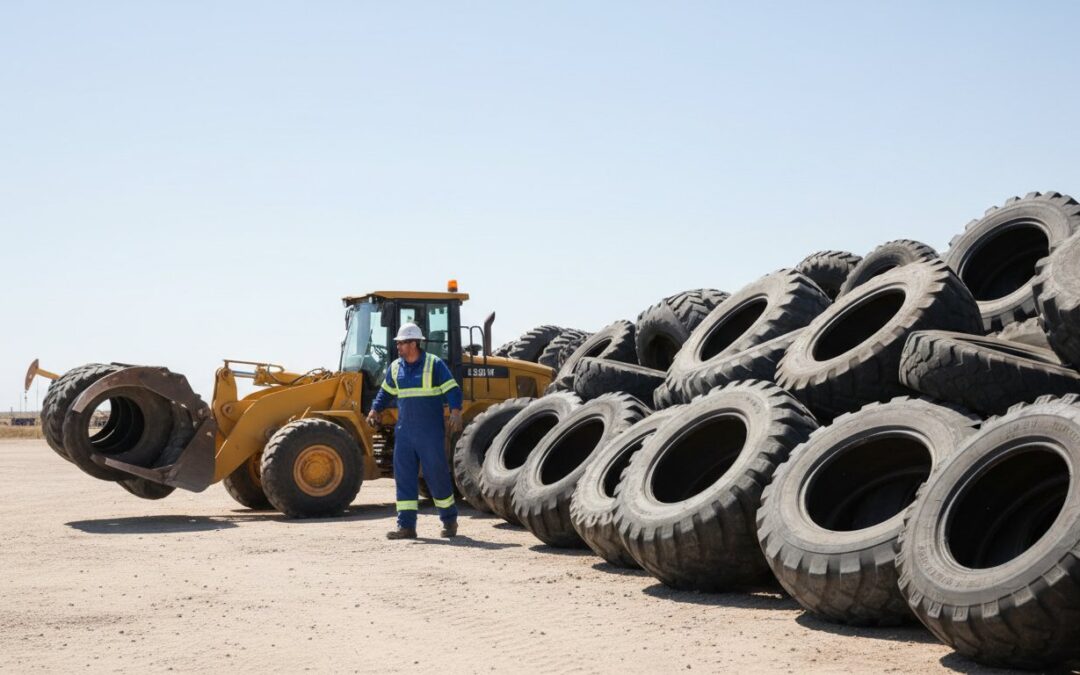
In 2025, the Texas Commission on Environmental Quality (TCEQ) issued over $2.4 million in penalties for improper scrap tire management. If you are managing a fleet in the Permian Basin, you know that an overflowing lot is a major liability. You likely feel the pressure of rising labor costs and the frustration of finding a facility that actually accepts large OTR or agricultural tires. Finding compliant tire disposal west texas shouldn’t be this difficult, yet many local businesses remain just one inspection away from a massive fine.
We will help you navigate these regulations and compare the most efficient disposal routes in Midland, Odessa, and Lubbock for 2026. This guide promises a clear understanding of current disposal costs and a strategy for securing the mandatory TCEQ manifests that protect your business. We will break down the differences between landfill hauling and professional pickup services, ensuring you have a reliable partner to handle the heavy lifting while you focus on your core operations. You can expect a direct look at the logistics, the paperwork, and the best local providers to keep your site clean and compliant.
Key Takeaways
- Learn how to navigate the unique environmental challenges of the Permian Basin and protect your property from health risks like mosquito-borne hazards.
- Compare the hidden costs of DIY landfill trips versus professional on-site collection to determine the most efficient disposal method for your needs.
- Understand the essential TCEQ regulations and manifest requirements that keep West Texas businesses safe from heavy financial penalties.
- Discover specialized disposal solutions for heavy-duty OTR and agricultural rubber that are typically rejected by standard municipal landfills.
- Find out why Tired Tyres offers the most reliable tire disposal west texas has to offer, providing seamless and compliant service from Midland to Lubbock.
Understanding Your Tire Disposal Options in West Texas
West Texas weather is brutal on abandoned rubber. In 2026, the Permian Basin’s 100-degree summers and 40 mph winds turn scrap piles into major fire hazards. Beyond the fire risk, the health hazard is immediate. Stagnant water trapped inside discarded tires in Midland and Odessa creates perfect breeding grounds for mosquitoes. This isn’t just a nuisance; it’s a public health priority for Ector and Midland counties. Managing these risks fits into the global tire recycling challenges where local solutions must meet strict environmental standards.
You have three main routes for tire disposal west texas: municipal landfills, specialized recycling centers, or hiring private haulers. By January 2026, the Texas Commission on Environmental Quality (TCEQ) increased its oversight. They now require digital manifest tracking for any transport of more than five tires. Fines for illegal dumping in 2026 have risen to $2,000 per violation for individuals, making proper disposal the only logical choice.
Local Disposal Landscape in Midland and Odessa
The City of Midland Landfill currently accepts up to four passenger tires per visit from residents with a valid utility bill. Odessa limits residential drops to five tires per month at the Citizen Collection Station. These programs don’t help local shops or fleet managers. Businesses must use registered transporters because “free” city cleanup days strictly exclude commercial waste. Using an unpermitted hauler can lead to secondary liability if those tires end up in a West Texas canyon or field. For a detailed breakdown of what businesses can expect to pay, our comprehensive guide on tire disposal cost Midland businesses face in 2026 covers all the pricing factors and hidden expenses.
Tire Disposal in Lubbock and the South Plains
Lubbock County faces a different scale of waste due to its heavy agricultural footprint. Large tractor tires require specialized shredding equipment not found at every local site. Disposal fees at the Lubbock City Landfill average $3.50 per passenger tire and can reach $65 for large OTR (Off-The-Road) tires. It’s vital to verify a site’s permit via the TCEQ Central Registry before unloading. In 2025, regional authorities shut down three unpermitted sites in the South Plains, leaving fewer but safer options for tire disposal west texas. We always recommend checking current gate rates, as prices for commercial loads adjusted twice in the last year.
DIY Landfill Drop-off vs. Professional Collection: A Side-by-Side Comparison
Choosing the right method for tire disposal west texas depends on your volume and your schedule. While a single spare tire is easy to toss in a truck, commercial loads or large cleanups present a different set of challenges. You have to weigh the immediate out-of-pocket cost against the long-term value of your time and legal safety.
Cost Breakdown: What You Actually Pay
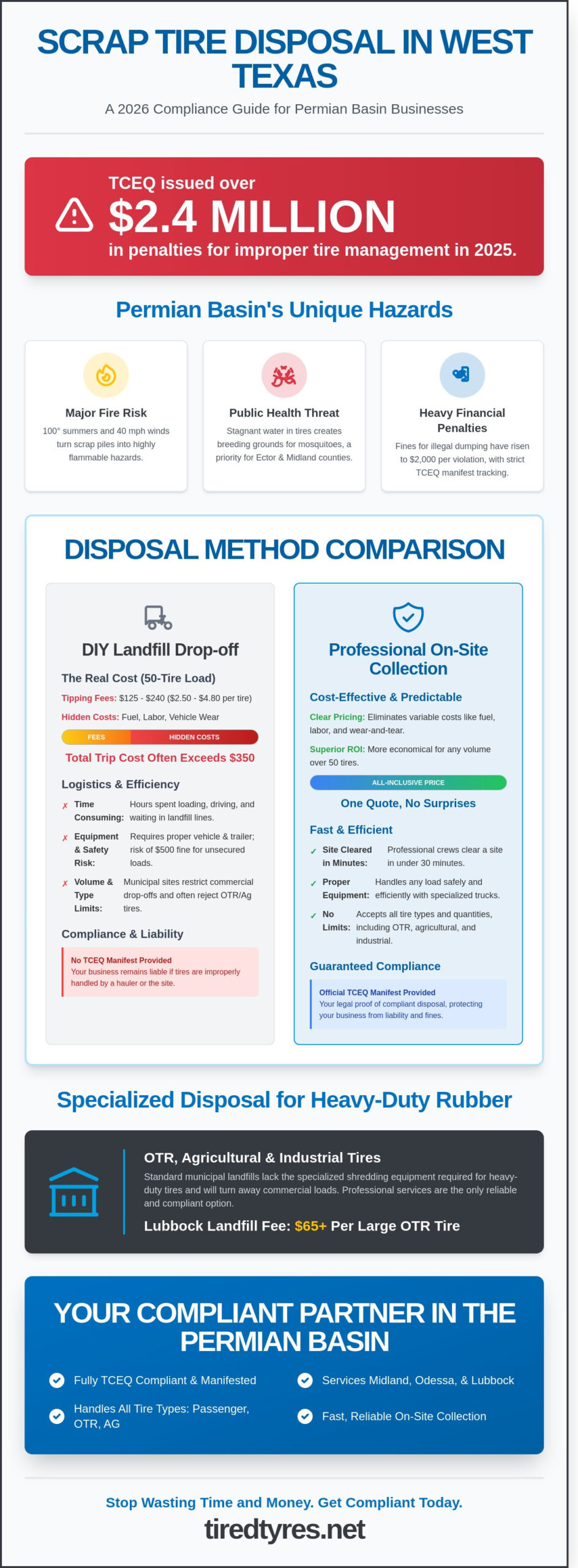
Landfills in Midland and Odessa currently charge between $2.50 and $4.80 per passenger tire as of early 2026. If you’re moving a lot of 50 tires, tipping fees alone hit $125 to $240. The hidden costs are where the DIY model breaks down. Between the $0.67 per mile IRS mileage rate for fuel and wear, plus the labor cost for a two-man crew, a single trip often exceeds $350. Bulk collection services provide a better ROI for 50+ tires because they eliminate these variable expenses. You also avoid the risk of a $500 fine for an unsecured load, which local law enforcement monitors strictly on Highway 80 and I-20. Understanding the complete tire disposal cost Midland businesses encounter helps you make informed decisions about whether DIY or professional services offer better value.
Logistics and Efficiency for Businesses
Efficiency isn’t just about speed; it’s about equipment. Most standard utility trailers aren’t built for the weight of 100 compressed tires. A professional crew clears a site in under 30 minutes, whereas a DIY effort involves hours of loading, driving, and waiting in landfill lines. It’s also a matter of public health. Stagnant water in tire piles creates breeding grounds for mosquitoes, a point emphasized in EPA information on scrap tires regarding vector-borne diseases. If you don’t have the staff to manage multiple trips, the backlog becomes a liability.
Volume limits are another hurdle for tire disposal west texas. Many municipal sites restrict how many semi-truck or OTR tires they’ll accept per day. If you show up with a trailer full of tractor tires without a prior permit, they’ll likely turn you away. Professional disposal also provides a manifest. This document is your legal proof of compliance with Texas Commission on Environmental Quality (TCEQ) regulations. If you’re looking to clear space without the headache, scheduling a bulk pickup ensures your scrap rubber is handled correctly and documented for your records.
Navigating TCEQ Regulations for West Texas Businesses
Commercial tire disposal west texas is strictly regulated to prevent environmental hazards and public health risks. The Texas Commission on Environmental Quality (TCEQ) enforces “cradle-to-grave” accountability for every tire. This means your business is responsible for a tire from the moment it’s removed from a rim until it reaches a permitted recycling or disposal facility. If a casing from your Midland shop is found in a dry creek bed, the state traces it back to you. Without the correct paperwork, your business faces the legal consequences.
To stay compliant, you must only use a “Permitted Tire Hauler” registered with the state. In the Permian Basin, verify the hauler’s 5-digit TCEQ registration number before they load a single tire. Using an unregistered “junk man” might save $50 today, but it can lead to administrative penalties exceeding $15,000 per violation. You also need to follow specific TCEQ tire storage regulations to ensure your on-site inventory doesn’t become a fire hazard or a breeding ground for pests. All manifests and disposal receipts must be kept in your records for at least 3 years.
Avoiding Illegal Dumping Penalties in Texas
Texas Health and Safety Code Chapter 365 defines illegal dumping as more than just tossing tires in a ditch. Storing more than 500 scrap tires on your property without a specific permit is a commercial violation. Many owners think “storing” tires for future projects protects them, but the state views unmanaged piles as illegal dumpsites. A professional hauler provides a transfer of liability. Once they sign the manifest and depart, the legal responsibility for that load shifts to the transporter and the final processing site.
The Manifest Process Simplified
The manifest is the only document that proves you followed the law. By 2026, many Lubbock and Odessa facilities have moved to digital tracking, but the requirements remain the same. A legal manifest must include the generator’s name, the hauler’s registration info, and the destination facility. It requires a 3-part signature chain: you sign when the tires leave, the driver signs upon receipt, and the end-user signs when the tires are processed. This closed-loop system is your insurance policy. It ensures every instance of tire disposal west texas is documented and verifiable during a TCEQ inspection.
Handling Heavy-Duty Waste: OTR, Agricultural, and Industrial Rubber
West Texas industrial hubs like Midland and Odessa generate a unique volume of rubber waste that standard recycling programs can’t manage. Passenger tires are simple to process. Off-the-Road (OTR) tires used in the Permian Basin’s oilfields are a different beast entirely. These massive units often weigh between 600 and 4,500 pounds. You can’t just toss them in a bin or leave them behind a shop. In 2026, 88% of municipal landfills in the Lubbock and Midland areas refuse to accept OTR or solid agricultural tires. They’re too dense for standard compactors and create massive air pockets that destabilize landfill cells over time.
Leaving these giant casings to rot isn’t just an eyesore. It’s a liability. Large-scale rubber waste in the Texas heat becomes a primary breeding ground for West Nile-carrying mosquitoes and a severe fire hazard. A single OTR tire fire can burn for days, releasing toxic oils into the soil. Proper tire disposal west texas requires a partner with the machinery to handle the scale and the permits to ensure legal compliance.
OTR and Semi-Truck Tire Solutions
Moving a 2,500lb OTR tire requires specialized rigging and heavy-duty flatbed transport. It’s a logistical hurdle that most local haulers won’t touch. For trucking fleets in the Permian Basin, managing 50 or 60 worn semi-truck casings every month is a major overhead cost. You need a registered transporter to move these loads to avoid TCEQ fines that can reach $5,000 per day for illegal storage. Tired Tyres uses specialized equipment like knuckle boom trucks for safe, efficient collection. We handle the heavy lifting so your fleet stays compliant and your yard stays clear of “faint-inducing” clutter.
Industrial Rubber Waste: Beyond the Tire
Midland’s industrial sector produces miles of scrap conveyor belts and thousands of feet of high-pressure hydraulic hoses annually. These items don’t fit into traditional recycling streams because of their high steel-cord content. Solid rubber skid steer tracks and industrial gaskets also pile up, creating storage headaches for site managers. Tired Tyres processes these diverse waste streams using high-torque industrial shredders designed for reinforced rubber. We take the “un-disposable” items that city services won’t touch, providing a clean slate for your operations.
If your site is cluttered with heavy-duty rubber or OTR casings, schedule an industrial pickup with Tired Tyres to clear your inventory today.
Why Tired Tyres is the Top-Rated Choice for Permian Basin Disposal
Tired Tyres understands the specific logistical challenges of the Permian Basin. We’ve focused our operations on providing the most reliable tire disposal west texas has to offer since our regional expansion in 2022. Our team doesn’t just pick up waste; we provide a professional partnership for businesses in Midland, Odessa, and Lubbock that need to maintain clean, compliant sites. We handle the entire spectrum of rubber waste, ensuring that your operation stays focused on its core goals while we manage the scrap.
- Full Scale Collection: We accept everything from standard 15-inch passenger tires to massive 63-inch OTR industrial tires used in mining and oilfield operations.
- Regulatory Certainty: Every single load we haul comes with a completed TCEQ (Texas Commission on Environmental Quality) manifest. This documentation is your shield during state inspections and environmental audits.
- Fixed Pricing: We provide transparent, no-hassle rates for our commercial and industrial clients. You won’t find surprise fuel surcharges or “handling fees” on your final invoice.
Our Process: From Your Site to Proper Disposal
Speed is essential for your workflow. You can schedule a pickup in under 5 minutes through our digital portal or by calling our dispatch office directly. We operate a fleet of 12 specialized trucks designed for heavy rubber loads, ensuring we can clear even the largest stockpiles in a single visit. Once collected, your tires are transported to authorized Texas end-points. We prioritize facilities that convert scrap rubber into Tire Derived Fuel (TDF) or crumb rubber for road construction, keeping your waste out of illegal dump sites.
Get a Custom Quote for Your West Texas Site
Pricing for tire collection isn’t a guessing game. We calculate your custom rate based on the total tire count, the specific size of the units, and your site’s distance from our primary hubs. Our service area covers the entire South Plains, including a 150-mile radius around the Midland-Odessa corridor. Whether you have a one-time cleanup or need a recurring monthly pickup, we scale our service to fit your volume. For businesses looking to clear their property efficiently, getting a tire pickup quote Midland companies can rely on ensures transparent pricing and professional service. Contact Tired Tyres for a bulk tire pickup quote today to get an accurate estimate for your location.
Streamline Your Permian Basin Waste Management Today
Managing rubber waste across the Permian Basin doesn’t have to be a logistical headache for your team. Staying compliant with 2026 TCEQ regulations is essential for avoiding steep penalties in Midland, Odessa, and Lubbock. Professional hauling saves your business the 4-hour round trips to local landfills and the high costs of specialized equipment rentals. Handling heavy-duty OTR and agricultural rubber requires specific machinery that standard trailers simply can’t support safely. It’s about protecting your bottom line while keeping your worksite clear and functional.
Tired Tyres operates as a TCEQ Permitted Hauler with the specialized OTR and industrial equipment needed for the toughest jobs. We serve the entire 300-mile corridor between Lubbock and the Permian Basin, providing the documented disposal records your business requires. Choosing a reliable partner means you can focus on your operations while we handle the heavy lifting. Schedule Your Professional Tire Pickup with Tired Tyres to ensure your tire disposal west texas strategy is efficient and fully compliant. Let’s get those old tires off your property and into the recycling stream where they belong.
Frequently Asked Questions
Is it illegal to keep a pile of scrap tires on my property in Texas?
Yes, it’s illegal to store more than 500 scrap tires on a property without a TCEQ registration. The Texas Commission on Environmental Quality enforces these regulations to prevent fire hazards and mosquito breeding. Code enforcement in cities like Midland can issue citations with fines starting at $500 per day for unauthorized accumulation on residential or commercial lots. Keeping smaller piles still requires proper covering to avoid health department penalties.
How much does the Midland landfill charge for tire disposal in 2026?
The Midland Landfill charges $3.50 per passenger tire and $150 per ton for bulk loads in 2026. These rates reflect a 4% increase from 2025 figures to cover rising environmental processing costs. Residents must provide a valid utility bill to access these specific local rates; otherwise, out-of-county surcharges of 25% apply at the scale house. Commercial haulers should call ahead to confirm daily capacity limits before arrival.
Do I need a special permit to transport my own scrap tires to the dump?
You don’t need a permit to transport up to 5 scrap tires to a disposal site for personal use. However, Texas law requires any person or business hauling more than 5 tires to register as a scrap tire transporter with the TCEQ. Failing to carry a valid registration number while moving bulk loads can lead to vehicle impoundment and state-level penalties. Always secure your load with heavy-duty straps to avoid littering fines.
What is a scrap tire manifest, and why does my business need one?
A scrap tire manifest is a five-part tracking document required by the TCEQ for every commercial tire transaction. Your business needs one to prove that your scrap tires were delivered to a legitimate, state-authorized processing facility. It protects you from liability if those tires are later dumped illegally. Keep these records for 3 years to remain compliant during environmental audits. This paperwork is essential for professional tire disposal west texas operations.
Can you dispose of large OTR tires from oilfield equipment?
Yes, you can dispose of OTR (Off-the-Road) tires at specialized industrial processing centers in the Permian Basin. Standard municipal landfills often reject these 400-pound oilfield tires due to their massive size and density. Professional haulers use heavy-duty loaders to manage these 57-inch rims; ensuring they’re shredded for civil engineering projects instead of taking up space in local pits. We coordinate specialized transport for these oversized items to ensure safe handling.
Does Tired Tyres pick up industrial rubber like conveyor belts or hoses?
Tired Tyres collects industrial rubber items including conveyor belts and hydraulic hoses alongside standard tire disposal west texas services. We handle bulk loads of oilfield waste that exceed 1,000 pounds; providing a single point of contact for site cleanups. This service helps drilling companies maintain OSHA compliance by removing tripping hazards and combustible materials from active pads. Our team uses flatbed trailers to haul away these heavy, reinforced rubber components efficiently.
What happens to the tires after they are collected in West Texas?
Collected tires are processed into Tire Derived Fuel (TDF) or crumb rubber at regional facilities like the one in Odessa. Approximately 45% of West Texas scrap tires are converted into fuel for cement kilns; while another 30% become rubberized asphalt for highway projects. This recycling loop prevents 20,000 tons of rubber from entering West Texas landfills annually. It’s a sustainable system that turns old rubber into valuable resources for infrastructure development.
How do I report illegal tire dumping in Odessa or Lubbock?
Report illegal tire dumping by calling the Texas Environmental Hotline at 1-888-777-3186 or using the Odessa 311 mobile app. Provide the exact GPS coordinates and a photo of the site to help investigators. In Lubbock, the Environmental Compliance department handles these reports; often responding within 48 hours to secure sites where more than 10 tires were abandoned. Reporting helps prevent West Texas from becoming a breeding ground for pests and West Nile virus.