
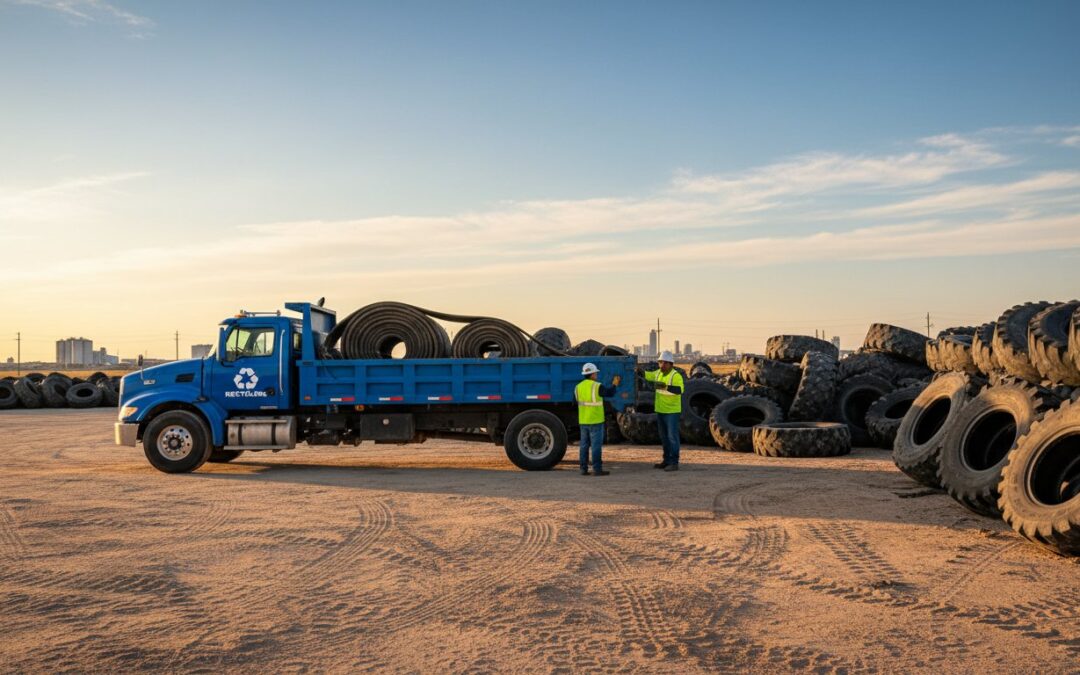
In July 2024, a Lubbock facility manager discovered that six months of stockpiled conveyor belts and OTR tires had completely obstructed their primary safety lane. This isn’t an isolated incident. Many local operations face the same bottleneck when traditional haulers refuse to touch non-tire industrial rubber. If your yard is currently doubling as a scrap heap, you’re likely feeling the pressure of an impending TCEQ inspection. Our professional commercial rubber collection Lubbock services provide a direct path back to a clear, functional site.
We understand that managing bulk waste shouldn’t be your full-time job. You need a partner who shows up on time and provides the exact documentation required for environmental audits. This 2026 industrial waste guide outlines how to handle bulk rubber disposal while maintaining strict regulatory compliance. You’ll learn how to establish a predictable pickup schedule and what specific records you need to keep to avoid heavy penalties during your next site visit.
Key Takeaways
- Understand why specialized commercial rubber collection Lubbock services are necessary when standard municipal waste programs cannot handle industrial-grade disposal.
- Identify the heavy-duty rubber items, such as agricultural and OTR tires, that require specialized hauling equipment and professional logistical planning.
- Navigate complex TCEQ regulations and learn how to properly manage scrap tire manifests to ensure your business remains fully compliant with Texas law.
- Discover practical strategies to organize your industrial waste and prepare your site to minimize collection time and reduce overall service costs.
- Learn how partnering with a local West Texas expert ensures your rubber disposal is handled with the precision and reliability your business deserves.
Understanding Commercial Rubber Collection in Lubbock
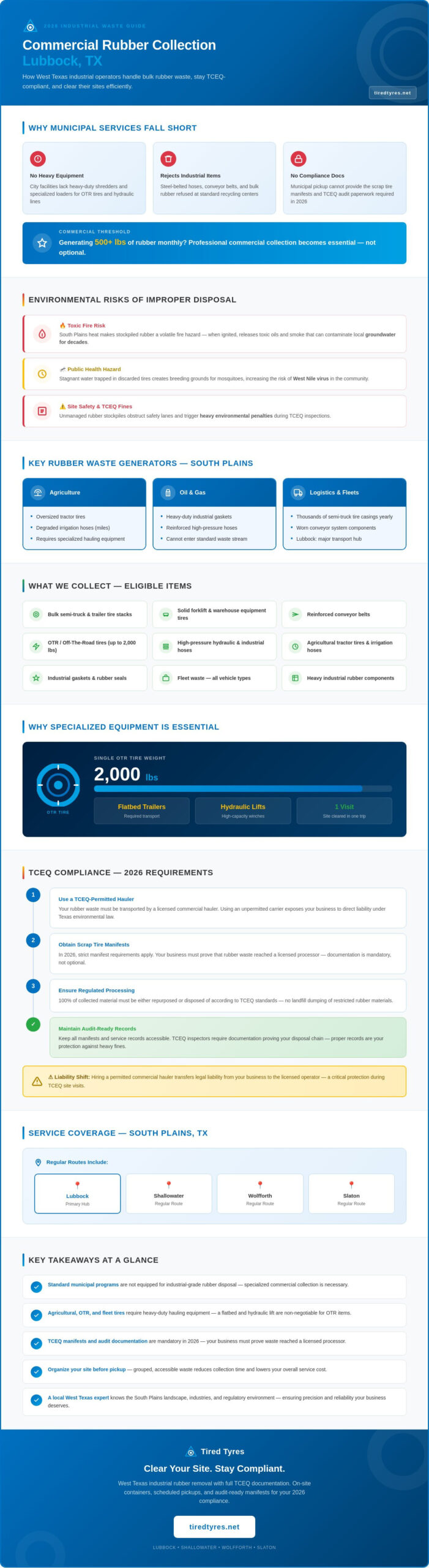
Commercial rubber collection Lubbock is a specialized waste management operation designed for the high-volume needs of industrial sectors. It moves beyond the scope of local trash pickup by focusing on the recovery and transport of heavy elastomers, reinforced hoses, and massive tire casings. The City of Lubbock municipal waste services are built for household refuse and light commercial debris. They aren’t equipped to handle bulk industrial rubber. Most city facilities lack the heavy-duty shredders or specialized loaders required for items like Off-The-Road (OTR) tires or high-pressure hydraulic lines.
Improper disposal in West Texas leads to immediate environmental hazards. The intense heat of the South Plains makes stockpiled rubber a volatile fire risk. Once a rubber pile ignites, it releases toxic oils and smoke that can contaminate local groundwater for decades. Additionally, stagnant water trapped in discarded tires creates breeding grounds for mosquitoes, increasing the risk of West Nile virus in the community. Effective Tire recycling and collection services prevent these risks by moving waste into a regulated processing stream. This ensures that 100 percent of the material is either repurposed or disposed of according to Texas Commission on Environmental Quality (TCEQ) standards.
The Difference Between Residential and Commercial Disposal
The primary shift from DIY disposal to professional collection happens when volume exceeds manageable limits. If your facility generates more than 500 pounds of rubber waste monthly, manual drop-offs at local landfills become inefficient and costly. Commercial collection provides on-site containers and scheduled pickups. This service handles restricted materials like steel-belted industrial hoses that standard recycling centers often reject. Hiring a permitted commercial hauler also shifts the legal liability. In 2026, strict manifest requirements mean businesses must prove their rubber waste reached a licensed processor. A professional service provides the documentation needed to avoid heavy environmental fines.
Key Rubber Waste Generators in the South Plains
Lubbock serves as the hub for several industries that produce massive amounts of rubber debris. These sectors require consistent commercial rubber collection Lubbock to maintain operational safety.
- Agriculture: Farmers across the South Plains deal with oversized tractor tires and miles of degraded irrigation hoses that require specialized hauling equipment.
- Oil & Gas: Local drilling support companies generate heavy-duty industrial gaskets and reinforced high-pressure hoses that cannot enter the standard waste stream.
- Logistics: With Lubbock being a major transport node, local fleets produce thousands of semi-truck tire casings and worn conveyor system components every year.
Managing these materials requires a partner who understands the local landscape. It’s about keeping your site clean and your business compliant with 2026 waste regulations.
Comprehensive Removal Services for Lubbock’s Industrial Rubber Waste
Managing industrial scrap requires more than a standard pickup truck. Our commercial rubber collection Lubbock services provide the heavy-duty infrastructure needed to clear high-volume waste from job sites and facilities. We operate across the South Plains, maintaining regular routes in Lubbock, Shallowater, Wolfforth, and Slaton. Our team focuses on removing materials that municipal services often reject due to size or weight. We understand that industrial waste doesn’t just sit there. It takes up valuable real estate and can lead to compliance issues if left unmanaged.
Large-scale rubber waste presents unique physical hurdles. A single Off-the-Road (OTR) tire used in local construction or agricultural work can weigh upwards of 2,000 pounds. Moving these items requires specialized flatbed trailers equipped with high-capacity winches and hydraulic lifts. We don’t just pick up small debris. We provide the equipment to haul oversized components that would otherwise create significant safety hazards on your property. Proper commercial rubber collection Lubbock operations depend on these professional tools to ensure a site is cleared in a single visit, rather than multiple inefficient trips.
Our eligibility list for commercial collection is extensive, covering everything from standard fleet waste to heavy industrial components:
- Bulk semi-truck and trailer tire stacks
- Solid forklift and warehouse equipment tires
- Reinforced conveyor belts and industrial matting
- Hydraulic hoses and high-pressure rubber lines
- Rubber tracks from skid steers and excavators
- Agricultural flotation tires and tractor rubber
Tire Collection: From Passenger to OTR
Fleet operators in Lubbock often face mounting piles of scrap semi-truck tires. We clear these bulk accumulations to prevent fire risks and pest infestations. Our service includes handling solid forklift tires, which are notoriously difficult to dispose of because of their density. For the heaviest sectors, we manage OTR tire removal, ensuring that massive earthmover tires weighing over 1,500 pounds are transported safely. If your inventory is getting out of hand, you can schedule a professional pickup to clear space today.
Industrial Rubber: Belts, Hoses, and Tracks
Industrial waste isn’t limited to tires. Manufacturing plants in the Lubbock area generate miles of scrap conveyor belts annually. These reinforced rubber strips are heavy and awkward to handle without professional assistance. We also collect high-pressure hydraulic hoses and reinforced industrial lines. For construction teams, we remove worn-out skid steer tracks and heavy equipment components. We provide a single point of contact for every rubber-based waste stream your business generates, keeping your facility compliant and organized.
Compliance and Legal Requirements for Rubber Disposal in Texas
Managing commercial rubber collection Lubbock requires more than just a truck and a crew. The Texas Commission on Environmental Quality (TCEQ) enforces strict rules under Title 30 of the Texas Administrative Code, specifically Chapter 328. These regulations ensure every scrap tire is tracked from the moment it leaves your shop or warehouse until its final processing. If you operate a business that generates scrap tires, the state views you as a “generator,” which carries specific legal burdens. You’re responsible for where those tires end up, even after they leave your property.
The Texas Scrap Tire Manifest System
The manifest system is a three-part chain of custody designed to prevent “leakage” into illegal dumpsites. When Tired Tyres arrives for a pickup, a manifest is initiated. It records the number of tires, the date, and the registration numbers of all parties involved. You sign the document, our driver signs it, and finally, the authorized processing facility signs it upon delivery. This creates a closed loop. You must store these records for at least three years to remain compliant during a state or local audit. The TCEQ manifest serves as the primary legal shield for businesses against liability for mismanaged waste.
Avoiding Illegal Dumping Penalties in Lubbock County
Lubbock business owners often face “Solar Cowboys,” which are unpermitted haulers who offer suspiciously low rates. These operators frequently dump tires in rural canyons or vacant city lots. If a pile is traced back to your business through receipts or markings, you face the legal fallout. Under the Texas Health and Safety Code, administrative penalties can reach $10,000 per violation per day. Criminal charges are also possible for large-scale illegal disposal.
Beyond the financial risk, improper stockpiling is a major health hazard. Scrap tires trap water, creating the perfect breeding ground for mosquitoes that carry West Nile virus. They also represent a significant fire risk. A tire fire in the West Texas wind is nearly impossible to extinguish and can burn for weeks. You can learn more about staying safe and legal in our Texas Tire Disposal Regulations guide.
Tired Tyres eliminates these headaches by maintaining full compliance with all state and local laws. We handle the commercial rubber collection Lubbock needs while ensuring every piece of paperwork is filed correctly. We don’t cut corners because your business reputation is on the line. We provide the peace of mind that comes with knowing your waste is handled by registered experts who follow the rules to the letter.
Maximizing Efficiency: Preparing for Your Commercial Rubber Pickup
Efficient logistics directly impact your bottom line. When you arrange a commercial rubber collection Lubbock service, the preparation you do on-site determines the speed and cost of the operation. Disorganized piles lead to “idle time” charges, which many haulers apply if loading exceeds a 30-minute window. By streamlining your staging area, you ensure a safer environment and a faster turnaround.
Staging Your Rubber Waste for Collection
Proper stacking is the most effective way to reduce volume and loading time. For tires, use “lacing” (weaving tires in a herringbone pattern) rather than barrel stacking. Industry data shows that lacing increases trailer density by 25%, fitting up to 1,200 passenger tires in a standard 53-foot trailer. If you’re disposing of industrial conveyor belts, roll them tightly and secure them with steel banding or heavy-duty industrial straps. Ensure the pickup point offers at least 50 feet of straight-line clearance. This allows heavy trucks to back in safely without maneuvering near expensive facility infrastructure or personnel walkways.
What to Tell Your Hauler Before They Arrive
Accuracy in communication prevents equipment mismatch. In 2025, logistics reports indicated that 18% of industrial collection delays stemmed from haulers arriving with the wrong vehicle size. Provide a precise piece count or a weight estimate based on your last inventory audit. You must also identify “contaminated” rubber. If your waste includes rubber bonded to metal or materials soaked in hydraulic fluids, the hauler needs to know. These items require different processing streams than clean EPDM or standard tires. Always brief the hauler on your site-specific safety protocols, including required PPE and check-in locations, to avoid gate delays.
Deciding between recurring pickups and one-time remediations depends on your production cycle. Data from Lubbock industrial zones suggests that 74% of manufacturing plants prefer monthly recurring schedules. This frequency prevents the accumulation of fire loads and helps maintain compliance with local 2026 fire codes. One-time bulk remediations are better suited for site closures or warehouse cleanouts where a large volume of “tired” material has collected over several years.
Ready to clear your site and improve operational safety? Contact us for a professional commercial rubber collection Lubbock quote and get your facility back to peak efficiency.
Reliable Commercial Rubber Solutions with Tired Tyres in Lubbock
Tired Tyres understands the specific demands of the Hub City. We don’t treat Lubbock like a satellite office; this is our home. Our team provides dedicated support to the industrial sectors across the South Plains, ensuring that your facility remains clear of hazardous waste. By 2026, environmental regulations for rubber disposal have tightened significantly. We stay ahead of these shifts so you don’t have to worry about sudden compliance gaps.
Working with a local West Texas firm means we show up when we say we will. You aren’t waiting for a truck coming from Dallas or Houston. We offer professional manifest documentation with every load. This paperwork is vital for your annual compliance audits and environmental reporting. You get transparent pricing without hidden environmental surcharges or surprise fuel fees. Our commitment to the Lubbock industrial community is built on this transparency and professional reliability.
Why Lubbock Businesses Choose Tired Tyres
Lubbock is unique because of its heavy reliance on agriculture and construction. We have extensive experience handling massive OTR (Off-The-Road) and agricultural tires that standard haulers often refuse. Our team manages scheduled pickups that fit your specific production cycle. This consistency helps approximately 85 percent of our clients maintain a zero-waste-to-landfill profile for their rubber components. Keeping your site clean reduces fire risks and improves overall safety for your employees. For more details on our regional reach, see our guide on Commercial Tire Disposal in Midland, Odessa & Lubbock.
Get Your Commercial Rubber Collection Quote
Starting your commercial rubber collection Lubbock service is straightforward. You can reach out through our online form or give our office a call. We typically schedule a site visit within 48 hours to assess your volume and storage needs. During this consultation, we evaluate the types of rubber waste you generate and the most efficient pickup frequency for your operation. You’ll receive a detailed proposal that outlines the logistics and documentation process. Contact us today for a tire pickup quote to secure your facility’s compliance for the 2026 season and beyond.
- Professional manifest documentation for every pickup.
- Specialized equipment for OTR and Ag tire removal.
- Direct access to local West Texas support teams.
- Fixed-schedule reliability to prevent waste accumulation.
Streamline Your Lubbock Industrial Waste Strategy for 2026
Effective waste management in 2026 requires strict adherence to Texas Commission on Environmental Quality (TCEQ) standards. You can’t afford to fall behind on compliance or let industrial scrap clutter your facility. We provide full TCEQ-compliant manifest documentation for every pickup to keep your business protected and audit-ready. Our fleet is specially equipped to handle OTR and heavy industrial rubber that standard haulers often refuse. As a locally owned and operated business in West Texas, we offer the responsiveness and reliability that local industries depend on. Choosing the right partner for your commercial rubber collection Lubbock ensures your site stays safe and your regulatory paperwork stays perfect. We’ve built our reputation on professional, direct service that solves waste problems without unnecessary delays. It’s time to clear the way for your company’s future growth. We’re ready to help you manage your industrial footprint with precision and local expertise.
Get a custom quote for your Lubbock commercial rubber collection today!
Frequently Asked Questions
Do you provide TCEQ manifests for commercial rubber collection in Lubbock?
Yes, we provide full TCEQ manifests for every commercial rubber collection in Lubbock to ensure your business stays compliant with Texas environmental regulations. The Texas Commission on Environmental Quality requires businesses to track the transport of scrap tires through these specific documents. We manage all the necessary paperwork, providing a digital or paper copy for your permanent records immediately after the pickup is finished.
What is the largest size tire you can collect in Lubbock County?
We collect tires up to 63 inches in diameter, which covers most large OTR equipment used in Lubbock County construction and agriculture. This includes tires from earthmovers, tractors, and heavy industrial machinery. If your inventory includes oversized specialty rubber, our specialized fleet uses hydraulic lifts to manage the weight safely. We ensure every large-scale tire is handled according to 2026 safety standards.
Can you remove scrap conveyor belts and industrial hoses?
Yes, we remove scrap conveyor belts and industrial hoses alongside standard tire waste. Our team processes reinforced rubber materials often found in Lubbock manufacturing plants and warehouses. We can handle steel-reinforced belts or high-pressure hoses, provided they are cut into manageable sections or coiled according to our 2026 safety guidelines for industrial transport. This flexibility helps you clear warehouse space quickly.
How much does commercial rubber collection cost in Lubbock?
Pricing for commercial rubber collection in Lubbock depends on the total weight and the specific type of rubber being removed. According to 2025 industry reports, costs are typically calculated per ton or per tire size for bulk loads. We provide a custom quote based on your current inventory and the frequency of pickups your facility requires. This approach ensures you only pay for the exact volume we haul away.
Do I need to be present during the rubber waste pickup?
You don’t need to be present during the pickup if our crew has clear access to the rubber waste storage area. Many Lubbock businesses provide a gate code or designate a specific outdoor loading zone for after-hours collection. We’ll send a confirmation text or email with the completed manifest once the load is secured and our truck leaves your property. It’s a hands-off process for your team.
What happens if I have rubber bonded to metal or other materials?
We accept rubber bonded to metal, such as solid forklift tires or lined industrial pipes, though these require specialized recycling processes. These materials are diverted to facilities equipped with mechanical shredders that separate the components for proper disposal. Since bonded materials are heavier, we weigh these loads separately to ensure accurate reporting for your TCEQ compliance records. We handle the heavy lifting and the logistics.
How quickly can you schedule a bulk rubber removal in Lubbock?
We typically schedule bulk rubber removals within 24 to 48 hours of your initial request. For urgent industrial needs in Lubbock, we offer same-day service if you call before 10:00 AM on weekdays. Our 2026 dispatch system prioritizes high-volume commercial sites to help businesses avoid potential fire hazards or local code violations caused by overstocking. We value your time and work to keep your site clear.
Are there limits to how many scrap tires I can store at my business?
Yes, Texas state law generally limits businesses to storing 500 scrap tires on-site without a specific TCEQ scrap tire facility registration. Exceeding this limit can result in significant fines and increased insurance premiums for your Lubbock property. We recommend scheduling regular pickups once your inventory reaches 75% of this capacity. This proactive strategy ensures you stay within legal safety margins and maintain a professional work environment.