
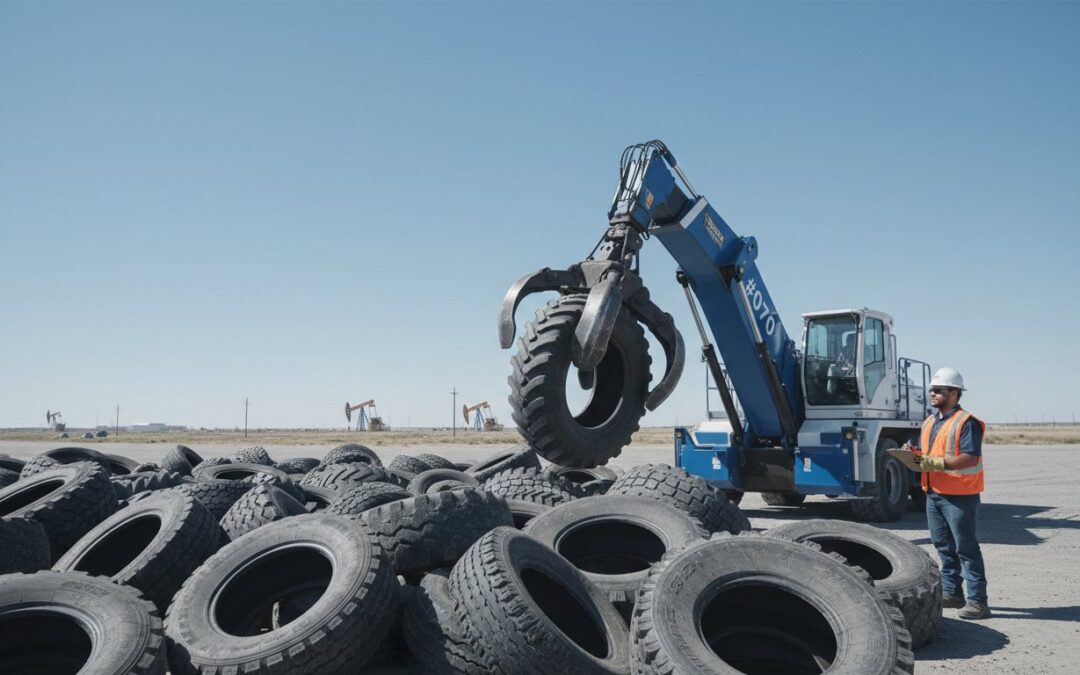
A single forgotten stockpile of OTR tires can trigger a TCEQ fine exceeding $25,000 before you even realize there’s a compliance issue. You likely already feel the weight of these regulations. It’s a logistical headache that drains your budget and creates unnecessary fire risks on your property. Managing commercial tire disposal in West Texas shouldn’t feel like a constant battle against red tape and rising hauling fees. We understand that your priority is keeping your fleet moving, not chasing down manifest paperwork or worrying about the next inspection.
You probably agree that the current system for handling heavy semi and OTR tires is both expensive and complicated. This guide helps you master the logistics, costs, and legal requirements for industrial rubber disposal across Midland, Odessa, and Lubbock. We’ll walk through the exact steps to achieve full regulatory compliance and maintain a cleared job site without the usual stress. This overview provides a clear roadmap to predictable costs and a professional disposal strategy that keeps your business running smoothly in 2026.
Key Takeaways
- Master the local logistics for managing bulk scrap rubber in Midland, Odessa, and Lubbock as market conditions shift in 2026.
- Navigate complex TCEQ regulations and learn why your business remains legally responsible for industrial waste until final processing.
- Optimize your commercial tire disposal by understanding the unique collection and processing rules for semi, OTR, and agricultural tires.
- Learn how to prepare your site for faster pickups and determine whether scheduled or on-call services best fit your operational needs.
- Discover the benefits of partnering with a Permian Basin expert to handle your entire range of industrial rubber waste efficiently.
Navigating Commercial Tire Disposal in Midland, Odessa & Lubbock (2026)
Commercial tire disposal involves the professional collection and legal processing of bulk scrap rubber generated by businesses. It isn’t just about hauling junk away. It’s a regulated system designed to handle the high volume of waste produced by the West Texas industrial engine. In 2026, companies in Midland, Odessa, and Lubbock face an increasing need for streamlined waste solutions as fleet sizes grow. The scale of this issue ranges from standard oil field service trucks to massive OTR (Off-The-Road) equipment used in heavy construction and mining operations. Because these tires are too large for standard landfills, businesses must rely on specialized facilities that understand the tire recycling process and state compliance standards.
The local landscape in the Permian Basin and South Plains is unique. Long haul distances and extreme weather make tire management a logistical challenge. Most commercial tire disposal programs now focus on high-efficiency collection routes to keep pace with the 24/7 nature of the oil and gas industry. Managing these stockpiles effectively prevents operational bottlenecks and keeps your yard clear for active equipment. It’s a practical necessity for maintaining a safe and organized job site.
The High Stakes of Improper Disposal
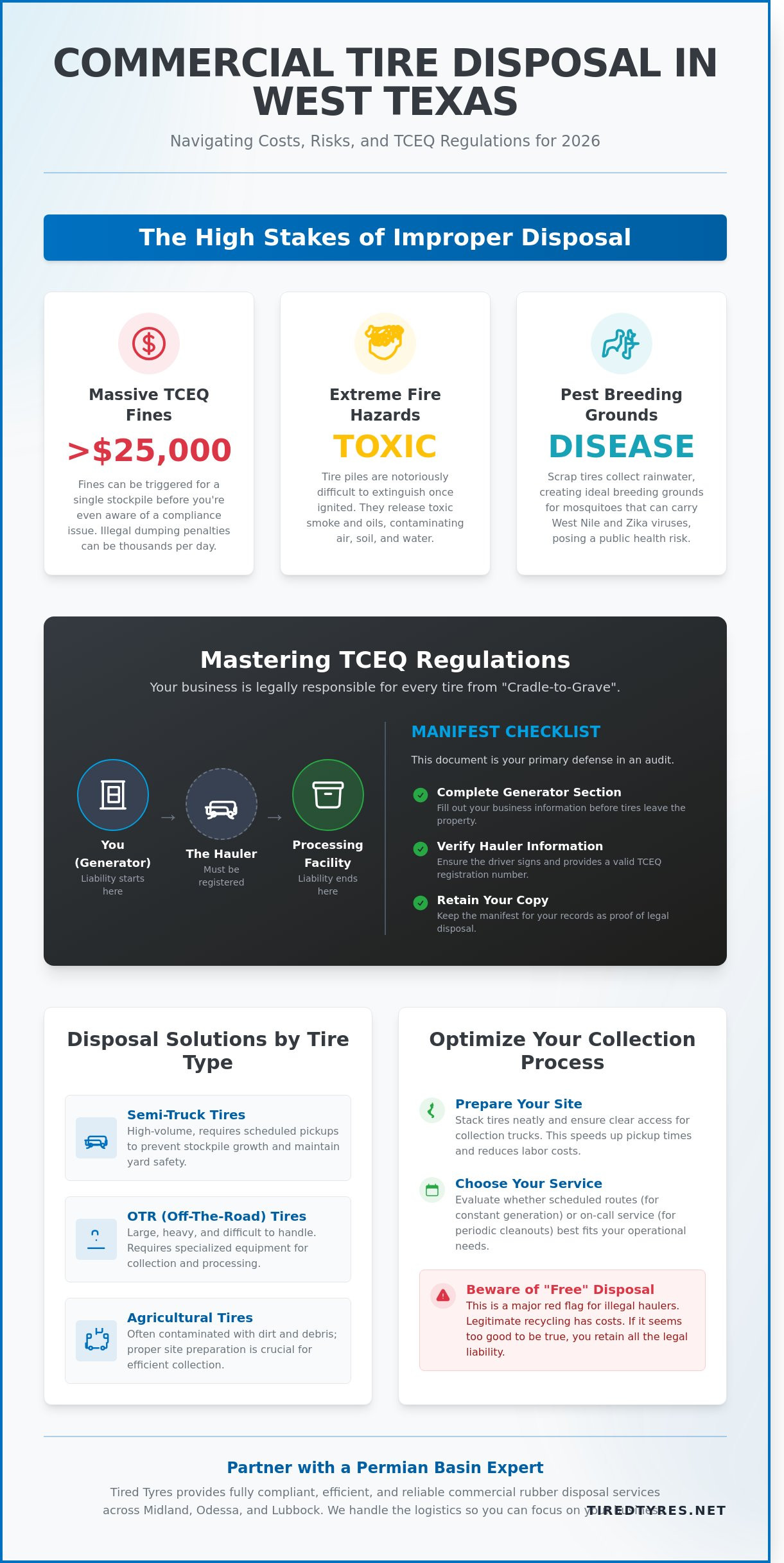
Storing scrap tires in the Texas heat presents serious environmental risks. Tire piles are notorious fire hazards. Once ignited, they are nearly impossible to extinguish and release toxic smoke into the atmosphere. They also serve as primary breeding grounds for pests like mosquitoes, which carry West Nile and Zika viruses. Beyond physical risks, the financial consequences of illegal dumping are steep. Fines from state regulators can reach thousands of dollars per day. Under Texas law, the generator of a scrap tire remains legally responsible for its proper disposal from the point of origin until it reaches a permitted processing facility.
The 2026 Market for Scrap Rubber in Texas
The market for recycled rubber has evolved significantly. By 2026, much of the rubber collected in Midland is being repurposed for local infrastructure projects, including rubberized asphalt for highway expansions. The oil and gas sector has shifted toward sustainable industrial waste management to meet corporate environmental goals. This shift makes professional commercial tire disposal a business necessity rather than an afterthought. You should be wary of “free” disposal offers. These are often a red flag for illegal hauling operations that lack the proper TCEQ permits. Legitimate recycling requires specialized equipment and labor, so if the price seems too good to be true, the legal liability likely stays on your shoulders.
Understanding Texas TCEQ Regulations for Industrial Rubber Waste
The Texas Commission on Environmental Quality (TCEQ) oversees all scrap tire activity under Title 30 of the Texas Administrative Code, Chapter 328. For businesses in the Permian Basin, this means commercial tire disposal is not just a logistics task; it is a legal mandate. The state follows a “cradle-to-grave” philosophy. As a tire generator, your business remains legally responsible for every tire until it reaches an authorized processor or disposal site. If a hired hauler illegally dumps your inventory in a West Texas field, the TCEQ can hold your business liable for the cleanup costs and associated fines.
Managing this risk requires verifying every partner in your supply chain. You should never release a shipment to a driver who cannot produce a valid TCEQ registration number. Verifying a hauler is a simple process through the TCEQ’s Scrap Tire Management database, which lists all currently permitted transporters. While the TCEQ manages state-level compliance, following national trends toward sustainable tire recycling solutions helps West Texas businesses stay ahead of evolving environmental standards and reduces long-term liability.
Manifest Compliance: Avoiding the Paperwork Pitfall
The scrap tire manifest system is your primary defense during a state audit. This multi-part document tracks the movement of tires from your facility to the final destination. To maintain compliance, you must follow these specific steps:
- Complete the generator section of the manifest before the tires leave your property.
- Ensure the hauler signs the document and provides their TCEQ registration number.
- Obtain a completed copy from the disposal facility within 60 days of the original shipment.
Texas law requires you to retain these records for at least 3 years. Failure to produce these documents during an inspection can lead to significant administrative penalties. For a deeper look at these requirements, review our Texas tire disposal regulations guide. If you need help organizing your documentation, professional disposal consultants can help streamline your record-keeping process.
Local Landfill Restrictions in West Texas
Landfills in the City of Midland and the City of Odessa have strict prohibitions against whole tires. Under state law, whole tires are banned from landfills because they trap methane gas and eventually “float” to the surface, which compromises the integrity of the landfill cap. Most local facilities only accept tires that have been shredded or split into at least four pieces.
Businesses caught placing whole tires in standard commercial waste bins face immediate consequences. In Texas, illegal tire disposal is a Class C misdemeanor, often resulting in fines of $500 per tire. For larger quantities, the charges can escalate to a state jail felony. Using a dedicated service for commercial tire disposal ensures your waste is processed into shredded material or tire-derived fuel, keeping your business compliant with local Midland-Odessa municipal codes.
Comparing Disposal Solutions for Semi, OTR, and Agricultural Tires
Commercial tire disposal requirements change based on the physical properties of the rubber. A standard semi-truck tire weighs roughly 110 pounds, whereas a large OTR tire used in Permian Basin mining can weigh as much as 15,000 pounds. These differences dictate the equipment and regulatory pathways needed for legal disposal. You can’t treat a 13-foot mining tire like a passenger car scrap; the logistics require heavy-duty machinery and specialized transport permits.
Fleet managers in Lubbock and Midland handle hundreds of casings every month. Managing a semi-truck fleet involves constant rotation. Industry data shows a single long-haul truck often generates 8 to 12 scrap tires per year. This volume creates a significant logistical burden for regional hubs. For detailed strategies on managing these volumes, see our semi-truck tire disposal guide for fleet managers.
Agricultural operations across the South Plains face different hurdles. Tractors and harvesters use high-flotation tires designed to minimize soil compaction. These tires have massive widths and reinforced beads that standard shredders cannot process. Farmers need solutions that prevent these tires from piling up in fence rows, which creates breeding grounds for pests and violates Texas Commission on Environmental Quality (TCEQ) standards. For comprehensive guidance on managing these specialized farm tires, see our agricultural tire collection in Midland, Odessa & Lubbock guide. Proper commercial tire disposal for farming ensures these massive units are hauled to facilities capable of handling high-ply rubber.
Logistics for Heavy-Duty and Specialty Rubber
OTR tires in the oil fields and mining sectors represent the ultimate disposal challenge. Collection from remote sites requires knuckle-boom loaders and specialized flatbeds. Standard haulers won’t touch these because of the weight and size constraints. If you’re operating in the Permian Basin, you need a partner equipped for OTR tire collection in Midland & Odessa. We focus on getting this heavy rubber off your site quickly to keep your work area safe and compliant.
Beyond Tires: Industrial Hoses and Conveyor Belts
Industrial sites often produce rubber waste that isn’t shaped like a wheel. Reinforced conveyor belts and high-pressure industrial hoses are common in West Texas processing plants. Standard waste contractors frequently refuse these items because they contain high concentrations of steel reinforcement. We provide a path to consolidate all your rubber waste into one stream. This includes:
- Steel-reinforced conveyor belts from mining and aggregate sites.
- Hydraulic and industrial hoses that require specialized stripping.
- Rubber tracks from construction and agricultural equipment.
Consolidating these materials reduces your vendor count and simplifies your compliance reporting. It’s a direct way to handle the difficult leftovers of industrial production. By integrating these items into your commercial tire disposal strategy, you eliminate the need for multiple waste contracts and ensure all rubber components are processed according to 2024 environmental standards.
How to Optimize Bulk Scrap Tire Collection for Your West Texas Business
Managing a high volume of waste is a logistical challenge for any fleet or retail operation. Efficient commercial tire disposal starts with a clear plan. You shouldn’t wait until your lot is overflowing to call for a pickup. Proactive management keeps your site compliant and your overhead low.
Calculating the real cost of disposal involves looking beyond the invoice. While hauling fees are a fixed expense, the alternative is much riskier. Under Texas Commission on Environmental Quality (TCEQ) regulations, improper storage or illegal dumping can lead to administrative penalties reaching $10,000 per day. It’s a gamble that doesn’t pay off for your bottom line.
Preparation saves money. If your tires are caked in West Texas mud or still mounted on rims, expect higher rates. Processing facilities charge extra for the labor required to strip rims or handle contaminated casings. Mud can add up to 20% to the weight of a scrap pile, which inflates your costs if you’re paying by the ton. Ensure your inventory is as clean as possible to avoid these surcharges.
Setting Up a Scheduled Pickup System
Auto shops in Odessa benefit from routine scrap tire removal because it prevents the buildup that attracts pests and creates fire hazards. You can learn how to arrange a scheduled tire pickup in Odessa to keep your workflow moving without interruption. Routine pickups reduce on-site clutter. This directly improves your safety ratings. OSHA data suggests that organized workspaces experience 25% fewer accidents related to trips and falls, making a regular schedule a smart liability move.
Site Preparation for Large-Scale Removals
Heavy collection trucks in Midland and Lubbock require specific access points to operate safely. You need to provide at least 14 feet of vertical clearance and a clear path for wide turns. If a truck can’t reach the pile, you’ll pay for the driver’s idle time while they wait for the area to be cleared.
- Sort tires by size: Keep passenger tires separate from tractor or OTR (off-the-road) tires.
- Check for debris: Remove rocks, water, and trash from the center of the tires.
- Stacking: Use a “laced” stacking pattern to maximize space and stability.
Clean, accessible piles reduce labor surcharges. When the loading process is streamlined, the truck spends less time on your property and more time moving your waste to the processor. This efficiency allows for more competitive commercial tire disposal rates over the long term.
Ready to clear your lot and improve your site safety? Contact us for efficient commercial tire disposal services today.
Tired Tyres: Your Partner for Commercial Rubber Disposal in the Permian Basin
Tired Tyres has been a fixture in West Texas since we opened our doors. We focus our operations on Midland, Odessa, and Lubbock, providing a localized service that national chains often overlook. Our team understands that commercial tire disposal isn’t just about hauling away junk. It’s about maintaining the operational flow of your business and keeping your site safe. We manage everything from standard passenger vehicle tires to the massive industrial hoses utilized in hydraulic fracturing operations. Every load we haul meets 100% TCEQ compliance. This ensures your company stays clear of environmental fines and regulatory headaches associated with the Texas Commission on Environmental Quality.
The Tired Tyres difference lies in our versatility and our commitment to the region. We provide transparent pricing for the South Plains and Permian regions, ensuring you know exactly what to expect before the first truck arrives. We handle a wide range of materials, including:
- Heavy-duty OTR (Off-the-Road) tires for construction and mining.
- Industrial rubber hoses and conveyor belts.
- Fleet vehicle tires for regional logistics firms.
- Large-scale agricultural tires for South Plains farming operations.
Why Local Expertise Matters in West Texas
Oil field service companies can’t wait weeks for a national waste management firm to process a work order. We provide the fast response times that global corporations simply can’t match. We know the backroads of the Permian Basin and the specific logistical hurdles of local farmers. Our local presence means we’re invested in keeping West Texas clean and professional. We treat your job site like it’s our own backyard because it is. By choosing a local partner, you’re supporting the West Texas economy while ensuring your waste is handled according to state-specific environmental laws.
Start Your Commercial Disposal Plan Today
Setting up a custom bulk removal plan is a straightforward process. We start with a site assessment to determine the volume and type of rubber waste you’ve accumulated. From there, we provide a detailed estimate tailored to your specific location in the South Plains or Permian Basin. New commercial accounts benefit from a streamlined onboarding process designed to get your site cleared quickly. We don’t believe in complex contracts or hidden fees. Our goal is to provide a reliable, repeat service that lets you focus on your core business operations. Don’t let old rubber pile up and create a fire hazard or a breeding ground for pests.
Get a commercial tire disposal quote for your Midland or Odessa site today. Our team is ready to help you build a cleaner, more compliant workplace.
Secure Your Compliance for 2026 and Beyond
Managing industrial rubber waste in West Texas requires more than just a truck; it demands strict adherence to the Texas Commission on Environmental Quality (TCEQ) 2026 standards. Staying compliant means tracking every OTR and semi tire from the job site to the processing facility. Improper storage leads to significant state penalties and environmental hazards. Tired Tyres simplifies this process across the entire Permian Basin and South Plains. As a TCEQ Permitted Hauler, we specialize in the heavy lifting required for OTR and industrial rubber. We’ve built our reputation on being the reliable local partner for commercial tire disposal, ensuring your business stays operational and audit-ready. Don’t let scrap piles become a liability for your Midland or Lubbock facility. Our team handles the logistics so you can focus on your core operations. We’re ready to clear your site with professional precision and help you maintain a clean, safe workspace.
Request a Bulk Commercial Tire Pickup Quote
Frequently Asked Questions
Is commercial tire disposal mandatory for businesses in Texas?
Yes, Texas law mandates that all businesses follow strict disposal protocols. Under the Texas Health and Safety Code, commercial entities must use registered transporters to move scrap tires. You can’t simply leave these at the curb or in a standard dumpster. Proper commercial tire disposal ensures your company stays compliant with state environmental regulations and avoids costly legal complications.
How much does it cost to dispose of semi-truck tires in Midland?
Costs depend on current market rates and the specific volume of your haul. The City of Midland Citizens Collection Center only accepts passenger tires from residents, not commercial entities. Businesses must hire a TCEQ-registered transporter. These professionals charge based on the number of tires or the total weight of the load, ensuring every semi-truck tire is tracked from your lot to the processing plant.
Can I take commercial tires to the local landfill in Odessa?
You can’t dispose of commercial loads at the Odessa Landfill. Municipal sites are designed for residential waste and small quantities. For larger business volumes, you’re required to use a licensed scrap tire facility. This keeps the landfill compliant with its state permit. We provide a direct alternative by picking up your inventory and handling the specialized processing required for industrial rubber.
What is a TCEQ tire manifest and why does my business need one?
A TCEQ tire manifest is a mandatory tracking form used to document the movement of scrap tires. Form TCEQ-10311 records the generator, the transporter, and the final disposal site. Your business needs these records to prove you used a legal commercial tire disposal service. Keep these documents for at least three years to stay protected during an environmental audit or inspection.
Do you collect scrap skid steer tracks and industrial hoses?
We certainly handle industrial rubber waste like skid steer tracks and heavy-duty hoses. These items don’t belong in a standard scrap pile because their steel reinforcement requires different shredding techniques. Our team manages the entire removal process for your West Texas job site. We make sure these bulky materials are processed correctly, keeping your workspace clean and your business compliant with local disposal standards.
How often should a West Texas auto shop schedule tire pickups?
Most West Texas shops find that a monthly pickup schedule works best for their workflow. If you generate more than 50 tires a week, you’ll likely need bi-weekly service to stay organized. Texas law generally limits businesses to storing 500 scrap tires on-site without a specific storage permit. Regular pickups prevent your shop from becoming a fire hazard or a breeding ground for West Nile mosquitoes.
What happens if a business is caught illegally dumping commercial tires?
Illegal dumping leads to severe financial and legal consequences under Texas Water Code Section 7.147. A business can face civil penalties up to $25,000 per day for each violation. If the state proves intentional dumping, criminal charges may apply. It’s much safer and more affordable to use a registered service than to risk the reputation and solvency of your company over a few scrap tires.
Can OTR tires be recycled or do they always go to a landfill?
OTR tires are fully recyclable and don’t have to end up in a landfill. Specialized facilities shred these massive tires into rubber mulch or tire-derived fuel. According to TCEQ data, roughly 87 percent of scrap tires in Texas are diverted to productive reuse. We prioritize recycling for all large-scale mining and construction tires to help your business meet its sustainability goals while clearing out your yard.