
In June 2024, a Midland industrial facility near the I-20 corridor faced heavy penalties simply because their rubber disposal manifests did not meet updated TCEQ requirements. It’s a frustrating reality for many businesses across the Permian Basin. You already know that letting OTR tires and heavy conveyor belts pile up is a massive liability. These stacks don’t just take up valuable real estate; they become breeding grounds for pests and pose a serious fire risk that can threaten your entire operation. Finding a professional scrap rubber hauling service in Midland is about more than just clearing space. It’s about protecting your business from regulatory scrutiny and safety hazards.
We understand that moving tons of vulcanized rubber is a logistical headache you would rather avoid. You need a solution that’s fast, transparent, and fully documented. This 2026 guide provides a clear roadmap for managing bulk rubber waste legally and efficiently. You’ll learn how to handle the latest TCEQ manifest protocols, the most effective ways to transport oversized industrial tires, and how to maintain a clean, compliant shop. We will show you how to turn a cluttered yard into a streamlined, environmentally responsible facility without the stress of improper disposal hanging over your head.
Key Takeaways
- Navigate strict TCEQ regulations to keep your business compliant and avoid the heavy fines associated with improper rubber disposal.
- Learn why a professional scrap rubber hauling service Midland is the only way to safely handle the environmental risks of bulk rubber accumulation.
- Identify the specific hauling requirements for your sector, whether you operate an auto shop, oilfield service, or South Plains farm.
- Streamline your disposal process by learning how to accurately calculate waste volume and sort materials before the truck arrives.
- Explore how our recycling mission transforms 90% of hauled waste into new products, keeping Midland clean and sustainable.
What is a Professional Scrap Rubber Hauling Service in Midland?
A professional scrap rubber hauling service Midland businesses rely on is a specialized logistics operation designed to handle high-volume industrial waste. It’s not a standard junk removal service that picks up old furniture or household trash. Instead, this service operates under strict mandates from the Texas Commission on Environmental Quality (TCEQ). In the Permian Basin, where industrial activity is constant, these haulers provide the heavy-duty infrastructure needed to move thousands of pounds of rubber from job sites to processing facilities. This specialized focus ensures that Midland’s land remains clear of hazardous stockpiles that can’t be handled by municipal trash routes.
The 2026 standards for waste management in Texas place a heavy emphasis on “cradle-to-grave” tracking. Professional haulers use specific manifest systems to document every load. This documentation protects Midland businesses from the legal liabilities associated with improper disposal. When you hire a professional, you’re investing in a fleet equipped with hydraulic loaders and high-capacity trailers specifically built to manage the weight and awkward dimensions of industrial rubber. These teams understand the local terrain and the unique demands of oilfield and construction sites across West Texas.
Tires vs. Industrial Rubber: What We Haul
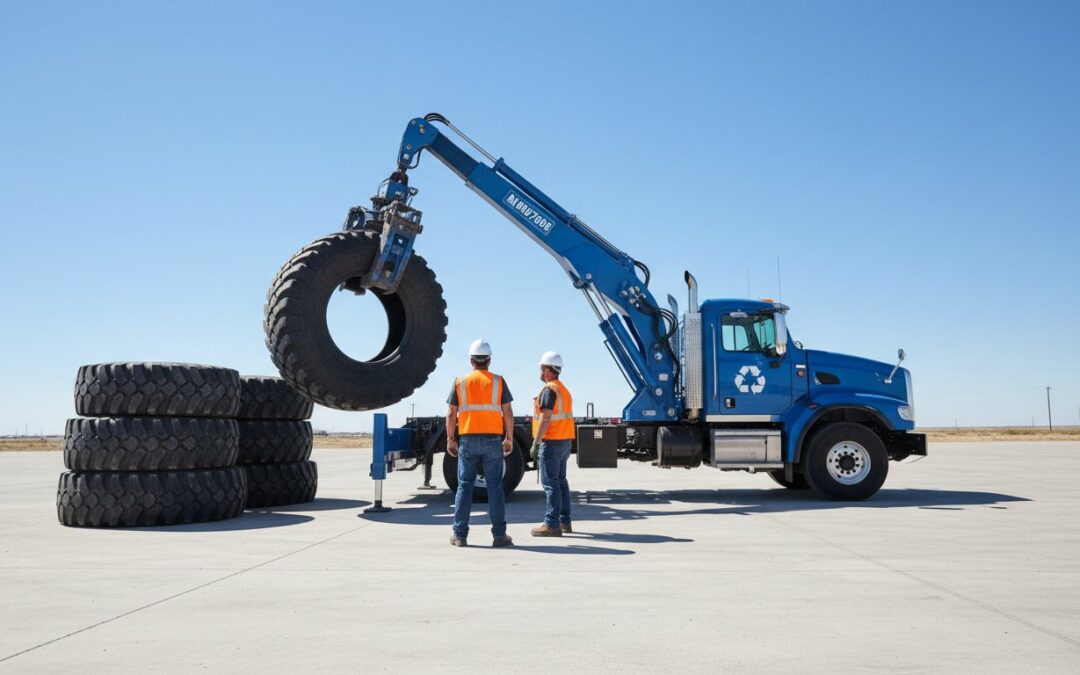
Disposal needs in Midland go far beyond standard passenger car tires. The industrial landscape requires a service that can manage diverse rubber materials. Tire recycling begins with the organized collection of various tire grades, including semi-truck tires and massive agricultural equipment tires. We also specialize in Off-the-Road (OTR) tires, which can weigh over 4,000 pounds each and require specialized cranes for loading.
- Commercial Tires: Bulk loads of semi-truck, bus, and delivery van tires.
- OTR Tires: Heavy equipment tires from mining, earthmoving, and oilfield machinery.
- Non-Tire Rubber: Industrial conveyor belts, high-pressure hoses, and solid rubber padding used in vibration dampening.
- Agricultural Rubber: Tractor tires and harvester tracks from surrounding farming operations.
The Role of a Permitted Hauler in West Texas
In Texas, hauling more than five scrap tires requires a formal registration with the state. This isn’t just a bureaucratic hurdle; it’s a safety measure. Scrap rubber is a significant fire hazard and a breeding ground for mosquitoes if left in the Midland heat. A permitted hauler follows strict protocols to ensure these materials reach certified shredding or recycling plants rather than illegal dump sites. This process keeps our local groundwater and soil safe from the toxins released during rubber degradation.
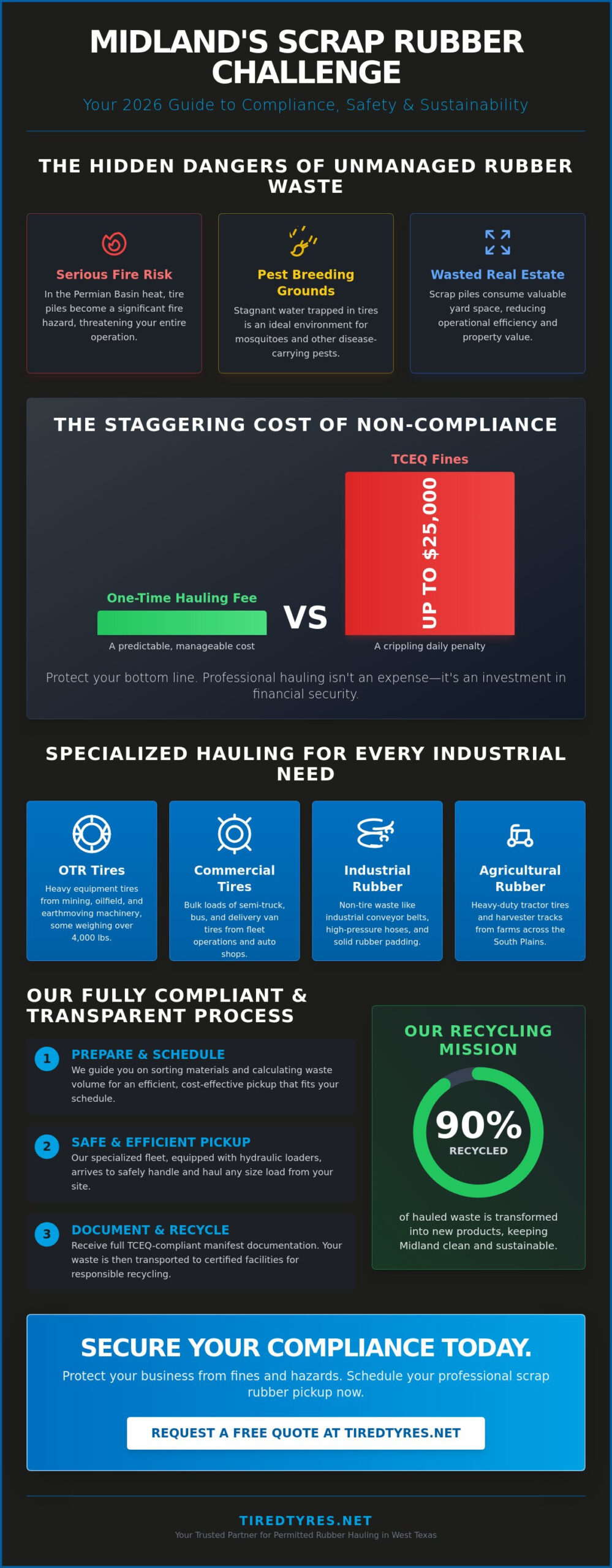
A permitted hauler acts as the legal bridge between waste generation and certified recycling. By using a legitimate scrap rubber hauling service Midland companies avoid the $10,000 daily fines often associated with TCEQ violations. We provide the peace of mind that comes with knowing your waste is being handled by experts who prioritize West Texas environmental health and safety standards.
Why Midland Businesses Need Specialized Rubber Removal
Midland’s climate isn’t kind to abandoned rubber. During the 2025 summer season, West Texas saw record-breaking heat that turned static tire piles into significant liabilities. Storing bulk rubber isn’t just an eyesore; it’s a direct threat to your bottom line. When you hire a professional scrap rubber hauling service Midland, you’re protecting your yard from more than just clutter. It’s about safety and financial survival in a tightening regulatory market.
The most common objection we hear involves the upfront cost of hauling. However, the math doesn’t support waiting. TCEQ administrative penalties for improper scrap tire storage can reach $25,000 per day. Comparing a one-time hauling fee to a recurring government fine makes the choice clear. Beyond the legal risks, property values in the Permian Basin industrial sectors are sensitive to site conditions. A clean, rubber-free yard signals a well-managed operation to potential partners or buyers. It’s hard to negotiate a top-tier lease or sale when your property is flagged for environmental hazards.
Fire Hazards and Pest Control in the Permian Basin
West Texas faces unique environmental challenges. Stagnant water trapped inside tires provides the perfect breeding ground for mosquitoes. In 2024, Lubbock and Midland reported increased mosquito activity, raising concerns about West Nile virus. Professional hauling acts as a proactive health strategy for your crew. Fire risk is the other major concern. Rubber fires in the heat of the Permian Basin burn at extreme temperatures and are notoriously difficult for local departments to extinguish. Once a pile ignites, the environmental cleanup costs often exceed the value of the property itself. Removing these piles is essential risk management for any industrial site.
Regulatory Compliance: The Scrap Tire Manifest
Compliance isn’t optional in Texas. Every business owner must understand the TCEQ manifest system. This document tracks the movement of tires from your site to a permitted processor. While the EPA offers a broad overview of state scrap tire laws and regulations, Texas enforcement is particularly strict about record-keeping. You’re responsible for your waste until it reaches its final destination. You can find a deeper dive into these requirements in our Texas Tire Disposal Regulations: A 2026 Guide for West Texas Businesses. Keeping these records for at least three years protects you during surprise inspections.
Professional hauling also transforms waste into a resource. Most rubber collected in Midland now enters recycling channels to become tire-derived fuel or rubberized asphalt for Texas highways. This shift helps the local economy and reduces the strain on our landfills. If you’re ready to clear your site and ensure you’re fully compliant, we can help you manage your bulk rubber disposal quickly and efficiently.
Comparing Hauling Solutions for Different Industries
Industrial waste in West Texas isn’t uniform. A standard box truck might work for a small tire shop, but it’s useless for a 2,000-pound OTR tire from a mining site. A professional scrap rubber hauling service Midland relies on must adapt to these specific demands. One-size-fits-all approaches fail because they don’t account for the weight and volume of industrial rubber. In 2026, efficiency depends on matching the right equipment to the specific rubber type.
Auto shops and oilfield services represent two ends of the logistics spectrum. While a dealership needs frequent, small-scale pickups, an oilfield site might require a massive one-time clearance of heavy-duty materials. Farmers in the South Plains face their own set of challenges. Large tractor tires and center pivot rubber often accumulate in fields because standard trash services refuse to touch them. By 2026, Texas environmental standards have made proper disposal a requirement for farm audits, making professional hauling a necessity rather than an option.
Oilfield and Industrial Rubber Logistics
Oilfield operations generate unique waste that requires specialized handling. We’re talking about reinforced industrial hoses and worn-out skid steer tracks that can weigh hundreds of pounds each. These items don’t stack neatly. Loading solid rubber waste requires heavy-duty trailers and hydraulic lifts. Midland-based processing plants often deal with miles of spent conveyor belts. You can’t just throw these in a dumpster. They require high-capacity hauling to prevent site clutter and fire hazards. Our teams use specialized loading equipment to ensure these heavy materials are moved safely and quickly.
Commercial Tire Programs for Auto Dealers
Auto dealers and high-volume tire shops face different pressures. High turnover means tires pile up fast. A shop handling 40 tire changes a day can quickly lose its storage space. Professional hauling keeps the bays clear and the workflow moving. It’s not just about cleaning; it’s about maximizing your shop’s square footage. We offer both scheduled and on-call services to fit your specific inventory cycles. For a deeper look at business-specific programs, check out our Commercial Tire Disposal in Midland, Odessa & Lubbock: The 2026 Guide.
Mining and construction sites present the most significant logistical hurdles. Handling high-volume OTR (Off-the-Road) and track waste requires a scrap rubber hauling service Midland companies trust for heavy lifting. These tires can exceed 10 feet in diameter. Moving them requires:
- Flatbed trailers with reinforced decking
- Specialized cranes or heavy-duty forklifts for loading
- Strict adherence to weight limits for Permian Basin roadways
- Coordinated logistics to minimize site downtime
Choosing the wrong hauling partner leads to delays and potential fines. Whether you’re managing a fleet of skid steers or a retail tire shop, your hauling solution should be as specialized as the equipment you use.
How to Prepare for a Bulk Rubber Pickup in Midland
Midland’s industrial growth in 2026 demands efficient waste management. Preparing for a bulk pickup isn’t just about clearing space. It’s about logistics and safety. First, assess the total volume. A standard 53-foot trailer typically holds between 1,300 and 1,500 passenger tires. If your pile contains industrial belts or OTR tires, the weight limit will be reached long before the trailer is physically full. Providing a scrap rubber hauling service Midland provider with accurate dimensions (Length x Width x Height) ensures they send the right equipment.
Sorting is the next priority. Keep passenger tires separate from industrial rubber and conveyor belts. Processing facilities often have different intake lines for these materials. Mixing them can lead to additional sorting fees or even rejection at the gate. When requesting a quote, provide clear photos of the pile and a description of the rubber types. This transparency prevents unexpected costs on the day of the haul.
Site Access and Loading Requirements
Large hauling trailers need room to maneuver. Ensure there’s a 50-foot turning radius available for the tractor-trailer. Clear a 15-foot perimeter around the rubber pile to allow loading equipment to operate safely. You must remove “un-haulable” contaminants like metal rims, excessive dirt, or hazardous fluids. These items damage industrial shredders and are often prohibited by state regulations. For heavy OTR tires or thick industrial belts, ensure your on-site team follows strict safety protocols. These items often weigh over 2,000 pounds and require specialized heavy-lifting machinery.
Documentation and Final Inspection
Verify the hauler’s permit the moment they arrive at your Midland site. Legitimate transporters should carry a valid registration from the Texas Commission on Environmental Quality (TCEQ). This protects your business from illegal dumping penalties. The manifest is your most important document. Signing it completes the liability transfer, proving you’ve disposed of the waste responsibly. After the trailer is loaded, perform a final walkthrough. Leaving behind even 5% of the scrap can attract pests or lead to fire code violations.
Tired Tyres: Midland’s Trusted Partner for Rubber Hauling
Managing bulk waste requires more than just a truck; it demands a deep commitment to the community. Tired Tyres operates with a clear mission to keep Midland, Odessa, and Lubbock clean and compliant with evolving environmental standards. As we move into 2026, the Permian Basin faces stricter oversight regarding industrial waste. We provide a professional scrap rubber hauling service Midland businesses rely on to stay ahead of these regulations. Our team handles the heavy lifting so you can focus on your primary operations without worrying about municipal fines or disposal backlogs.
Our recycling initiative is the backbone of our service. We’ve optimized our logistics to ensure that 90% of the hauled waste we collect is transformed into new, functional products. This isn’t just a goal; it’s our standard operating procedure. By choosing a local partner, you’re supporting a circular economy that keeps West Texas productive and sustainable. We offer custom hauling solutions tailored to the specific needs of Permian Basin industrial and commercial clients, whether you’re clearing out a warehouse or managing ongoing site waste.
Serving the Heart of West Texas
Local expertise is our greatest asset. National waste conglomerates often struggle with the specific municipal disposal rules found in Midland and Odessa. We know these regulations inside out. Our specialized fleet is designed specifically for industrial rubber and bulk tire collection, allowing us to navigate tight commercial spaces and heavy industrial sites with ease. We don’t treat your business like a number on a spreadsheet. We understand the regional terrain, the weather challenges, and the urgency of West Texas commerce. This proximity allows us to offer faster response times and more flexible scheduling than any national provider.
From Hauling to Recycling: The Full Circle
The journey doesn’t end when our trucks leave your property. We track every load to ensure professional processing. Once we haul the material, it follows a path toward becoming rubber mulch for landscaping or high-durability rubber-modified asphalt for regional roads. This process significantly reduces the burden on West Texas landfills, which are already reaching capacity in many counties. By diverting thousands of tons of rubber annually, we help preserve our local environment for future generations. It’s a practical, efficient system that turns a liability into a resource.
Ready to clear your site? It’s time to partner with a team that values your time and the local environment. Contact Tired Tyres for a hauling quote in Midland today. We provide transparent, no-nonsense estimates that help you plan your budget effectively. Don’t let scrap rubber pile up; let our scrap rubber hauling service Midland experts handle the logistics for you.
Streamline Your Bulk Rubber Disposal Strategy
Managing bulk rubber waste shouldn’t be a headache for your Midland operation. Success in 2026 requires a partner that understands the technical demands of OTR and industrial rubber. We use specialized equipment designed specifically for these heavy loads, ensuring your site stays clear and compliant. Choosing a TCEQ State Permitted Hauler protects your business from liability while supporting local sustainability goals. We’re proud that 90% of the rubber we haul is recycled, turning your waste into a resource for new products. Finding a reliable scrap rubber hauling service Midland companies can depend on means prioritizing both efficiency and environmental responsibility. It’s time to move those old piles and reclaim your workspace. Our team handles the heavy lifting so you can focus on your daily operations. We’ve built our reputation on being a helpful, professional partner for local industries that don’t have time for delays.
Get a Professional Hauling Quote for Your Midland Business
Let’s get your facility back to peak efficiency today.
Frequently Asked Questions
Do I need a permit to have scrap tires hauled from my Midland business?
You don’t need a personal permit to hire a scrap rubber hauling service Midland professional, but the transporter must hold a valid TCEQ registration. Texas law requires any business generating over 500 tires annually to verify their hauler’s credentials before any removal begins. We handle all the documentation so your Midland facility stays fully compliant with 2026 state environmental standards.
What types of industrial rubber can be hauled away besides tires?
We haul various industrial materials including reinforced conveyor belts, hydraulic hoses, and large scale gaskets used in Permian Basin extraction sites. Industrial rubber accounts for 40% of non-tire waste in the Midland region. We also process thick rubber matting and heavy duty dock bumpers. Our team ensures these specific materials are cleared from your yard quickly to prevent potential safety hazards.
How much does a scrap rubber hauling service cost in Midland?
Costs for a scrap rubber hauling service Midland depend on total volume, material type, and site accessibility. While we don’t set a flat fee here, industry data from 2024 suggests bulk tire disposal often ranges between $200 and $600 per ton depending on the processing facility’s current gate fees. Contact us for a specific quote based on your site’s current inventory and the specific rubber types you have.
Can you haul OTR tires and skid steer tracks from oilfield sites?
We specialize in hauling heavy OTR tires and reinforced skid steer tracks directly from active oilfield locations. These items often weigh over 2,000 pounds each and require specialized loading equipment for safe transport. Our fleet is equipped with the necessary machinery to lift and move these oversized items without damaging your site. We currently serve 15 different oilfield service hubs across the greater Midland area.
What is a TCEQ scrap tire manifest and why do I need one?
A TCEQ scrap tire manifest is a mandatory state document that tracks the movement of tires from your site to the final disposal facility. Texas Administrative Code Title 30 requires this documentation for all commercial hauling activities. It proves you disposed of the waste legally and responsibly. We provide completed copies of Form 20097 for your records to ensure you pass any state environmental audits without issues.
Is there a limit to the amount of rubber waste you can haul in one trip?
Our standard 53-foot trailers can accommodate approximately 2,000 passenger tires or 24 tons of shredded rubber in a single trip. Smaller 26-foot box trucks are available for tighter urban sites in Midland where space is limited. We coordinate the fleet size based on your specific volume and site constraints. This ensures we clear your entire stockpile in the fewest trips possible to maximize efficiency.
What happens to the rubber after it is hauled away from my site?
Most rubber we haul is transported to regional processing plants where it’s shredded for use as Tire Derived Fuel or crumb rubber. In Texas, 85% of collected scrap tires are diverted from landfills for these specific industrial purposes. Your waste might end up in new asphalt or as protective playground surfacing. This sustainable process keeps local Midland landfills free of bulky, non-biodegradable materials that take up space.
How do I schedule a bulk rubber pickup in Odessa or Lubbock?
You can schedule a bulk pickup in Odessa or Lubbock by calling our central dispatch or using our online booking portal. We typically provide a firm service date within 24 hours of your initial inquiry to keep your project moving. Our teams operate across the entire Permian Basin every week. Simply provide your site coordinates and an estimated tire count to get your haul on our 2026 calendar.