

In April 2026 alone, the Texas Commission on Environmental Quality approved more than $1.4 million in fines against 88 regulated entities. For commercial operations in Midland and Odessa, a simple mistake in waste disposal can quickly escalate into a State Jail Felony with penalties reaching $10,000 per violation. You need a reliable way to avoid illegal dumping fines Texas authorities strictly enforce, especially as regulations around scrap tire and rubber disposal become more complex.
It’s understandable to feel overwhelmed by the five-part manifest system and the strict three-year record retention rules. You want to focus on your core operations, not worry about whether your paperwork will survive a surprise TCEQ audit. This 2026 compliance guide provides the clarity you need. You’ll learn the specific legal requirements for disposing of everything from semi-truck and OTR tires to scrap conveyor belts and hoses. We’ve included a practical checklist to ensure your documentation is airtight, protecting your business from liability and high-stakes legal fees. By the end of this article, you’ll have a clear strategy to keep your site compliant and your business secure.
Key Takeaways
- Understand the legal definition of “abandonment” and why keeping scrap rubber on your property can trigger heavy citations.
- Learn how to avoid illegal dumping fines Texas authorities calculate based on material weight and volume, which can reach $10,000 per violation.
- Discover why the TCEQ five-part manifest is your most important legal shield against liability during a state audit.
- Follow a step-by-step checklist to audit your storage area for vector compliance and verify hauler registration status.
- See how professional collection services for OTR tires and scrap rubber can handle manifest management to keep your records airtight.
What Qualifies as Illegal Dumping in Texas?
The primary law governing waste in the Lone Star State is the Texas Health and Safety Code, specifically Chapter 365, also known as the Texas Litter Abatement Act. Many business owners believe that as long as they aren’t dumping tires in a ditch or on a backroad, they are safe from prosecution. This is a dangerous assumption. Illegal dumping includes any disposal, transport, or storage of solid waste at a location that isn’t a state-authorized facility. If you want to avoid illegal dumping fines Texas law enforcement is increasingly active in issuing, you must understand that “abandoning” materials on your own commercial property is often treated as a criminal act.
There’s a significant difference between simple littering and commercial-scale dumping. While tossing a single bag of trash is a Class C misdemeanor, commercial dumping for economic gain carries much harsher penalties. This applies to any business that disposes of waste to save on tipping fees or hauling costs. Common violations that business owners often overlook include:
- Transporting scrap rubber to a site that doesn’t have a TCEQ permit.
- Storing more than 500 scrap tires on the ground without a storage site registration.
- Failing to produce a valid manifest when a peace officer or TCEQ inspector asks for disposal records.
A common misconception is that a “neat” pile isn’t a violation. Even if you stack your scrap semi-truck tires or OTR tires in an organized manner behind your shop, it’s still considered illegal dumping if the site isn’t permitted for long-term storage. If the material isn’t moving through the legal manifest system, the state views it as abandoned waste.
The Legal Definition of Solid Waste
Texas law classifies scrap tires and industrial rubber as “Special Waste.” This category requires specific handling because these materials don’t degrade like standard refuse and pose unique fire risks. This classification extends beyond just passenger tires. It includes scrap skid steer tracks, industrial hoses, and scrap conveyor belts. According to 2026 TCEQ standards, an unauthorized site is any location that lacks a valid permit or registration to receive, process, or store solid waste for more than 48 hours. If you hold these items longer without a permit, you’re technically operating an illegal dump site.
Why West Texas is a Target for Enforcement
The Permian Basin has seen unprecedented industrial growth, leading to a surge in scrap rubber from heavy machinery and fleet operations. Consequently, Midland and Odessa have become focal points for environmental enforcement. Local vector control departments are especially vigilant. They identify illegal tire piles because they serve as breeding grounds for mosquitoes and rodents that carry disease. Beyond the health risks, abandoned rubber poses a threat to our local groundwater. Chemicals from degrading tires can leach into the soil, creating long-term environmental liabilities. Understanding these risks is the first step to ensure you avoid illegal dumping fines Texas authorities use to protect our water and public health.
The Cost of Non-Compliance: Fines and Penalties in 2026
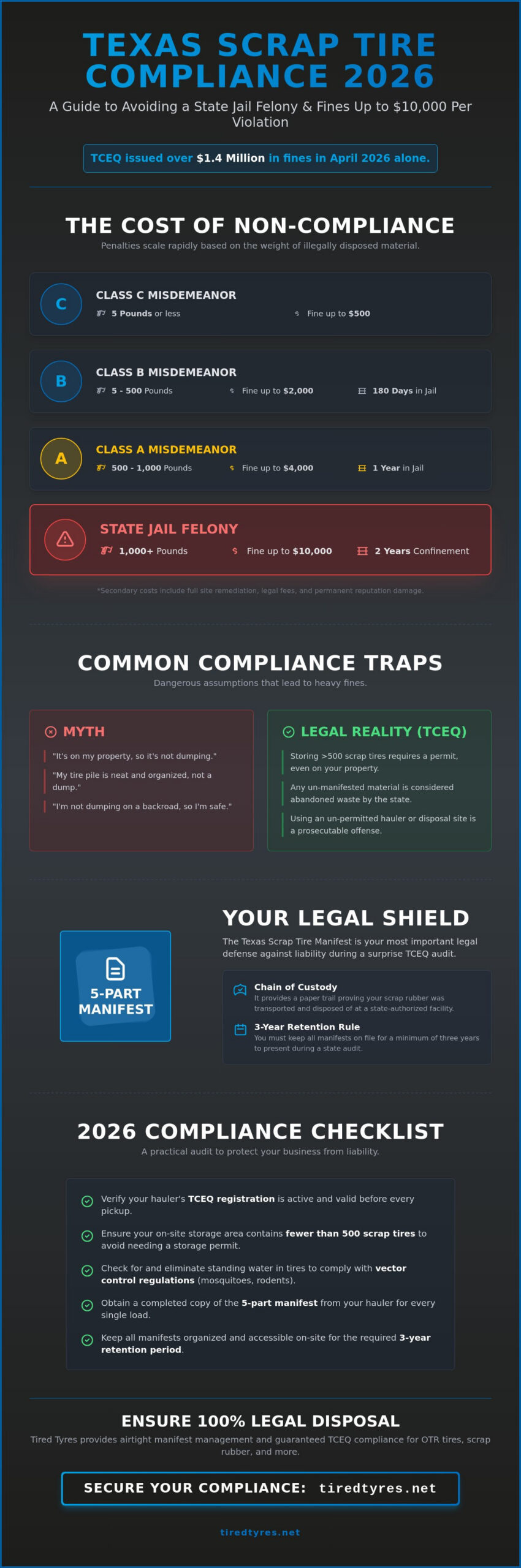
Texas doesn’t take environmental violations lightly. In April 2026, the TCEQ approved over $1.4 million in fines against 88 regulated entities. To avoid illegal dumping fines Texas law imposes, you must realize that penalties scale rapidly based on the weight and volume of the material. For commercial operations, the threshold for a felony is surprisingly low. While an individual might face a misdemeanor for a few bags of trash, a business disposing of more than 200 pounds of scrap rubber for economic gain can be charged with a State Jail Felony.
The state uses a tiered system to determine punishment under the Texas Health and Safety Code § 365.012. These are the current standards for 2026:
- Class C Misdemeanor: A fine up to $500 for dumping 5 pounds or less.
- Class B Misdemeanor: Up to $2,000 and 180 days in jail for weights between 5 and 500 pounds.
- Class A Misdemeanor: Up to $4,000 and one year in jail for weights between 500 and 1,000 pounds.
- State Jail Felony: Up to $10,000 and two years of confinement for 1,000 pounds or more.
Beyond the immediate fines, the secondary costs are often what sink a business. You are responsible for the total cost of remediation. If the state has to clean up a site you were involved with, they will bill you for every hour of labor and equipment used. Additionally, a public felony conviction permanently damages your reputation with clients and partners in the Permian Basin.
Class A and Class B Misdemeanors
Jail time becomes a real possibility the moment waste exceeds five pounds. If the dumped material is designated as hazardous or if it’s contained in a closed barrel, the state often pursues the highest possible penalty category. Multiple violations are especially dangerous. Texas law allows for compounded daily fines; this means you could be fined for every single day the waste remains at an unauthorized site. These costs accumulate faster than most businesses can settle them.
Commercial Liability and the ‘Generator’ Rule
The most critical concept for fleet managers to understand is that you are responsible for your waste from “cradle to grave.” Even after you pay a hauler to take your semi-truck or OTR tires, you remain legally liable for where they end up. Hiring an unpermitted “independent” hauler because they offer a lower price is a massive legal risk. If they dump your scrap rubber in a Lubbock County field, the TCEQ will trace the waste back to you as the generator. You’ll face the same felony charges as the person who actually pulled the trigger on the dump. Working with a registered partner is the only way to ensure your liability ends when the tires leave your gate.
The Texas Scrap Tire Manifest System: Your Legal Shield
The TCEQ scrap tire manifest is more than just a receipt. It is a legally binding document that proves your business complied with state law. To avoid illegal dumping fines Texas inspectors issue during audits, you must ensure every load of scrap rubber leaving your facility is documented. This five-part form tracks the waste from the moment it’s loaded until it reaches its final, permitted destination. Without this paper trail, you have no way to prove you didn’t dump the material yourself. If the tires are found in a ditch, and you don’t have a manifest showing they were legally hauled away, the state will hold you responsible.
The system relies on a three-part verification process. As the generator, you fill out the first section. The transporter signs the second, and the authorized facility signs the third upon arrival. This chain of custody ensures that liability is transferred correctly. If a hauler refuses to provide or sign a manifest, stop the transaction immediately. This is a major red flag. It usually means they aren’t registered with the TCEQ and likely intend to dump your tires illegally to avoid tipping fees. Don’t risk your business’s future on an unrecorded handshake deal.
Verified TCEQ regulations published on February 18, 2026, require all manifests and related documentation to be retained for three years. These records must be made available to the TCEQ or local law enforcement upon request. If you can’t produce a manifest for a collection that happened two years ago, you could still face significant penalties. Keeping a clean, organized filing system for these documents is just as important as the disposal itself.
Chain of Custody Requirements
Tracking the journey of your scrap rubber requires diligence. You should always verify a hauler’s TCEQ registration number before they touch a single tire. This number confirms they are authorized to transport special waste on Texas roads. For a deeper look at these requirements, read our guide on Texas Tire Disposal Regulations. Following these steps ensures your scrap skid steer tracks or semi-truck tires reach a permitted recycling facility rather than an unauthorized site. A valid manifest is the only proof that the chain of custody remained intact.
Audit Protection for West Texas Businesses
Organizing your disposal records is essential for surviving a surprise inspection in Ector or Lubbock County. Local environmental officers often look for gaps in manifest sequences. If you have 100 tires on-site but only have manifests for 20, you’ll have some explaining to do. Professional collection services help by managing the paperwork for you and providing copies of every transaction. In 2026, digital manifest tracking has become the industry standard. It provides a searchable, timestamped record that is much harder to lose than a physical carbon copy. This level of organization is your best defense against an aggressive state audit.
2026 Compliance Checklist for Avoiding Dumping Fines
Proactive management is the only way to avoid illegal dumping fines Texas inspectors levy against commercial operations. Waiting for an audit to fix your processes is a recipe for a $10,000 penalty. Use this five-step checklist to ensure your facility stays on the right side of the law.
- Step 1: Audit your storage area. Check for standing water and vector issues. In West Texas, local inspectors prioritize piles that could breed mosquitoes or harbor rodents.
- Step 2: Verify TCEQ registration. Never hire a hauler without checking the TCEQ Central Registry. An active registration number is your first line of defense.
- Step 3: Enforce a manifest-only policy. Every load of scrap rubber, from passenger tires to OTR tires, must have a signed five-part manifest before it leaves your property.
- Step 4: Train your team. Many violations happen because an employee makes a “side-deal” with an unpermitted hauler. Ensure every staff member understands that “giving away” tires is a legal liability.
- Step 5: Maintain a regular pickup schedule. Stockpiling more than 500 tires on the ground requires a specific TCEQ storage site registration. Regular collections keep your inventory below this threshold.
Storage Standards to Prevent ‘Nuisance’ Citations
In Odessa, vector control officers are particularly aggressive about standing water. If you store semi-truck or agricultural tires outdoors, they must be covered or stacked to prevent rain collection. Midland fire marshals also enforce strict “fire breaks” or distances between bulk tire piles and buildings. OTR and agricultural tires require specialized storage because their size makes them difficult to move quickly in an emergency. Keeping these large-scale items organized shows inspectors that you’re running a professional, compliant operation.
Vetting Your Disposal Partner
Before you sign a contract, ask where your waste is going. A reputable partner will tell you if the tires are headed for a shredding facility, a recycler, or a permitted monofill. You should also ask to see their most recent TCEQ annual report. For more details on choosing a provider in the Permian Basin, see our guide on Commercial Tire Disposal. If you’re ready to clear your site now, you can schedule a compliant scrap rubber collection with our team to ensure your manifests are handled correctly from day one. We focus on transparent, documented disposal so you don’t have to worry about surprise citations.
How Tired Tyres Ensures 100% Legal Disposal
Tired Tyres operates as a fully permitted and registered TCEQ tire hauler. This registration is the foundation of our service and your primary defense against liability. We provide the professional documentation you need to avoid illegal dumping fines Texas authorities enforce through rigorous 2026 audit programs. Our team handles the entire manifest process from start to finish. We ensure every passenger, semi-truck, and OTR tire is tracked from the moment it leaves your gate until it reaches a state-authorized facility. You don’t have to guess if your waste was handled correctly; you’ll have the signed paperwork to prove it.
Our fleet is equipped with specialized machinery designed for the specific challenges of industrial rubber collection. We don’t just pick up standard tires. We provide dedicated collection for scrap skid steer tracks, scrap hoses, and scrap conveyor belts. These materials often create storage headaches for industrial sites and farms in the Permian Basin. Because we understand the “Special Waste” classification for industrial rubber, we ensure these items are processed according to the latest environmental standards. Whether it’s a single load of agricultural tires or a recurring pickup of scrap solid tires, we maintain the same level of regulatory precision.
Professional Collection in Midland, Odessa, and Lubbock
Reliable scheduling is essential for staying below the 500-tire storage limit that triggers additional TCEQ registrations. We serve the specific needs of Midland, Odessa, and Lubbock with a focus on efficiency. We handle the “tough stuff” that general waste haulers often refuse, such as heavy OTR tires and bulk scrap rubber collection. Our goal is to keep your site clean and compliant. By providing transparent, digital manifest management, we make sure you’re always audit-ready. If an inspector visits your Lubbock or Ector County facility, you can produce the necessary chain-of-custody records in seconds.
Request a Compliance Consultation
Every business has different waste streams and disposal frequencies. An auto shop in downtown Lubbock requires a different approach than a large-scale industrial operation in Midland or a farm in the South Plains. We create customized collection plans that map directly to your operational volume. This professional approach to chain-of-custody significantly reduces your legal risks and protects your business reputation. Don’t leave your compliance to chance with unpermitted haulers. Contact Tired Tyres for a legal disposal quote today and let us take the burden of waste management off your shoulders.
Secure Your Compliance Strategy Today
Managing commercial waste in Texas requires more than just moving piles of rubber. It’s about the documented proof that your scrap semi-truck tires and industrial tracks reached a permitted destination. The state’s manifest system is your primary defense against aggressive enforcement. Without these records, you remain legally liable for every pound of material, even after it leaves your facility.
Implementing a consistent audit process and vetting your haulers are the most effective ways to avoid illegal dumping fines Texas authorities approve against businesses every month. Tired Tyres is here to take the complexity out of your environmental compliance. As a fully TCEQ Registered Hauler serving Midland, Odessa, and Lubbock, we provide full manifest documentation for every pickup. We ensure your records are airtight and your site stays clear of hazardous stockpiles.
Protect your business—Schedule a legal tire pickup with Tired Tyres today. You don’t have to navigate these regulations alone. With a professional partner handling your scrap rubber, you can focus on your business with total peace of mind.
Frequently Asked Questions
What are the specific fines for illegal tire dumping in Texas?
Fines are determined by the weight and volume of the discarded material. For commercial operations, dumping 200 pounds or more of scrap rubber for economic gain is a State Jail Felony, which carries fines up to $10,000 and two years of confinement. Smaller violations range from $500 for five pounds or less to $4,000 for amounts reaching 1,000 pounds. These penalties are designed to ensure businesses avoid illegal dumping fines Texas authorities strictly enforce.
Can I be fined if a hauler I hired dumps my tires illegally?
Yes, you remain legally liable under the “generator” rule. Texas law follows a “cradle to grave” responsibility model, meaning the business that created the waste is responsible for its final destination. If you hire an unpermitted hauler and they dump your semi-truck or OTR tires in an unauthorized location, the TCEQ can pursue you for criminal penalties and the full cost of site remediation.
How do I verify if a tire hauler is legally permitted by the TCEQ?
You should request the hauler’s unique TCEQ registration number and verify it through the TCEQ Central Registry database. Every legitimate transporter must maintain an active registration and file annual reports with the state. If a hauler cannot produce this number or refuses to sign a manifest, it’s a clear sign they aren’t authorized to handle special waste on Texas roads.
What is a scrap tire manifest and why do I need one?
A scrap tire manifest is a five-part tracking form that documents the journey of waste from your site to a permitted facility. It serves as your primary legal shield during a state audit. You need this document to prove that your scrap rubber was handled by a registered transporter and received by an authorized site. Without it, you have no evidence of legal compliance.
Is it illegal to store scrap tires on my own commercial property?
It is illegal to store more than 500 scrap tires on the ground or 2,000 in containers without a specific TCEQ storage site registration. Beyond these limits, even small piles can trigger citations if they aren’t managed for vector control. In Midland and Odessa, local inspectors often issue fines for “nuisance” piles that collect water and breed mosquitoes or harbor rodents.
How can I report illegal dumping in Midland or Odessa?
You can report violations to the TCEQ Region 7 office in Midland or contact local law enforcement environmental divisions. Providing specific details like the location of the dump, the type of waste, and any vehicle descriptions helps authorities investigate. Reporting illegal activity helps protect the local groundwater and maintains a fair market for businesses that follow the rules to avoid illegal dumping fines Texas law imposes.
Are the rules different for industrial rubber like conveyor belts?
Industrial rubber items like scrap conveyor belts, skid steer tracks, and hoses are classified as “Special Waste” and follow the same rules as tires. Because these materials don’t degrade and pose fire risks, they must be transported by registered haulers and documented through the manifest system. Failing to treat these items as special waste can lead to the same felony charges as illegal tire dumping.
What happens if I lose my tire disposal records?
Losing your records puts your business at high risk during a TCEQ inspection. Texas law requires you to keep all manifest documentation for at least three years and make it available upon request. If you can’t produce these records, the state may treat the missing waste as illegally dumped. It’s best to maintain digital backups of all manifests to ensure you’re always audit-ready.