
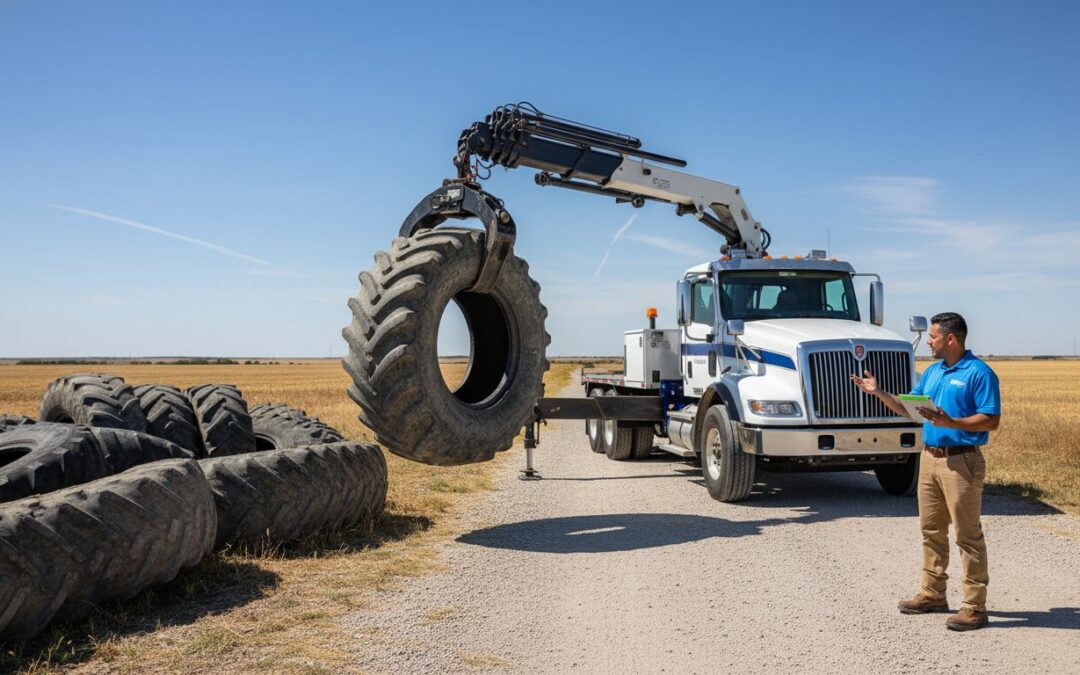
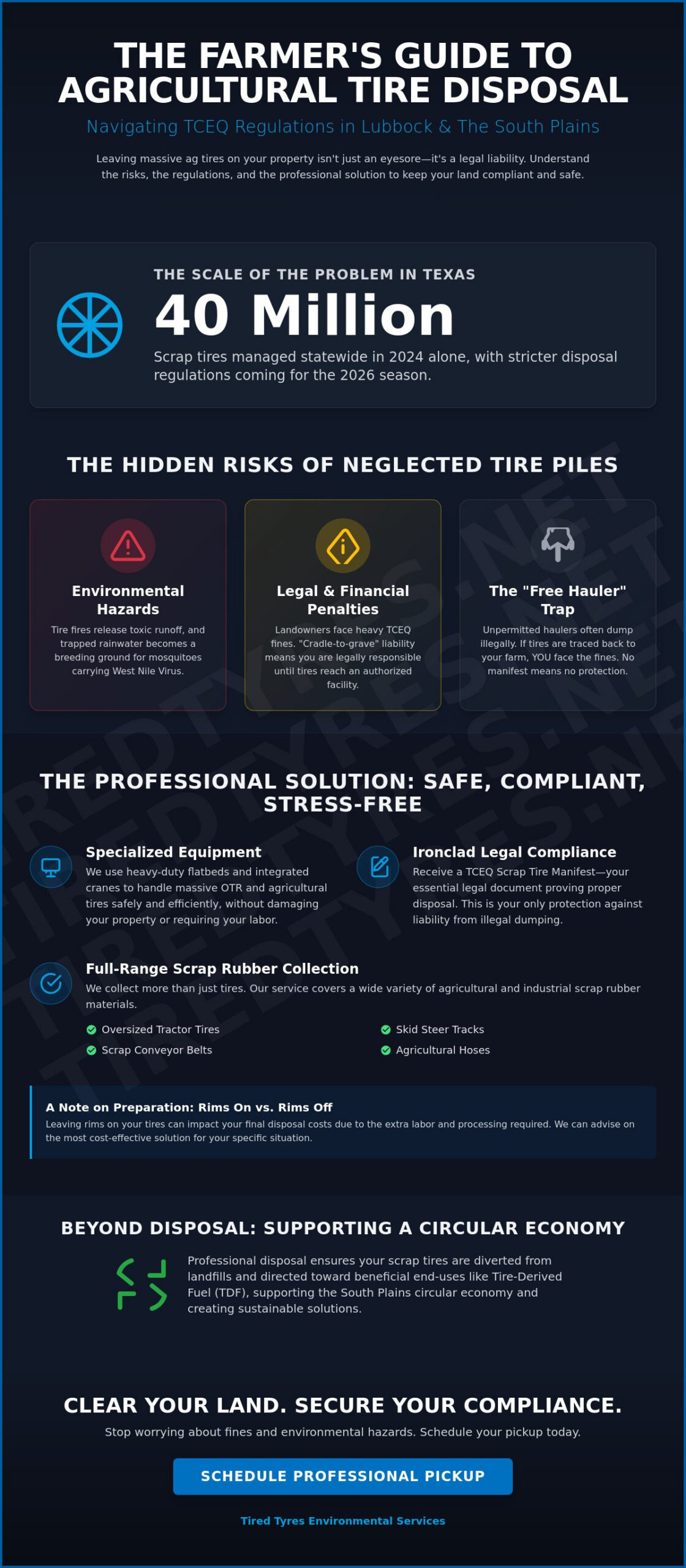
Leaving a pile of massive agricultural tires to rot on your property isn’t just an eyesore; it’s a legal liability that could trigger heavy TCEQ fines. In Texas, the state managed nearly 40 million scrap tires in 2024 alone, and the regulations for disposal have only tightened for the 2026 season. If you’re looking for a reliable farm tractor tire pickup Lubbock service, you’re likely dealing with weights that are impossible to move without specialized equipment. You need more than just a hauler. You need a partner who understands that the farmer remains legally responsible until those tires reach an authorized facility.
It’s frustrating when “free” haulers disappear or, even worse, dump your waste illegally, leaving you to face the consequences. This guide will show you how to clear your land efficiently while securing the legal manifest documentation you need to stay compliant. We’ll preview the 2026 TCEQ reporting requirements, explain the manifest system, and outline how to schedule a professional pickup for everything from oversized tractor tires to scrap conveyor belts and skid steer tracks. You’ll learn exactly what it takes to get your property back in order without the stress of regulatory audits.
Key Takeaways
- Understand why a TCEQ Scrap Tire Manifest is your essential legal protection against illegal dumping fines and state liability.
- Discover how a professional farm tractor tire pickup Lubbock service handles massive OTR and agricultural tires using specialized loading equipment.
- Learn the logistics of preparing your tire pile, including how the decision to leave rims on or off impacts your final disposal costs.
- Identify the full range of scrap rubber eligible for collection, including tractor tires, skid steer tracks, and agricultural hoses.
- Find out how professional disposal supports the South Plains circular economy by diverting scrap tires toward beneficial end-uses like tire-derived fuel.
Managing Agricultural Tire Waste in Lubbock and the South Plains
Agricultural tire disposal in Lubbock and the surrounding South Plains is more than just a cleaning task; it’s a regulated environmental service. Farmers across West Texas often deal with massive acreage where scrap rubber can accumulate unnoticed for years. These piles aren’t just an eyesore. They represent a significant environmental risk. In our semi-arid climate, a tire fire can be nearly impossible to extinguish, smoldering for weeks and releasing toxic runoff into the soil. Additionally, even a small amount of trapped rainwater makes these tires perfect breeding grounds for mosquitoes, which carry West Nile and other viruses common to the region. Scheduling a professional farm tractor tire pickup Lubbock service is the first step in mitigating these hazards before they become a liability.
Landowners face strict legal responsibilities under Texas state law. The Texas Commission on Environmental Quality (TCEQ) holds the “generator” of the waste responsible for where that waste ends up. If you own the land, you own the problem. Managing these materials correctly through proper Tire recycling channels ensures that your farm stays compliant and your land remains productive. Ignoring the pile only increases the risk of state-level inspections and potential fines that far outweigh the cost of professional collection.
The Scale of the Scrap Tire Problem in West Texas
Modern high-clearance tractors and harvesters use tires that are significantly larger than those from just a decade ago. A single rear tire from a modern combine can weigh several hundred pounds. Local municipal landfills in Lubbock County often refuse these oversized units or charge exorbitant “special waste” fees because they don’t fit in standard compactors. This creates a gap between active agricultural waste and abandoned piles. The sheer volume of rubber involved in a farm tractor tire pickup Lubbock project requires heavy-duty logistics that standard trash services simply can’t provide. Professional collectors use specialized equipment to handle these massive footprints without damaging your property.
Why “Free” Pickup is a Risk for Your Farm
It’s tempting to say yes to an independent hauler offering “free” or ultra-cheap pickup. However, unpermitted haulers often dump tires in Lubbock County ditches or remote canyons to avoid disposal fees. Because of “cradle-to-grave” liability, if those tires are traced back to your farm, you’re the one the TCEQ will contact. You are legally responsible for the tires until they are processed at an authorized facility. Choosing professional commercial tire disposal gives you the peace of mind that comes with a paper trail. You’ll receive the necessary manifest documentation to prove the tires were handled legally. It’s a small investment that protects your farm’s reputation and your bank account from the fallout of illegal dumping.
Professional Farm Tractor Tire Pickup Services in Lubbock
Professional agricultural tire collection is a specialized operation that goes far beyond standard hauling. In West Texas, the sheer scale of modern machinery means that tires aren’t just heavy; they’re logistically complex. A professional farm tractor tire pickup Lubbock service provides the heavy-duty equipment needed to manage these massive loads safely. Most standard trailers can’t handle the weight or dimensions of high-horsepower rear tires or combine rubber. Reliable service providers utilize specialized flatbeds and integrated cranes to lift and secure these materials without requiring the farmer to provide additional labor or machinery. This turnkey approach keeps your operation moving while we handle the heavy lifting.
Staying compliant with state law is the primary reason to choose a professional service. In Texas, any entity transporting scrap tires must be registered with the TCEQ. This registration ensures that the transporter follows strict environmental protocols and utilizes the required manifest system. When you schedule a professional pickup, you aren’t just hiring a truck; you’re securing a legal paper trail. This documentation proves that your scrap rubber was moved by a permitted professional and delivered to an authorized processing facility. It’s the only way to protect your farm from the liability of illegal dumping. If you’re ready to clear your equipment yard, scheduling an agricultural tire collection is the most efficient way to maintain a compliant worksite.
Types of Agricultural Tires We Collect
Our collection services cover the full spectrum of rubber used on the South Plains. This includes everything from small implement tires used on planters and drills to the massive rear tires found on high-clearance tractors. We also handle specialized high-flotation models and heavy-duty grain cart rubber designed for high load capacities. Beyond traditional pneumatic tires, we collect solid rubber irrigation tracks and scrap skid steer tracks. Whether you’re clearing out a single set of harvester tires or a decade’s worth of accumulated irrigation pivot rubber, professional collection ensures every piece is accounted for and processed correctly.
The Difference Between Passenger and Ag Tire Collection
Ag tires aren’t car tires. They’re massive industrial components that require a different approach to pricing and processing. While passenger tires are often collected by the unit, agricultural rubber is typically priced by weight. This is because a single OTR or tractor tire can weigh as much as twenty car tires combined. The processing requirements are also more intense. Large-scale tires require heavy-duty industrial shredders to break down the thick rubber and internal steel belts. Logistically, picking up from a remote field or a turnrow in Lubbock County is much more demanding than a city tire shop. Professional services are built to handle these rural challenges, ensuring that even the most remote equipment yards stay clean and hazard-free.
Logistics and Preparation: Getting Massive Tires Ready for Collection
Preparing for a scheduled collection is the best way to ensure the job is done quickly and safely. When you book a farm tractor tire pickup Lubbock service, the goal is to get the rubber off your property with zero complications. A well-organized staging area allows crews to load efficiently, which reduces the time heavy machinery spends on your land. Most farmers find that spending a short amount of time on site preparation prevents delays and ensures that weight measurements are as accurate as possible. Safety is the priority, so stacking tires in a stable, accessible location is the first step toward a successful cleanup.
Proper stacking prevents the pile from becoming a habitat for snakes or pests while it waits for collection. If you’re dealing with different sizes, keep the largest OTR and tractor tires at the bottom of the stack to create a stable base. This organization helps the grapple truck operator work faster and more safely. By following a few simple preparation steps, you can turn a hazardous stockpiling situation into a streamlined logistics operation that clears your land and keeps your farm in compliance with state regulations.
Removing Rims and Debris
Most processing facilities require tires to be removed from their metal rims before they’ll accept them for recycling. Processing equipment is designed for rubber, and steel rims can damage industrial shredders. Beyond the rims, many West Texas tractors use liquid ballast for added traction. You must drain any calcium chloride or beet juice before the collection crew arrives. These liquids add immense weight and can cause environmental spills during transport. It’s also vital to knock off heavy mud and dried soil. Since agricultural disposal is typically calculated by weight, clearing away dirt ensures you aren’t paying to dispose of West Texas earth along with your rubber.
Site Access Requirements for Collection Crews
Collection trucks are heavy. When they’re loaded with oversized agricultural tires, their weight increases significantly. You need to identify a staging area that offers enough clearance for large flatbeds and grapple trucks to maneuver. Avoid areas with low-hanging power lines or narrow gates that could snag a crane arm. One of the biggest risks on South Plains farms is soft or sandy ground. A loaded truck can easily sink into loose soil, leading to property damage or the need for heavy-duty towing. Choosing a staging area on a packed gravel road or a concrete pad is the safest option. Ensuring clear, stable paths for the equipment saves the farmer time and money by preventing logistical bottlenecks.
Legal Compliance: TCEQ Manifests and Avoiding Fines
In Texas, the law is clear: the person who generates the scrap tire is responsible for its final destination. This “cradle-to-grave” liability means that if a pile is found abandoned in a Lubbock County canyon or ditch, state authorities will trace it back to the original source. Understanding Texas tire disposal regulations is the only way to protect your farm from massive administrative penalties. For any farm tractor tire pickup Lubbock project, the most critical piece of paper you will handle is the TCEQ Scrap Tire Manifest. This document tracks the journey of every tire from your equipment yard to an authorized processing facility, ensuring the rubber is handled according to state environmental standards.
Record-keeping is a mandatory part of staying compliant. You must keep copies of these manifests for at least three years to prove proper disposal during a state audit. If your operation stores more than 500 scrap tires on the ground or 2,000 in enclosed containers, you are required to register as a storage site with the TCEQ. Registered generators must also submit annual status reports through the STEERS portal by December 31st each year. The TCEQ manifest stands as the only legal proof of proper disposal in Texas, serving as your ultimate defense against liability claims and environmental fines.
The Role of the Permitted Hauler
You shouldn’t trust your farm’s reputation to an unverified hauler with a trailer. Always check a transporter’s permit status through the state database before allowing them to load your scrap rubber. A legitimate service provider will always issue a state-approved manifest at the time of collection. Tired Tyres provides a state-approved manifest for every Lubbock pickup, ensuring your tires are accounted for every mile of the way. This professional documentation offers the “cradle-to-grave” legal protection you need to focus on your harvest instead of worrying about regulatory paperwork.
Lubbock County Specific Disposal Rules
Local ordinances in Lubbock County are particularly strict regarding stockpiles near residential zones or sensitive water areas like playa lakes. These piles are viewed as public health hazards because they harbor pests and pose a severe fire risk. If you are planning a property sale or a major farm cleanup, having your disposal receipts in order is vital for a smooth transaction and to avoid delays with local inspectors. To ensure your cleanup meets every state and local standard, schedule a professional agricultural tire collection today. A compliant farm tractor tire pickup Lubbock service is the most reliable way to clear your land while keeping your records perfect for the TCEQ.
Why Tired Tyres is Lubbock’s Trusted Partner for Ag Tire Disposal
Choosing a partner for agricultural waste management requires trust in their equipment and their word. Tired Tyres understands that Lubbock farmers operate on a scale that most urban haulers simply can’t imagine. We’ve built our service specifically around the heavy-duty needs of West Texas agriculture. When you schedule a farm tractor tire pickup Lubbock, you’re hiring a team that knows the difference between a standard front-end loader tire and a massive combine harvester unit. We have the specialized trailers and lifting cranes necessary to handle these loads without asking you to provide the labor. Our goal is to make the disposal process as invisible to your daily operation as possible.
Reliability is our hallmark. We know that when you call for a farm tractor tire pickup Lubbock, you need that space cleared for new equipment or seed storage. Our weight-based pricing model ensures that you only pay for exactly what we haul away. There are no hidden fees or surprise surcharges that haven’t been discussed upfront. This transparency is why so many operations across the South Plains trust us with their scrap rubber year after year. We also prioritize tire recycling because we live and work in this community. Diverting your waste into tire-derived fuel or crumb rubber applications supports a more sustainable South Plains and keeps our local environment clean for the next generation of farmers.
Local Expertise in the South Plains
Our team has deep roots in the Midland, Odessa, and Lubbock communities. This local presence means we understand the specific geography and rural road networks of Lubbock County better than any national provider. We don’t get lost looking for a turnrow or a remote equipment yard. Our drivers are experienced with the sandy soil and soft ground conditions that often trap less experienced crews. By maintaining direct access to the reliable tire disposal network across West Texas, we ensure that your tires are moved efficiently from your field to an authorized processing facility with zero delays.
Get a Quote for Your Lubbock Farm Today
Getting started is a straightforward process designed to save you time. You can estimate your total load weight by checking the manufacturer specifications on your tire sidewalls or using a standard weight chart for your tractor model. This helps us provide a more accurate initial estimate and ensures we send the right equipment for the job. Once you have a general idea of your inventory, simply reach out to our team to discuss your location and preferred pickup window. We’ll handle the manifest paperwork and the heavy lifting, leaving you with a clean property and full legal compliance. Contact Tired Tyres for a farm tire pickup quote in Lubbock and let us take the burden of scrap rubber off your hands.
Secure Your Property and Stay TCEQ Compliant
Clearing scrap rubber from your farm doesn’t have to be a logistical headache or a legal risk. By choosing a professional farm tractor tire pickup Lubbock service, you ensure that every oversized tire is handled with specialized equipment and documented through the proper channels. Your legal responsibility as a waste generator only ends when you have a state-approved manifest in hand. Proper site preparation and removing rims will save you time and ensure a seamless collection process during the busy 2026 season.
Tired Tyres is a TCEQ Permitted Transporter dedicated to serving the agricultural heart of Midland, Odessa, and Lubbock. We provide state-approved manifests for every load, giving you the cradle-to-grave protection your operation deserves. Don’t let old rubber become a fire hazard or a breeding ground for pests on your land. Our team is ready to handle the heavy lifting so you can focus on what matters most: your harvest.
Schedule Your Lubbock Farm Tire Pickup Now
Frequently Asked Questions
How much does it cost to pick up a tractor tire in Lubbock?
Disposal costs for agricultural tires are calculated by weight because their size varies significantly compared to standard passenger tires. You’ll receive a quote based on the total tonnage of your load. This weight-based approach ensures you’re paying a fair price for the exact amount of rubber being hauled away from your property.
Do you accept tractor tires that are still on the rim?
Tires must be removed from their metal rims before they can be collected for processing. Industrial recycling equipment is designed specifically for rubber and can be severely damaged by steel rims. Removing the rims before our crew arrives also allows for a faster loading process and more accurate weight measurements for your final invoice.
Can I drop off my farm tires at your Lubbock facility instead of a pickup?
We focus on professional on-site collection services to handle the logistical challenges of massive agricultural rubber. Our trucks are equipped with the necessary cranes and trailers to manage heavy loads directly from your equipment yard or field. This service saves you the trouble of finding specialized transport for oversized tires that don’t fit in standard trailers.
What happens to the agricultural tires after you pick them up?
Collected tires are transported to authorized processing facilities where they’re typically shredded for beneficial end-uses. Many agricultural tires in Texas are converted into tire-derived fuel for industrial kilns. Others are processed into crumb rubber for use in rubberized asphalt, sports turf, or livestock area surfaces, supporting a circular economy in the South Plains.
Is there a minimum number of tires required for a farm pickup in Lubbock County?
There isn’t a strict minimum tire count, but scheduling a farm tractor tire pickup Lubbock is most cost-effective when handling bulk loads. We recommend grouping your scrap rubber, including irrigation tracks and implement tires, into a single collection. This consolidation maximizes the efficiency of the heavy-duty equipment sent to your ranch or farm.
How quickly can you schedule a pickup for a large tire stockpile on a ranch?
Pickup availability depends on current seasonal demand and our existing routes through Lubbock County. We work to accommodate the busy planting and harvest schedules of our local farmers as efficiently as possible. Contacting us early allows for better coordination of the specialized grapple trucks and flatbeds required for large-scale agricultural cleanups.
Do you provide the required TCEQ manifest for every agricultural pickup?
Yes, we provide a state-approved TCEQ manifest for every load we transport. This document is your essential legal proof that the tires were disposed of at an authorized facility. Keeping these records on file protects your operation from potential fines and satisfies Texas state record-keeping requirements for scrap tire generators.
What should I do if my tires are filled with liquid ballast?
You must drain all liquid ballast, such as calcium chloride or beet juice, before the tires are ready for collection. Liquid-filled tires are too heavy for standard lifting equipment and pose environmental spill risks during transport. Ensuring your tires are dry and free of heavy mud helps maintain a safe work environment for the collection crew.