
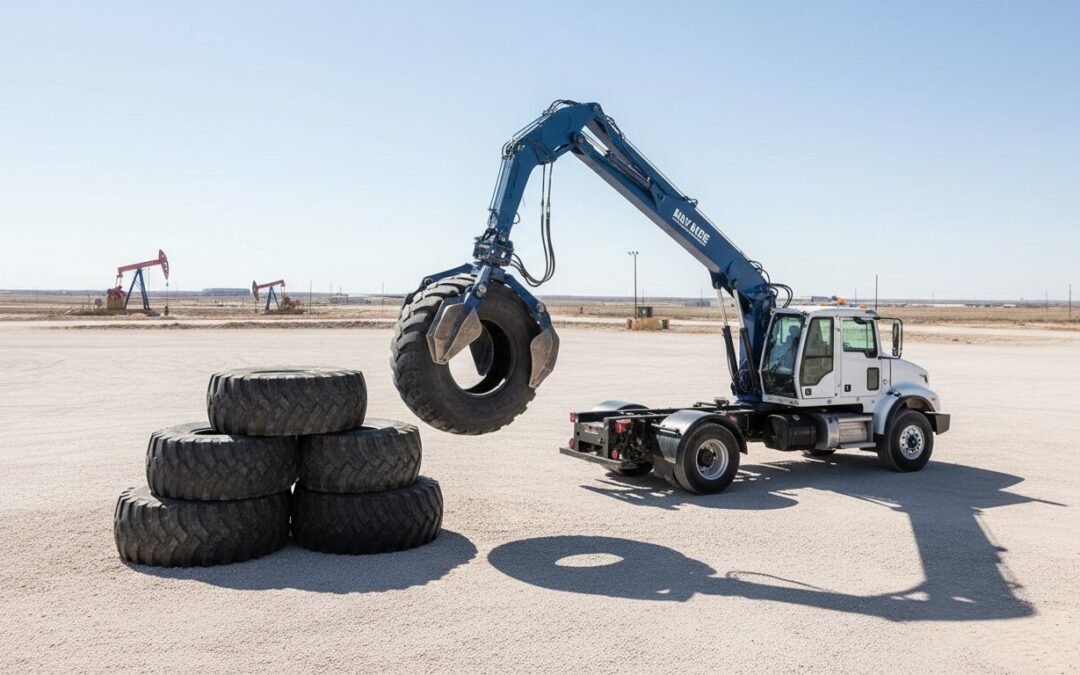
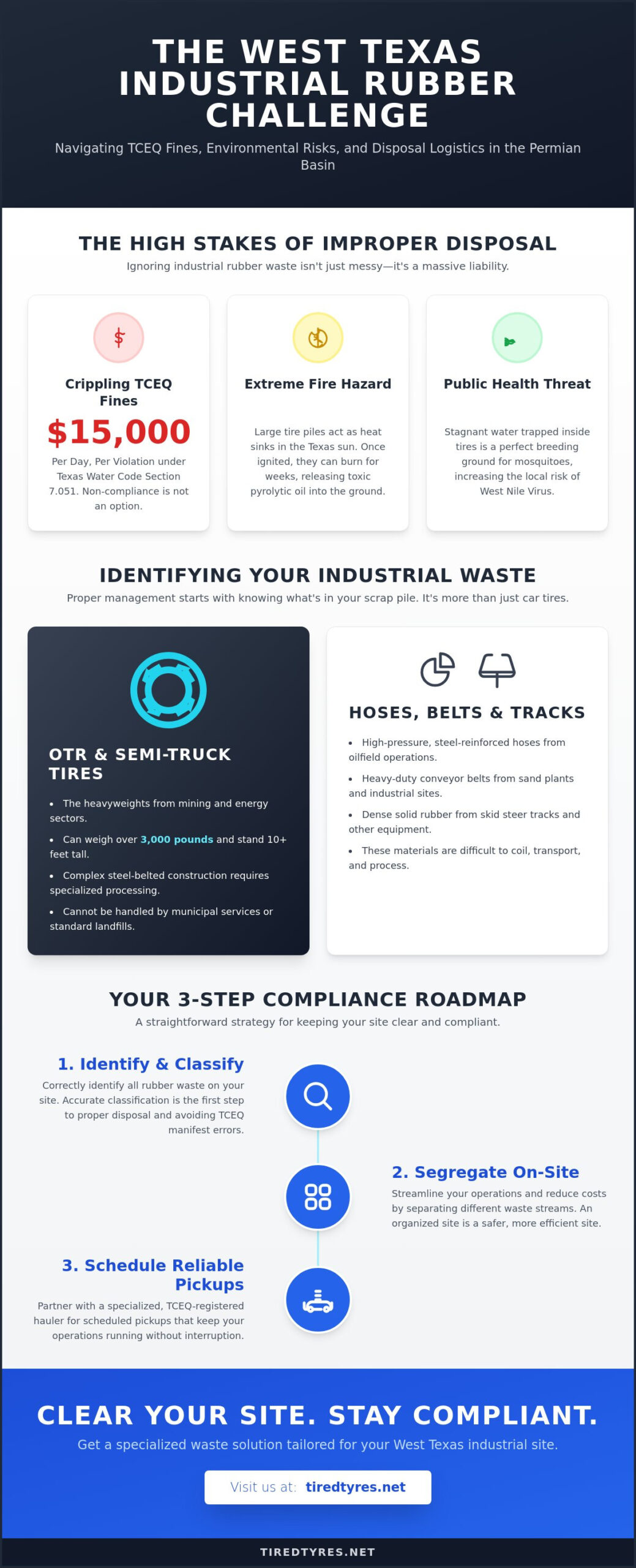
In West Texas, a pile of Off-The-Road (OTR) tires isn’t just an eyesore; it’s a ticking legal timebomb that can trigger TCEQ fines faster than a Permian Basin dust storm. You already know that keeping your industrial yard clear in Midland, Odessa, or Lubbock is a constant battle against space and safety regulations. Finding reliable West Texas industrial waste solutions means more than just hiring a general hauler. It requires a partner who understands that improper scrap management can lead to administrative penalties reaching $15,000 per day under Texas Water Code Section 7.051.
We’re here to help you navigate these complexities with a straightforward approach to industrial rubber waste. You’ll learn exactly how to master the latest 2026 TCEQ manifesting requirements and eliminate the fire and health risks associated with massive tire stockpiles. This guide provides a clear roadmap for maintaining full regulatory compliance, clearing your site of heavy-duty scrap, and establishing a scheduled pickup service that keeps your operations running without a hitch.
Key Takeaways
- Understand why specialized West Texas industrial waste solutions are essential for handling the high-volume rubber scrap generated by the energy and agricultural sectors.
- Identify the specific classifications of industrial rubber, including massive OTR tires, to ensure you select the correct disposal method for your site.
- Navigate the mandatory TCEQ manifest system with confidence to avoid heavy fines and ensure your tire transportation remains fully legal.
- Discover how on-site waste segregation and reliable scheduled pickups can streamline your operations and reduce long-term management costs.
- Gain insights into working with Permian Basin experts who provide the specialized logistics needed for heavy-duty rubber disposal.
The Growing Need for Specialized West Texas Industrial Waste Solutions
The Permian Basin produces more than just energy; it generates a massive volume of specialized debris. Industrial rubber waste in our region includes steel-reinforced hydraulic hoses, heavy-duty conveyor belts from sand plants, and the massive tires found on earthmoving equipment. Between 2010 and 2020, Midland and Odessa saw population increases of roughly 30% and 25% respectively. This rapid expansion has pushed local infrastructure to its breaking point. Standard municipal services simply aren’t built for this type of volume. Finding effective West Texas industrial waste solutions requires a partner who understands the unique demands of the energy and agricultural sectors.
Why General Waste Management Falls Short in the Permian Basin
Standard garbage trucks and residential haulers aren’t equipped for the oilfield. A single Off-The-Road (OTR) tire can weigh over 3,000 pounds. Standard hydraulic lifts on municipal trucks will fail under that load. Standard landfills also face tire surfacing issues where buried rubber eventually works its way back to the top of the cell. Because of this, many local facilities in the South Plains have strict limits or total bans on bulk rubber intake. Additionally, the TCEQ enforces Title 30 Texas Administrative Code Chapter 328. This code requires detailed manifesting for every scrap tire transported. General haulers often lack the specific registration or the paperwork systems to keep your business compliant with these state laws.
Local Environmental Impact in Midland, Odessa, and Lubbock
Improper storage in the South Plains creates immediate hazards. West Texas often experiences more than 100 days per year with temperatures exceeding 90 degrees Fahrenheit. Large tire piles act as massive heat sinks. Once ignited, a tire fire can burn for weeks and release toxic pyrolytic oil into the ground. In Lubbock County, stagnant water trapped inside tires provides the perfect breeding ground for mosquitoes. This increases the local risk of West Nile virus, which has been a recurring health concern in the region for over a decade. Tire recycling offers a controlled way to manage these risks. Instead of leaving rubber to degrade and leach chemicals into the soil, professional recovery turns a liability into a resource. By 2026, as Permian production is projected to reach new highs, having specialized West Texas industrial waste solutions will be a requirement for any site manager.
Beyond the Oilfield: Identifying Your Industrial Rubber Waste Types
Industrial rubber isn’t a single category of waste. In West Texas, the materials piling up on your site vary significantly in weight, composition, and legal handling requirements. While many people think only of car tires, the reality for site managers in Midland and Odessa involves much tougher materials. Effectively implementing West Texas industrial waste solutions begins with identifying exactly what is in your scrap pile. Each material requires a different logistical approach to ensure it doesn’t become a permanent fixture in your yard. By 2026, as industrial activity continues to climb, distinguishing between these waste streams is the only way to maintain an organized and compliant site.
OTR and Semi-Truck Tire Management
Off-the-Road (OTR) tires are the heavyweights of the energy and mining sectors. These tires, often found on loaders, graders, and haul trucks, can stand over 10 feet tall and weigh several tons. In the Permian Basin, OTR waste typically comes from large-scale earthmoving projects or mining operations. Because of their massive size and the heavy steel beads inside, you can’t dispose of them through traditional channels. You need a reliable tire disposal plan that manages both these giants and the high-volume semi-truck tires used by logistics fleets. Processing steel-belted tires is significantly more complex than handling solid rubber tires. Solid tires are incredibly dense, which complicates many industrial rubber recycling processes that rely on shredding or mechanical separation.
Scrap Hoses, Belts, and Skid Steer Tracks
Oilfield operations generate miles of high-pressure hoses every year. These hoses, used in fracking and drilling, are built with multiple layers of wire reinforcement to handle extreme pressure. Once they fail, they’re difficult to coil and even harder to transport. Conveyor belts from regional sand and aggregate plants present a similar logistical nightmare. These belts are designed to be nearly indestructible, meaning they won’t break down in a landfill and often require specialized shearing equipment for removal. Skid steer tracks are another common problem for construction and oilfield service companies. These tracks are a hybrid of thick rubber and internal steel cables. Most standard dumpsters in Lubbock or Odessa won’t accept them because they can damage the compactors on standard garbage trucks. If you’re dealing with an accumulation of these materials, you can consult with a specialist to clear your site efficiently and safely.
Navigating Texas Tire Disposal Regulations for Industrial Sites
Compliance isn’t just a suggestion in the Permian Basin; it’s a legal shield for your business. When you manage an industrial site in Midland or Lubbock, you’re responsible for every piece of rubber that leaves your gate. Understanding the latest Texas tire disposal regulations is the only way to ensure your company isn’t held liable for environmental mismanagement. The state doesn’t care if you hired a third party; if your tires are found in a ravine, the trail leads back to the generator. This makes choosing the right West Texas industrial waste solutions a critical operational decision rather than a simple janitorial task.
The Importance of the TCEQ Manifest
The Texas Commission on Environmental Quality (TCEQ) uses a strict manifest system to track scrap tires from the point of generation to the final disposal site. This five part form is your proof of legal compliance. To complete it correctly, you must record the name and registration number of the hauler, the specific number or weight of the tires, and the destination facility’s information. Under Texas law, you must retain these records for at least 3 years to pass a state audit. If a hauler cannot provide a signed manifest that shows the tires reached an authorized facility, you remain legally liable for that waste. Don’t risk your reputation on a handshake deal; ensure every load is documented.
Avoiding Fines and Legal Liabilities
Illegal dumping in Midland and Lubbock counties carries heavy penalties. Under the Texas Health and Safety Code, illegal disposal of industrial waste can lead to criminal charges and administrative fines. For industrial scale violations, these fines often exceed $10,000 per day for each violation. You also need to watch out for “tire cowboys.” These are unregistered haulers who offer low prices but lack the proper state permits. They often dump waste on backroads or abandoned lots, leaving the original business to face the legal fallout.
Working with a registered commercial tire disposal partner eliminates this risk. A legitimate partner will provide you with their TCEQ registration number and a completed manifest for every pickup. To verify a hauler, use this quick checklist:
- Ask for their current TCEQ scrap tire transporter registration.
- Verify their insurance coverage for industrial hauling.
- Confirm they are delivering the waste to a permitted processing or recycling facility.
By following these steps, you secure your operations and ensure your West Texas industrial waste solutions meet every state requirement in 2026.
Optimizing Your Industrial Waste Strategy in West Texas
Efficiency in waste management starts long before a hauler arrives at your gate. For companies operating in the Permian Basin, effective West Texas industrial waste solutions rely on a proactive approach to site organization. A disorganized yard doesn’t just look unprofessional; it creates logistical bottlenecks that slow down your primary operations. By implementing a clear strategy for on-site segregation and storage, you reduce the time required for loading and ensure that your scrap doesn’t become a safety or environmental liability. By 2026, as operational costs in the energy sector continue to fluctuate, streamlining these secondary processes is a practical way to protect your bottom line.
On-Site Storage Best Practices
Proper storage is your first line of defense against local hazards. Tires should be barrel-stacked or laced to prevent water from pooling inside the casings. Stagnant water can become a breeding ground for mosquitoes in as little as 7 days, creating a health risk for your crew. You should also designate a specific “waste zone” for reinforced hoses and conveyor belts. Keeping these materials separate from your tire piles prevents them from becoming tangled, which makes the eventual collection much faster. When handling massive OTR scrap, always use a loader with a specialized tire manipulator. Attempting to move these tons of rubber with standard forks often leads to equipment damage or workplace injuries.
Scheduling and Logistics for Midland-Odessa
Choosing between scheduled and on-call service depends entirely on your monthly throughput. If your facility generates more than 150 passenger tire equivalents (PTE) every 30 days, a scheduled monthly pickup is usually the most efficient choice. It prevents the “mountain effect” where piles grow so large they become a fire risk and a TCEQ red flag. For sites that have accumulated legacy scrap over several years, a one-time bulk remediation project can clear your entire yard in less than a week. This immediate clearing improves site traffic flow and lowers your insurance risk profile.
Integrating professional tire recycling into your operations also helps meet corporate ESG (Environmental, Social, and Governance) requirements. By 2026, many major operators in Midland and Odessa will require their contractors to provide documented proof of sustainable waste practices. Moving your rubber waste into a recycling stream rather than a landfill provides the data you need for these reports. If you want to eliminate the clutter in your yard, you can request a site cleanup plan to determine the most cost-effective way to handle your current volume.
Tired Tyres: Specialized Industrial Rubber Solutions for the Permian Basin
Managing a high-traffic industrial site requires partners who respect your time and your regulatory obligations. Tired Tyres provides the specialized expertise necessary to handle the most challenging rubber waste streams in the region. We aren’t a general waste hauler that occasionally picks up tires; we are the local authority for tire disposal in Midland, TX, and the surrounding South Plains. Our team focuses exclusively on the logistics of rubber recovery, providing West Texas industrial waste solutions that keep your yard clean and your manifests in order. By 2026, as environmental oversight continues to tighten, working with a niche specialist is the most reliable way to avoid the pitfalls of generalist disposal services.
Our Specialized Collection Capabilities
We built our fleet and equipment to handle the materials that standard garbage trucks won’t touch. This includes everything from high-volume passenger and semi-truck tires to the massive OTR models used in mining and heavy construction. We also specialize in the “un-haulable” items that often sit in yards for years because nobody else will take them. If you have reinforced hydraulic hoses, heavy-duty conveyor belts, or solid rubber tracks, we have the shearing and loading equipment to remove them safely. Our service footprint covers the entire Permian Basin, with dedicated routes running through Midland, Odessa, and Lubbock. We don’t just pick up the easy loads; we provide a comprehensive solution for every rubber product on your inventory list.
Why Local Expertise Matters
When you call us, you aren’t reaching a corporate call center in another state. You’re talking to professionals who understand the specific pace of the West Texas oilfield. We know that a blocked access road or an overflowing scrap pile can halt production, so we prioritize punctuality and efficient loading. Our commitment to West Texas industrial waste solutions includes a rigorous approach to TCEQ compliance. We handle all the professional manifesting on-site, ensuring you have a clear paper trail for every ton of rubber we remove. This transparency builds the trust necessary for long-term industrial partnerships.
By choosing a local partner, you also support the regional economy and ensure your waste stays within a managed, legal recycling stream. We don’t believe in “one-size-fits-all” service. Whether you need a one-time site remediation to clear a decade of accumulated scrap or a reliable, scheduled pickup for your fleet maintenance facility, we tailor our approach to your volume. Don’t let industrial rubber become a permanent liability on your property. You can request an industrial site quote today to see how quickly we can clear your yard and secure your compliance for 2026.
Secure Your Site and Compliance for 2026
Managing industrial rubber in the Permian Basin doesn’t have to be a regulatory headache. You’ve seen how specialized equipment handles 3,000 pound OTR tires and how maintaining a 3 year archive of TCEQ manifests protects your business from state fines. By 2026, the demand for transparent, professional West Texas industrial waste solutions will only grow alongside our regional energy production. Proper site organization and scheduled pickups are the most effective ways to ensure your site remains a safe environment for your crew while meeting every environmental standard.
Tired Tyres is ready to help you clear your yard and secure your compliance. We’re a locally owned and operated TCEQ Permitted Hauler with the specialized OTR and industrial rubber equipment needed for heavy duty site remediation. Whether you’re in Midland, Odessa, or Lubbock, we provide the direct local support that corporate haulers often lack. Don’t let scrap piles become a fire risk or a legal liability for your company. Contact Tired Tyres for a specialized industrial waste quote today and get back to focusing on your core operations with total peace of mind.
Frequently Asked Questions
What is the legal way to dispose of OTR tires in West Texas?
The legal way to dispose of OTR tires is to hire a TCEQ-registered transporter to haul them to a permitted processing facility or landfill. Standard municipal services don’t have the heavy duty equipment required for these multi-ton tires. Using an authorized partner ensures you receive a signed manifest. This document is your only legal proof of proper disposal under Texas Water Code Section 7.051, protecting you from future liability.
Do I need a permit to have scrap tires picked up from my Midland business?
You don’t need a transporter permit as the generator, but you must verify that your chosen hauler is currently registered with the TCEQ. The state requires you to keep records of all scrap tire transactions. If you store more than 500 tires on-site at any time, you may need a scrap tire facility registration to remain compliant with local Midland County health and safety codes.
How does the TCEQ manifest system work for industrial rubber waste?
The system uses a multi-part tracking form that documents the waste from your site to its final destination. When the hauler picks up your rubber, both parties sign the manifest. Once the waste is delivered to a permitted facility, the facility sends a signed copy back to you. This closed loop system is essential for West Texas industrial waste solutions to prove that scrap didn’t end up in an illegal dump.
Can I take industrial hoses and conveyor belts to a standard landfill in Odessa?
Most standard landfills in Odessa reject reinforced hoses and conveyor belts because the internal steel cables can damage compactors. These materials are classified as special industrial waste and often require processing at a specialized facility. You should contact a dedicated rubber recovery service that uses industrial shears to break these items down into manageable pieces for recycling or disposal. This prevents equipment damage and ensures environmental compliance.
What are the risks of stockpiling old tires on my industrial site in Lubbock?
Stockpiling creates immediate fire hazards and health risks from mosquito-borne illnesses like West Nile virus. In the arid Lubbock climate, tire piles can act as fuel for intense fires that release toxic pyrolytic oil into the groundwater. Additionally, the TCEQ can issue administrative penalties reaching $15,000 per day if your stockpile exceeds legal limits or lacks proper fire lanes and vector control. Regular removal is the only way to eliminate these risks.
How much does industrial tire disposal typically cost in the Permian Basin?
Disposal costs are determined by the weight, size, and location of the scrap, especially since OTR tires require specialized loading equipment. We don’t provide specific quotes without a site assessment, but the market rate reflects the logistics of hauling heavy rubber across the South Plains. Factors like the presence of steel beads or whether the tires are still mounted on rims will also influence the final service fee for your cleanup.
Is there a difference between tire disposal and tire recycling in Texas?
Yes, disposal typically involves burying shredded rubber in a landfill, while recycling converts the material into new products like rubberized asphalt or tire-derived fuel. Texas law encourages recycling as it diverts millions of tires from landfills annually. Choosing recycling-focused West Texas industrial waste solutions helps your company meet corporate sustainability goals while reducing the environmental footprint of your Permian Basin operations. It turns a waste product into a valuable resource.
How do I prepare my site for a bulk scrap rubber pickup?
Clear a dedicated loading area and ensure all rubber waste is accessible to heavy machinery like loaders or grapple trucks. You should separate tires from other industrial debris like metal or wood to speed up the loading process. Providing a clear path for large trailers ensures the crew can work safely and minimizes the time your facility’s daily operations are interrupted during the cleanup project. Proper preparation reduces on-site labor time.