
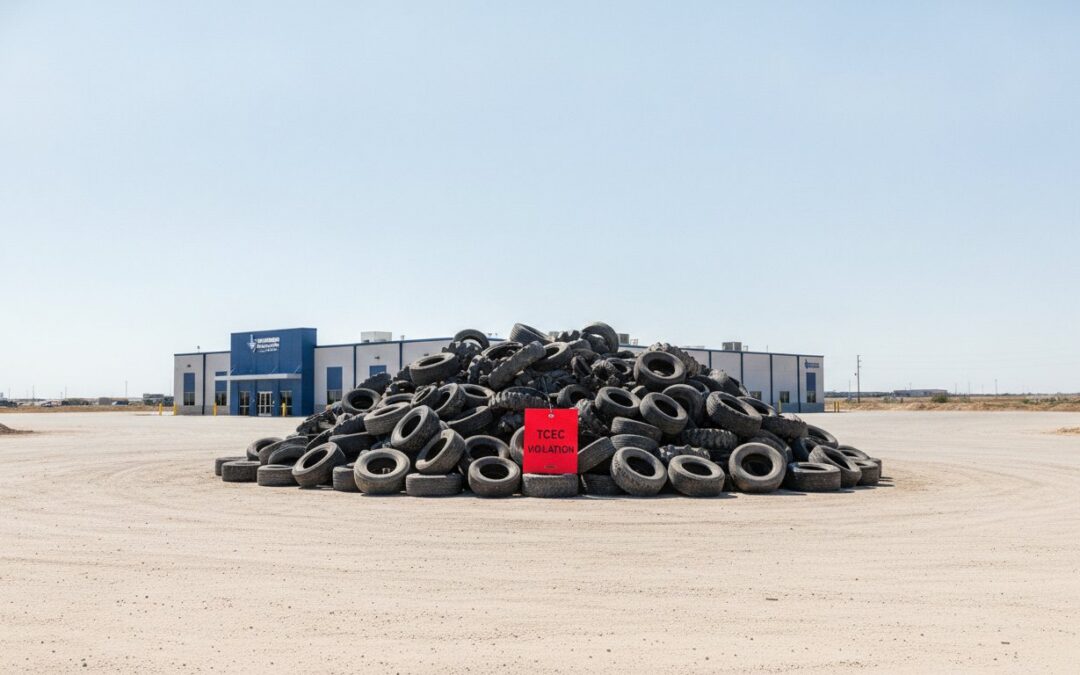
In West Texas, a single undocumented tire pickup can trigger a TCEQ fine that wipes out your quarterly profit margin. Many fleet managers treat rubber disposal as a simple waste task, but in 2026, it has become a high-stakes liability management strategy. Identifying the common mistakes to avoid when disposing of commercial tires is no longer just about cleaning up the yard; it’s about protecting your business from aggressive environmental oversight and costly legal traps.
We understand that managing massive volumes of OTR or semi-truck tires is a logistical burden. It’s exhausting to keep up with complex Texas manifest requirements while trying to maintain a safe, hazard-free facility. You deserve a disposal process that is documented, compliant, and completely hands-off. This article will help you navigate current state laws and avoid the specific pitfalls that often lead to heavy fines for West Texas operations. We will examine the seven most expensive errors companies make, ranging from improper storage thresholds to failing the critical 60-day manifest return rule.
Key Takeaways
- Learn the specific five-part manifest requirements that ensure your business remains compliant with 2026 TCEQ regulations.
- Discover why mixing OTR tires or scrap skid steer tracks with standard waste is a liability trap and how to separate them for proper processing.
- Understand the fire safety stacking rules and why waiting for a full load can actually increase your legal and environmental risks.
- Identify the critical mistakes to avoid when disposing of commercial tires to prevent rubber leachate and protect West Texas soil.
- Build a reliable, documented disposal trail that proves full regulatory compliance during any state or local site inspection.
The Hidden Risks of Improper Commercial Tire Disposal
West Texas businesses often view scrap rubber as a minor nuisance. This perspective is dangerous. Treating tire disposal as a low priority leads to systemic failures in compliance. Choosing the wrong partner to save on upfront costs is among the top mistakes to avoid when disposing of commercial tires. The Texas Commission on Environmental Quality (TCEQ) enforces strict guidelines. “Cheap” solutions often result in five-figure penalties that far outweigh any initial savings. Financial repercussions usually manifest in three ways:
- Daily fines for exceeding storage limits without proper registration.
- Administrative penalties for missing or incomplete manifest documentation.
- Full financial liability for clean-up costs if your tires are dumped illegally by an unverified hauler.
Beyond the ledger, the environmental impact can be permanent. When thousands of tires sit in the sun, they eventually degrade. This releases harmful chemicals into the ground. A professional tire recycling process ensures these materials are repurposed rather than left to contaminate the local ecosystem. Illegal dumping or improper storage doesn’t just hurt the planet; it puts your business name on a public list of environmental violators. This reputational damage is often harder to repair than a mechanical failure.
Large stockpiles of OTR or semi-truck tires also create immediate operational hazards. They consume space meant for equipment and inventory. They obstruct sightlines for forklift drivers and fleet operators. If a pile catches fire in the arid Permian Basin climate, the result is often a catastrophic loss of property and a massive local air quality crisis. Keeping your site clear isn’t just about aesthetics. It’s about maintaining a functional, safe workspace for your team.
While the regulatory environment varies by region, the core principle of professional waste management remains constant. Companies like Solowaste Ltd demonstrate how specialized waste services can help businesses maintain safe, hazard-free facilities through organized collection and disposal strategies.
Legal Liability and the Chain of Custody
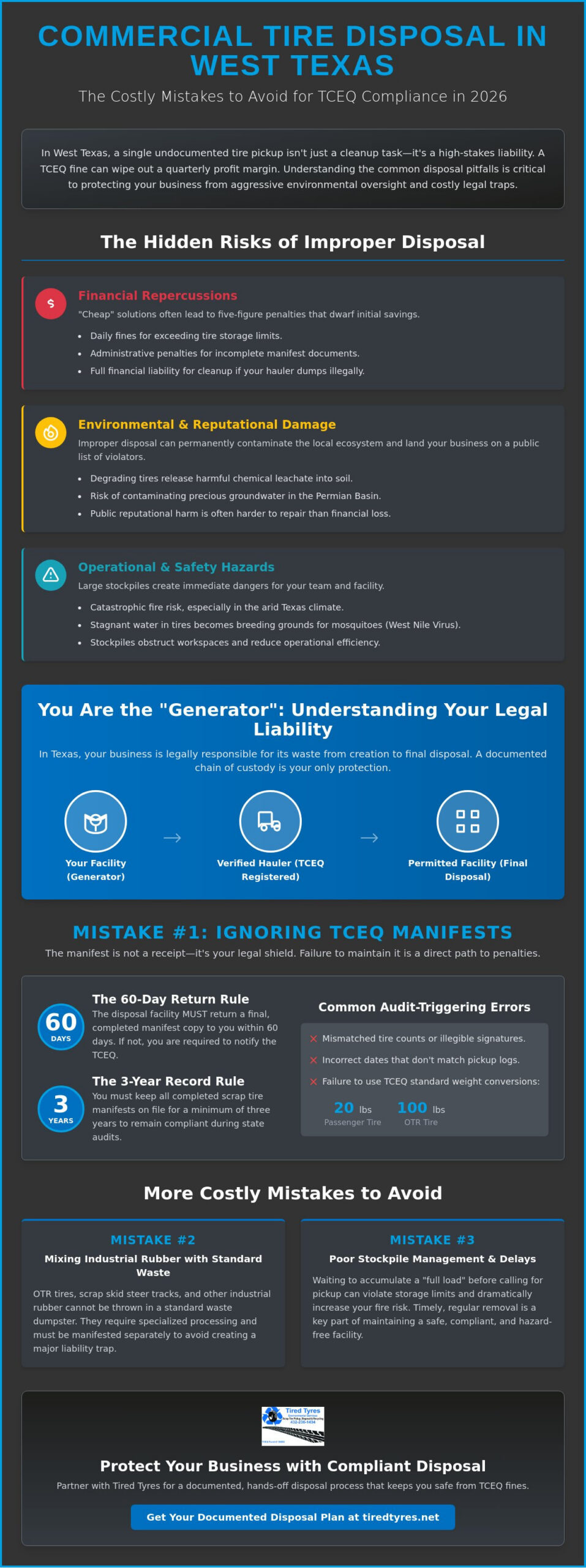
In Texas, you’re legally classified as the “Generator.” This means you’re responsible for the waste from the moment it’s removed from a vehicle until it reaches a permitted disposal site. Handing off tires to a freelance hauler based on a verbal agreement is a massive risk. If those tires end up in a West Texas canyon, investigators will trace them back to your facility. You must maintain a clear, documented chain of custody to protect your business. Relying on anyone without a verified TCEQ registration number is a gamble you’ll eventually lose.
Environmental Hazards in the Permian Basin
The Lubbock and Midland regions face unique challenges. Groundwater is a precious resource here. Rubber leachate can migrate through sandy soil and reach aquifers over time. Additionally, West Texas heat turns stagnant water trapped inside tires into prime breeding grounds for mosquitoes. This creates a preventable health risk for your crew, including exposure to West Nile virus. Proper, timely removal is the only way to eliminate these workplace hazards and protect the local community.
Mistake #1: Ignoring TCEQ Compliance and Manifest Requirements
The scrap tire manifest is the most vital document in your disposal process. It isn’t just a receipt; it’s a legal shield. In Texas, the manifest tracks every tire from the point of generation to the final processing facility. Failing to maintain this paper trail is one of the most dangerous mistakes to avoid when disposing of commercial tires. Without a completed manifest, you have no proof that your waste didn’t end up in an illegal dump site. This leaves your business fully liable for environmental remediation costs and state penalties.
Texas uses a 5-part manifest system to ensure accountability. Each party in the chain must handle their specific copy correctly. You receive the first copy when the transporter loads the tires. The transporter and the disposal facility then sign and exchange copies. Most importantly, the facility must return a final, completed copy to you within 60 days. If you don’t receive this final document, you’re required to notify the TCEQ. Failing to flag a missing manifest is a major red flag during audits. You must keep these records for at least three years to remain compliant with state law.
Common filing errors often trigger unnecessary environmental audits. Mismatched tire counts or incorrect weight estimations are frequent culprits. For reporting, the TCEQ uses standard conversion rates: 20 lbs for passenger tires and 100 lbs for off-the-road (OTR) tires. If your manifest shows 50 OTR tires but only lists 1,000 lbs, the math won’t clear an inspector’s desk. Always ensure signatures are legible and dates match the actual pickup. If you need help managing your manifest trail, our team provides documented, compliant collection services that simplify this burden.
The Paper Trail: Protecting Your Business
Documenting the cradle-to-grave journey of every tire is your best defense. You must store these documents in a way that makes them immediately accessible. While many businesses move toward digital records, the TCEQ often requires original physical copies during on-site inspections. Keep your manifests organized by date and location. The TCEQ manifest serves as your primary legal defense against illegal dumping charges by documenting the legitimate transfer of waste to a registered facility.
Working with Permitted Haulers
Before a hauler touches a single tire, you must verify their credentials. You can check the TCEQ database to ensure their transportation permit is active and valid. For more details on these requirements, read our Texas Tire Disposal Regulations: A 2026 Guide for West Texas Businesses. “Ghost haulers” often offer lower rates but lack registration. They frequently disappear with your tires, leaving you responsible when those tires are found in a ditch. Always demand a registration number and verify it before signing any paperwork.
Mistake #2: Treating Industrial Rubber Waste as Standard Trash
Mixing industrial rubber with general waste is a common error that leads to rejected loads and unexpected fees. Landfills often refuse heavy-duty items like conveyor belts or OTR tires because they damage standard compaction equipment. One of the critical mistakes to avoid when disposing of commercial tires is assuming a standard trash service can handle the volume and weight of industrial-grade rubber. These materials require a specific disposal path that standard waste streams aren’t built to support.
OTR and semi-truck tires contain high-tensile steel cables. Processing these units requires specialized high-torque shredders. If you attempt to sneak these into a standard pickup, the hauler will likely leave them behind. This creates an immediate safety hazard and a compliance gap on your site. Logistical planning is essential here. A single OTR tire can weigh hundreds of pounds. In fact, the TCEQ officially uses 100 lbs as a baseline weight for reporting OTR units. If your loading equipment isn’t rated for this weight, you risk workplace injuries during the removal process.
Logistical failures often stem from underestimating the footprint of heavy-duty rubber. A pile of scrap conveyor belts or agricultural tires takes up significantly more space than passenger tires. This clutter interferes with daily commercial logistics. It blocks emergency access and creates blind spots for heavy machinery operators. Managing this waste isn’t just a matter of cleaning up; it’s about maintaining an efficient, safe commercial site in the high-demand West Texas market.
The Complexity of OTR and Agricultural Tires
Traditional shredders can’t process massive earthmover or tractor tires. These units require a dedicated collection strategy that accounts for their size and density. For more localized advice on handling these massive units, see our Commercial Tire Disposal in Midland, Odessa & Lubbock: The 2026 Guide. When preparing heavy tires for pickup, ensure your loading dock is clear. Your crew should follow strict safety protocols, as OTR tires can be unstable if stacked improperly. Never stack these larger units more than two high without professional stabilization equipment.
Beyond Tires: Industrial Rubber Components
Permian Basin industrial sites generate a variety of scrap rubber beyond just tires. Scrap conveyor belts and industrial hoses are often overlooked until they become a major site hazard. You shouldn’t mix scrap skid steer tracks with standard passenger tire piles. The internal steel structure of a track is too dense for standard recycling streams. Solid tire disposal also requires a different approach. Because they lack the air cavity of pneumatic tires, they’re significantly heavier and harder to process. Keeping these streams separate ensures a reliable, documented disposal trail.
Mistake #3: Poor Stockpile Management and Delayed Removal
Many fleet managers fall into the “waiting for a full load” trap. They assume that consolidating a massive pile of OTR or semi-truck tires will save money on transportation. In reality, this delay is one of the primary mistakes to avoid when disposing of commercial tires. Large stockpiles quickly exceed TCEQ registration thresholds, which are set at 500 tires on the ground or 2,000 in enclosed, lockable containers. Once you cross these limits, your business faces significantly higher regulatory scrutiny and more complex reporting requirements.
Safety is the most urgent concern with delayed removal. In the arid West Texas climate, a tire fire is an environmental disaster that is nearly impossible to extinguish. Large piles concentrate heat and provide ample fuel. Beyond fire risks, stagnant water trapped inside tires attracts pests. TCEQ regulations require businesses storing tires outdoors to implement vector control measures at least every two weeks to prevent mosquito breeding. Frequent pickups eliminate these breeding grounds before they become a workplace health hazard for your crew.
The harsh South Plains sun also complicates disposal. UV degradation happens quickly in Midland and Odessa. Extended exposure makes rubber brittle and less valuable for high-quality recycling applications. If you want to maintain a clean facility and ensure your scrap rubber is handled efficiently, you should schedule a professional tire collection before the elements take their toll on your inventory.
Establishing a Scheduled Pickup Routine
Assessing your generation rate is the first step toward a compliant site. If your shop produces 50 semi-truck tires a month, a quarterly pickup might leave you with a dangerous backlog. Implementing a “just-in-time” removal strategy keeps your facility organized and reduces the risk of accidental non-compliance. For a deeper look at managing these logistics, refer to our guide on Reliable Tire Disposal in Midland, Odessa & Lubbock: The 2026 West Texas Guide.
Safe On-Site Storage Protocols
If you must store tires temporarily, follow strict spacing rules. Keep piles at least 50 feet away from buildings and property lines to comply with standard fire safety codes. Indoor storage in lockable containers is the gold standard for West Texas weather as it prevents both UV damage and water accumulation. If you store tires outside, use heavy-duty tarps to keep them dry and out of the sun. Proper stacking reduces fire surface area and prevents water accumulation. This simple step protects your property and keeps your site ready for an unannounced TCEQ inspection.
Partnering with Tired Tyres for Compliant West Texas Disposal
Tired Tyres provides a professional, documented solution for businesses across the Permian Basin. We understand that managing a commercial site requires precision and efficiency. Our team specializes in the collection of diverse rubber waste streams, ensuring that your facility remains clean and compliant. We handle everything from our Passenger & Light Truck Tire Collection to the massive units found in our OTR (Off-the-Road) Tire Collection. By centralizing your disposal through a registered provider, you eliminate the most common mistakes to avoid when disposing of commercial tires, such as fragmented record-keeping or relying on unverified transporters.
Our commitment to TCEQ manifest accuracy is the cornerstone of our service. We manage the entire five-part manifest process, ensuring each party signs the necessary documentation at the time of pickup. We prioritize returning the completed final copy to your office within the state-mandated 60-day window. This rigorous attention to detail protects your status as a “Generator” and provides a clear legal defense during environmental audits. Whether you are clearing out a Semi-Truck Tire Collection or disposing of specialized industrial components, we provide the reliable trail of custody that West Texas regulators demand.
Environmental stewardship is a practical necessity in our region. We ensure that your scrap rubber becomes a resource rather than a site hazard. By removing tires before they suffer UV degradation or become pest breeding grounds, we help you maintain a safer workplace. Our routes cover Midland, Odessa, and Lubbock, providing consistent service that prevents dangerous stockpiles from forming. We don’t just haul waste; we provide a liability management strategy that keeps your operations running smoothly without the threat of unexpected state penalties.
Why West Texas Businesses Choose Tired Tyres
Local businesses choose us because we understand the specific demands of oil field, agricultural, and commercial fleet operations. We offer the convenience of a single provider for your entire scrap rubber inventory. This includes our Agricultural Tire Collection, scrap skid steer tracks, and scrap conveyor belt collection. You don’t have to coordinate with multiple vendors to clear your yard. We simplify the logistical burden and the associated paperwork, allowing your management team to focus on core operations instead of waste tracking. Our experience in the Permian Basin ensures we arrive with the right equipment for heavy-duty industrial rubber removal.
Get Started with a Professional Collection Plan
Establishing a compliant disposal routine is simple. When you request a quote, we ask for the approximate count of units and the specific types of rubber on your site, such as scrap hose collection or solid tires. This information allows us to provide an accurate estimate and dispatch the appropriate vehicles. When our trucks arrive, our crew follows all site safety protocols to ensure a fast, incident-free pickup. We work around your schedule to minimize disruption to your daily logistics. Contact Tired Tyres today for a reliable commercial tire disposal quote.
Secure Your Compliance with Professional Disposal
Managing commercial rubber waste doesn’t have to be a legal gamble for your West Texas business. By prioritizing accurate TCEQ manifests and clearing stockpiles before they exceed state limits, you protect your company from aggressive environmental audits. Understanding the specific mistakes to avoid when disposing of commercial tires ensures that your facility remains a safe, efficient workspace. Just as you would hire Transition Roofing to secure your building’s exterior, proper tire disposal is essential for total site compliance. Keeping these waste streams separate is the only way to maintain a clean, compliant site.
Don’t let scrap rubber become a liability on your Midland, Odessa, or Lubbock site. Tired Tyres offers professional, local service backed by TCEQ-compliant manifest processing and specialized equipment for OTR and industrial rubber. We take the complexity out of waste management so you can focus on your core operations. Schedule your compliant commercial tire pickup with Tired Tyres today and secure a documented disposal trail for your business. We are ready to help you maintain a clean, hazard-free facility with the professional care your business deserves.
Frequently Asked Questions
What are the specific TCEQ fines for illegal commercial tire disposal?
Fines for violating Texas waste regulations can reach thousands of dollars per day depending on the severity of the offense. The TCEQ issues administrative and civil penalties for improper storage, illegal dumping, and failing to maintain manifest records. In addition to state fines, businesses are often held financially responsible for the full cost of environmental remediation at dump sites traced back to their facility.
Can I take commercial truck tires to the Midland or Odessa landfills?
Most municipal landfills in Midland and Odessa have very restrictive policies regarding commercial tires. They typically require tires to be split, quartered, or shredded before they will accept them for disposal. Managing this processing yourself is labor-intensive and expensive. Most West Texas businesses find it much more efficient to use a specialized collection service that handles the heavy lifting and compliance paperwork on-site.
How do I verify if a tire hauler is properly permitted in Texas?
You must check the TCEQ’s active registration database for scrap tire transporters to confirm a hauler’s status. A legitimate transporter will always have a valid registration number and should be willing to provide it before loading any material. Verifying these credentials is one of the essential mistakes to avoid when disposing of commercial tires, as it protects you from the liability of “ghost haulers” who dump waste illegally.
What should I do if I inherited a tire stockpile on a new commercial property?
You should contact the TCEQ immediately to report the existing stockpile and document that you are not the generator of the waste. Being proactive helps establish that the liability belongs to the previous owner. Once reported, you should hire a registered transporter to clear the site. This ensures you receive a legal manifest trail that proves the property has been brought back into full regulatory compliance.
Are there different rules for disposing of OTR tires versus semi-truck tires?
Yes, the rules differ primarily due to weight and processing requirements. The TCEQ uses a 100 lb conversion rate for OTR tires for reporting purposes, which is much higher than the standard for semi-truck tires. OTR units also require specialized high-torque shredders because of their massive size and dense internal steel cables. Most standard recycling facilities aren’t equipped to handle these larger agricultural and earthmoving tires.
How long am I required to keep my tire disposal manifests in Texas?
Texas law requires you to maintain all scrap tire manifests for a minimum of three years from the date of the pickup. These documents must be readily available for inspection by TCEQ officials or local health authorities. Keeping an organized, chronological file of these signed manifests is your primary legal defense. It proves that your commercial waste was transferred to a registered facility and managed according to state law.
Can Tired Tyres handle other rubber waste like skid steer tracks and hoses?
Yes, our service extends beyond standard tires to include various industrial rubber components. We provide collection for scrap skid steer tracks, conveyor belts, and industrial hoses that landfills often refuse to accept. These items are integrated into our documented disposal trail. This allows you to clear your entire site of rubber waste while maintaining the same high level of manifest accuracy and legal compliance.
What happens to the tires once they are collected from my site?
Once we collect the tires, they are transported to a registered processing facility for recycling or energy recovery. Many tires are shredded to be used as tire-derived fuel (TDF) or in civil engineering projects like road base and playground surfacing. This professional processing ensures that your scrap rubber becomes a secondary material stream. It prevents the long-term environmental hazards associated with tires sitting in West Texas landfills or illegal dump sites.