
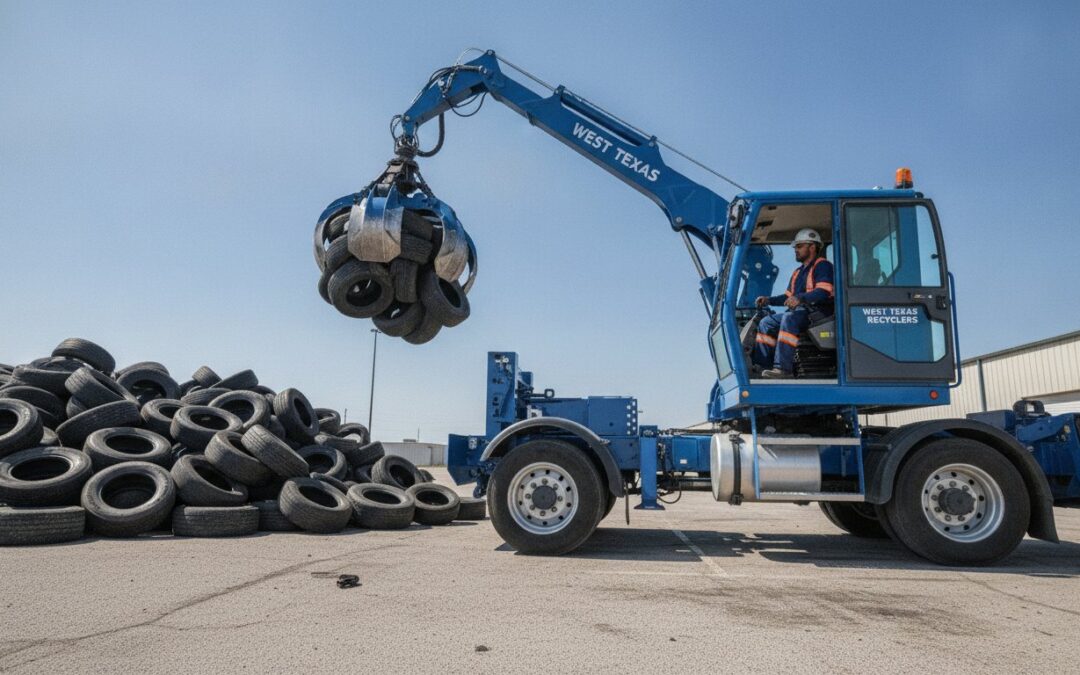
Is saving a few dollars on disposal worth the risk of a state jail felony? Many Permian Basin business owners believe that loading up the company truck and heading to the landfill is the most cost-effective way to clear out old inventory. It’s a common assumption, but the reality of bulk tire pickup vs self-hauling Odessa often tells a different story. Between the physical strain of moving heavy semi-truck tires and the complex web of Texas Commission on Environmental Quality (TCEQ) regulations, what looks like a simple DIY task can quickly become a significant liability.
We understand that your time is better spent managing operations than navigating waste logistics. In this guide, we provide a clear cost-benefit analysis of professional services compared to the hidden burdens of self-hauling. You’ll learn about Odessa’s strict landfill restrictions and why the TCEQ issued over $2.4 million in penalties for improper tire management in 2025 alone. We’ll show you how to maintain a legal manifest system and clear your space without the threat of $25,000 daily fines hanging over your business. By the end, you’ll have a practical strategy to handle scrap rubber efficiently and safely.
Key Takeaways
- Odessa’s municipal waste rules mean you can’t toss tires in standard bins. You’ll learn why local landfill restrictions and health risks make professional disposal a necessity for your facility.
- Self-hauling costs more than a tank of gas. We break down the hidden expenses of labor, vehicle maintenance, and the physical strain of moving heavy OTR or semi-truck tires.
- Handling your own transport can lead to massive legal headaches. We compare bulk tire pickup vs self-hauling Odessa to show how the state-mandated manifest system protects your business from TCEQ fines.
- Professional collection isn’t just a convenience; it’s a scalable solution. You’ll see how delegating tire logistics allows your team to focus on core operations while improving your bottom line.
- Specialized fleets handle more than just standard tires. Discover how to clear space by disposing of scrap conveyor belts, skid steer tracks, and heavy rubber hoses safely and efficiently.
The Reality of Tire Disposal in Odessa and the Permian Basin
Managing waste in West Texas isn’t just about throwing things in a dumpster. The City of Odessa has a strict “no-tire” policy for all municipal solid waste collection. If you place a tire in a city container or any other receptacle used for standard garbage, you’re breaking a local ordinance. This makes the choice between bulk tire pickup vs self-hauling Odessa a critical decision for local business owners. While a resident might manage one or two tires a year, a commercial shop or oilfield service company faces a much larger logistical challenge. Leaving scrap rubber on your property isn’t a long-term solution; it’s a safety hazard. Piles of tires catch rainwater, creating a perfect breeding ground for mosquitoes that carry West Nile virus. They also pose a severe fire risk. Once a tire pile ignites, it is notoriously difficult to extinguish and can release toxic smoke across the Petroplex for weeks.
Bulk tire pickup is a specialized environmental service. It differs from residential disposal because it’s built to handle the high-volume, heavy-duty needs of businesses. Whether you’re dealing with a stack of passenger tires or massive industrial rubber components, you need a system that removes the liability from your shoulders while keeping your facility clean and compliant with state law.
Odessa Landfill and Solid Waste Restrictions
The Odessa landfill doesn’t make it easy for businesses to drop off waste. Whole tires are often rejected because they don’t compact well and tend to “float” to the surface of landfills over time. Even when they are accepted, they often require special handling or shredding fees that can quickly exceed your budget. The Texas Commission on Environmental Quality (TCEQ) oversees these rules to ensure that rubber doesn’t end up in unauthorized sites. For a business, this means every tire must be accounted for from the moment it’s removed from a vehicle until it reaches a permitted facility. If you choose self-hauling, you’re responsible for knowing these shifting landfill limits and paying the associated gate fees out of pocket.
The Growing Problem of Scrap Rubber in West Texas
West Texas is unique. Our economy runs on heavy machinery, which means we generate massive amounts of industrial rubber. We aren’t just talking about passenger car tires; we’re dealing with Agricultural tires, OTR (Off-the-Road) tires, and even scrap conveyor belts from industrial sites. Simple dumping is no longer a viable or legal option for local shops. Understanding the Tire recycling process is the first step toward moving these hazards off your property. Stockpiling rubber in our semi-arid climate is an environmental gamble. As the oil and gas industry continues to grow, the accumulation of scrap skid steer tracks and heavy hoses requires a professional approach to keep the Permian Basin clean and safe for everyone.
The Hidden Costs and Logistics of Self-Hauling Scrap Tires
Many Odessa business owners assume that using a company truck for disposal is the cheapest route. It isn’t. When you analyze the bulk tire pickup vs self-hauling Odessa debate, you have to look past the fuel gauge. The real expense lies in the costs of transporting tires, which includes everything from hourly wages to the accelerated depreciation of your fleet. Hauling heavy, dirty rubber is hard on suspension systems and truck beds. If you’re using a primary service vehicle, you’re also risking punctures from metal debris often found at disposal sites. These hidden factors turn a “free” DIY task into an expensive operational drain.
Equipment and Labor Requirements
Your staff’s time has a specific dollar value. Every hour a technician spends wrestling with OTR tires or loading a trailer is an hour they aren’t completing billable work. Loading agricultural tires or heavy semi-truck rubber is physically exhausting. It increases the risk of workplace injuries, which can lead to workers’ compensation claims that dwarf any potential savings. If you don’t own a heavy-duty trailer, rental fees add another layer of cost. You also have to secure the load properly; West Texas winds will quickly turn an unsecured scrap tire into a road hazard or a reason for a police stop. It’s often more efficient to let experts manage your scrap rubber collection so your crew can stay focused on the jobs that actually grow your business.
Landfill Wait Times and Disposal Fees
Regional disposal sites in Ector and Midland Counties often have long queues during peak hours. Your driver might sit in line for over an hour just to reach the scale. Once there, you’ll face a confusing mix of per-tire or per-ton fees. If your load contains “contaminated” items, like tires filled with dirt, stagnant water, or debris, the facility might reject the entire haul. This forces your driver to bring the mess back to your shop, doubling your labor and fuel costs for zero progress. Professional collection eliminates these variables. You get a predictable schedule and a team that handles the heavy lifting for you, ensuring your facility stays clear without the logistical headache of DIY transport.
Compliance and the Texas Manifest System: Why DIY is a Legal Risk
In the Permian Basin, the legal requirements for tire disposal are often overlooked until an audit occurs. The Texas Commission on Environmental Quality (TCEQ) uses a “cradle-to-grave” tracking system known as the scrap tire manifest. This document isn’t just paperwork; it’s your legal shield. When comparing bulk tire pickup vs self-hauling Odessa, many business owners don’t realize that self-hauling more than five tires at once requires a manifest. If you’re caught transporting tires without this documentation, or if you hand them off to an unpermitted “junk hauler,” you remain legally responsible for those tires. If they end up in a West Texas pasture, the TCEQ will trace them back to your business.
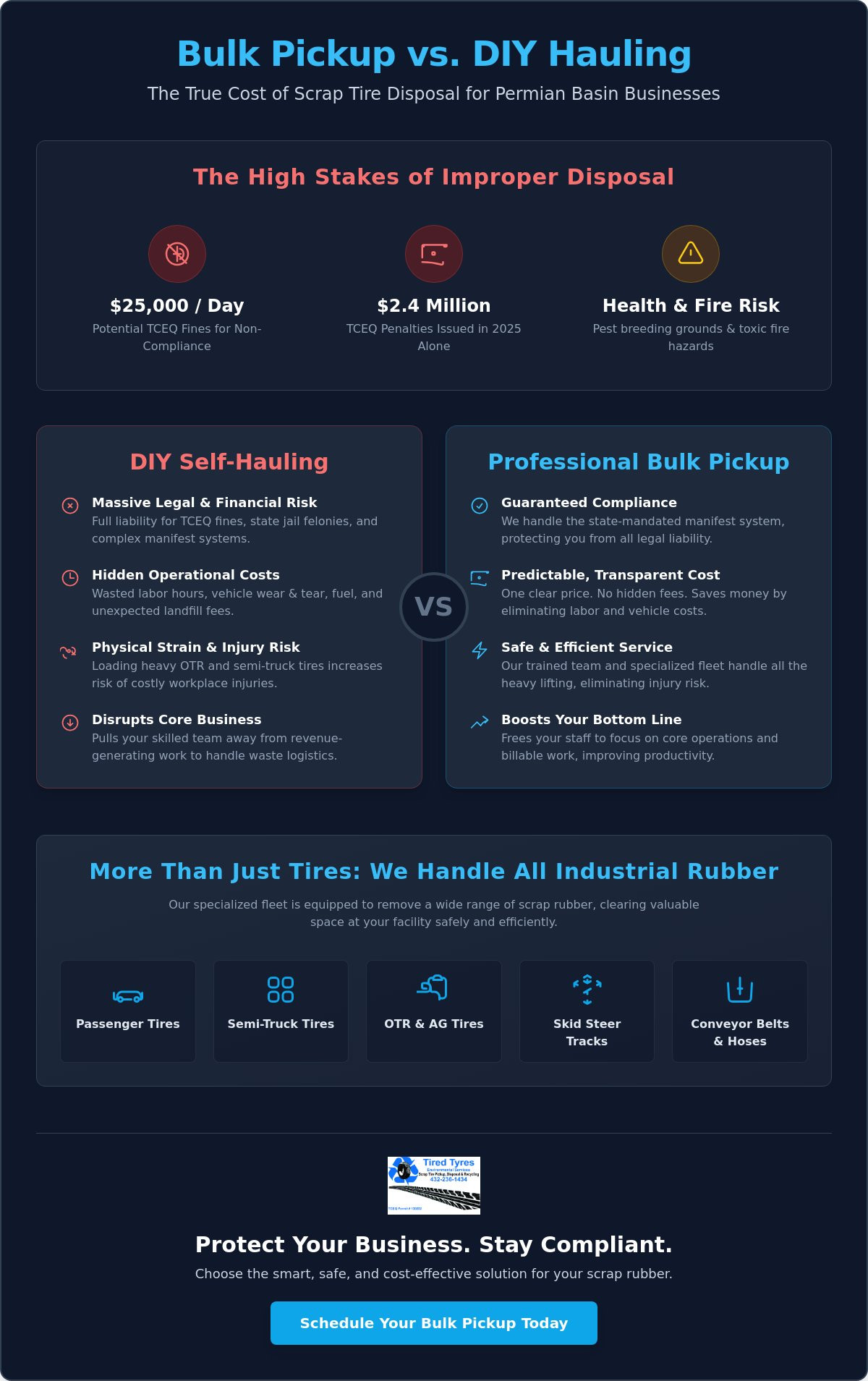
The financial stakes are high. In 2025, the TCEQ issued over $2.4 million in penalties for improper scrap tire management. Fines for improper disposal can exceed $4,000 per occurrence. For larger stockpiles, unauthorized dump sites can trigger fines of up to $25,000 per day. Professional collection ensures that every tire is logged, tracked, and disposed of at a permitted facility. This creates a paper trail that protects your business during an audit. You shouldn’t risk your company’s reputation on a “handshake” deal that lacks proper documentation.
TCEQ Regulations for Odessa Businesses
Under Texas law, any business that produces scrap tires is a “scrap tire generator.” This includes tire shops, fleet managers, and industrial sites. Your responsibility doesn’t end when the tires leave your property. You must ensure they are handled by a registered hauler and keep manifest records for at least three years. For a deeper look at these requirements, see our guide on Texas tire disposal regulations. Staying compliant is much cheaper than defending your business against a state jail felony charge, which can apply to illegal dumping of more than 200 pounds of waste.
The Dangers of Unpermitted Hauling
It’s tempting to accept a cheap offer from an unpermitted hauler. These individuals often lack the necessary TCEQ registration. Without a permit, they cannot legally access authorized recycling centers. This often leads to tires being dumped in remote areas of Ector or Midland Counties. If your tires are found in an illegal dump, you are liable for the cleanup costs and the resulting fines. Tired Tyres eliminates this risk. We provide 100% legal, manifest-documented disposal for every load. We handle the paperwork, so you can prove your compliance to any inspector at a moment’s notice.
Calculating the ROI: When Bulk Pickup Saves Your Business Money
Scalability is where the return on investment becomes most apparent. As your scrap pile grows, the logistics of self-hauling become exponentially more difficult. A single trip to the landfill might handle 20 tires, but what happens when you have 200? A professional service uses high-capacity trailers designed for maximum efficiency. This prevents the “pile-up” problem that consumes valuable real estate on your property. By keeping your facility clear, you improve workflow and reduce the risk of accidents, which is an unquantifiable but vital part of your business’s ROI.
Opportunity cost is the final piece of the puzzle. Every hour your team spends at a disposal site is an hour they aren’t generating revenue. If your top mechanic is stuck in a landfill line, you’re losing billable shop time. Delegating these logistics to a specialist allows your crew to focus on their core strengths. You gain peace of mind knowing that your business is 100% compliant with Texas law without having to manage the minute details of waste transport yourself.
Small Loads vs. Large-Scale Remediation
There is a tipping point where self-hauling stops making sense. If you have a single set of four tires, a quick trip might seem logical. However, once you reach ten or more tires, the TCEQ manifest requirements and the physical labor involved make professional pickup the only efficient choice. Scheduled collections are particularly effective for high-volume shops. They ensure that rubber never accumulates to the point of becoming a fire hazard or a distraction for your team.
Industrial and OTR Specifics
For businesses dealing with heavy machinery, the DIY option isn’t just expensive; it’s often impossible. Self-hauling OTR (Off-the-Road) tires or agricultural rubber requires specialized trailers and heavy-lifting equipment that most small businesses don’t have. Attempting to move these massive items with standard trucks can cause thousands of dollars in vehicle damage. You can explore our commercial tire disposal options to see how we handle these heavy-duty loads with the right tools for the job. To keep your yard clear and your team safe, schedule your next collection with a partner who understands West Texas industrial needs.
Efficient Bulk Tire Collection with Tired Tyres in Odessa
Tired Tyres operates with a clear mission: keeping the Permian Basin clean while protecting local businesses from waste-related liabilities. Unlike general junk haulers who often lack the proper TCEQ permits for industrial rubber, our team focuses exclusively on scrap tire and rubber collection. Our specialized fleet is built to navigate the rugged terrain of West Texas oilfields and agricultural sites. We have the equipment to handle heavy loads that would easily break a standard commercial truck. When evaluating bulk tire pickup vs self-hauling Odessa, the specialized nature of our service becomes a major advantage for businesses dealing with complex waste streams.
We provide a comprehensive range of collection services tailored to the Petroplex. Our team is equipped to handle everything from standard automotive waste to heavy industrial materials. We collect:
- Passenger and Light Truck Tire Collection
- Semi-Truck Tire Collection
- Agricultural and OTR (Off-the-Road) Tire Collection
- Scrap skid steer tracks and scrap conveyor belts
- Scrap rubber hoses and solid tires
Our process is designed for speed and transparency. It starts with a custom quote tailored to your specific volume and ends with a TCEQ-compliant manifest in your hands. We don’t believe in “handshake” deals; we believe in documented compliance. This commitment ensures that your business stays on the right side of state regulations while keeping your yard clear of hazards.
Why Local Expertise Matters
We have deep roots in the Permian Basin and South Plains. We aren’t just a service provider; we’re your neighbors in Odessa and Midland. By focusing strictly on rubber waste, we’ve developed the most efficient routes and disposal partnerships in the region. This specialization allows us to support local tire recycling efforts more effectively than a general waste company ever could. We understand the specific needs of the local oil, gas, and agricultural sectors because we live and work alongside them every day.
Get Started with a Custom Quote
Preparing for a pickup is simple. To ensure the fastest service, we recommend stacking your tires in a centralized, accessible location. Removing rims and ensuring the pile is free of heavy debris or stagnant water helps our team load the trailer quickly and keeps your costs predictable. Whether you have a small stack of semi-truck tires or a yard full of scrap conveyor belts, we’re ready to help. Taking the first step is easy. You can clear your space and secure your legal compliance with a single phone call or message. Contact Tired Tyres for your Odessa tire pickup quote today!
Streamline Your Waste Logistics in the Permian Basin
Choosing the right disposal method is about protecting your time and your reputation. While self-hauling might seem like a simple way to save money, the hidden costs of labor, vehicle wear, and strict TCEQ regulations often make it a liability. Professional collection removes the physical strain of moving heavy OTR rubber while providing the essential manifest documentation you need for legal compliance. By delegating these logistics, you allow your team to focus on revenue-generating work instead of waiting in landfill lines.
When you weigh the benefits of bulk tire pickup vs self-hauling Odessa, the professional choice offers superior long-term ROI. Tired Tyres is a TCEQ Permitted Hauler that has been serving the Permian Basin since we were founded. We specialize in industrial and OTR rubber, ensuring that even the most difficult scrap is handled safely and legally. It’s time to clear your yard and secure your facility’s future with a partner you can trust.
Request Your Bulk Tire Pickup Quote in Odessa and let our experienced team handle the heavy lifting for you. We look forward to helping you keep West Texas clean and compliant.
Frequently Asked Questions
Can I take tires to the Odessa landfill myself?
You can transport tires to the landfill, but you’ll encounter strict local ordinances and handling fees. The City of Odessa prohibits tires in standard municipal containers, and many regional landfills require tires to be split or shredded before they’re accepted. This often makes self-hauling a frustrating and time-consuming process for business owners who lack specialized processing equipment.
What is the maximum number of tires I can haul without a permit in Texas?
In Texas, you can generally haul up to five scrap tires without a manifest or specialized permit. Once you exceed this limit, the Texas Commission on Environmental Quality (TCEQ) requires specific documentation to track the waste. Transporting more than five tires at once without a manifest is a regulatory violation that can lead to significant state penalties.
Do I need a manifest if I am hauling my own business’s tires?
Yes, you’re required to use a scrap tire manifest if you transport more than five tires, even if they’re generated by your own business. This “cradle-to-grave” tracking system is mandatory for all scrap tire generators in the state. It serves as your only legal proof that the tires reached a permitted disposal site rather than an illegal dump.
How much does bulk tire pickup cost in Odessa?
The cost of a pickup varies based on the volume, location, and the specific type of rubber waste you have. Factors like tire size and the total weight of the load influence the final quote. We provide transparent, custom pricing for every project to ensure you’re getting a solution that fits your business’s specific operational needs.
What types of industrial rubber waste does Tired Tyres collect?
We collect a broad range of materials, including scrap conveyor belts, skid steer tracks, and heavy-duty rubber hoses. Our service also covers solid tires and specialized industrial components that standard waste haulers won’t touch. This specialization is a key factor when evaluating bulk tire pickup vs self-hauling Odessa for oilfield or agricultural sites.
How do I know if a tire hauler is legally permitted by the TCEQ?
A legally permitted hauler will provide a TCEQ-compliant manifest for every load and should be able to produce their registration number upon request. You can also verify their status through the TCEQ’s central registry. Using an unpermitted hauler leaves your business liable for any illegal dumping that occurs after the tires leave your property.
What happens to the tires after they are picked up from my Odessa location?
Once we collect your scrap rubber, it’s transported directly to a state-permitted facility for authorized processing or recycling. This ensures that the material is handled according to environmental standards and kept out of unauthorized West Texas pastures. This professional path minimizes the environmental footprint of your waste while maintaining your legal compliance.
Can Tired Tyres handle large OTR or agricultural tires?
Yes, we’re equipped to manage massive OTR (Off-the-Road) and agricultural tires that are too heavy for standard commercial trucks. Our fleet is built to handle the weight and dimensions of industrial rubber common in the Permian Basin. You don’t have to risk your company vehicles or staff safety trying to move these heavy loads yourself.