

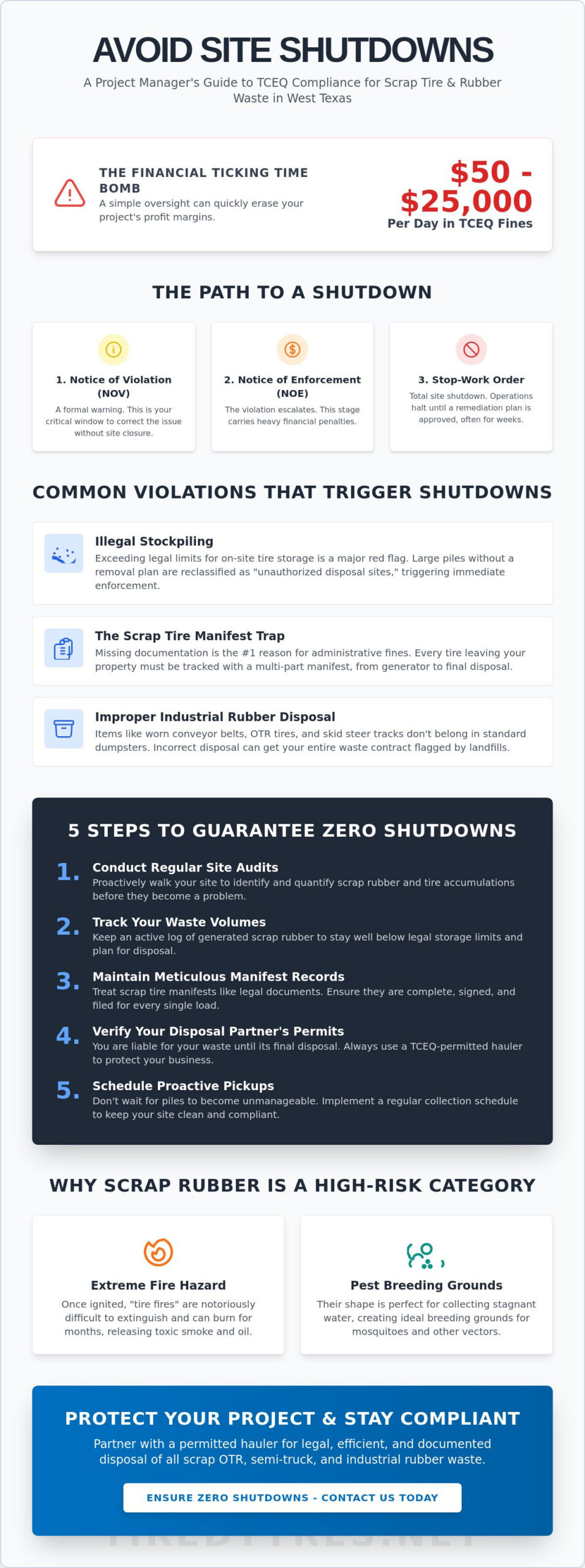
In West Texas, a single overlooked pile of scrap tires isn’t just a mess; it’s a financial ticking time bomb that can halt your entire operation. With the Texas Commission on Environmental Quality assessing penalties between $50 and $25,000 per day for solid waste violations, a simple oversight can quickly erase your project’s profit margins. You probably already know that staying compliant is a full-time job, and the fear of a sudden “Notice of Enforcement” hanging over your site is enough to keep any project manager up at night.
It’s understandable to feel overwhelmed by the complexity of scrap tire manifest requirements and shifting local ordinances in Midland and Odessa. This article provides the clarity you need to avoid stop-work orders for waste violations by managing scrap rubber and tire waste according to the latest Texas regulations. We’ll examine the specific triggers for site shutdowns, the financial impact of non-compliance in 2026, and how to implement a waste removal workflow that ensures zero shutdowns. By the end, you’ll have a clear roadmap to maintain full TCEQ compliance while keeping your project on schedule and your site running efficiently.
Key Takeaways
- Understand how the TCEQ uses enforcement actions like site shutdowns to address serious environmental non-compliance.
- Discover practical ways to avoid stop-work orders for waste violations by tracking your rubber waste volumes and keeping required manifest records.
- Evaluate the financial risks of project delays, including the high cost of idle labor and heavy equipment in the Permian Basin.
- Learn a reliable five-step process for maintaining site compliance through regular audits and verifying disposal partner permits.
- Recognize the benefits of using a permitted hauler to manage scrap OTR, semi-truck, and industrial rubber waste legally and efficiently.
What is a Stop-Work Order for Waste Violations?
A stop-work order in the environmental sector is a formal directive that forces a business to halt its activities immediately. While many project managers associate these orders with OSHA safety hazards, shutdowns frequently stem from violations of Environmental law and waste management protocols. In West Texas, the Texas Commission on Environmental Quality (TCEQ) acts as the primary enforcement body. If an inspector finds that your site management poses a risk to public health or the environment, they have the authority to suspend your operations. Understanding how to avoid stop-work orders for waste violations starts with recognizing that these orders aren’t just administrative hurdles; they’re legal tools used to prevent environmental damage.
The enforcement process usually follows a specific hierarchy. It often begins with a Notice of Violation (NOV), which serves as a formal warning. This is your window to fix the issue without a site closure. If you ignore this or the violation is severe, it escalates to a Notice of Enforcement (NOE), which carries heavy fines. A total site shutdown occurs when the TCEQ determines that continued operation would cause irreparable harm or if a company repeatedly fails to comply with previous warnings. For businesses in the Permian Basin, these shutdowns can last weeks while the agency reviews remediation plans.
The Legal Authority Behind Environmental Shutdowns
Texas Administrative Code Title 30 provides the legal framework for these enforcement actions. It grants state agencies the power to regulate how solid waste is stored, transported, and discarded. Local health departments in Midland and Ector counties often coordinate with state inspectors to identify non-compliant sites. An “Immediate Threat” stop-work order is triggered by conditions like uncontrolled hazardous runoff or massive, undocumented waste piles. These situations allow inspectors to bypass standard warning periods to protect the community from immediate danger.
Rubber Waste: A Unique Compliance Category
Rubber waste, particularly scrap tires and industrial belts, falls into a high-risk compliance category. Unlike general construction debris, tires are regulated strictly because they present unique hazards. They are notoriously difficult to extinguish once ignited, creating “tire fires” that can burn for months. Their shape also allows them to collect stagnant water, making them prime breeding grounds for mosquitoes. To stay compliant, you must follow specific Texas tire disposal regulations regarding storage limits and manifest records. According to Texas state law, a waste tire is defined as a tire that’s no longer suitable for its original intended purpose because of wear, damage, or defect. Failing to document the removal of these items is one of the fastest ways to trigger an inspection.
Common Waste Violations That Trigger Shutdowns in West Texas
In West Texas, the fastest way to attract a surprise inspection is through visible stockpiling. Many project managers mistakenly believe that as long as waste stays on their property, they aren’t in violation. However, exceeding the legal limit for on-site tire storage is a major red flag for local authorities. When scrap rubber piles grow too large without a clear removal plan, they transition from “stored materials” to “unauthorized disposal sites.” This shift often triggers the TCEQ’s enforcement process, which can lead to immediate site closures until the backlog is cleared by a professional hauler.
To effectively avoid stop-work orders for waste violations, you must also account for industrial rubber that often gets overlooked. Items like worn-out conveyor belts and scrap skid steer tracks don’t belong in standard dumpsters. Most Midland and Odessa landfills have implemented tighter restrictions in 2026, and disposing of these heavy rubber components incorrectly can result in your entire waste contract being flagged. If you’re unsure about your current inventory, scheduling a scrap rubber collection can help you clear the site before an inspector arrives.
The Scrap Tire Manifest Trap
Missing documentation is the primary reason for administrative fines in the Permian Basin. Under Texas tire disposal regulations, every single tire that leaves your property must be tracked using a multi-part manifest system. You’re required to retain these records for at least three years to satisfy a surprise audit. A compliant manifest must include the generator’s information, the hauler’s TCEQ registration number, and the signature of the authorized disposal facility. If you can’t produce these forms on demand, inspectors may assume the waste was disposed of illegally, leading to a “Notice of Enforcement.”
Illegal Dumping and Vicarious Liability
Your responsibility for waste doesn’t end when the truck leaves your gate. Texas law applies “vicarious liability” to waste generators, meaning you’re legally responsible for where your scrap tires end up. With unauthorized tire piles increasing by 15% in Ector and Midland counties over the last two years, law enforcement has ramped up the use of trail cameras in known dumping spots. If a low-cost, unpermitted hauler dumps your waste in a ditch, the trail of evidence leads directly back to your site. In Midland, dumping over 200 pounds of waste is a state jail felony. One local contractor recently faced a total project shutdown after their “cheap” hauling partner was caught dumping tires on a rural lease road, proving that unverified disposal partners are a massive liability risk.
The Real Financial Impact of a Stop-Work Order
In the Permian Basin, a project shutdown is an immediate burn of capital. When operations halt, the costs of idle heavy equipment and labor don’t disappear; they accumulate by the hour. Project managers often face thousands of dollars in daily overhead while their crews sit idle. Beyond labor, most industrial contracts include steep penalties for missed milestones. To effectively avoid stop-work orders for waste violations, you must look past the initial fine and consider the cumulative cost of downtime that can derail an entire project’s profitability.
The Texas Commission on Environmental Quality (TCEQ) calculates administrative penalties on a per day, per violation basis. These civil penalties typically range from $50 to $25,000 per day. If a violation involves the release of pollutants, that daily cap can jump to $40,000. One of the most significant financial deterrents is the “Economic Benefit” penalty. This is valued at 50% of the total money a company saved by remaining out of compliance. For example, if a firm saved $50,000 annually over five years by avoiding proper disposal, they could face an additional $175,000 fine on top of their base penalties.
Long-term damage to your corporate reputation is harder to quantify but equally devastating. A history of environmental shutdowns can disqualify your business from future bidding on government contracts or large-scale industrial projects. Prime contractors and developers prioritize partners who manage risk effectively. A single state-issued shutdown remains on your public record, signaling to future clients that your site management may be a liability.
Remediation Costs vs. Proactive Disposal
Emergency site cleanup is significantly more expensive than scheduled commercial tire disposal. When you’re under a shutdown order, you lose your negotiating power. Emergency removal services often charge a premium because they know your project is at a standstill and you are under pressure to reopen. Budgeting for waste removal as a fixed operational cost allows you to maintain a clean site and keep your expenses predictable.
Legal and Administrative Fees
Lifting a state-issued order requires more than just clearing the waste. You’ll likely need to hire environmental counsel to navigate administrative orders and legal filings. Reopening a site also involves mandatory filing fees and follow-up inspections by state officials to verify the remediation. These secondary costs pile up quickly. The cost of compliance is always lower than the cost of a 48-hour shutdown.
5 Steps to Ensure Compliance and Avoid Site Closures
Preventing a project shutdown requires a shift from reactive cleanup to proactive management. Taking these five steps is the most effective way to avoid stop-work orders for waste violations before an inspector ever steps foot on your property. It starts with a weekly audit of your on-site rubber waste volumes. You should designate a specific staff member to count scrap tires and industrial rubber components every Friday. By tracking these numbers, you can ensure your site stays well below the legal stockpiling thresholds that trigger mandatory TCEQ reporting.
Organization is just as important as the physical cleanup. You should implement a centralized digital filing system for all waste manifests immediately. If an inspector asks for proof of legal disposal, you don’t want to be digging through a truck’s glove box for crumpled paperwork. Additionally, you must train your site foremen on the specific storage requirements for OTR and agricultural tires. These large tires must be stored in a way that prevents water accumulation, which usually means stacking them properly or covering them with heavy-duty tarps to prevent mosquito breeding grounds.
Finally, don’t wait for your storage area to reach capacity before calling for a pickup. Scheduling regular, recurring removals ensures that waste never becomes a visible red flag. If you are managing a high-volume site in the Permian Basin, a bi-weekly or monthly schedule is often safer than “on-call” service, which can be delayed by hauler availability. You can schedule a professional tire pickup to establish a consistent removal rhythm that keeps your site clear.
Vetting Your Waste Partners
Your compliance is only as strong as the hauler you hire. Before signing a service agreement, you should ask for their TCEQ registration number and verify it on the state’s database. Red flags include haulers who only accept cash, refuse to provide a multi-part manifest, or use unmarked vehicles. A legitimate partner will always provide reliable tire disposal documentation that protects you from vicarious liability. If they can’t show you exactly where the waste is going, they aren’t a safe partner for your business.
Site Organization for Inspectors
First impressions matter during an environmental audit. Creating a designated “Waste Zone” with clear signage and organized rows of scrap rubber shows an inspector that you have a management plan in place. Clean site aesthetics often reduce the frequency of deep-dive inspections because they suggest a culture of compliance. If your site looks orderly, inspectors are less likely to assume you are cutting corners elsewhere. Proactive communication with local environmental officers can also go a long way; if you have a temporary backlog due to equipment failure, letting them know your plan to fix it can prevent a minor issue from escalating into a formal violation.
Protect Your Project with Tired Tyres Professional Collection
Tired Tyres provides a direct, professional solution for West Texas businesses looking to avoid stop-work orders for waste violations. As a TCEQ-permitted tire hauler active as of June 2026, we understand the specific regulatory pressures of the Permian Basin industrial sector. Our operations are built around the reality that you can’t afford a single day of administrative shutdown. By using a permitted hauler, you shift the legal burden of disposal onto a partner who is already vetted by the state. We serve Midland, Odessa, and Lubbock with a focus on high-volume industrial, OTR, and agricultural rubber waste.
Our “Manifest-First” approach is designed specifically for client protection. We don’t just pick up your waste; we provide the exact multi-part manifest documentation required by Texas state law. This ensures that if an inspector arrives for a surprise audit, you have the proof of legal disposal ready to present immediately. We maintain rigorous records of where every load of scrap rubber is processed, closing the loop on your vicarious liability. This transparency ensures your site remains compliant and shielded from the heavy fines associated with undocumented waste removal.
Comprehensive Rubber Waste Solutions
Managing industrial waste involves more than just standard passenger tires. Our team handles specialized collections that many general haulers avoid, including scrap skid steer tracks, scrap hoses, and scrap conveyor belts. These items are frequently rejected by municipal landfills in Midland and Odessa, especially under the tighter 2026 restrictions. Dealing with OTR (Off-the-Road) and large agricultural tires requires heavy-duty equipment and specialized expertise to handle the weight and volume safely. We take the full burden of rubber waste management off your hands, allowing your site foremen to focus on the build rather than coordinating complex disposal logistics.
Get a Compliance-Focused Quote Today
Establishing a regular collection schedule is the most effective way to maintain a clean, compliant site. Whether you need bi-weekly removals for a high-traffic construction site or a one-time clearing of a legacy stockpile in Lubbock, we customize our service to your specific operational needs. Peace of mind comes from knowing your site aesthetics and documentation will always pass a TCEQ inspection. Don’t wait for a formal notice or a site warning to address your scrap rubber accumulation. Protect your project and get a tire pickup quote for your Midland or Odessa site today to ensure your project stays on track and fully compliant.
Secure Your Site’s Operational Future
Proactive management and strict documentation are your best defenses against state-issued shutdowns. By conducting weekly audits and maintaining a designated waste zone, you eliminate the visual and administrative red flags that trigger TCEQ enforcement. Implementing these strategies is the most reliable way to avoid stop-work orders for waste violations and protect your project’s bottom line from the high costs of idle labor and equipment in the Permian Basin.
Tired Tyres has served the region since its founding, providing the specialized equipment needed for heavy OTR and industrial rubber removal. We provide TCEQ-compliant manifest documentation with every load to ensure your records are always audit-ready. Request a compliant scrap tire pickup quote for your West Texas site to keep your operations moving without interruption. Maintaining environmental compliance is a straightforward process when you have a professional team handling the logistics. We are here to help you focus on the build while we take the burden of waste management off your shoulders.
Frequently Asked Questions
What is the maximum number of scrap tires I can store in Texas without a permit?
You can generally store up to 500 scrap tires on your property without registering as a formal storage site with the TCEQ. However, local ordinances in West Texas cities like Midland often impose stricter limits to minimize fire hazards and health risks. It’s best to maintain a low inventory and schedule regular pickups to stay well below these thresholds and avoid unnecessary regulatory attention.
Can the TCEQ shut down my entire construction site for a waste violation?
Yes, the TCEQ has the legal authority to halt all site operations if a waste violation is deemed an immediate threat to public health or the environment. While enforcement often begins with a warning or a fine, serious issues like massive undocumented stockpiles or hazardous runoff can lead to a total site-wide shutdown. Taking proactive management steps is the only reliable way to avoid stop-work orders for waste violations during a project.
How do I verify if a tire hauler is properly permitted in Texas?
You should verify a hauler’s status by searching for their TCEQ registration number on the agency’s Central Registry database. A legitimate, permitted hauler will always have their registration number visible on their transport vehicles and will provide it upon request before any service agreement is signed. Never hire a provider who cannot prove they hold a current state permit for tire transportation.
What should I do if an inspector issues a stop-work order for waste?
You must immediately stop the activities identified in the order and begin the remediation process specified by the inspector. This usually involves hiring a permitted hauler to clear the non-compliant waste and documenting the entire removal process. Once the site is cleared, you must submit proof of legal disposal and manifest records to the TCEQ to request that the order be lifted.
Do industrial rubber items like conveyor belts require a manifest?
Yes, heavy industrial rubber items like scrap conveyor belts and skid steer tracks require formal documentation to prove they reached an authorized disposal facility. While the specific multi-part manifest system is a legal requirement for tires, general solid waste regulations still hold you liable for the final destination of industrial rubber. Keeping these records ensures you aren’t held responsible for illegal dumping by a third-party hauler.
How long do I need to keep scrap tire manifest records in Midland County?
You are required to retain all scrap tire manifest records for a minimum of three years to satisfy state and local regulations. Keeping these documents in a centralized digital filing system allows you to produce them instantly during a surprise audit. In Midland County, being unable to show these records on demand is one of the most common reasons for administrative fines and project delays.
Are there specific storage rules for OTR tires compared to passenger tires?
The primary difference in storage rules involves the management of stagnant water and mosquito prevention. Because OTR tires are significantly larger, they collect more water and are harder to drain, often requiring heavy-duty tarps or specific stacking methods to stay compliant. While the storage volume limits are similar, the physical footprint and fire risk of OTR tires often prompt more frequent inspections from environmental officers.
Does Tired Tyres provide the necessary documentation to satisfy TCEQ audits?
Yes, Tired Tyres provides a fully compliant multi-part manifest for every load we collect from your site. This documentation is specifically designed to satisfy TCEQ audits and provides the paper trail needed to prove your waste was handled by a permitted professional. Utilizing our manifest system is a critical component for managers who want to avoid stop-work orders for waste violations on their industrial sites.