
Did you know a single scrap tire can breed over 500 mosquitoes in just seven days of stagnant water? If you’re managing a fleet or a job site in the Permian Basin, you probably already feel the pressure of keeping your facility clean. However, staying compliant with Midland commercial tire storage regulations isn’t just about aesthetics or pest control. It’s about protecting your business from state jail felonies and fines that often exceed $4,000 per occurrence. In West Texas, your tire pile is a public record of your corporate integrity.
We understand that keeping track of TCEQ thresholds and manifest requirements feels like a full-time job. You want to focus on your core operations without worrying about an unexpected environmental audit or a PR disaster. This guide provides the clarity you need to navigate Texas law safely and efficiently. You’ll learn the exact limits for unregistered storage, the critical deadlines for 2026 reporting, and the best practices for handling everything from semi-truck tires to scrap conveyor belts while avoiding the confusion of out-of-state rules.
Key Takeaways
- Understand how visible tire piles serve as a public-facing record of your corporate integrity and professional standing in the Midland business community.
- Identify the specific thresholds of Midland commercial tire storage regulations, including the 500-tire limit for ground storage and the 2,000-tire rule for enclosed containers.
- Protect your business from the liability trap of unauthorized haulers by ensuring every load of scrap rubber is backed by a valid TCEQ manifest.
- Learn how to conduct a comprehensive rubber waste audit to manage everything from OTR tires to scrap conveyor belts and skid steer tracks.
- Discover the financial and legal risks of “cheap” disposal and how to implement a zero-stockpile policy that keeps your facility audit-ready.
Protecting Your Brand: The Link Between Waste Management and Business Reputation
In the Permian Basin, your facility’s appearance often speaks louder than your balance sheet. Waste Reputation Management is a concept West Texas businesses must master to stay competitive. It refers to the strategic management of a company’s environmental footprint and physical site cleanliness to protect its professional standing. When customers or potential partners drive past your yard in Midland, they shouldn’t see a growing mountain of rubber. Adhering to Midland commercial tire storage regulations is the first step in ensuring your site doesn’t become a local eyesore or a regulatory target.
Visible tire piles create a negative psychological impact. They signal to partners that operational details might be slipping. Professional Sustainable Rubber Waste Management is now a prerequisite for high-value B2B contracts. Major oil and gas players or logistics firms don’t want to be associated with partners who ignore environmental ethics. Modern investors vet your disposal partners before signing long-term deals. If your scrap rubber ends up illegally dumped, your brand name is on the manifest that leads investigators back to your door.
Visual Integrity and Site Professionalism
A “Permian-Strong” professional aesthetic requires more than just high-quality equipment. It demands a clean, organized yard. Scrap tire piles don’t just look bad; they attract pests and create fire hazards that increase your insurance liability. Potential business partners look for these red flags during site visits. A clean facility suggests that you’re disciplined and detail-oriented. By proactively managing your Midland commercial tire storage regulations, you reduce workplace safety incidents and present a face of competence to the community. It’s a simple way to show you have your operations under control.
Corporate Responsibility as a Competitive Edge
Ethical disposal is a powerful marketing tool. You can leverage your commitment to legal disposal routes to build trust with local city councils and regional regulators. This transparency is a significant advantage when bidding on municipal or state contracts. Environmental ethics also help you attract top talent. Skilled workers in Lubbock or Odessa increasingly prefer employers who demonstrate corporate responsibility. They want to work for a company that respects the West Texas landscape. When you prioritize compliant disposal for your scrap conveyor belts or OTR tires, you aren’t just following the law. You’re building a brand that the community respects and wants to support.
TCEQ Storage Thresholds: When Your Midland Business Needs a Permit
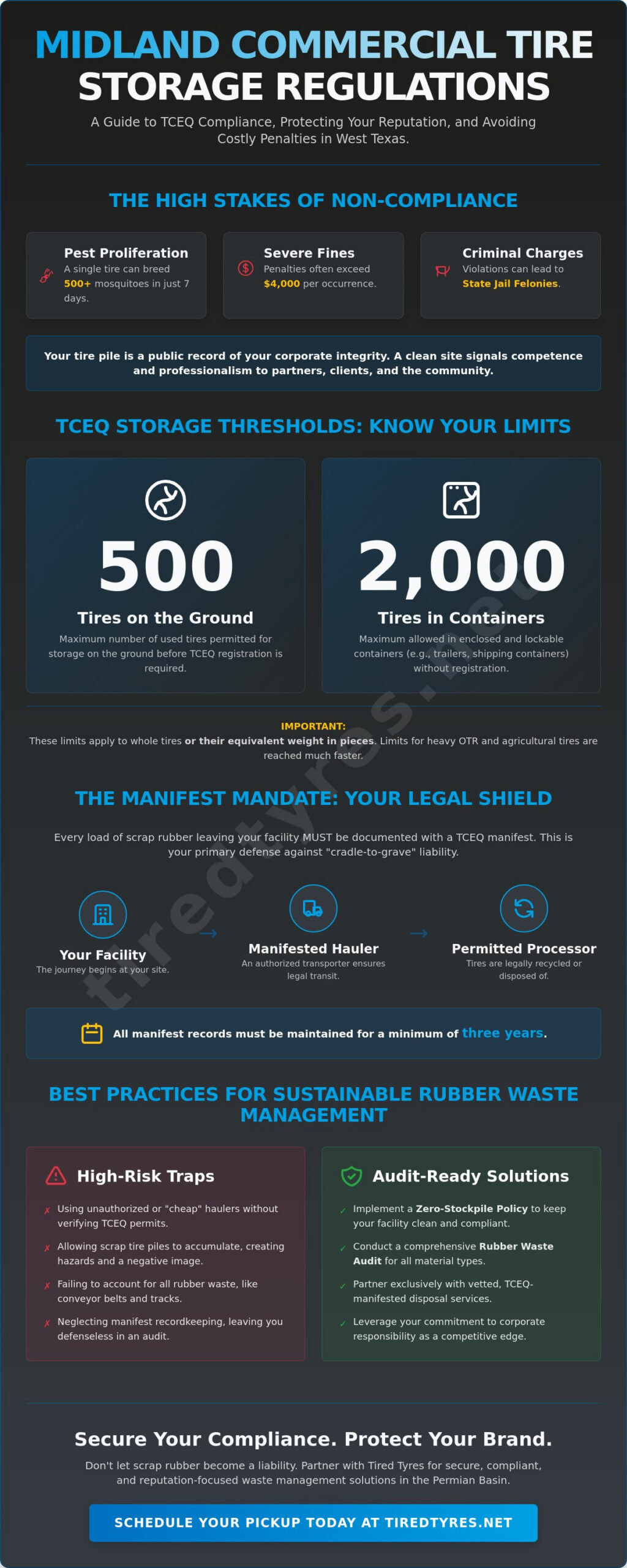
It’s easy to get lost in search results that mix up Midland, Michigan with our own Permian Basin. In West Texas, the Texas Commission on Environmental Quality (TCEQ) maintains strict oversight of scrap rubber. If your business stores more than 500 used tires on the ground, you are legally required to register as a storage site. For those using enclosed and lockable containers, the threshold is 2,000 tires. These Midland commercial tire storage regulations also apply to equivalent weights of tire pieces. For companies handling OTR (Off-the-Road) or agricultural tires, these limits are reached much faster than you might expect. Staying current with Texas Tire Disposal Regulations is the only way to ensure your 2026 operations remain audit-ready.
The Manifest System and Recordkeeping
Compliance doesn’t end with storage limits. Every time scrap rubber leaves your facility, a manifest must document the journey. This tracking system is your primary defense against “cradle-to-grave” liability. Texas law requires you to maintain these records for at least three years. If an unauthorized hauler takes your tires and dumps them in a field, the TCEQ will trace those tires back to your business. Professional haulers provide the verified documentation that self-hauling often lacks. This paper trail proves you’ve followed the law from the moment the tire was removed until it reached a permitted processor. Accurate recordkeeping is a non-negotiable part of West Texas business management.
Local Midland and Odessa Landfill Realities
Relying on municipal landfills in Midland or Odessa is becoming increasingly difficult for commercial entities. Most local facilities no longer accept whole tires. By 2026, restrictions on tires still mounted on rims have become even more stringent. If you attempt to self-haul bulk rubber, you’ll likely face rejection or significant surcharges at the gate. Specialized processors provide a more reliable and professional alternative. They divert your waste into sustainable tire recycling markets where rubber is repurposed for tire-derived fuel or rubberized asphalt. This approach is often more cost-effective than navigating the complex and ever-changing rules of general waste sites. If you need help clearing out a backlog, consider reaching out to a TCEQ-permitted disposal partner to simplify your compliance and protect your reputation.
The High Cost of “Cheap” Disposal: Avoiding Scandals and Fines
Choosing the lowest bid for tire removal is a common mistake for Permian Basin facility managers. The “guy with a trailer” might offer a price that seems unbeatable, but this often leads to the “cheap” disposal trap. Without a TCEQ-permitted hauler, your scrap rubber frequently ends up in a ditch or an abandoned lot. Under Midland commercial tire storage regulations, the responsibility for that waste never leaves your business. If those tires are traced back to your site, you’re the one facing the legal fallout.
Liability in Texas is comprehensive and follows the waste generator. It doesn’t matter if your tires were dumped in Lubbock or Ector County; the state holds you responsible for their final destination. When law enforcement uses trail cameras to investigate illegal sites, they look for any identifying markers that lead back to the source. “I didn’t know they would dump them there” isn’t a valid legal defense. Investing in TCEQ-compliant tire disposal solutions is a fraction of the cost of a state jail felony charge.
The PR Nightmare of Environmental Mismanagement
Social media has turned environmental mismanagement into a public spectacle. Residents in Midland and Odessa are quick to post photos of illegal dump sites to local community groups. If your company’s logo or recognizable industrial waste is visible in those photos, the damage to your brand equity is immediate. It takes years to build a reputation in West Texas, but only one viral post about a mosquito-infested tire pile to destroy it. Once your business is linked to an environmental scandal, regaining the trust of partners and the public is a long, expensive process.
Financial and Legal Consequences
The financial math of illegal dumping is grim. Dumping more than 200 pounds of waste, which is roughly 10 standard passenger tires, is classified as a state jail felony. Fines for these occurrences often exceed $4,000 per instance. Beyond the immediate penalties, a single violation of Midland commercial tire storage regulations can cause your commercial insurance premiums to skyrocket. Perhaps most importantly, a record of environmental violations often disqualifies businesses from lucrative government and municipal contracts. The long-term cost of a bad disposal choice far outweighs any short-term savings.
Best Practices for Sustainable Rubber Waste Management
Proactive management is the most effective way to stay ahead of Midland commercial tire storage regulations. A successful strategy begins with a thorough rubber waste audit. Don’t limit your inventory to just passenger tires. You must categorize all rubber assets, including scrap skid steer tracks, industrial hoses, and bulk conveyor belts. By understanding exactly what you generate, you can implement a “Zero-Stockpile” policy for your Odessa or Midland facility. This approach ensures that waste never accumulates long enough to trigger registration requirements or attract regulatory scrutiny. It also allows you to integrate Tire Recycling into your company’s ESG goals, showing investors that your Permian Basin operations are both compliant and sustainable.
Before you engage any waste management partner, you must verify their TCEQ permits. Don’t take a verbal assurance as proof. Ask for their registration number and check its validity on the state database. A legitimate partner will always provide a manifest for every load that leaves your site. This documentation is your only shield against the “cradle-to-grave” liability discussed in previous sections. If a hauler can’t show you where your waste is going, they aren’t a safe choice for your business reputation.
Establishing a Collection Schedule
Stagnant rubber is a liability. As mentioned earlier, a single tire can breed over 500 mosquitoes in just seven days if it holds water. Beyond the health risks, large piles are significant fire hazards that are notoriously difficult to extinguish. You should match your pickup frequency to your business’s specific waste generation rate. A consistent Commercial Tire Disposal plan prevents these hazards from developing. Regular removals keep your site professional and ensure you stay well below the 500-tire threshold for ground storage. It’s much easier to manage small, frequent loads than to deal with a massive cleanup project once a year.
Managing Industrial Rubber Waste
Industrial rubber requires a different approach than standard tires. Scrap conveyor belts and heavy-duty hoses are too bulky for standard dumpsters and are frequently rejected at municipal landfills. These materials shouldn’t be left to rot in a corner of your yard. Specialized processing is necessary to break down these items so they can enter the Texas circular economy. Currently, about 90% of professionally collected scrap tires and rubber are diverted into secondary markets like tire-derived fuel or rubberized asphalt. By partnering with a permitted processor, you ensure these materials are repurposed rather than abandoned. If you’re ready to clean up your facility and secure your reputation, schedule your rubber waste audit today to get started with a compliant disposal plan.
Partnering with Tired Tyres: Secure, Compliant, and Reputation-Focused
Managing a commercial facility in the Permian Basin requires partners who understand the specific challenges of our region. Tired Tyres is a locally owned West Texas company that focuses exclusively on the Midland business landscape. We don’t provide the distant, generalized support of a national waste brand. Instead, we offer direct access to local experts who understand how Midland commercial tire storage regulations impact your daily operations. Our team ensures that your scrap rubber management is a seamless part of your facility’s maintenance rather than a source of regulatory stress.
Our commitment to 100% TCEQ manifest compliance means you never have to worry about “cradle-to-grave” liability. We handle the heavy lifting and the paperwork, providing you with a clear legal trail for every load we collect. Whether you’re clearing out a backlog of agricultural tires or establishing a routine for your semi-truck fleet, we build a Tire Disposal in Midland strategy that builds trust with regulators and partners alike. We use specialized equipment designed for the toughest industrial rubber waste, ensuring your site remains clean and audit-ready at all times.
The Tired Tyres Difference
Working with local experts in Midland, Odessa, and Lubbock gives you a distinct advantage. We provide transparent pricing without the “landfill surprises” or hidden surcharges common with less specialized haulers. Our fleet is specifically designed for heavy industrial rubber and OTR tire collection. This specialized focus allows us to handle scrap skid steer tracks, industrial hoses, and bulk conveyor belts that standard trash services simply can’t manage. We know the local terrain and the specific 2026 restrictions at regional facilities, allowing us to navigate Midland commercial tire storage regulations with precision and speed.
Your Reputation, Our Priority
A clean, organized yard is a silent testimonial to your professionalism. Our reliable, scheduled pickups prevent the accumulation of rubber waste that creates fire hazards and attracts pests. When we arrive at your site, our professional service reflects positively on your entire operation. We don’t just haul waste; we protect the brand equity you’ve worked hard to build in the Permian Basin. By keeping your facility compliant and aesthetically sharp, we help you maintain the “Permian-Strong” image that wins contracts and attracts top talent. Contact Tired Tyres for a professional waste audit and quote today.
Secure Your Permian Basin Legacy Through Compliance
Staying ahead of Midland commercial tire storage regulations is a matter of corporate survival in today’s Permian Basin. We’ve seen how staying below TCEQ thresholds and maintaining a zero-stockpile policy protects you from state jail felonies and public relations disasters. Your liability doesn’t end when the tires leave your yard; it only ends when you have a signed manifest from a permitted processor. These documents are your ultimate defense during a state audit and prove your commitment to the community.
A clean facility signals to your partners that you’re disciplined and reliable. By prioritizing ethical disposal for everything from OTR tires to scrap conveyor belts, you’re investing in the long-term health of your brand. You don’t have to manage these complex rules alone. Our team provides the local expertise and specialized equipment needed to keep your site compliant and professional. We’re here to help you focus on your core operations while we handle the heavy rubber waste.
Protect your business reputation with professional tire disposal from Tired Tyres. We offer TCEQ-compliant manifest tracking and specialized handling for industrial rubber waste across Midland, Odessa, and Lubbock. Let’s work together to keep West Texas clean and your business secure.
Frequently Asked Questions
Why is professional waste management important for my Midland business reputation?
Professional waste management prevents your facility from becoming an eyesore or a public health hazard. In the Permian Basin, a clean and organized site signals operational discipline to potential partners and investors. If your rubber waste ends up in an illegal dump, the resulting PR scandal can permanently damage your brand’s integrity. It’s about showing the community and your clients that you value West Texas environmental standards.
What are the TCEQ regulations for tire storage in Texas for 2026?
Current 2026 TCEQ rules require scrap tire storage site registrations to be renewed every 60 months. Businesses must also submit an annual summary of their scrap tire management activities by March 1 of each year. Failure to meet these reporting deadlines or follow Midland commercial tire storage regulations can lead to heavy state fines. These rules ensure that all scrap rubber is accounted for from the point of generation to final processing.
How many tires can I store in Midland before needing a permit?
You can store up to 500 scrap tires on the ground or up to 2,000 tires in enclosed, lockable containers before a TCEQ permit is required. These limits apply to the total count of whole tires or their weight equivalent in shredded pieces. If your inventory exceeds these specific numbers, you must register your facility as a scrap tire storage site to avoid significant legal penalties and state jail felony charges.
What is a scrap tire manifest and why does my business need one?
A scrap tire manifest is a legal tracking document required for transporting more than five tires at once in Texas. It provides a verified paper trail proving your waste reached a permitted disposal or recycling site. Under Midland commercial tire storage regulations, your business must keep these records for at least three years. This documentation protects you from liability if your waste is ever discovered at an unauthorized dump site.
Does Tired Tyres handle OTR and agricultural tire disposal in Odessa?
Yes, Tired Tyres provides specialized collection for OTR and agricultural tires throughout the Odessa and Midland areas. Our fleet is specifically equipped to handle heavy industrial rubber that standard trash services often reject. We also collect scrap skid steer tracks, solid tires, and industrial hoses. This ensures that your heavy equipment waste is managed according to all state environmental standards and legal requirements.
What are the risks of using an unpermitted tire hauler in Lubbock?
Using an unpermitted hauler in Lubbock exposes your business to “cradle-to-grave” liability. If an unauthorized hauler dumps your tires illegally, the state holds you responsible for the cleanup and all associated legal fees. In Texas, dumping more than 200 pounds of waste is a state jail felony. This often results in fines exceeding $4,000 per occurrence and can disqualify your business from future government contracts.
How often should a Permian Basin business schedule scrap rubber pickup?
We recommend scheduling pickups before your inventory approaches TCEQ registration thresholds or the seven-day mosquito breeding cycle. For most active Midland facilities, a monthly or bi-weekly schedule prevents fire hazards and keeps the site looking professional. Matching your pickup frequency to your specific waste generation rate ensures you never have a dangerous backlog of industrial rubber or scrap tires on your property.
Is it legal to haul my own business tires to the Midland landfill?
While you can technically haul your own tires, the City of Midland landfill does not accept whole tires and has strict 2026 restrictions on tires still mounted on rims. You’ll likely face high surcharges or outright rejection at the gate for bulk loads. Using a professional processor is more efficient because they accept all rubber types and provide the necessary manifests that municipal landfills typically don’t offer for commercial audits.