
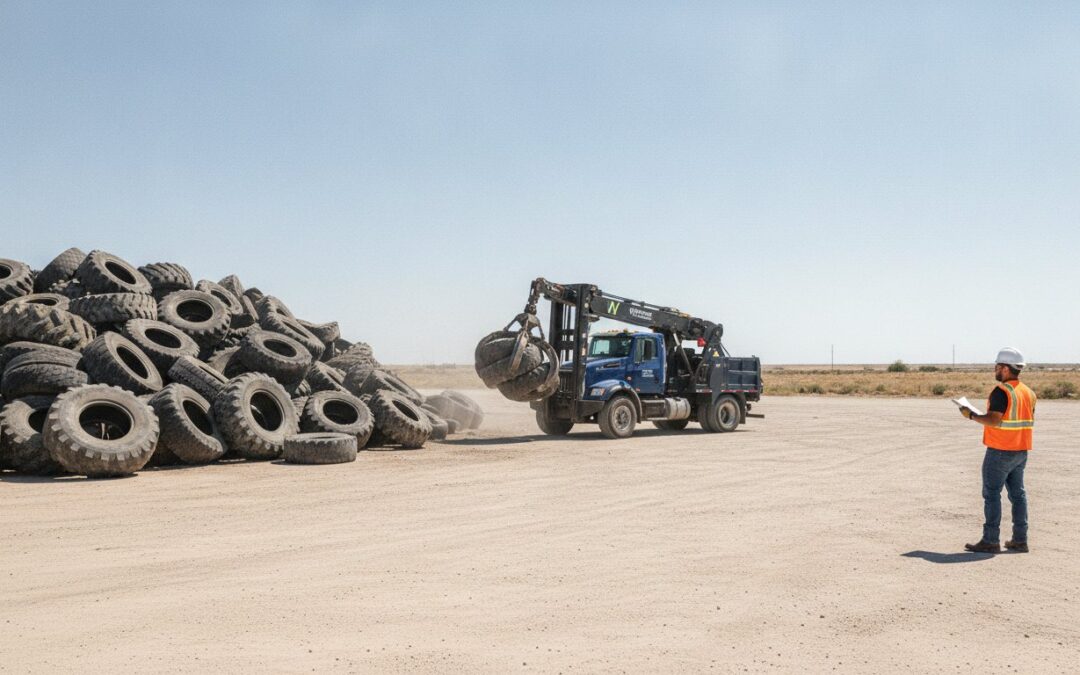
What if that growing mountain of rubber on your property wasn’t just an eyesore, but a high-interest debt against your business’s legal standing? In West Texas, a scrap tire pile taking up valuable yard space is more than a nuisance; it’s a liability that threatens your operational ROI. You’ve likely felt the frustration of losing room for heavy equipment or the constant anxiety over fire hazards and mosquito breeding grounds. It’s a common struggle, especially when moving massive OTR or semi-truck tires feels like an impossible task and the fear of a TCEQ fine reaching $10,000 per day hangs over your head.
The good news is that you don’t have to face these risks alone. You can reclaim your land and transform a cluttered yard into productive, revenue-generating space while staying strictly compliant with Texas environmental laws. This guide will walk you through the essential steps to clear your property safely. You’ll learn how to navigate the mandatory manifest system, secure legal disposal documentation, and finally eliminate the pest and fire risks that come with stockpiled rubber. It’s time to stop worrying about inspections and start using your land the way it was intended.
Key Takeaways
- Understand why Texas authorities classify stockpiled tires as high-hazard waste and how one pile can attract more illegal dumping to your property.
- Learn the specific TCEQ storage limits and how the mandatory manifest system shields your business from costly legal penalties.
- Discover the true financial impact of a scrap tire pile taking up valuable yard space and how much revenue that reclaimed land can generate.
- Explore the professional remediation process for categorizing bulk rubber waste, including agricultural tires, semi-truck tires, and industrial conveyor belts.
- Find out why partnering with a West Texas specialist ensures your property’s cleared efficiently while maintaining full environmental compliance.
The Hidden Costs of a Scrap Tire Pile Taking Up Valuable Yard Space
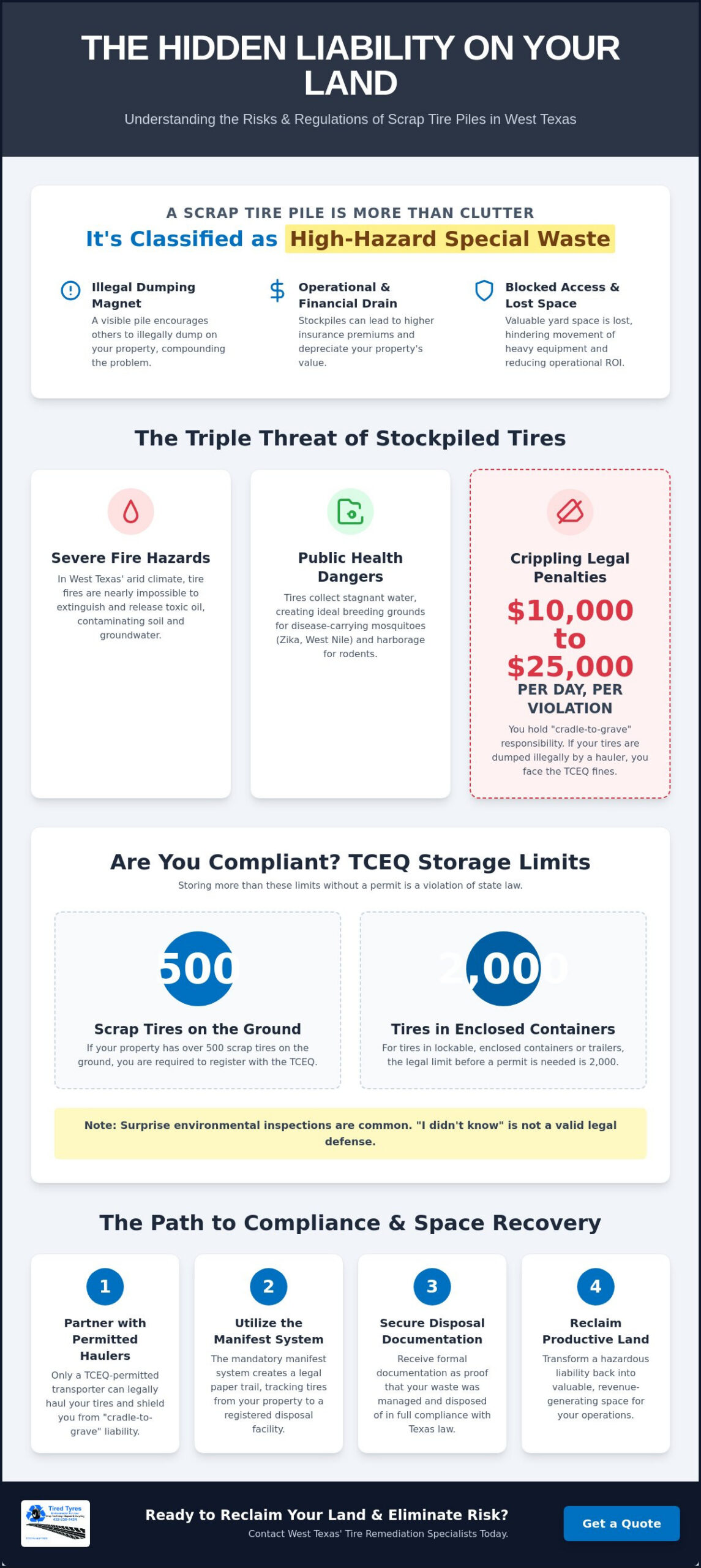
A scrap tire stockpile is a liability that depreciates property value. In the eyes of Texas authorities, these aren’t just old parts; they are classified as “special waste.” Having a scrap tire pile taking up valuable yard space creates a high-hazard environment that regulators prioritize for inspections. The Texas Commission on Environmental Quality (TCEQ) monitors these sites closely because rubber does not decompose naturally. Instead, it sits and collects risks that grow more expensive the longer they are ignored.
Beyond the tires you actually own, a visible pile acts as a magnet for outside trouble. It’s the “broken window” effect in action. Once others see a scrap tire pile taking up valuable yard space, they often assume your property is an unmonitored dumping ground, which leads to midnight drops of even more tires. This clutter doesn’t just look bad; it hits your bottom line directly. Insurance providers for industrial and commercial properties in West Texas often view these stockpiles as significant risks. This can lead to higher premiums or even policy cancellations if the site isn’t cleared promptly.
Fire Hazards and the Permian Basin Climate
West Texas is known for its arid, windy conditions. These factors make tire fires particularly dangerous and difficult to manage. Unlike a wood fire, a tire fire creates its own fuel source as the rubber melts and burns. They are nearly impossible to extinguish once they reach a certain temperature. In the Permian Basin, a single spark can turn a stockpile into a long-term disaster. Beyond the heat, these fires produce toxic pyrolytic oil. This runoff can seep into the soil and contaminate groundwater, leading to massive environmental cleanup costs that far exceed the price of disposal. Large piles also physically block fire department access, making it harder for emergency crews to reach your primary buildings or equipment during a crisis.
Pest Breeding and Public Health Liabilities
Stagnant water trapped inside tires makes them the perfect incubator for mosquitoes. Even in dry climates, a small amount of rain or irrigation runoff is enough to start a breeding cycle. These pests carry diseases like West Nile and Zika, posing a direct threat to your crew and the local community. Large agricultural or OTR tire piles also provide ideal harborage for rodents and snakes. If a neighbor’s health is impacted by the pests breeding on your land, you could face significant legal liabilities and lawsuits. Understanding Tire recycling processes is the first step toward removing these biological hazards and protecting your business’s reputation and legal standing.
Texas Scrap Tire Regulations: Why Stockpiling is a Legal Risk
In Texas, the law is very specific about how many tires you can keep on your property before you need a permit. Storing more than 500 scrap tires on the ground or more than 2,000 in enclosed, lockable containers requires formal registration with the Texas Commission on Environmental Quality (TCEQ). If you have a scrap tire pile taking up valuable yard space that exceeds these limits without a permit, you aren’t just cluttered; you’re in violation of state law. Many property owners believe that keeping a stockpile “out of sight” behind a fence or in a remote corner of a ranch provides protection. However, surprise environmental inspections are common in the Permian Basin, and “I didn’t know they were there” is not a valid legal defense.
The distinction between a generic junk hauler and a permitted scrap tire transporter is critical for your protection. A standard hauler might offer a lower price, but if they dump those tires illegally, the legal trail leads directly back to you. Under Texas law, you maintain “cradle-to-grave” responsibility for your waste. This means that if your tires are found in a ditch or an unpermitted site, you are the one facing the consequences. Researching the environmental and health impacts of tires shows why the state takes these violations so seriously.
The $25,000 a Day Risk
TCEQ penalties are structured to be punitive. For standard violations, fines can reach $10,000 per day, per violation. For more severe cases or repeat offenses, those penalties can climb as high as $25,000 per day. In 2025 alone, the TCEQ issued over $2.4 million in penalties for improper scrap tire management. These aren’t just theoretical numbers; West Texas businesses frequently face these non-compliance penalties during routine audits. To stay protected, it’s vital to follow the latest Texas Tire Disposal Regulations to ensure your site meets every current standard.
Legal Documentation: The Manifest System
The scrap tire manifest is your only ironclad defense against dumping allegations. This mandatory five-part document tracks the tires from the moment they leave your yard until they reach a permitted recycling or disposal facility. You must keep copies of these manifests for at least three years. Before any tires are loaded onto a truck, always verify the hauler’s TCEQ registration number. This documentation proves you’ve met your legal obligations. If you’re currently dealing with a scrap tire pile taking up valuable yard space, working with a professional team like Tired Tyres ensures every manifest is handled correctly, protecting your business from future liability.
Calculating the Value of Reclaimed Yard Space
Every square foot of your property should contribute to your bottom line. When you have a scrap tire pile taking up valuable yard space, you aren’t just losing land; you’re losing money. OTR tires and semi-truck tires have massive footprints. A single stack of heavy equipment tires can easily occupy 100 square feet or more. When these piles grow, they consume areas originally designed for equipment storage, vehicle maneuvering, or inventory staging. Assessing the total square footage lost is the first step in understanding the true cost of inaction.
Operational flow is the heartbeat of any West Texas industrial site. A cluttered yard forces drivers to take longer routes or perform complex backing maneuvers to avoid debris. This inefficiency leads to increased fuel consumption and higher risks of equipment damage. Clearing out old rubber waste reduces equipment downtime by creating wider, safer lanes for your fleet. Beyond the logistics, a clean yard protects your professional reputation. When a client or inspector visits your site, a tidy facility signals precision and reliability. A disorganized yard suggests a disorganized business, which can erode trust before a single word is spoken.
Industrial Space vs. Disposal Costs
Yard space in Midland/Odessa is a finite asset that should generate revenue. While there is a one-time cost to remove bulk rubber, the long-term value of the reclaimed land is significantly higher. Extra space allows you to take advantage of bulk inventory purchasing when prices are low. If you can store more pipe, parts, or tools safely, you can improve your profit margins on every project. For lawn care professionals who use this reclaimed space to grow their fleet, Mowing Route Density offers a specialized platform for renting high-quality equipment. It’s much more profitable to use that land for revenue-generating assets than to let it serve as a free warehouse for waste rubber.
Insurance and Property Tax Benefits
Property cleanliness directly impacts your overhead costs. Removing significant fire hazards like tire stockpiles often allows you to negotiate lower commercial insurance quotes. Insurers look favorably on businesses that actively mitigate risks. Additionally, the physical state of your property influences appraisal values. A site free of “special waste” is much easier to lease or sell if your business needs change. For more information on clearing your site, consult this guide on Reliable Tire Disposal to see how professional recovery works in your area. Clearing a scrap tire pile taking up valuable yard space is an investment in your property’s future marketability.
Professional Remediation: The Process of Clearing Bulk Tire Piles
Clearing a scrap tire pile taking up valuable yard space is a multi-step operation that requires more than just a truck and a crew. It’s a logistical process designed to ensure safety and legal compliance. Professional remediation begins with a clear plan to categorize the waste. We separate the inventory into specific groups, including our Passenger & Light Truck, Semi-Truck, and Agricultural Tire Collections. This sorting is necessary because different types of rubber require different transport and recycling methods. We also identify other industrial items like scrap skid steer tracks, scrap solid tires, or scrap conveyor belts that may be mixed into the pile.
Once categorized, the second step involves securing the site for heavy equipment access. Loaders and transport vehicles need stable ground and enough room to maneuver without risking damage to your existing structures. The third step is the loading and manifesting phase. As the tires are loaded, we document the count and type to satisfy TCEQ requirements. This ensures your legal “cradle-to-grave” responsibility is fully documented. Finally, we perform a site sweep. This verification step ensures that all rubber debris is removed, leaving you with a clean, usable yard that’s ready for productive use.
Handling Specialized Waste: OTR and Industrial Rubber
Moving massive Off-the-Road (OTR) tires presents unique challenges. These units can weigh thousands of pounds and are impossible to move with standard warehouse equipment. Professional recovery requires specialized loaders and heavy-duty trailers designed for oversized loads. We don’t just stop at tires, though. Industrial yards often accumulate other rubber liabilities like scrap hoses and scrap conveyor belts. These items often get tangled deep within a scrap tire pile taking up valuable yard space. Our crew uses specialized machinery to extract and collect these materials, ensuring that every piece of industrial rubber is cleared from your property in a single, efficient pass.
Logistics and Scheduling for Commercial Yards
Preparation is the key to minimizing business disruption during a cleanup. We recommend staging your tires in an accessible area away from high-traffic fleet lanes before the crew arrives. This allows our team to work quickly without blocking your daily operations. Depending on your business volume, you might choose a one-time bulk cleanup or a regular collection schedule to prevent piles from accumulating again. When planning your recovery, you should check with your service provider about scheduling options that fit your specific needs. If you’re ready to clear your property and protect your legal standing, contact the team at Tired Tyres to schedule your bulk rubber recovery.
Partnering with Tired Tyres for Space Recovery in West Texas
Local expertise matters when you’re dealing with state regulators and environmental standards. We focus on the specific needs of businesses in Midland, Odessa, and Lubbock because we understand the regional challenges of the Permian Basin and South Plains. A scrap tire pile taking up valuable yard space isn’t just a physical obstacle; it’s a hurdle to your business’s growth. Our team provides a direct, professional solution that removes the burden of waste management from your shoulders. We’re committed to a transparent process where every load is accounted for, ensuring you have the documentation necessary to prove full compliance with Texas environmental laws.
Our capabilities go far beyond standard passenger tires. We provide specialized recovery for a wide range of industrial rubber products that many general haulers won’t touch. Our service list includes:
- OTR (Off-the-Road) Tire Collection for heavy mining and construction equipment.
- Agricultural Tire Collection to clear ranch and farm properties.
- Semi-Truck Tire Collection for logistics hubs and fleet yards.
- Scrap conveyor belt and hose collection to manage industrial manufacturing waste.
- Scrap skid steer track and solid tire collection for construction and warehouse sites.
By handling these diverse materials, we help you turn a neglected corner of your property back into a functional asset.
Serving the Permian Basin and South Plains
We know the local landscape. Many landfills in the Midland area have implemented tighter restrictions on whole tires and often refuse “rim-on” tires from commercial entities. Our team stays current on these shifting local rules so you don’t have to. We provide rapid response times for businesses facing imminent environmental inspections or those who simply need their land back immediately. If you’re ready to clear the clutter, contact us today for a quote on bulk tire removal.
The Tired Tyres Advantage: Compliance and Reliability
Our manifest system is your best defense against state penalties. We track the chain of custody for every piece of rubber we remove, protecting you from the “cradle-to-grave” liability that comes with waste generation. Whether you’re dealing with massive agricultural tires or a scrap tire pile taking up valuable yard space behind your shop, we have the heavy-duty equipment to handle the job safely. Don’t let a tire pile kill your yard’s potential. It’s time to reclaim your property. You can call Tired Tyres for a cleanup plan that fits your schedule and restores your operational flow.
Reclaim Your Property and Protect Your Business
A scrap tire pile taking up valuable yard space shouldn’t be the reason your property value or safety is at risk. By moving from a liability-based mindset to one of space optimization, you’re investing in your yard’s future. You now understand how the TCEQ manifest system and professional remediation can eliminate the threat of massive fines while clearing away everything from semi-truck tires to industrial conveyor belts. Reclaiming this land allows for better equipment flow, lower insurance risks, and a more professional environment for your clients and crew.
Since our inception, Tired Tyres has served the Midland, Odessa, and Lubbock areas with a focus on reliability and precision. We bring the specialized equipment needed to handle heavy OTR and agricultural collections that standard haulers often avoid. Our TCEQ-compliant manifest system ensures your legal trail is airtight and your “cradle-to-grave” responsibility is fully met. Reclaim your yard space today with a professional tire pickup quote from Tired Tyres. It’s time to stop managing waste and start putting your property back to work.
Frequently Asked Questions
How many scrap tires can I legally store on my property in Texas?
You can legally store up to 500 scrap tires on the ground or 2,000 tires in enclosed, lockable containers without a TCEQ registration. If your inventory exceeds these specific thresholds, you’re required to register as a storage site. Failing to do so can result in significant daily penalties during a surprise environmental inspection.
What are the penalties for illegal tire dumping in Midland or Odessa?
Dumping or improperly storing over 200 pounds of rubber is prosecuted as a state jail felony in Texas. Beyond criminal charges, the TCEQ can issue administrative penalties as high as $10,000 per day for each violation. In 2025 alone, the state issued over $2.4 million in fines for improper scrap tire management.
Do I need a special permit to transport my own scrap tires to a landfill?
Yes, any entity transporting more than five scrap tires for commercial purposes must be a registered transporter with the TCEQ. Most West Texas landfills have strict restrictions and often refuse whole tires from commercial businesses. It’s usually more efficient to use a permitted service that provides the mandatory manifest documentation for your records.
How much does professional tire pile removal typically cost?
Disposal costs are negotiated based on the specific volume and the categories of tires in your inventory. A scrap tire pile taking up valuable yard space that contains heavy OTR or agricultural tires requires different equipment and logistics than a pile of standard passenger tires. Most providers offer custom quotes after assessing the site’s accessibility and waste types.
Can I be fined if someone else dumps tires on my property?
Yes, Texas law holds the landowner responsible for any waste found on their property, regardless of who placed it there. This “cradle-to-grave” liability means you’re legally required to remediate the site. Clearing a scrap tire pile taking up valuable yard space promptly is the best way to avoid being targeted for secondary illegal dumping or state fines.
What is a TCEQ scrap tire manifest and why do I need one?
A scrap tire manifest is a mandatory five-part document that tracks tires from the generator to a permitted recycling or disposal facility. You must keep copies of these manifests for three years to prove your business followed legal disposal protocols. This document is your primary defense if the state ever questions your waste management history.
How do I get rid of large OTR or tractor tires that landfills won’t take?
Large Off-the-Road (OTR) and agricultural tires require specialized recovery teams with heavy-duty loaders and trailers. Most municipal landfills don’t have the equipment to process these massive units and will flatly refuse them. Professional collectors who specialize in industrial rubber are the only reliable way to clear these oversized liabilities from your yard.
Are there any free tire disposal events in Lubbock or Midland in 2026?
Residents should monitor the City of Lubbock and City of Midland websites for seasonal “community cleanup” dates. For commercial entities, the HB 464 grant program was established in 2026 to help counties fund the remediation of large illegal dumpsites. However, these programs often have strict limits on the number of tires accepted per participant.