
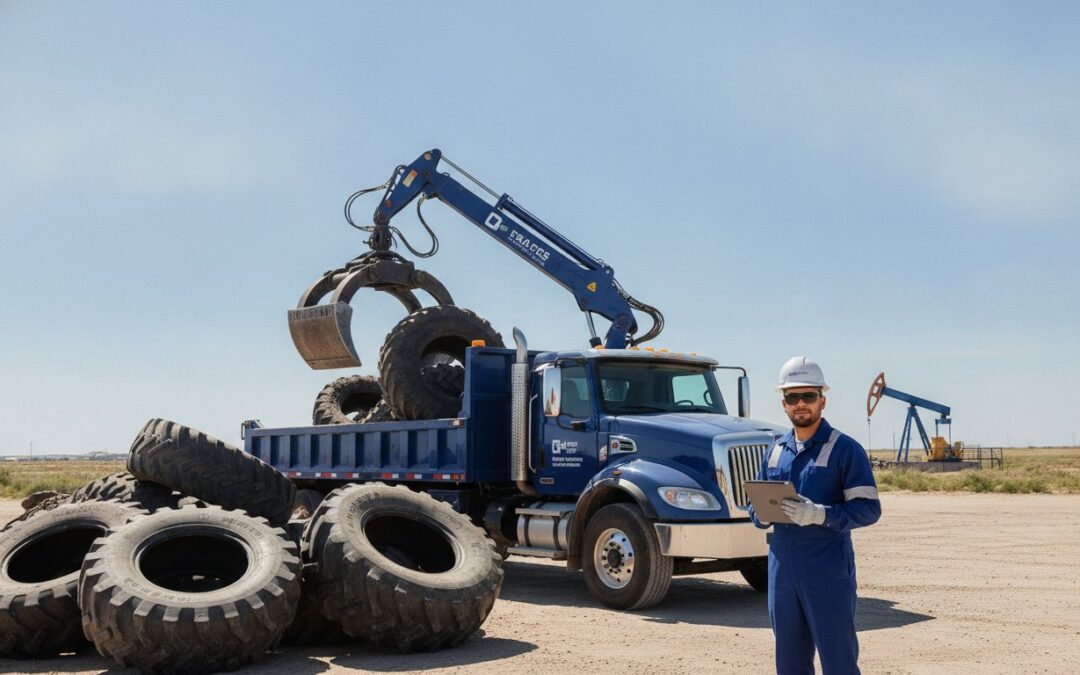
If your scrap tire hauler disappears before a TCEQ inspector arrives, you’re the one left holding the liability for every piece of rubber on your property. In the Permian Basin and South Plains, “cradle to grave” responsibility isn’t just a legal term; it’s a significant financial risk if your paperwork isn’t perfect. You’ve likely dealt with the frustration of scheduled pickups that never happen or the headache of trying to move massive OTR and agricultural tires that standard haulers won’t touch.
Finding a reliable scrap tire hauler West Texas operations can depend on is about more than just a truck. It’s about ensuring your site stays clean and your business remains fully compliant with the latest state regulations. You deserve a partner who shows up on time and handles the complex manifest tracking required by the TCEQ so you can focus on your actual work. It’s time to stop worrying about potential fines and start expecting professional consistency.
This 2026 guide reveals how to secure a dependable hauling service that prioritizes legal documentation and predictable schedules. We’ll explore the current requirements for scrap tire generators, the best ways to manage industrial rubber waste, and how to verify that your disposal partner is truly operating within the law.
Key Takeaways
- Finding a reliable scrap tire hauler West Texas companies can trust ensures your site stays clean and scheduled pickups are never missed.
- Learn why the Texas Scrap Tire Manifest is your primary legal defense against “cradle to grave” liability and potential TCEQ fines.
- Discover the specialized equipment and logistical requirements needed to safely remove large OTR, agricultural, and semi-truck tires.
- Understand how to streamline your collection process by establishing effective staging areas to reduce pickup times and costs.
- Identify the critical compliance standards every permitted hauler must meet to protect your business from illegal dumping risks.
The Search for a Reliable Scrap Tire Hauler in West Texas
Finding a reliable scrap tire hauler West Texas businesses can depend on is often more difficult than it should be. In cities like Midland and Odessa, the oilfield moves fast, and scrap rubber piles up even faster. If you’ve ever been “ghosted” by a hauler after a scheduled pickup, you know the frustration. It’s not just an eyesore. Leftover tires on your property can decrease land value and create significant safety hazards, including fire risks and breeding grounds for pests. Choosing the wrong partner means risking your reputation and facing potential TCEQ fines if those tires end up in a ditch rather than entering the proper tire recycling process.
The Logistical Landscape of the Permian Basin
The geography of the Permian Basin and South Plains presents unique challenges that Central or East Texas haulers don’t always understand. Serving remote oilfield sites or rural farmsteads requires a deep knowledge of the local dirt roads and property layouts. When a hauler lacks a local presence in Midland or Odessa, response times suffer. You shouldn’t have to wait weeks for a collection while West Texas weather beats down on your rubber waste. Intense sun and heat can cause tires to degrade or become fire hazards, making timely removal a critical safety priority for any commercial operation.
Reliability vs. Just a Truck
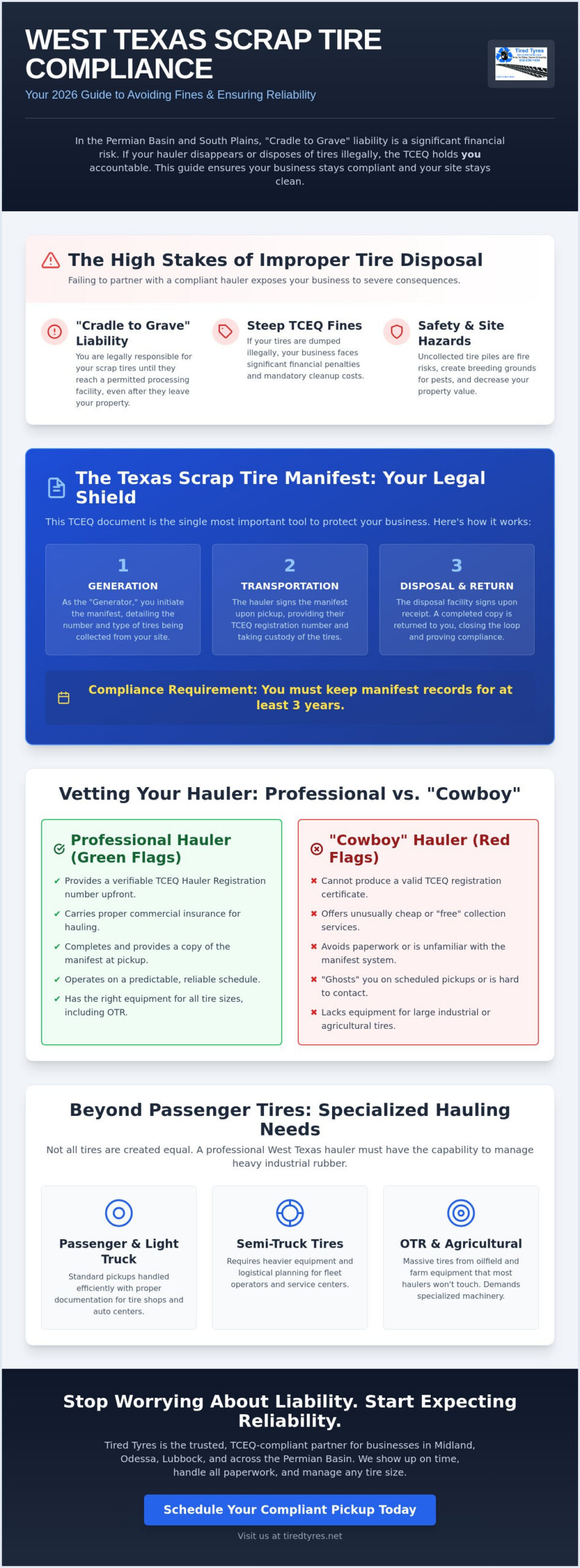
A professional hauler provides more than just a flatbed. They provide a documented chain of custody. Many “cowboy” haulers operate without the necessary permits, putting your business at risk for every tire they take. True reliability means having a fleet capable of handling diverse loads, from passenger car tires to massive OTR rubber. You need to know if your hauler can manage a semi-truck tire collection as easily as a light truck pickup. Consistency is the foundation of a clean site.
Professional standards also include communication. You should expect a hauler who confirms appointments and provides clear documentation upon arrival. A dependable partner offers a predictable schedule rather than an “on-call” promise that never materializes. This consistency ensures your staging area stays clear and your site remains compliant with Texas laws. Using a reliable scrap tire hauler West Texas relies on means your documentation is handled correctly the first time, every time.
Understanding TCEQ Compliance and Manifest Requirements
A Texas Scrap Tire Manifest is the primary legal document tracking a tire from generation to disposal. The Texas Commission on Environmental Quality (TCEQ) uses this rigorous system to monitor the millions of scrap tires generated across the state each year. If you operate a tire shop, a commercial fleet, or an industrial site, you are legally classified as a “Generator.” This role carries a heavy weight. Under Texas law, you’re responsible for your waste until it reaches a permitted processing facility. If a hauler chooses to dump tires illegally in a Lubbock County field, the TCEQ will trace those tires back to your business. You hold the liability for the cleanup costs and any associated fines.
The Paper Trail: Why Manifests Matter
The manifest acts as your legal shield. It documents the exact number of tires collected, the transporter’s details, and the facility receiving the waste. You must maintain these records for at least 3 years to remain compliant during a TCEQ audit. This “Cradle-to-Grave” rule ensures that the responsibility doesn’t end when the truck leaves your property. If you can’t produce a manifest for every tire that left your site, you risk steep penalties. A professional hauler will provide a completed copy at the time of pickup and ensure the final disposal signature is returned to you. This process creates a transparent chain of custody that protects your business from liability.
Vetting Your Hauler’s Credentials
Never let a truck leave your property without first verifying its TCEQ Hauler Registration number. This number is a mandatory requirement for anyone transporting more than five scrap tires at a time in the state of Texas. Ask to see their current registration certificate and verify it against the state’s database before they load a single tire. Legitimate professionals also carry specific commercial insurance to cover the unique risks of hauling heavy rubber loads. If a service offers “free” or unusually cheap collection, it’s a major red flag. These operators often lack the permits and facility relationships required for legal disposal. Choosing a reliable scrap tire hauler West Texas businesses trust means you aren’t just paying for a pickup; you’re paying for the certainty that your documentation is audit-ready. Proper vetting today prevents a costly legal disaster tomorrow.
Beyond Passenger Tires: Handling Industrial and OTR Rubber Waste
Most waste haulers stop at passenger cars and light trucks. In the industrial heart of the Permian Basin, that’s simply not enough. Oilfield and mining operations rely on massive Off-the-Road (OTR) tires that can weigh thousands of pounds and stand over six feet tall. Moving these giants requires specialized loaders and heavy-duty trailers designed for oversized loads. For industrial operators who also need specialized vehicle support, JTT Towing and Storage provides heavy-duty towing and truck repair services to keep large-scale machinery functional. If you’ve ever tried to call a standard junk removal service for an OTR tire collection, you’ve likely been told “no” before you even finished the sentence. These items aren’t just heavy; they’re logistically complex and require a partner with the right equipment and experience.
The need for a reliable scrap tire hauler West Texas businesses can count on extends to more than just round rubber. Industrial sites often struggle with scrap conveyor belts, hydraulic hoses, and solid rubber tracks that standard landfills refuse to touch. These materials are often reinforced with steel or high-strength fabrics, making them nearly impossible to process without industrial-grade machinery. Leaving these materials to pile up doesn’t just waste space; it creates a significant liability for your company.
Oilfield and Industrial Rubber Disposal
Managing industrial rubber waste requires a specific approach. Scrap conveyor belts from mining or industrial sites are bulky and difficult to transport. Similarly, discarded hydraulic and industrial hoses take up massive amounts of room in traditional dumpsters. Specialized scrap rubber collection covers these unique items, including scrap skid steer tracks and scrap solid tires. Because these materials are so dense, they require a hauler who understands the weight limits and transport regulations specific to industrial rubber. Professional removal ensures these materials are handled correctly from the moment they leave your site.
Agricultural Tire Solutions for West Texas Farmers
The farming community across Lubbock and the South Plains faces its own set of challenges. Large-scale tractor and implement tires are essential for production, but they’re a nightmare to dispose of once they reach the end of their life. Discarded agricultural rubber often ends up at the back of a barn or the edge of a field. These piles quickly become breeding grounds for mosquitoes and habitats for rodents, posing a health risk to your family and workers.
Efficient agricultural tire collection removes these hazards before they become a problem. Whether you’re clearing out years of accumulated tractor tires or need a one-time pickup for a set of irrigation tires, a professional service keeps your farmstead clean and compliant. By choosing a reliable scrap tire hauler West Texas residents trust, you ensure your agricultural waste is managed with the same precision as a high-volume commercial shop.
Once your land is free of industrial and agricultural waste, you can shift your focus toward property enhancement. To see how professional landscaping can transform your site, you can explore Medjool date palm options that thrive in the Texas sun and add long-term value to your estate.
How to Streamline Your Scrap Tire Collection Process
Efficiency isn’t just about speed; it’s about reducing costs and maintaining a safe workspace. When a reliable scrap tire hauler West Texas businesses trust arrives at your site, they shouldn’t have to navigate obstacles or spend hours sorting through a disorganized pile. Proper preparation ensures that your rubber waste is removed quickly and that your documentation is handled without delay. Whether you manage a high-volume shop in Midland or a remote industrial site, a few simple adjustments to your collection process can make a significant difference.
Establishing a dedicated staging area is the most effective way to keep your property organized. This area should be on a flat, solid surface to prevent tires from sinking into the ground or collecting mud, which can complicate the loading process. Storing tires on a gravel or concrete pad keeps them dry and accessible for heavy machinery. For businesses with consistent volume, a reliable scrap tire hauler West Texas operations depend on can help you decide if a weekly, monthly, or project-based schedule is the best fit for your needs.
Preparing Your Site for Pickup
Stacking your tires correctly is the easiest way to maximize loader efficiency. Stacking them in neat columns or using a ‘laced’ pattern reduces the pile’s footprint and allows the hauler to load the truck much faster. You should also ensure there’s a clear path for large collection trucks to maneuver. If a driver has to navigate around heavy equipment or through narrow gates, it slows down the entire service. Segregating your waste is also critical. Keep passenger tires separate from larger OTR or agricultural tires, as these often require different loading equipment and disposal protocols.
Scheduling and Communication
Consistency is key for busy automotive businesses. Setting up a scheduled tire pickup in Odessa ensures your inventory never exceeds your storage capacity or violates local safety codes. For one-time bulk cleanups or project-based removals, clear communication is essential. When calling for a quote, have your estimated tire counts and types ready. Knowing exactly how many semi-truck tires or skid steer tracks you have helps the hauler send the right equipment the first time. If you’re ready to clear your property and ensure full compliance, schedule your next collection with a team that understands West Texas logistics.
Why Tired Tyres is the Trusted Partner for Midland, Odessa, and Lubbock
Choosing a partner for waste management requires more than just finding a truck. It’s about finding a team that understands the specific regulatory and logistical pressures of the Permian Basin. Tired Tyres has built a reputation as the reliable scrap tire hauler West Texas operations depend on by prioritizing transparency and professional consistency. We don’t just pick up rubber; we manage your liability through 100% TCEQ compliance and meticulous manifest tracking. When we handle your collection, you receive a clear paper trail that satisfies state auditors and keeps your business protected.
Our commitment to direct communication means you’re never left wondering when a truck will arrive. We recognize that a cluttered site is a safety hazard and a drain on your productivity. By providing predictable schedules and specialized equipment, we remove the guesswork from rubber waste disposal. Whether you are managing a small automotive shop or a sprawling industrial complex, you deserve a partner who values your time as much as you do.
Our Local West Texas Footprint
Our expertise is rooted in the unique landscape of West Texas. We provide specialized support for tire disposal in Midland, TX, where the fast-paced oilfield demands rapid response times and clear documentation. In the Lubbock area, we serve the agricultural and commercial sectors with the heavy-duty equipment needed for large-scale tractor tire removal. Our presence in Odessa ensures that industrial and automotive clients have a dependable resource for routine pickups. We aren’t a distant corporation; we’re local professionals who know these roads and the specific needs of the people who work on them.
The Tired Tyres Difference
What sets us apart is our ability to handle the full spectrum of rubber waste. While other haulers might refuse industrial items, our team is equipped for everything from standard passenger tires to scrap conveyor belts and skid steer tracks. We understand that your site needs to stay clear to remain productive. That’s why we show up when we say we will. We don’t hide behind complex jargon or vague promises. Instead, we offer direct, honest communication and a commitment to getting the job done right the first time.
Whether you need a one-time cleanup for a stack of OTR tires or a recurring schedule for your tire shop, we have the versatility to meet your needs. We take pride in our precision and our professional dedication, ensuring that every piece of rubber is disposed of legally and efficiently. Don’t let your scrap pile become a liability. Reach out to us today for a reliable tire disposal quote and experience the peace of mind that comes with professional West Texas service.
Take Control of Your Scrap Tire Management
Protecting your business from environmental liability requires more than just moving rubber off your property. It’s about maintaining a flawless paper trail through the TCEQ manifest system and ensuring your waste reaches a permitted facility. You’ve learned that a reliable scrap tire hauler West Texas operations depend on must have the specialized equipment to handle everything from standard passenger tires to massive OTR and industrial rubber waste. By streamlining your staging area and scheduling consistent pickups, you eliminate the risks of illegal dumping fines and property degradation.
Tired Tyres is ready to be that professional partner. As a TCEQ permitted hauler serving Midland, Odessa, and Lubbock, we are specialists in OTR and industrial rubber removal. We understand the logistical challenges of the South Plains and the Permian Basin; we’re committed to direct, honest communication with every client. Don’t let scrap piles become a burden on your productivity or your legal standing.
Get a Reliable Scrap Tire Pickup Quote from Tired Tyres today. We’ll help you maintain a clean, compliant site with the professional service your business deserves.
Frequently Asked Questions
Is it illegal to dump tires in West Texas?
Yes, it’s illegal to dump whole tires anywhere in the state. Texas law requires that tires are shredded, split, or quartered before they can be placed in a landfill. Illegal dumping on unauthorized sites can lead to heavy fines from the TCEQ for both the property owner and the waste generator.
How much does it cost to have scrap tires hauled away in Midland?
Collection costs depend on the size of the tires and the total volume of the load. Standard passenger tires are priced differently than heavy-duty OTR or agricultural tires, which require specialized loading equipment. We provide custom quotes based on the specific types and quantities of rubber waste you need removed.
Do I need a permit to have my tires picked up by a hauler?
You don’t need a personal permit to have tires removed, but you’re legally required to use a TCEQ-registered hauler. As the generator, you’re responsible for the tires until they reach a permitted disposal facility. Always verify your hauler’s registration number to ensure your business remains compliant with state law.
Can you dispose of large OTR or tractor tires?
Yes, we specialize in the removal of large-scale OTR and agricultural tires. These massive items require heavy-duty loaders and specific transport trailers due to their extreme weight and size. We have the experience and equipment necessary to handle these challenging loads safely and efficiently.
What happens to the tires after they are collected?
Collected tires are transported to a permitted processing facility where they’re typically recycled. The primary end-uses in Texas include tire-derived fuel (TDF) and crumb rubber for manufacturing. This process ensures that rubber waste is repurposed rather than sitting in unauthorized stockpiles or landfills.
Do you provide scrap tire manifests for every pickup?
We provide a completed Texas Scrap Tire Manifest for every collection we perform. As a reliable scrap tire hauler West Texas businesses trust, we ensure your chain of custody is fully documented. You should keep these records for at least 3 years to stay prepared for potential TCEQ audits.
How should I store my scrap tires while waiting for collection?
Store your tires in a neat, organized staging area on a solid, flat surface. Stacking them correctly prevents water from pooling inside, which stops mosquitoes and other pests from breeding. Ensuring clear access for large trucks will also make the loading process much faster and more cost-effective.
Can you handle other rubber waste like conveyor belts or skid steer tracks?
Yes, we collect various industrial rubber materials, including scrap conveyor belts, skid steer tracks, and heavy-duty hoses. These dense items are often rejected by standard waste haulers because of their weight and material composition. We have the specialized equipment required to transport these industrial materials to the proper facilities.