
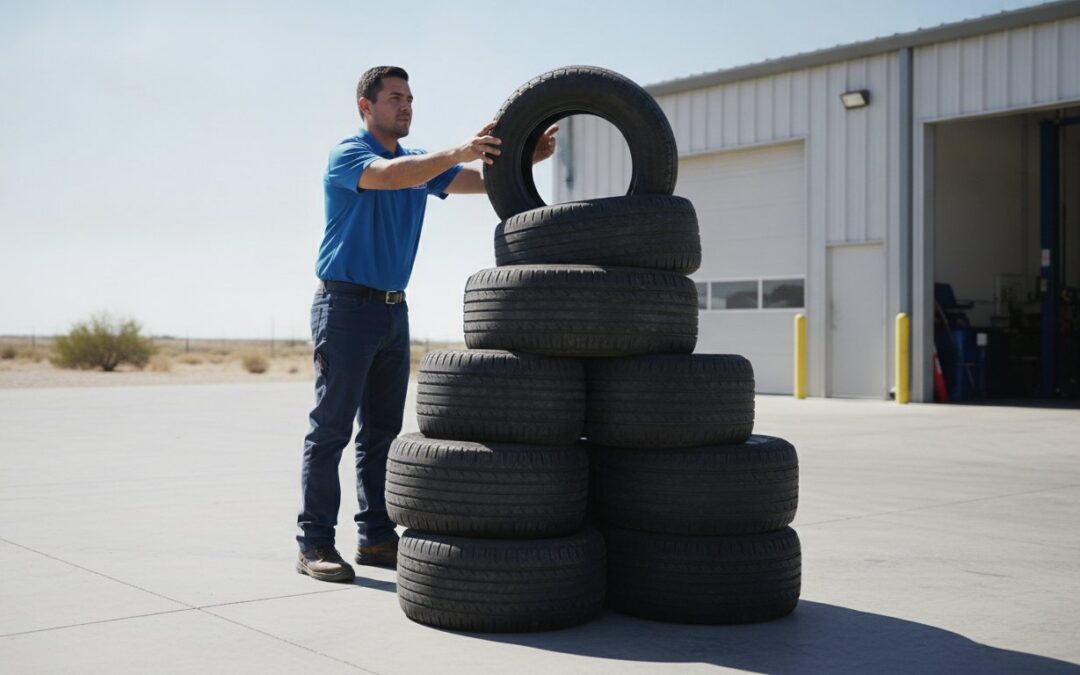
The TCEQ issued over $2.4 million in penalties for improper scrap tire management in 2025 alone. With fines for unauthorized storage reaching as high as $25,000 per day, a small oversight in your yard can quickly become a massive financial liability. We know you’d rather focus on your customers than worry about a growing pile of rubber that attracts mosquitoes and poses a fire risk in the West Texas heat. It’s difficult to keep up with shifting regulations and confusing paperwork when you’re busy running a shop.
This 2026 guide explains everything you need to know about scrap tire disposal for auto shops to keep your operations legal and efficient. You’ll learn how to manage your manifest records, understand current storage thresholds, and find a dependable collection partner who shows up on schedule. We’ll break down the specific TCEQ requirements so you can maintain a clean, organized shop and avoid the stress of unexpected audits.
Key Takeaways
- Understand the specific TCEQ storage limits to ensure your shop stays under the threshold for unauthorized sites and avoids heavy daily fines.
- Optimize your yard by designating a dedicated scrap zone and using stacking techniques that maximize space while preventing pest infestations.
- Evaluate why professional scrap tire disposal for auto shops is more cost-effective than municipal “amnesty days” or self-hauling to a landfill.
- Learn the critical manifest retention rules that protect your business during a state inspection and prove your environmental compliance.
- Discover how a scheduled pickup partner in West Texas can turn a messy liability into a streamlined, hands-off part of your weekly operations.
The Hidden Costs of Scrap Tire Accumulation for Auto Shops
A pile of old rubber in the corner of your lot might seem like a minor eyesore. It’s actually a drain on your business. When you neglect scrap tire disposal for auto shops, you pay for that clutter in lost productivity and increased risk. Every square foot of your property should generate revenue. If it’s covered in tires, it isn’t working for you. Beyond the financial loss, a messy yard damages the professional image you’ve worked hard to build with your customers.
Space Management and Shop Efficiency
Think about the physical footprint of your scrap. A typical pile of 200 tires can consume 150 to 200 square feet of usable space. Over a six-month period, that’s a bay’s worth of room that could have been used for vehicle storage or a new piece of equipment. When technicians navigate around these obstructions, it slows down their workflow. Moving a stack of tires just to get a floor jack through a narrow path is wasted labor. Beyond the internal mess, there’s the “broken window” effect. A visible pile of waste signals to the community that your shop is a dumping ground. It’s common for shops to find extra tires they didn’t generate appearing overnight because passersby saw an existing pile and assumed one more wouldn’t matter.
Beyond improving the shop’s appearance, a well-organized yard allows for the better use of space for modern equipment and staff amenities. For example, some managers are now designating areas for efficient transport solutions like Tartarian E-bikes, helping team members handle quick off-site tasks without the hassle of moving a service truck.
Environmental and Safety Liabilities
The Permian Basin sun is brutal on rubber. In the intense heat of a West Texas summer, scrap tires become massive fire hazards. Tire fires are notoriously difficult to extinguish. They produce thick, toxic smoke and can burn for days. This risk doesn’t go unnoticed by insurance providers. If an inspector sees improper waste storage, you might face premium hikes or policy cancellations. There’s also the biological factor. Even a small amount of stagnant water trapped inside a tire is a perfect breeding ground for mosquitoes. These pests carry diseases that can affect your staff and customers. Managing the tire recycling process through a professional service ensures these risks are handled by experts. Implementing a consistent system for scrap tire disposal for auto shops ensures your yard stays clean and your liability stays low.
Texas Tire Disposal Regulations: Staying TCEQ Compliant
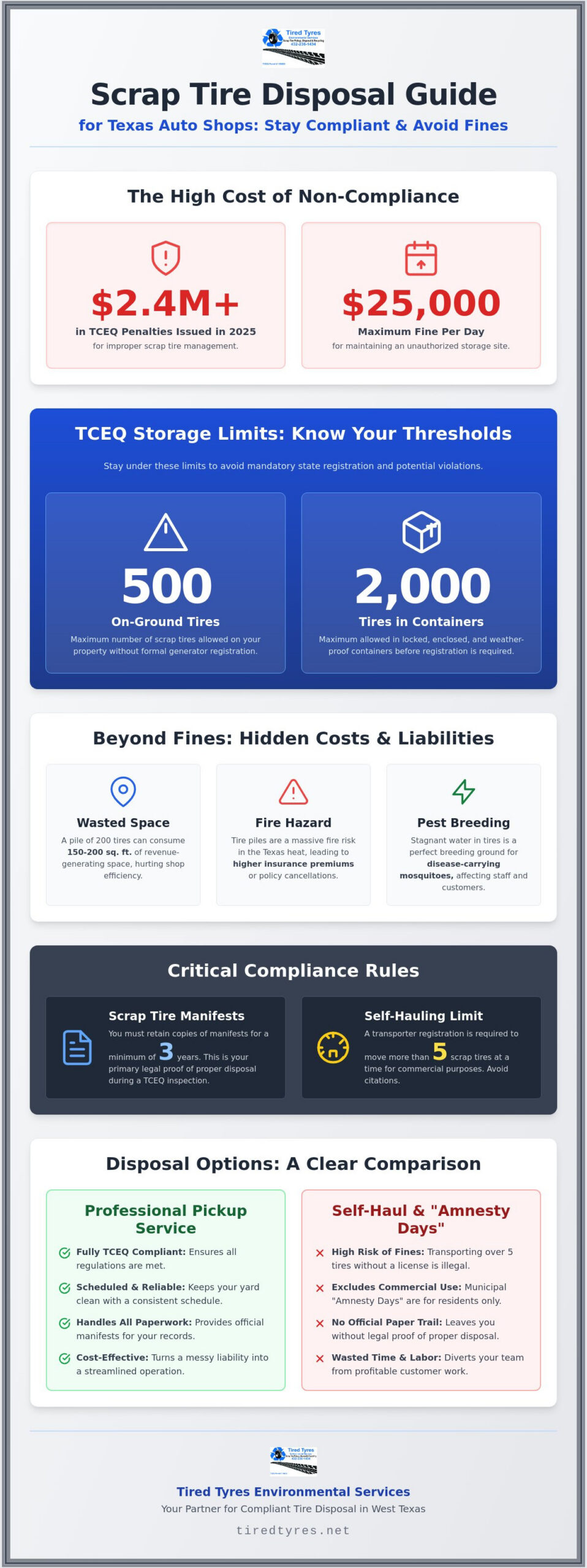
The Texas Commission on Environmental Quality (TCEQ) sets strict standards for how businesses handle rubber waste. For most owners, scrap tire disposal for auto shops is a matter of staying below specific storage thresholds. Under current 2026 regulations, your shop can store up to 500 scrap tires on the ground without needing a formal generator registration. If you exceed this number, or if you store more than 2,000 tires in locked, enclosed containers, you must register your site with the state. Staying within these limits is the easiest way to avoid the administrative burden of extra permits.
Ignoring these rules carries a heavy price tag. The TCEQ doesn’t take environmental safety lightly; they issued over $2.4 million in penalties in 2025 for improper management. Fines for maintaining an unauthorized storage site can reach $25,000 per day. These regulations exist because of the significant health and safety risks of tire piles, including their potential to fuel uncontrollable fires and harbor disease-carrying pests. Keeping your inventory low and your records clean is your best defense against state enforcement.
The Scrap Tire Manifest System
Every time tires leave your property, a paper trail must follow. The scrap tire manifest is a multi-part form that tracks the journey from your shop to the final processing facility. You’re required to keep copies of these manifests for at least three years. Each form must clearly list the registered hauler’s name, their TCEQ registration number, and the authorized destination for the tires. The TCEQ manifest serves as the primary legal defense for auto shops against charges of illegal dumping or improper disposal. Without it, you have no way to prove you hired a legitimate service.
Storage and Transportation Limits
Many shop owners wonder if they can simply haul their own waste to the local landfill. In Texas, you generally need a transporter registration to move more than five scrap tires at a time for commercial purposes. Attempting to “self-haul” large loads without the proper credentials can lead to immediate citations if you’re pulled over. It’s also a mistake to rely on municipal “Amnesty Days” in cities like Midland or Odessa. These events are almost exclusively funded for residential use and specifically exclude commercial enterprises. If you need a partner who understands these local nuances, you can schedule a compliant pickup to handle the logistics for you. Proper outdoor storage also requires following fire code standards, which include maintaining clear paths between tire stacks and keeping them away from property lines and flammable structures.
Comparing Disposal Options: Municipal Events vs. Professional Pickup
When the stack of old rubber in your yard starts to overflow, it is tempting to look for the cheapest way out. Many owners consider waiting for city cleanup events or hiring a guy with a flatbed trailer to clear the lot. While these options seem like a bargain, they often create more problems than they solve for a commercial business. Effective scrap tire disposal for auto shops requires a method that is both legal and consistent. Cutting corners on disposal can lead to a messy paper trail that won’t hold up during a TCEQ audit.
Municipal “Amnesty Days” are a common sight in Midland and Odessa. These programs are designed to help local residents clean up their garages and prevent illegal dumping in neighborhoods. They are not intended for commercial enterprises. Most city-run events have strict limits on the number of tires per vehicle and explicitly bar businesses from participating. If you send a shop truck to one of these events, you will likely be turned away or asked to pay commercial tipping fees that negate any perceived savings.
Self-hauling is another option that carries hidden burdens. You have to factor in the cost of fuel and the wear on your equipment. The biggest expense is the loss of billable time. Every hour a technician spends loading a trailer and driving to a landfill is an hour they aren’t turning a wrench. Landfills also charge commercial rates for bulk tire drop-offs. When you add up the labor and the fees, the “do-it-yourself” approach is rarely the most economical choice for a busy shop.
The Myth of Free Commercial Disposal
There is no such thing as free disposal for a business. If someone offers to take your tires for free or at a price that seems too good to be true, they are likely a “ghost hauler.” These unregistered individuals often dump tires in West Texas canyons, alleys, or abandoned lots to avoid landfill fees. If those tires are traced back to your shop, you are the one held liable for the cleanup costs and fines. You can learn more about these risks in our Texas Tire Disposal Regulations guide. Professional collection is the only way to guarantee a valid TCEQ manifest that proves you followed the law.
Benefits of Scheduled Collection Services
A reliable pickup partner turns waste management into a predictable routine. Instead of waiting for a crisis, you can set a schedule that keeps your inventory well below the 100-tire threshold. This prevents your yard from becoming a safety hazard or an eyesore. Scheduled services offer several advantages:
- Predictable Maintenance: You never have to worry about the pile reaching a level that triggers an inspection.
- Fixed Costs: Professional fees are transparent. You can easily factor these into the “disposal fee” you charge customers on their invoices.
- Maximum Productivity: A professional crew handles all the heavy lifting. Your technicians stay focused on billable work while we clear the yard.
Choosing a registered partner for scrap tire disposal for auto shops ensures your business remains compliant while you focus on serving your customers.
Optimizing Your Shop’s Tire Management Workflow
Setting up a dedicated “Scrap Zone” is the first step toward efficient scrap tire disposal for auto shops. This area should be easily accessible for collection trucks but far enough from your service bays to avoid blocking vehicle movement. If your technicians have to move old tires just to get to a work station, you’re losing money on labor. A clear, designated zone also makes it easier to track exactly how much waste you have on hand. It prevents the pile from slowly creeping into areas meant for customer parking or parts storage.
Proper stacking is just as important as location. While many shops throw tires into a loose heap, “lacing” them (overlapping them in a woven pattern) or stacking them in neat columns saves significant space. Neat stacks also prevent the collection of stagnant water, which is vital for West Texas shops where mosquito-borne illnesses are a health department concern. We recommend setting a pickup threshold well before you hit state limits. Calling for service when your pile reaches 75 to 100 tires ensures you never cross into unauthorized storage territory and keeps your yard looking professional.
Organizing for Efficiency
Separating your inventory by size can drastically speed up the loading process. Keep your passenger and light truck tires in one area, while semi-truck or agricultural tires go in another. This organization helps our crews clear your lot faster and ensures more accurate manifest reporting. For shops that handle large fleet accounts, understanding the nuances of Commercial Tire Disposal is essential for maintaining high-volume efficiency. While tire racks can save floor space, simple floor stacking is often more practical for high-turnover shops that move rubber out every few weeks.
Financial Management of Waste
Managing scrap tire disposal for auto shops shouldn’t be a financial burden. Most successful shops implement a transparent “Disposal Fee” on every customer invoice. It’s best to be direct with your clients about why this fee exists; it covers the cost of environmentally responsible recycling and the administrative work of state compliance. By tracking your monthly “in-and-out” flow, you can predict exactly when your pile will hit your pickup threshold. This foresight prevents the “emergency” calls that happen when a pile suddenly becomes unmanageable. Implementing a $3-$5 disposal fee per tire can turn a waste problem into a cost-neutral operation.
If you’re ready to clear your yard and get your shop back to peak efficiency, you can request a professional collection today.
Reliable Scrap Tire Pickup for West Texas Auto Shops
Government websites often tell you what not to do, but they rarely provide a direct solution for the rubber piling up in your yard. Tired Tyres is your local Permian Basin partner, offering a straightforward path to cleanliness and compliance. We specialize in Passenger & Light Truck Tire Collection, providing the consistent support that shops in Midland, Odessa, and Lubbock need to stay operational. For many managers, finding dependable scrap tire disposal for auto shops is the final step in securing their business against state audits and environmental hazards.
Our service goes beyond standard vehicles. We understand the diverse needs of West Texas, which is why we also provide Semi-Truck Tire Collection and Agricultural Tire Collection for shops serving the region’s transport and farming sectors. If your facility handles heavy machinery, we offer OTR (Off-the-Road) Tire Collection as well. Every pickup we perform is backed by a commitment to full TCEQ compliance. We provide the accurate manifests you need to prove your shop followed the law, protecting you from the heavy daily fines that can sink a small business.
Why Local Expertise Matters in West Texas
The Permian Basin and South Plains have unique geographic and regulatory challenges. A national hauler might not understand the specific landfill rules in Ector County or the logistical hurdles of a rural shop outside Lubbock. We live and work here. We understand the pace of the local automotive industry and the importance of a clear yard for your daily workflow. Supporting a local business means you get a partner who is responsive to your schedule and invested in the environmental health of our shared West Texas communities. We aren’t just a truck that shows up; we’re a professional resource for your shop’s long-term success.
This commitment to regional service is a hallmark of industry leaders; just as we serve West Texas, instantrecovery.co.uk provides dedicated vehicle recovery and transport for businesses across East London and the surrounding areas.
Get Started with a Scheduled Solution
Moving to a professional waste management plan is simpler than most owners realize. You can review our Reliable Tire Disposal guide to see how we structure our service for different business sizes. When you reach out, we’ll help you determine a pickup frequency that matches your shop’s volume. During your first visit, our crew handles the heavy lifting, organizes the loading process, and hands you a completed manifest before they leave. This process ensures that scrap tire disposal for auto shops is a hands-off, worry-free part of your week. It’s time to stop managing a tire pile and start managing your shop.
Ready to clear your lot? Contact Tired Tyres for a pickup quote in Midland, Odessa, or Lubbock today.
Secure Your Shop’s Future with Professional Disposal
Managing scrap tire disposal for auto shops doesn’t have to be a source of stress or a legal liability. By staying below TCEQ storage thresholds and maintaining a clear manifest trail, you protect your business from the millions of dollars in penalties issued annually. A clean yard isn’t just about avoiding fines; it’s about creating a safe, efficient workspace where your technicians can work without navigating around rubber piles. Moving from a reactive approach to a scheduled system is the best way to maintain long-term shop productivity.
Tired Tyres is ready to take the logistics off your plate. We provide professional collection services across Midland, Odessa, and Lubbock, ensuring every load is documented with TCEQ-compliant manifests. Whether you need to clear passenger tires or heavy-duty OTR waste, our team has the local expertise to handle the job safely and efficiently. It’s time to reclaim your shop floor and focus on serving your customers. Schedule your TCEQ-compliant tire pickup with Tired Tyres today and experience the difference a reliable local partner makes. Your shop deserves a clean, organized start.
Frequently Asked Questions
Can auto shops use city tire recycling events in Midland or Odessa?
No, municipal “Amnesty Days” are almost exclusively reserved for residential use. These programs are funded to help households clear out small amounts of waste and prevent illegal dumping in neighborhoods. Most city events in the Permian Basin explicitly bar commercial enterprises and auto shops from participating. Businesses must use a registered transporter to remain compliant with state law.
What is the maximum number of tires an auto shop can store in Texas without a permit?
You can store up to 500 scrap tires on the ground without a TCEQ generator registration. If you use enclosed, lockable containers or trailers, that limit increases to 2,000 tires. Crossing these thresholds without the proper state paperwork can lead to daily fines. It’s best to schedule regular scrap tire disposal for auto shops to keep your inventory well below these limits.
How do I know if a tire hauler is legally permitted by the TCEQ?
Always ask to see the hauler’s current TCEQ registration number before they load any tires. A legitimate transporter will have this number and will be able to provide a professional manifest for your records. You can also verify their status through the TCEQ’s online database of registered transporters. Using an unpermitted hauler puts your shop at risk if those tires are later dumped illegally.
Do I need to keep a manifest if I only have 20 tires picked up?
Yes, you must keep a manifest for every commercial tire pickup regardless of the load size. The TCEQ requires generators to retain these records for three years to prove that the waste was handled by an authorized facility. This paper trail is your primary legal defense during a state inspection. It proves you aren’t responsible for any improper disposal that might occur after the tires leave your lot.
What happens to the scrap tires after they are collected from my shop?
Most scrap tires in Texas are recycled or used for energy recovery. In 2024, approximately 46% of tires were processed into tire-derived fuel (TDF), while 19% were turned into crumb rubber for various products. Another 18% were disposed of in authorized landfills. Using a professional service ensures your scrap tire disposal for auto shops contributes to these legitimate end-use markets rather than ending up in an unauthorized dump site.
Can Tired Tyres pick up large OTR or agricultural tires from my shop?
Yes, we provide collection services for a wide range of heavy-duty tires. Our team is equipped to handle OTR (Off-the-Road) tires, agricultural tires, and semi-truck tires. We also collect scrap skid steer tracks and solid tires. Whether you run a standard passenger car shop or a heavy equipment repair facility, we can manage your specific rubber waste volume with full compliance.
Is it legal to cut tires in half to save space in my shop’s scrap pile?
While cutting tires might save physical space, it doesn’t change your status as a tire generator or bypass TCEQ storage limits. Many processing facilities actually prefer whole tires because their shredding equipment is designed for specific dimensions. Cutting tires can also make them more difficult to stack safely. We recommend using proper lacing or stacking techniques to maximize your yard space instead of processing the tires yourself.
How much does professional scrap tire collection typically cost for a shop?
Texas operates on a free-market system, so there is no state-mandated fee for tire collection. Costs are negotiated directly between the shop and the registered transporter. These rates usually depend on your location, the volume of tires, and the frequency of pickups. Most shops cover these expenses by charging customers a transparent disposal fee on each invoice, making the process cost-neutral for the business.