
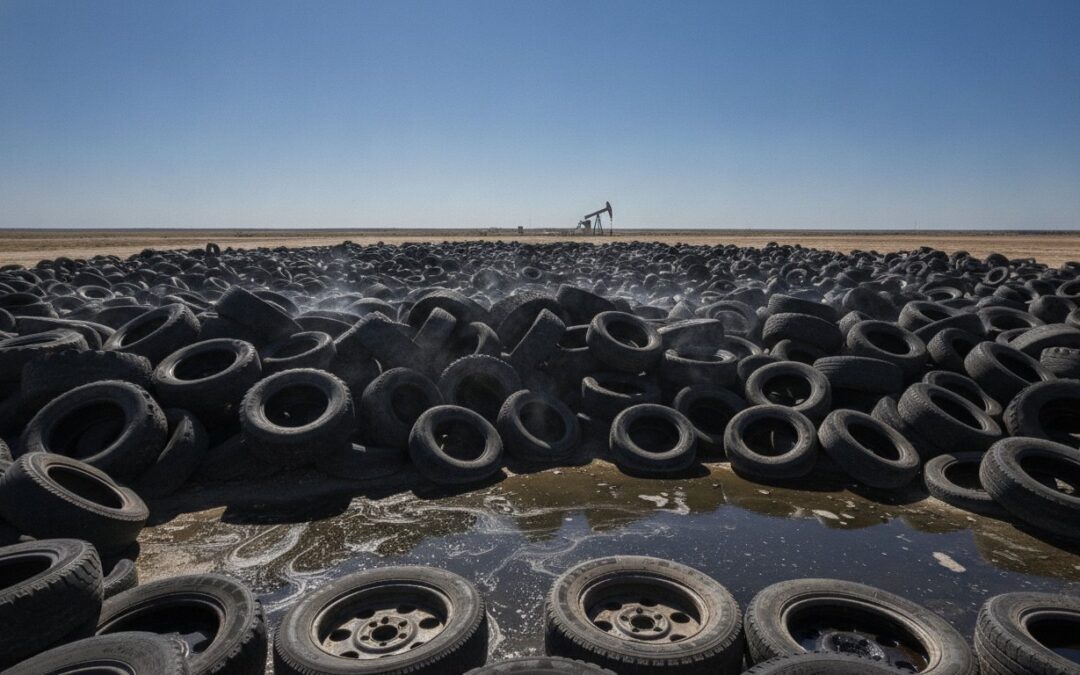
What if the pile of old rubber behind your shop is doing more than just taking up space? In the intense heat of West Texas, it’s easy to view rubber accumulation as a minor nuisance or a simple storage headache. However, those stacks in Midland, Odessa, and Lubbock are actually active biological and chemical “reactors” that threaten your land and your health. Understanding the specific scrap tire health hazards is the first step toward reclaiming a safe environment for your business or family.
You likely already know that stagnant water in tires is a magnet for mosquitoes, but the risks in 2026 go much deeper. From the threat of West Nile virus to the danger of toxic, uncontrollable tire fires, the stakes for property owners have never been higher. This guide will help you identify the primary health threats and navigate the risk of TCEQ fines for improper storage. You’ll learn how to manage your inventory safely in the short term and find a professional local service to remove the burden permanently.
Key Takeaways
- Learn how scrap tires act as ideal breeding grounds for disease-carrying mosquitoes and why they remain active even during cooler Texas nights.
- Understand the long-term chemical risks as heavy metals and petroleum-based additives leach into your soil and groundwater.
- Identify why tire fires are a unique threat in the West Texas heat and why they’re notoriously difficult for standard emergency services to extinguish.
- Discover the full scope of scrap tire health hazards and how rubber accumulation creates a “toxic cocktail” on your property.
- Find out how professional collection ensures TCEQ compliance and permanently removes these environmental liabilities from your land.
Understanding the Scope of Scrap Tire Health Hazards in 2026
Scrap tire health hazards aren’t just about aesthetics; they represent a convergence of biological, chemical, and physical risks. In 2026, environmental standards in Texas have tightened because we now understand that a tire is more than just rubber. It’s a complex assembly of petroleum products, steel, and chemical stabilizers designed specifically to resist breaking down. This durability, while great for the road, makes them a permanent liability once they reach the end of their life. Local authorities in Lubbock and the Permian Basin are increasingly focused on these sites because the risks don’t stay contained to the property lines.
The “stockpile effect” is a real concern for property owners. As tires sit exposed to the elements, the sun’s UV rays and fluctuating temperatures begin to degrade the outer layers. This process doesn’t make the tire disappear. Instead, it releases trapped gases and allows chemicals to migrate to the surface. Over time, a small pile of rubber can transform into a localized environmental crisis, affecting the very ground you walk on. This gradual decay is why older stockpiles often present a higher chemical risk than fresh tire deliveries.
The Physical Structure Problem
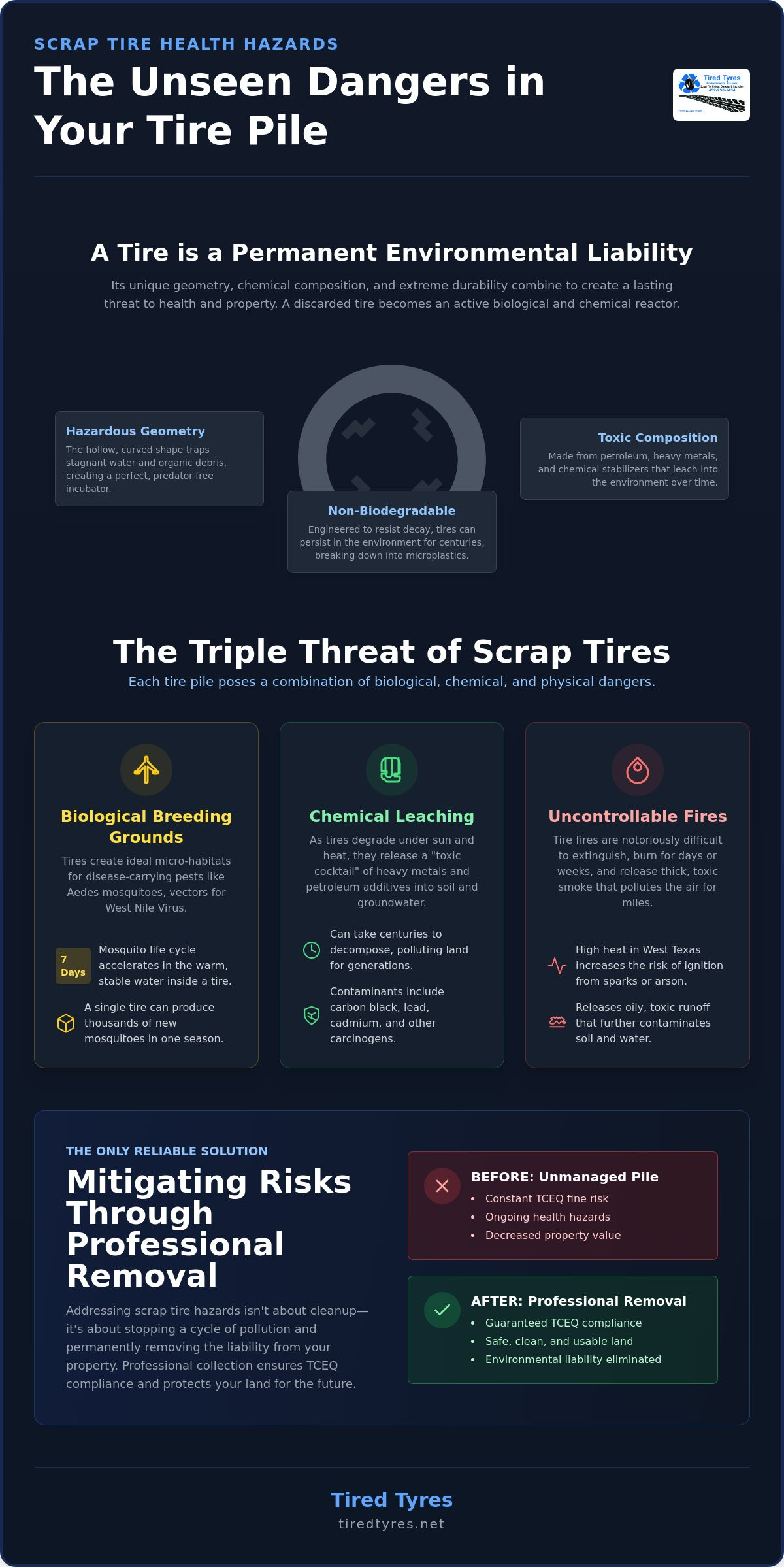
Tires are uniquely dangerous because of their geometry. The hollow, circular shape is designed to hold air, but when discarded, it becomes a master at trapping stagnant water, heat, and organic debris. Even in the arid climate of West Texas, a single rainfall can provide enough moisture to last for weeks inside the casing. This creates a protected, thermally stable environment that is nearly impossible to drain manually. Pathogens and pests find the inner rim to be a perfect incubator, shielded from the wind and predators. Because of this shape, simple surface cleaning won’t remove the internal biological threats.
Tires as Long-Term Environmental Pollutants
Rubber tires are essentially non-biodegradable. If left in the soil of Midland or Odessa, they can last for centuries. As they slowly wear down, they don’t return to nature; they break into micro-particulates and leach heavy metals into the surrounding earth. This contributes to the growing waste tire problems seen across the region. When the rubber interacts with West Texas soil, the chemical stabilizers begin to fail. This leads to the release of carbon black and other additives that can compromise groundwater quality over several decades.
Understanding Tire recycling and its hazards is essential for anyone managing a fleet or a ranch. Proper disposal isn’t just about cleaning up; it’s about stopping a cycle of pollution. When scrap tire health hazards are left unaddressed, the cost of remediation only grows as the rubber integrates further into the local ecosystem. Professional collection remains the only reliable way to ensure these materials are handled according to current TCEQ standards.
Biological Breeding Grounds: Mosquitoes and Disease Vectors
Old tires are more than just clutter. They’re highly efficient biological incubators. In the arid climates of Midland and Odessa, water is a precious resource for pests. A single rain shower can fill a tire casing, and because of the curved design, that water doesn’t evaporate for weeks. This “stagnant water trap” is a primary driver of scrap tire health hazards across West Texas. Even when the surrounding ground is bone dry, the interior of a tire remains a humid, protected environment.
The dark rubber of a tire acts as a solar collector. It absorbs heat throughout the day and maintains a stable temperature during cool Texas nights. This thermal insulation allows mosquito larvae to develop much faster than they would in a natural pond or a drainage ditch. While birds and bats might eat mosquitoes in the open, they can’t navigate the tight, dark spaces inside a tire rim. This creates a sanctuary where larvae mature without natural interference. It’s a structural advantage that nature doesn’t provide, making unmanaged tires far more dangerous than a simple puddle on the ground.
The Mosquito Life Cycle in Scrap Tires
Aedes mosquitoes, the primary carriers of several dangerous viruses, actually prefer man-made containers over natural water sources. The rough texture of the rubber provides an ideal surface for egg-laying. In the high-temperature environments of 2026, the transition from egg to adult can happen in as little as seven days. A single passenger tire can produce thousands of biting insects in one season. This turns a small pile into a significant neighborhood threat. Research into the environmental and health impacts of tires shows that these breeding sites are much more productive than typical backyard puddles. The water inside is often rich in organic matter like dead leaves, providing an endless food supply for the developing larvae.
Diseases of Concern in West Texas
The South Plains continues to face a persistent threat from West Nile Virus. In Lubbock County, 2026 data shows that mosquito populations are increasingly active in areas with improper waste management. In urban centers like Midland and Odessa, the risk of Zika and Dengue is no longer a distant concern as temperatures rise. According to 2026 public health models, a single unmanaged tire stockpile can increase the local vector capacity for mosquito-borne illness by nearly 400 percent when compared to properties with professional drainage. Reclaiming your land from these pests starts with removing their habitat. If you have an accumulation of rubber on your property, scheduling a professional tire collection is the most effective way to break the breeding cycle and protect your community’s health.
Chemical Leaching and Toxic “Cocktails” in the Soil
While tires look solid and inert, they’re actually a complex blend of over 800 chemical mixtures. As the rubber breaks down under the intense West Texas sun, it releases a “toxic cocktail” directly into the ground. These additives include petroleum products, carbon black, and various stabilizers designed to keep the tire from cracking on the road. Once these tires become scrap, those same stabilizers begin to fail. This process is a primary driver of scrap tire health hazards because it creates long-term soil contamination that is both difficult and expensive to remediate.
Researchers are particularly concerned about a specific chemical called 6PPD-quinone. This substance forms when 6PPD, an antioxidant used to protect rubber, reacts with ozone in the air. While early studies focused on its impact on aquatic life, 2026 environmental data suggests that this chemical also accumulates in the soil and can affect local plant health. According to EPA research on tire pollution, these chemicals don’t just stay on the surface. They migrate through the dirt, creating a zone of toxicity that can persist for decades after the tires are removed.
Heavy Metal Contamination
Zinc is a major concern for property owners because it’s used in high concentrations during the vulcanization process. When tires sit in a field for years, zinc, lead, and cadmium leach into the dirt. Local wildlife and livestock often graze near these piles, and these metals can enter the food chain through the soil and local vegetation. This poses a direct threat to the health of the animals and the quality of local agricultural products. For landowners in Midland and Lubbock, this isn’t just an environmental issue. It’s a financial one. Documented soil contamination can significantly lower property resale values and lead to mandatory cleanup orders from the TCEQ.
Groundwater Vulnerability in West Texas
The geology of the Permian Basin makes chemical leaching especially dangerous. Much of the soil around Midland and Odessa is sandy and highly permeable. This structure allows rainwater to wash toxins deep into the earth much faster than in regions with heavy clay soil. If your property relies on a private well, a nearby tire pile is a direct threat to your drinking water. These chemicals can eventually reach the water table, affecting the health of the entire local watershed. Professional collection is the only way to stop this downward migration before it reaches your primary water source and causes permanent damage to your land’s health.
The Hidden Danger of Tire Fires and Air Quality
Large stockpiles in Midland or Lubbock are essentially massive batteries of stored energy. Unlike other forms of waste, rubber is a high-energy fuel source that is incredibly difficult to ignite but nearly impossible to stop once it starts. In the intense West Texas summer heat, the risk of spontaneous combustion is a reality for unmanaged piles. When tires are stacked too deep, internal heat from decomposition and solar radiation can build up to the point of ignition. This creates one of the most severe scrap tire health hazards for the surrounding community, as these fires can burn for weeks or even months.
Water is often useless against these blazes. Because of their circular shape, tires trap air pockets that feed the fire while simultaneously shedding water away from the core. Attempting to extinguish a large pile with water often creates a secondary crisis. The heat melts the rubber into pyrolytic oil, a free-flowing liquid that carries toxins deep into the soil. A single semi-truck tire can produce several gallons of this oil during a fire. This liquid byproduct poisons the ground and can migrate toward the water table much faster than standard leaching processes.
Airborne Toxins and Respiratory Health
The smoke from a tire fire is a concentrated plume of hazardous pollutants. It contains high levels of particulate matter (PM2.5), which is small enough to enter the bloodstream through the lungs. This smoke also carries dioxins and furans, which are potent carcinogens produced during low-temperature combustion. Children and the elderly are at the highest risk for acute respiratory distress during these events. Unlike a typical brush fire, the chemical complexity of burning rubber means the air remains dangerous long after the visible flames are suppressed. Residents in downwind areas of the South Plains often report lingering health issues for months following a major site fire.
The Long-Term “Fire Footprint”
A tire fire site remains a hazardous waste zone for decades. The combination of ash, charred steel wires, and solidified pyrolytic oil creates a “fire footprint” that is extremely expensive to clean. In several case studies across the South Plains, remediation costs for fire-damaged land have exceeded the original property value. Preventative removal is the only logical choice for property owners who want to avoid this liability. Scheduling a professional scrap tire collection is a straightforward way to eliminate the fuel source before the Texas heat turns a storage problem into an environmental disaster. Reclaiming your property today ensures that these scrap tire health hazards never have the chance to go up in smoke.
Mitigating Risks with Professional Scrap Tire Removal
Addressing scrap tire health hazards requires a move from passive storage to active removal. In West Texas, many property owners try to manage old rubber by moving it to the back of a lot or a remote corner of a ranch. This doesn’t solve the problem; it only hides the biological and chemical risks. Illegal dumping is never a viable solution. It carries heavy penalties and simply transfers the environmental burden to another location. Professional collection is the only way to stop these hazards at the source and ensure your land remains a safe environment for your family or employees.
The role of Tired Tyres is to provide a direct, compliant path for rubber disposal across Midland, Odessa, and Lubbock. We focus on removing the liability from your property before a minor accumulation turns into a major health crisis. If you have a pile of tires today, the first step is to isolate them from stagnant water and heat. Once they’re staged, scheduling a professional pickup ensures that the rubber is processed according to modern environmental standards rather than being left to leach toxins into the Permian Basin soil.
Compliance and Liability
Business owners face strict scrutiny when it comes to waste management. Navigating Texas tire disposal regulations is essential for anyone operating a shop, farm, or industrial site. Proper disposal isn’t just about the physical removal of the tires. It’s about the manifest tracking system. A manifest is a legal document that proves your tires were handled by a registered transporter and delivered to a permitted facility. This paper trail is your primary shield against environmental lawsuits and TCEQ fines. Without it, you remain legally responsible for those tires even after they leave your property.
Choosing a Reliable Tire Disposal Partner
Finding a reliable tire disposal service means looking for a partner that handles the full scope of your inventory. Tired Tyres manages everything from standard passenger and semi-truck tires to heavy agricultural and OTR (Off-the-Road) units. These larger tires require specialized equipment and expertise because of their sheer weight and volume. Our process is designed to be efficient and transparent. We arrive at your site in the Midland or Lubbock area, load the material, and provide the necessary documentation to confirm compliant disposal. This direct approach removes the guesswork and allows you to focus on your business while we handle the environmental heavy lifting.
Reclaiming Your West Texas Property
Accumulated rubber is a silent liability that grows more dangerous with every passing Texas summer. From the immediate threat of mosquito-borne illness in Lubbock to the long-term environmental damage caused by chemical leaching in Midland, the risks are far too high to ignore. Successfully managing scrap tire health hazards means moving beyond temporary storage and choosing a permanent, legal solution that protects your soil and groundwater. Professional removal is the only way to ensure these materials don’t simply become a problem for the next generation.
Tired Tyres brings the specialized equipment necessary to handle everything from standard passenger tires to heavy agricultural and OTR units. As a local, family-owned business serving the Permian Basin, we provide TCEQ-compliant manifest tracking to ensure your legal liability is fully transferred and documented. You don’t have to manage these complex environmental risks or potential fines on your own. Our team handles the heavy lifting so you can focus on running your business or enjoying your land.
Ready to clear your land and restore the safety of your property? Get a Professional Tire Pickup Quote in Midland & Odessa and take the first step toward a cleaner, hazard-free environment today. It’s time to reclaim your space and protect your community’s health.
Frequently Asked Questions
What are the most common diseases spread by mosquitoes in scrap tires?
West Nile virus remains the primary threat in the South Plains and Lubbock area. Tires also provide ideal breeding grounds for mosquitoes that carry Zika and Dengue. Because rubber casings trap heat and stagnant water, they allow these disease vectors to reproduce much faster than they would in natural ponds or drainage ditches.
Can scrap tires catch fire on their own in the Texas heat?
Yes, spontaneous combustion is a real risk for large, deep piles during the intense West Texas summer. When tires are stacked too tightly, internal heat from decomposition and trapped solar energy can build up to ignition temperatures. These fires are notoriously difficult to extinguish and release toxic pyrolytic oil that can permanently damage your soil.
How do chemicals from tires get into the groundwater?
Toxins migrate through the earth during rainfall or through direct leaching as the rubber degrades over time. In the Permian Basin, the sandy soil structure facilitates a faster downward movement of heavy metals and petroleum byproducts. This process creates significant scrap tire health hazards for rural property owners who rely on private water wells.
Is it illegal to keep a large pile of scrap tires on my property in Texas?
Keeping unmanaged scrap tires can lead to heavy TCEQ fines and significant legal liabilities. Texas law requires proper registration for storage sites and manifest tracking for all tire transport. Maintaining an unpermitted pile without these protections exposes you to environmental lawsuits and mandatory, expensive cleanup orders.
Do old tires attract snakes and other dangerous wildlife in West Texas?
Yes, the dark and thermally stable cavities within a tire pile are ideal habitats for rattlesnakes and rodents. These spaces provide a sanctuary from the wind and predators while maintaining warmth during cool desert nights. This creates an immediate physical safety risk for any employees or family members working near the accumulation.
What is the safest way to store tires temporarily before pickup?
The best method is to keep tires under a waterproof cover or inside a dry, enclosed building to prevent water collection. If they must stay outdoors, stacking them in a way that allows for natural drainage or drilling holes in the sidewalls can reduce biological risks. However, scheduling a professional removal is the only way to eliminate the liability entirely.
How much tire accumulation is considered a “stockpile” by the TCEQ?
While specific thresholds can vary by local ordinance, the TCEQ monitors any site where rubber accumulation creates a public health risk. Even small piles can be cited as a public nuisance if they’re found to be breeding grounds for disease-carrying pests. It’s best to consult current Texas regulations to ensure your business remains compliant.
Can I just bury my old tires to avoid health hazards?
Burying tires is illegal in Texas and only hides the environmental problem rather than solving it. Underground tires will still leach chemicals into your soil and can eventually resurface as the ground shifts over time. Professional collection is the only legal and effective way to manage these materials and protect your property value.