
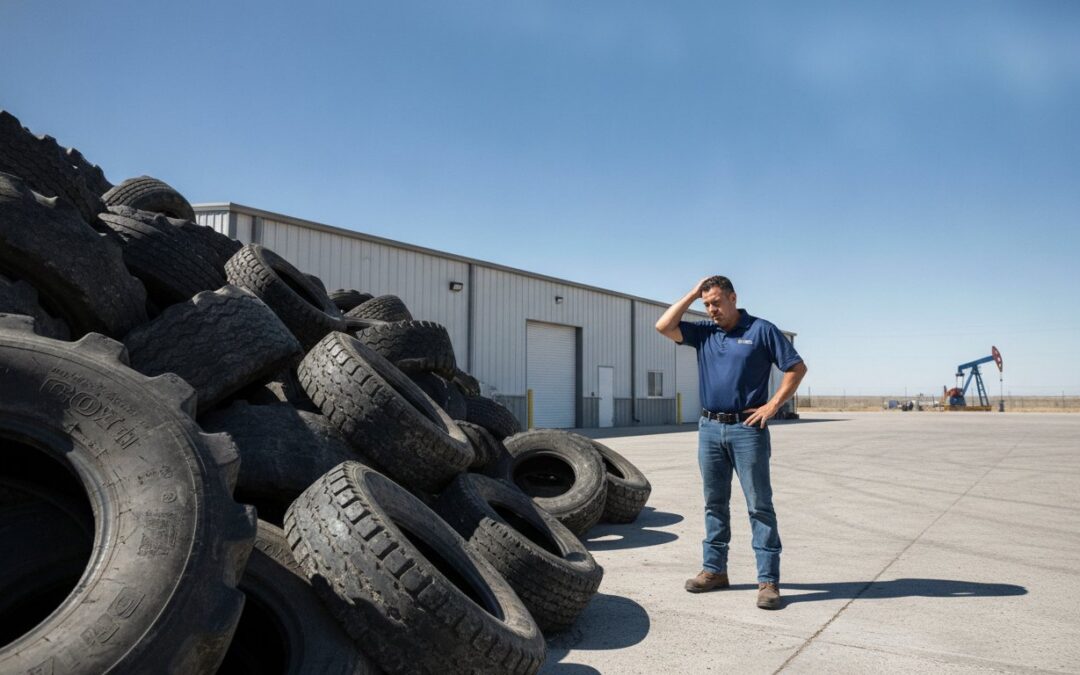
Did you know that storing as few as five unregistered off-the-road tires in West Texas can trigger a fine exceeding $25,000 per day? It’s a staggering figure, but with the TCEQ issuing over $2.4 million in penalties during 2025, the risk is very real for local operations. You’ve likely felt the stress of watching a scrap pile grow behind your shop, wondering if you’re just one surprise inspection away from a business-ending citation. Staying informed about commercial tire pile fines Texas regulations feels like a full-time job when you’re already busy managing a fleet or a job site in Midland or Odessa.
You shouldn’t have to choose between your daily operations and legal safety. We understand that the cradle to grave manifest system and the strict storage limits updated for 2026 are often confusing for business owners. This guide breaks down exactly how many tires you can legally keep on your property, the specific documentation required to survive an audit, and the most efficient way to clear your lot permanently. We’ll show you how to protect your business and turn that rubber liability into a closed loop of compliance.
Key Takeaways
- Learn the critical legal distinction between a “used tire” and a “scrap tire” to avoid accidental storage violations.
- Understand how daily accrual penalties can turn a small oversight into a six-figure liability for your West Texas operation.
- Master the “cradle-to-grave” manifest system to ensure you are never held liable for commercial tire pile fines Texas inspectors issue.
- Follow a clear 2-step process to audit your current inventory and verify your waste hauler’s TCEQ permits.
- Discover how professional collection for OTR, semi-truck, and agricultural tires can permanently clear your lot and your legal record.
Understanding TCEQ Regulations for Commercial Tire Piles in 2026
The Texas Commission on Environmental Quality (TCEQ) views a tire pile as more than just an eyesore; it’s a high-priority environmental hazard. In West Texas, where fleet operations and industrial sites are dense, understanding the distinction between a used tire and a scrap tire is critical. A used tire is one that can still be legally and safely operated on a vehicle. Once a tire is no longer fit for its original purpose, it becomes “scrap.” This distinction matters because once you cross the threshold of 500 scrap tires on the ground, your property is legally classified as a stockpile. At this point, the risk of commercial tire pile fines Texas authorities levy becomes a daily reality.
Liability doesn’t end just because you didn’t create the pile. If tires are abandoned on your property by a previous tenant or an illegal dumper, you are still the legal “generator” in the eyes of the state. You’re responsible for the remediation and any penalties that accrue until the site is cleared. The TCEQ maintains a “cradle-to-grave” policy, meaning the responsibility for the waste follows the property owner until a signed manifest proves the tires reached a permitted facility.
The Legal Status of Scrap Tires in Texas
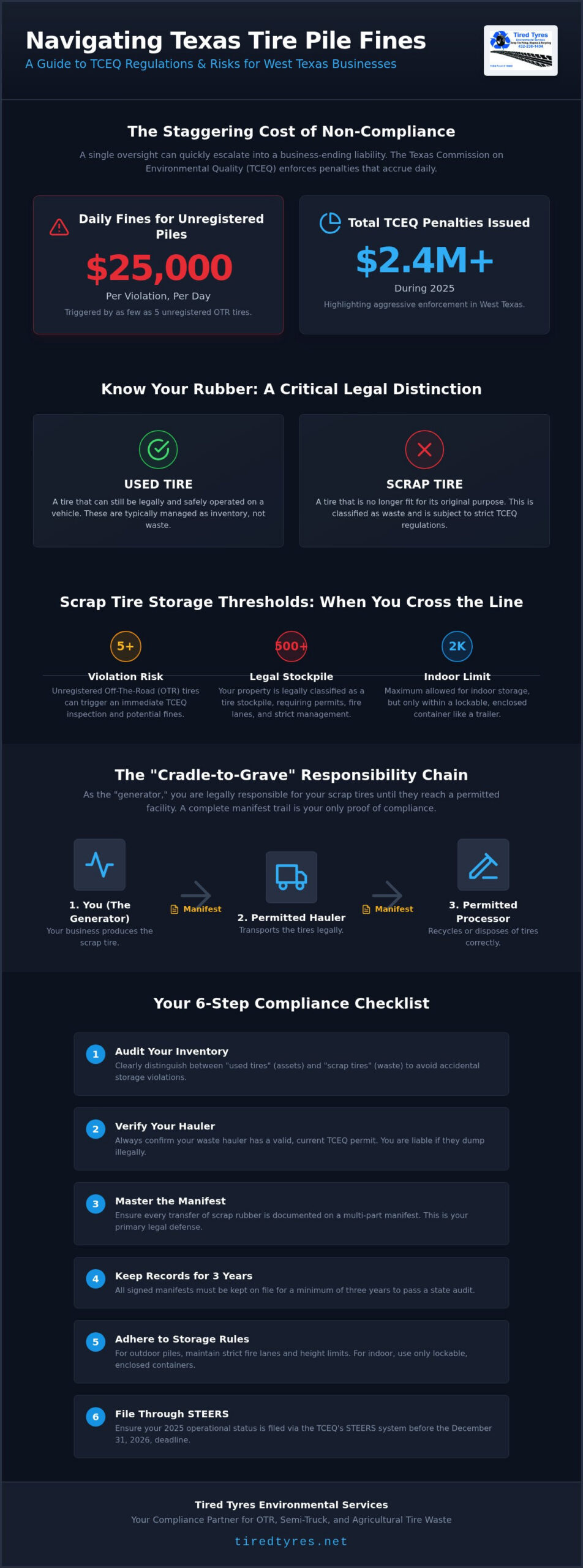
Texas law divides the industry into three categories: generators, haulers, and processors. If your business produces waste rubber, you’re a generator. You’re legally responsible for that tire from the moment it’s removed until it reaches a permitted facility. Modern tire recycling processes ensure these materials don’t end up in landfills, but the path to those facilities must be documented. As of 2026, outdoor storage requires strictly maintained fire lanes and height limits to prevent uncontrollable fires. Indoor storage is permitted for up to 2,000 tires, provided they’re in a lockable, enclosed container like a trailer. Every transfer of rubber must be recorded on a multi-part manifest, which you must keep on file for at least three years to survive a state audit.
Why West Texas Businesses are Under Scrutiny
Businesses in Midland, Odessa, and Lubbock face unique scrutiny due to the environmental sensitivity of the Permian Basin and South Plains. Illegal piles can leach chemicals into the soil, potentially impacting groundwater quality in our arid climate. In 2026, inspectors have shifted their focus toward industrial rubber waste, including OTR tires, agricultural tires, and oilfield hoses. The TCEQ is actively looking for unregistered sites that haven’t filed their 2025 operational status through the STEERS system by the December 31, 2026, deadline. If you operate in the oil patch or large-scale farming, maintaining a clean manifest trail is your only protection against aggressive enforcement and commercial tire pile fines Texas inspectors are authorized to issue.
The Financial Reality: Calculating Potential Fines and Liabilities
The math behind environmental enforcement is simple but devastating. The Texas Commission on Environmental Quality (TCEQ) doesn’t just issue one-time tickets; they use a daily accrual system. This means a single violation for an unregistered stockpile can result in penalties of up to $25,000 per day. If you’re storing 50 unregistered scrap tires, you could face commercial tire pile fines Texas inspectors set at $10,000 for every day the pile remains on-site. These numbers quickly exceed the annual profit margins of most small to mid-sized West Texas businesses.
Property owners often assume they’re safe if they didn’t personally dump the rubber. However, Texas law holds the current landowner responsible for any waste found on their property. This liability extends to the “cradle-to-grave” manifest system. If you hire an unpermitted hauler who illegally dumps your tires in a ravine, the TCEQ will trace those tires back to you. You’ll be responsible for the full cost of remediation, legal fees, and the resulting administrative penalties. Protecting your business requires more than just moving the pile; it requires a documented paper trail that proves the waste reached a legal destination.
Administrative vs. Criminal Penalties
In 2026, the line between a storage error and a criminal charge has narrowed. Administrative penalties usually stem from manifest errors or exceeding storage limits. However, violations can escalate to criminal “illegal dumping” charges if the TCEQ determines there was intent to bypass state laws. Local law enforcement in the Permian Basin has increased environmental policing, often working alongside state inspectors. Under HB1463, transporters can now be fined up to $500 per tire for delivering to unregistered sites. For commercial entities, these criminal charges can lead to permanent business license revocation and significant personal liability for company officers.
The Cost of Non-Compliance in Midland and Odessa
When you compare the expense of professional commercial tire disposal to the potential for a $1.4 million fine package, the choice is clear. A single failed inspection often triggers a multi-year audit of all your waste records, not just tires. This process is invasive and expensive, often leading to increased insurance premiums and a damaged reputation with local contractors. Investing in a permitted removal partner is the only way to ensure your financial liability ends the moment the tires leave your lot. Clearing a pile today is significantly cheaper than defending a daily accrual fine in court tomorrow.
Key Compliance Standards to Avoid Citations
Avoiding commercial tire pile fines Texas businesses often face starts with rigorous documentation. TCEQ inspectors don’t just look at the physical tires; they audit your filing cabinet. If you can’t produce a valid paper trail for every tire that left your property in the last three years, you’re technically in violation. Compliance isn’t just about getting the rubber off your lot. It’s about proving exactly where it went and who took it there.
In West Texas, the dry climate doesn’t exempt you from vector control. Even a small amount of stagnant water inside a semi-truck tire can become a breeding ground for mosquitoes carrying the West Nile or Zika viruses. State law requires that scrap tires be kept dry, treated with larvicide, or altered (split or shredded) to prevent water retention. If an inspector finds larvae in your pile, the resulting fines are often issued on the spot.
Mastering the Scrap Tire Manifest System
The 5-part manifest is your primary legal defense. This document tracks the rubber from the generator to the hauler, and finally to the authorized processor. You must ensure that each party signs their respective section at the time of transfer. Once the tires reach the processing facility, the processor has a legal obligation to send a completed copy back to you. This is known as the 60-Day Rule. If you haven’t received the final, signed manifest within 60 days of the pickup, you are legally required to report the hauler to the TCEQ. Failing to report a “lost” manifest makes you just as liable as the hauler if those tires are eventually found in an illegal dump site.
Storage and Fire Prevention Requirements
Fire safety is a major focus for West Texas fire marshals and TCEQ agents. To satisfy 2026 standards, outdoor tire piles must not exceed 15 feet in height or 50 feet in width. You’re also required to maintain 40-foot fire lanes between piles and keep all rubber at least 50 feet away from property lines. These gaps ensure that emergency vehicles can navigate your site if a fire breaks out.
A common compliance gap involves industrial rubber products. Many businesses mistakenly believe that scrap skid steer tracks, conveyor belts, and industrial hoses are exempt from these rules. In reality, these items are high-density fuel sources that fall under the same storage and disposal scrutiny as OTR or agricultural tires. Whether you’re storing a stack of semi-truck tires or a pile of worn-out rubber tracks, the same fire lane and separation distance requirements apply to protect your facility and the surrounding Permian Basin environment.
Steps to Remediate a Tire Pile and Ensure Compliance
If your West Texas lot is currently over the 500-tire limit, you’re operating in a high-risk zone. You can’t wait for a TCEQ inspector to knock before you start clearing the rubber. To effectively avoid commercial tire pile fines Texas authorities issue, you need a systematic remediation plan that prioritizes documentation over speed. This isn’t just about hauling trash; it’s about legally transferring liability from your business to a permitted processor.
Auditing Your Current Rubber Waste
Start by categorizing your inventory. A mixed pile of passenger, semi-truck, and heavy OTR tires is difficult to quantify at a glance. For mixed stockpiles, estimate your count by measuring the pile’s total cubic yardage and applying standard conversion factors. Don’t forget to identify non-tire rubber waste. Items like scrap conveyor belts and industrial hoses often require separate handling and documentation to meet 2026 disposal standards. Documenting this starting point provides proof of your intent to comply if an audit begins mid-remediation.
Selecting a Permitted Hauler
The most dangerous mistake a business owner can make is accepting a “free” or undocumented pickup. If a hauler can’t provide a TCEQ registration number, they’re likely dumping your tires in a West Texas ravine. Because of the “cradle-to-grave” rule, you’ll be held responsible for the cleanup costs and the fines once those tires are traced back to your shop. Always verify a hauler’s status on the TCEQ website and ask for the specific location of their final processing destination. You need a partner who understands the manifest process as well as the logistics of moving bulk OTR tires. You can secure your business by scheduling permitted disposal services that guarantee a complete paper trail.
Finalizing the Remediation
Once you’ve selected a partner, schedule a bulk removal to bring your inventory well below the legal 500-tire threshold. This immediate action stops the clock on potential daily accrual penalties. After the initial clearing, implement a “Zero-Pile” policy. This involves scheduling recurring pickups based on your generation rate. Regular removals ensure you never hit the storage limits that trigger registration requirements. This proactive approach turns a looming legal threat into a routine, manageable operational expense.
Professional Collection: Why Tired Tyres is Your Compliance Partner
Managing a commercial site in West Texas involves balancing heavy logistics with strict environmental oversight. When your inventory approaches the legal storage threshold, the risk of commercial tire pile fines Texas inspectors can levy becomes a significant financial threat. Tired Tyres acts as your compliance shield, providing professional collection and disposal services that remove the legal burden from your shoulders. We don’t just haul away rubber; we manage the entire documentation loop to ensure your business stays protected from the $25,000 per day penalties discussed earlier.
Our team specializes in the heavy duty requirements of the Permian Basin and South Plains. Handling bulk OTR (Off-the-Road), semi-truck, and agricultural tires requires specialized equipment and permitted hauling capabilities that standard waste services lack. We operate extensively throughout Midland, Odessa, and Lubbock, providing reliable pickups that keep your lot clear and your manifest records current. Professional removal isn’t just an operational expense; it’s a strategic investment in avoiding the massive TCEQ citations that wiped out $2.4 million from Texas business margins in 2025.
Comprehensive Industrial Rubber Solutions
Compliance gaps often occur when businesses overlook non-tire rubber waste. We provide specialized scrap hose and track collection to ensure every piece of industrial waste is accounted for. Whether you’re managing a single shop or a large-scale oilfield remediation project, we provide the documented, legal disposal trail necessary to survive an audit. Our process ensures that every agricultural tire and skid steer track reaches a permitted processor, closing the “cradle-to-grave” loop for your peace of mind.
Get Started with a Compliance Audit
If you’re unsure where your current inventory stands relative to the 2026 storage limits, we can help you quantify your volume and plan a removal schedule. We stay current on all Texas tire disposal regulations to provide our partners with accurate, actionable advice. Don’t wait for a surprise inspection to discover a manifest error or a storage violation. You can protect your bottom line and maintain a clean facility by taking action today. Contact Tired Tyres for a professional pickup quote today and let our experienced team handle the logistics of your rubber waste remediation.
Secure Your Operation Against Regulatory Risk
The regulatory landscape in 2026 leaves no room for error when it comes to rubber waste. The daily accrual system ensures that commercial tire pile fines Texas inspectors issue can escalate from a minor oversight into a business-ending liability in just a few days. Maintaining a strict manifest system and staying below the 500-tire threshold are essential survival strategies for any fleet or industrial site in the Permian Basin.
You don’t have to manage these complex storage limits and fire safety requirements alone. Tired Tyres provides the TCEQ-compliant manifest documentation you need to survive a state audit. Our team has the specialized expertise to handle heavy OTR tires, agricultural rubber, and industrial tracks. We serve the entire South Plains and Permian Basin, ensuring your waste reaches a permitted processor every time.
Take the first step toward a clean, compliant lot today. Protect your business from TCEQ fines-schedule your tire pickup today. Investing in professional removal now is the most reliable way to secure your company’s future and focus on your core operations with total peace of mind.
Frequently Asked Questions
How many tires can I store on my commercial property in Texas without a permit?
You can store up to 500 scrap tires on the ground or up to 2,000 tires in enclosed, lockable containers without a TCEQ registration. Exceeding these limits without the proper state permits immediately exposes your business to enforcement actions. If your inventory crosses these thresholds, you must register as a storage site and comply with strict fire safety and vector control standards to avoid citations.
What are the specific TCEQ fines for illegal tire piles in 2026?
TCEQ administrative and civil penalties can reach up to $25,000 per day for each violation. In 2026, enforcement is aggressive. Storing just 50 unregistered scrap tires can result in commercial tire pile fines Texas inspectors set at $10,000 per day. These penalties accrue every single day the violation remains uncorrected, making it one of the most expensive environmental risks for West Texas businesses.
Does the property owner get fined if someone else dumped tires on their land?
Yes, the current property owner is legally responsible for any scrap tires found on their land. Texas law operates on a “cradle-to-grave” liability model. Even if a previous tenant or an illegal dumper left the rubber behind, the burden of remediation and potential fines falls on you. You must clear the site through a permitted hauler to end your legal liability.
What is a scrap tire manifest and why is it required for businesses?
A scrap tire manifest is a multi-part tracking document that records the movement of tires from the generator to the final processor. It serves as your primary legal defense during a state audit. You’re required to retain these records for at least three years. Without a signed manifest, you cannot prove that your waste was disposed of legally, leaving you vulnerable to commercial tire pile fines Texas authorities issue.
Can I be fined for storing scrap skid steer tracks or industrial hoses?
Yes, scrap skid steer tracks, industrial hoses, and conveyor belts are classified as industrial rubber waste. These items are subject to similar storage and disposal regulations as standard tires. Because they are high-density fuel sources, fire marshals and TCEQ agents monitor these piles closely. Improperly storing these materials can trigger the same daily accrual penalties as an unregistered tire stockpile.
How do I report illegal tire dumping in Midland or Odessa?
You should report illegal dumping by contacting the TCEQ Environmental Complaint Hotline at 888-777-3186. For local issues in Midland or Odessa, you can also contact the TCEQ Region 7 office directly. Reporting unauthorized sites helps prevent environmental hazards like tire fires and mosquito breeding grounds while protecting the local groundwater quality in our arid West Texas climate.
What happens if I don’t have records of where my scrap tires went?
Failing to maintain manifest records leaves your business legally defenseless. If tires you generated are found in an unauthorized dump, and you don’t have a signed manifest to prove they were picked up by a permitted hauler, you are liable for the cleanup costs and fines. The TCEQ assumes the generator is at fault unless documented proof of legal transfer is provided.
Are there different rules for OTR and agricultural tires compared to passenger tires?
While the core storage limits are the same, the financial stakes are higher for larger rubber. Storing as few as five unregistered off-the-road (OTR) tires can trigger a fine exceeding $25,000. Because OTR and agricultural tires are more difficult to process, inspectors often use them as a primary indicator of whether a site is operating as an unpermitted disposal facility.