
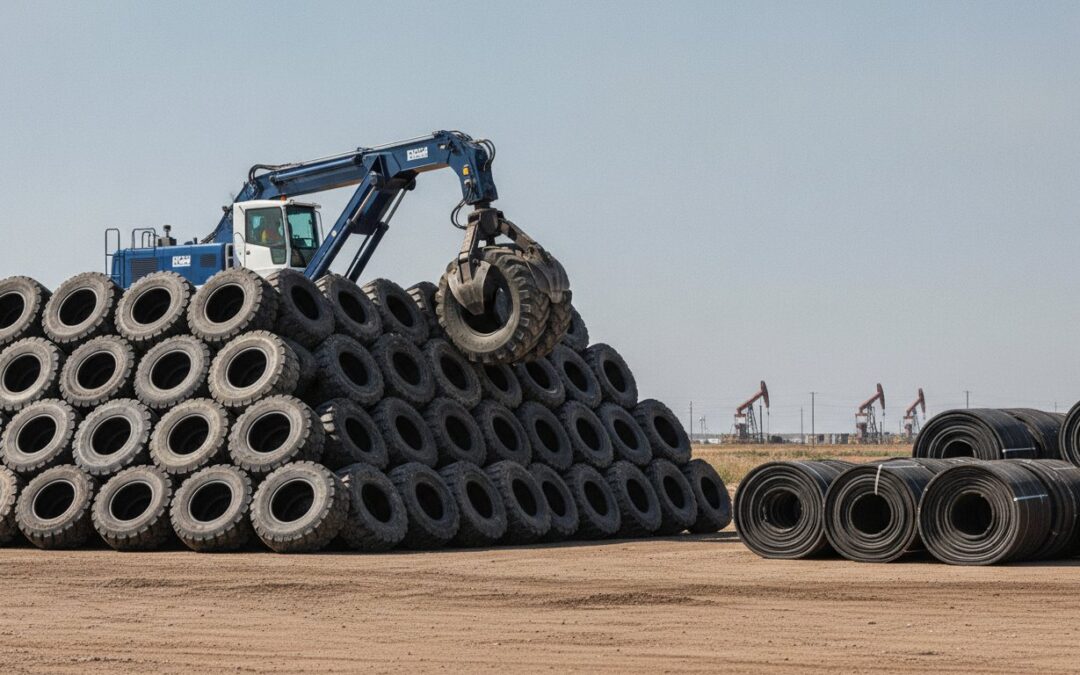
Storing just five unregistered off-the-road (OTR) tires in Midland can trigger TCEQ fines exceeding $25,000. For Permian Basin business owners, handling commercial rubber waste removal Midland isn’t just about clearing space; it’s a high-stakes legal requirement. You already know that the City of Midland Landfill won’t take whole tires, and the paperwork for TCEQ manifests is a massive headache. Dealing with heavy OTR tires or miles of scrap conveyor belts requires more than just a standard trailer and a strong back.
This guide will show you how to master industrial rubber disposal while ensuring 100% regulatory compliance. We’ll break down the 2026 disposal laws, explain how to handle bulk materials like skid steer tracks or industrial hoses, and outline the most cost-effective way to clear your site. You’ll learn about the latest STEERS reporting deadlines and how to avoid the state jail felonies associated with improper dumping. By the end, you’ll have a clear roadmap to keep your operations efficient and your business fully protected from administrative penalties.
Key Takeaways
- Understand the strict 2026 TCEQ manifest requirements to protect your business from massive fines for improper tire storage or disposal.
- Learn why the City of Midland Landfill bans whole tires and how to navigate local ordinances regarding bulk rubber disposal.
- Master the logistics of commercial rubber waste removal Midland for specialized materials like industrial hoses and scrap conveyor belts.
- Identify the specific preparation steps and volume estimation techniques needed to clear your industrial site efficiently.
- Discover how specialized hauling equipment can manage heavy OTR and agricultural tires that general waste companies often refuse.
The Challenges of Commercial Rubber Waste in Midland
Commercial rubber waste isn’t limited to the tires on your truck. In the Permian Basin, it includes scrap conveyor belts, industrial hoses, and massive OTR tires used in oilfield work. Managing these materials is a distinct logistical challenge. Finding reliable commercial rubber waste removal Midland is essential because these items don’t fit in compactors and don’t belong in standard landfills. Standard waste services often refuse these items because they require specialized handling and processing equipment.
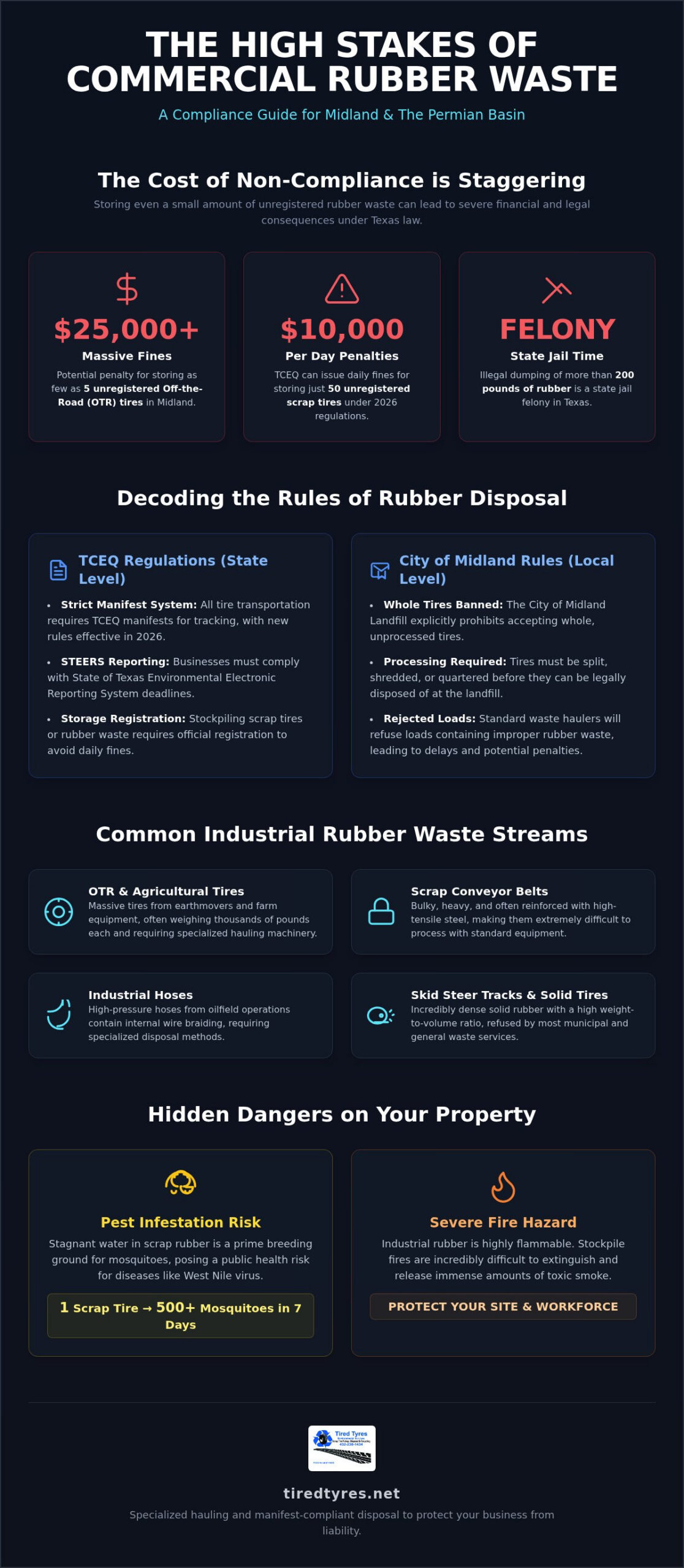
The Tire recycling process is complex because rubber is designed to be durable and heat-resistant. This durability makes it a nightmare for traditional waste management. When these materials are stockpiled, they create significant financial risks. Under 2026 regulations, the TCEQ can issue fines of $10,000 per day for storing just 50 unregistered scrap tires. If you have as few as five OTR tires sitting on your property without registration, those fines can exceed $25,000. Illegal dumping is even more severe; dumping more than 200 pounds of rubber is a state jail felony in Texas.
Landfill Bans and Local Regulations
The City of Midland Landfill, located at 7904 S. Garden City Highway, operates under strict local ordinances. Specifically, Midland Municipal Code Chapter 8-6 prohibits the acceptance of whole tires. They must be split, shredded, or quartered before they’re even considered for disposal. This means you can’t simply toss industrial rubber into a commercial dumpster. Standard garbage haulers aren’t equipped to process these materials. Attempting to hide them in general waste often leads to rejected loads and heavy penalties from the city.
Public Health and Site Safety Concerns
Beyond the legal risks, rubber stockpiles are a genuine hazard to your workforce. In West Texas, stagnant water trapped in tires or coiled hoses becomes a prime breeding ground for pests. A single scrap tire can produce over 500 mosquitoes in just seven days. With Midland health officials strictly enforcing vector control in 2026 to prevent West Nile virus outbreaks, an untidy site is a major liability. Additionally, industrial rubber is highly flammable. Once a stockpile catches fire, it’s incredibly difficult to extinguish and releases toxic smoke across your facility. Professional commercial rubber waste removal Midland services eliminate these safety gaps by clearing the site before a problem starts.
Beyond Tires: Industrial Rubber Waste Streams
Many businesses assume commercial rubber waste removal Midland only applies to truck tires. In reality, the industrial sectors of the Permian Basin produce tons of specialized rubber waste that general haulers won’t touch. These items require heavy-duty equipment because they’re often reinforced with high-tensile steel or industrial fabric. Standard waste services aren’t equipped to process the sheer density of oilfield and agricultural rubber. You need a partner who understands that a 4,000-pound OTR tire requires a different logistical approach than a stack of passenger tires.
Scrap Conveyor Belts and Industrial Hoses
Conveyor belts from local mining or processing plants are notoriously difficult to dispose of. They’re bulky, heavy, and reinforced with materials designed to resist shredding. High-pressure hoses from oilfield operations present similar challenges due to their internal wire braiding. Because these items are often tracked under the TCEQ manifest system, you need a hauler who understands the documentation requirements. Tired Tyres provides a specialized Scrap conveyor belt collection service designed specifically for these reinforced rubber streams.
Skid Steer Tracks and Solid Rubber Tires
Skid steer tracks and solid forklift tires present a high weight-to-volume ratio that many waste companies refuse to handle. Unlike standard tires, these items have no air pockets and are incredibly dense. Most municipal waste programs don’t have the machinery to process these solid rubber blocks. We handle these mixed-material items by using equipment rated for high-density loads. This ensures your yard stays clear of heavy debris that can damage standard trailers or compactors. If your facility has accumulated solid rubber waste, it’s safer to arrange a professional collection than to risk damaging your own equipment.
Heavy Duty: Agricultural and OTR Tire Disposal
Off-the-Road (OTR) tires used in earthmoving and oilfield construction can weigh several thousand pounds each. The logistics of hauling massive OTR units involve specialized loaders and flatbeds. Midland’s agricultural community faces similar hurdles with large tractor and harvester tires. Specialized OTR collection is the only safe way to manage these massive units. DIY hauling is dangerous and often results in rejected loads at disposal sites. We provide the equipment and expertise to haul these heavy-duty items directly from your site, maintaining a clean and safe environment for your workers.
Compliance and the TCEQ Manifest System
Compliance isn’t just a suggestion in the Permian Basin; it’s a legal shield for your company. A scrap tire manifest is a multi-part form that documents the movement of rubber from the point of generation to its final destination. In Texas, the law identifies the business owner as the “generator.” This means you’re legally responsible for the waste even after it leaves your property. If your commercial rubber waste removal Midland provider dumps those tires in a ravine, the TCEQ will trace the manifest back to you. Professional documentation is the only way to prove you’ve followed the law from start to finish.
The EPA tracks national Industrial Rubber Waste Streams to monitor how much material actually reaches recycling facilities versus landfills. In 2026, Texas has tightened these requirements further. By December 31, 2026, all generators must report their operational status through the STEERS system. You’ve got to keep copies of every manifest for at least three years. If an auditor walks into your Midland office tomorrow, you need to show exactly where every ton of rubber went. We ensure that every pickup is documented correctly so you don’t have to worry about surprise inspections.
The Role of a Permitted Tire Hauler
Don’t trust your compliance to an unpermitted hauler with a flatbed. A legitimate provider must have a current TCEQ registration and a City of Midland Garbage Hauler’s Permit, which costs $500 per vehicle annually. If you hire someone without these credentials, you’re participating in an illegal transaction that leaves you liable for any future mismanagement. We handle all the technical paperwork and provide the signed manifests you need for your files. For a deeper dive into the specific rules, check out our Texas Tire Disposal Regulations: A 2026 Guide.
Avoiding Illegal Dumping Penalties
Some business owners still believe they can “donate” old tires to local ranches for erosion control or simply bury them on-site. In 2026, these practices are illegal and carry heavy criminal penalties. Dumping more than 200 pounds of rubber is a state jail felony that can lead to fines exceeding $4,000 per occurrence. The manifest system creates a “cradle-to-grave” trail that makes it impossible to hide large volumes of waste. Using a professional commercial rubber waste removal Midland service ensures that your legal liability ends the moment the manifest is signed. It’s the most cost-effective way to protect your business from the $10,000-per-day fines associated with improper storage or disposal.
Planning Your Bulk Rubber Removal in the Permian Basin
Efficient commercial rubber waste removal Midland starts long before the collection truck arrives. Proper site planning ensures that your operations aren’t disrupted and that every ton of material is accounted for during the loading process. In the fast-paced industrial environment of West Texas, an unorganized waste pile leads to safety hazards and delayed pickups. By taking a few proactive steps, you can streamline the process and ensure your site remains compliant with all local safety ordinances.
Site Assessment and Waste Auditing
The first step is a thorough audit of your current inventory. You’ll need to sort your rubber waste into distinct categories to help our team deploy the right equipment. Group your passenger and light truck tires separately from your semi-truck tire collection. OTR and agricultural tires require significantly more space and specialized loading machinery, so these should be kept in a clear, accessible area.
Industrial rubber items like scrap hoses and conveyor belts should be coiled or stacked away from the tire piles. This separation prevents smaller items from getting lost under heavy tires and speeds up the loading time. Pay close attention to your access points. Our heavy collection vehicles need a stable, wide path to reach the waste. Ensure there’s enough clearance for a trailer to maneuver without blocking your primary warehouse or oilfield equipment lanes. If your site is particularly tight, let us know in advance so we can plan a specific approach route.
Logistics of Scheduled Pickups
Consistency is the best defense against rubber accumulation. For auto shops, truck stops, and fleet managers, setting up a recurring schedule is the most efficient choice. This prevents you from ever reaching the TCEQ storage limits that trigger mandatory registration. We coordinate removals across Midland, Odessa, and Lubbock to ensure West Texas businesses stay ahead of their waste streams. If you’re dealing with a one-time industrial site cleanup, coordination is even more critical. You’ll need to estimate the total volume so we can send the appropriate number of trailers.
For more detailed regional logistics, you can read our guide on Reliable Tire Disposal in Midland, Odessa & Lubbock. Whether you need a monthly pickup or a massive one-time haul, we’ll work with your site’s specific footprint to minimize downtime. When you’re ready to clear your yard and secure your compliance, contact Tired Tyres today to schedule your professional collection.
Midland businesses need a partner who understands the unique industrial demands of the Permian Basin. Tired Tyres isn’t just a hauling company. We’re specialists in commercial rubber waste removal Midland who prioritize your legal safety and site efficiency. Our team serves the entire region, including Odessa and Lubbock, providing a reliable link between your industrial site and proper recycling facilities. We manage the heavy lifting and the complex paperwork so you can focus on your core operations. We’ve built our reputation on being the hauler that says “yes” to the heavy materials that general waste companies refuse to touch.
Full-Service Collection for Every Industry
Every industry in West Texas has different waste management needs. Oilfield operators often struggle with scrap hose collection and reinforced conveyor belts that are too heavy for standard trailers. Agricultural businesses need a reliable way to move massive, mud-caked tractor tires. Automotive fleets require consistent semi-truck tire collection to keep their bays clear. We provide tailored solutions for all these sectors. Our crews are highly trained in OTR Tire Collection and the removal of scrap skid steer tracks.
We don’t just drop off a container and leave the work to you. We provide professional loading and transportation by expert crews who understand how to handle high-density rubber. Our fleet is equipped to manage everything from scrap solid tire collection to light truck tires. By choosing a specialist, you’re ensuring that your waste is handled by people who know the specific weight limits and safety protocols of the Permian Basin. This commitment to environmental stewardship means your rubber waste is processed legally, reducing the risk of fire and pest issues on your property.
Get Started with a Custom Quote
Transparency is the foundation of our service. We provide custom, itemized quotes based on your specific waste stream and volume. You won’t find hidden fees or surprise surcharges in our billing. Our goal is to provide a compliant, cost-effective solution that keeps your business in good standing with the TCEQ. Whether you have a single pile of scrap solid tires or a massive inventory of agricultural rubber, we offer a clear path to disposal.
We understand that every business has a budget. That’s why we offer flexibility in our collection services. You can choose the frequency and scale that matches your production cycle. Our process is designed to be as fast and efficient as possible, minimizing the time our trucks spend on your site. Contact Tired Tyres for your commercial rubber removal quote today! and see how easy it is to secure your site’s compliance. We’re ready to help you clear the way for your next project.
Secure Your Midland Site and Compliance for 2026
Managing industrial rubber doesn’t have to be a source of stress or legal risk for your company. By understanding the strict TCEQ manifest requirements and the specific landfill bans in the Permian Basin, you can protect your business from significant daily fines. Successful operations rely on keeping work areas clear of hazardous stockpiles, whether you’re dealing with massive OTR tires, agricultural units, or reinforced industrial belts. A clean site isn’t just about aesthetics; it’s a fundamental part of your safety and regulatory strategy.
Choosing a specialized partner ensures that your waste is handled with the correct equipment and documented with 100% regulatory precision. Local expertise in commercial rubber waste removal Midland means your materials are processed according to 2026 standards, moving from your site to a legal disposal facility without the headache of DIY logistics. We provide the manifest documentation you need to satisfy any state auditor and the heavy-duty trailers required for bulk hauling. Get a Professional Quote for Commercial Rubber Removal today and let our experts handle the heavy lifting. Your site safety and legal compliance are in good hands.
Frequently Asked Questions
Is it illegal to put tires in a commercial dumpster in Midland?
Yes, it is illegal to dispose of whole tires in standard commercial dumpsters. Midland Municipal Code Chapter 8-6 prohibits the City of Midland Landfill from accepting whole tires in general waste loads. If a garbage hauler discovers tires in your bin, they’ll reject the load and you may face significant fines. Professional collection is the only legal way to manage these materials.
What types of industrial rubber does Tired Tyres collect besides tires?
We collect a wide variety of industrial rubber materials that standard waste companies refuse. This includes scrap skid steer tracks, reinforced conveyor belts, and high-pressure industrial hoses from oilfield operations. We also handle scrap solid tire collection for forklifts and other heavy machinery. Our specialized equipment is rated for the high weight and density of these reinforced rubber streams.
Do I need to provide a manifest for my scrap tires?
The TCEQ requires a manifest for every scrap tire shipment to track the waste from “cradle to grave.” As the waste generator, you’re legally responsible for ensuring this documentation is accurate and filed correctly. We provide all the necessary manifest documentation during our collection process. This paperwork is your primary defense during a state environmental audit or inspection.
How much does commercial rubber waste removal cost in the Permian Basin?
Costs for removal depend on the volume of material, the weight of the load, and the specific type of rubber waste. Removing a pile of OTR tires requires different machinery than a standard semi-truck tire collection. We provide transparent, custom quotes for every project to ensure you aren’t paying for more than you need. Contact us for an itemized estimate based on your site’s specific waste stream.
Can you pick up large OTR tires from oilfield sites in Odessa?
Yes, we specialize in heavy-duty OTR and agricultural tire collection throughout Odessa and the surrounding oilfields. These tires often weigh thousands of pounds and require specialized loaders for safe transport. Our crews are trained to manage the logistics of remote site pickups. We ensure these massive units are removed efficiently without damaging your site’s infrastructure or blocking essential equipment lanes.
How do I schedule a recurring tire pickup for my Midland auto shop?
Scheduling a recurring pickup is simple and helps you stay below TCEQ storage limits. Most Midland auto shops and fleet managers prefer monthly or bi-weekly removals to keep their workspace clear. You can set up a schedule by calling our office or requesting a consultation through our website. We’ll assess your typical waste volume and create a timeline that fits your shop’s specific production needs.
What happens to the rubber waste after it is collected?
Collected rubber is transported to permitted processing facilities where it’s recycled or disposed of according to state law. Many tires are shredded for use in civil engineering projects, rubberized asphalt, or as tire-derived fuel. For facilities that process these recycled materials into commercial products, you can check out Choice Bagging Equipment for advanced production line solutions. This process ensures that commercial rubber waste removal Midland contributes to environmental stewardship. It also prevents scrap tires from becoming breeding grounds for mosquitoes or fire hazards in West Texas.
Does Tired Tyres serve Lubbock and other surrounding areas?
Yes, our service area covers the entire Permian Basin and South Plains regions. We provide commercial rubber waste removal Midland, Odessa, and Lubbock, serving both industrial and agricultural clients. Whether your business is located in a major city center or at a remote oilfield site, we have the logistics in place to reach you. We bring the same level of professional compliance and heavy-duty equipment to every community we serve.