
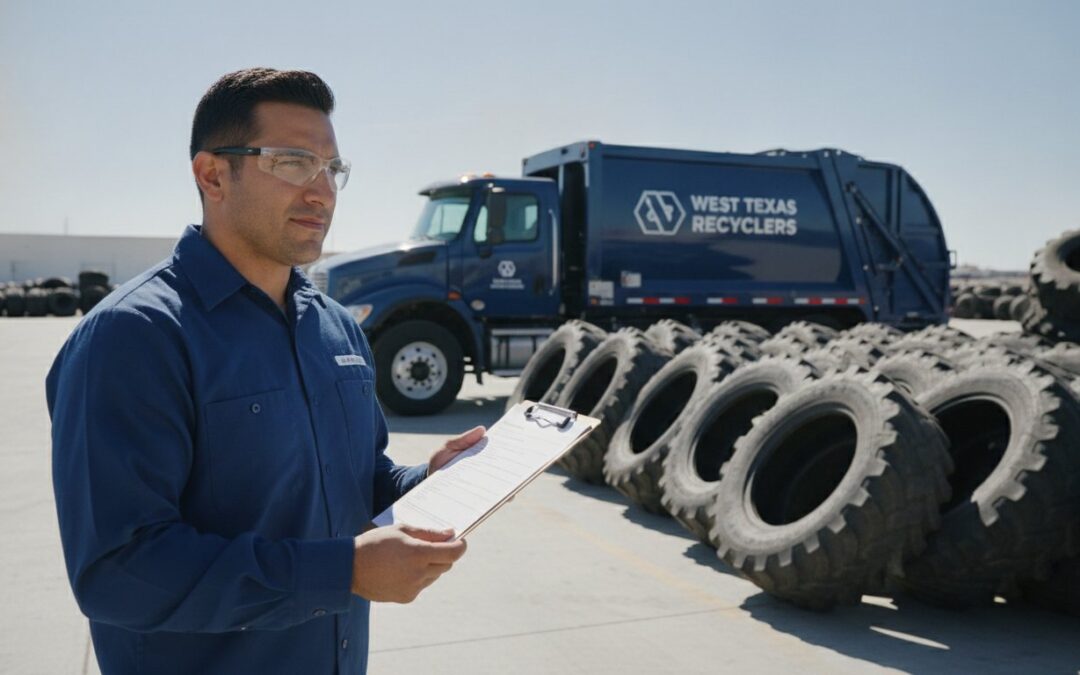
In Texas, a single missing signature on a scrap tire manifest isn’t just a clerical error; it’s a liability that can trigger fines of up to $50,000 per day per violation. You likely already know that managing a fleet or job site in West Texas is demanding enough without the constant shadow of a TCEQ audit. Keeping track of every OTR tire, agricultural tire, and skid steer track leaving your property often feels like a paperwork nightmare that never ends.
This guide will help you master the commercial tire disposal manifest requirements Texas mandates for 2026 so you can protect your business from environmental liability and costly penalties. We’ll break down the technical details of the five-part TCEQ-10304 form, explain the critical 60-day return deadline, and show you how to build a recordkeeping system that stands up to any inspector. By the end, you’ll have a clear path to total compliance and a reliable way to handle even your most difficult industrial rubber waste. Our goal is to replace your paperwork anxiety with the confidence that your records are foolproof and your business is secure.
Key Takeaways
- Understand “cradle-to-grave” liability to ensure your business isn’t held responsible for tires once they leave your facility.
- Learn the specific commercial tire disposal manifest requirements Texas mandates through the mandatory 5-part TCEQ-10304 form.
- Master the three-year recordkeeping rule to keep your West Texas business prepared for any surprise TCEQ audit.
- Identify the distinct legal responsibilities of generators versus transporters to verify that your haulers are properly registered.
- Discover how professional collection for OTR and agricultural tires can automate your compliance and manifest management.
Understanding ‘Cradle-to-Grave’ Liability in Texas Tire Disposal
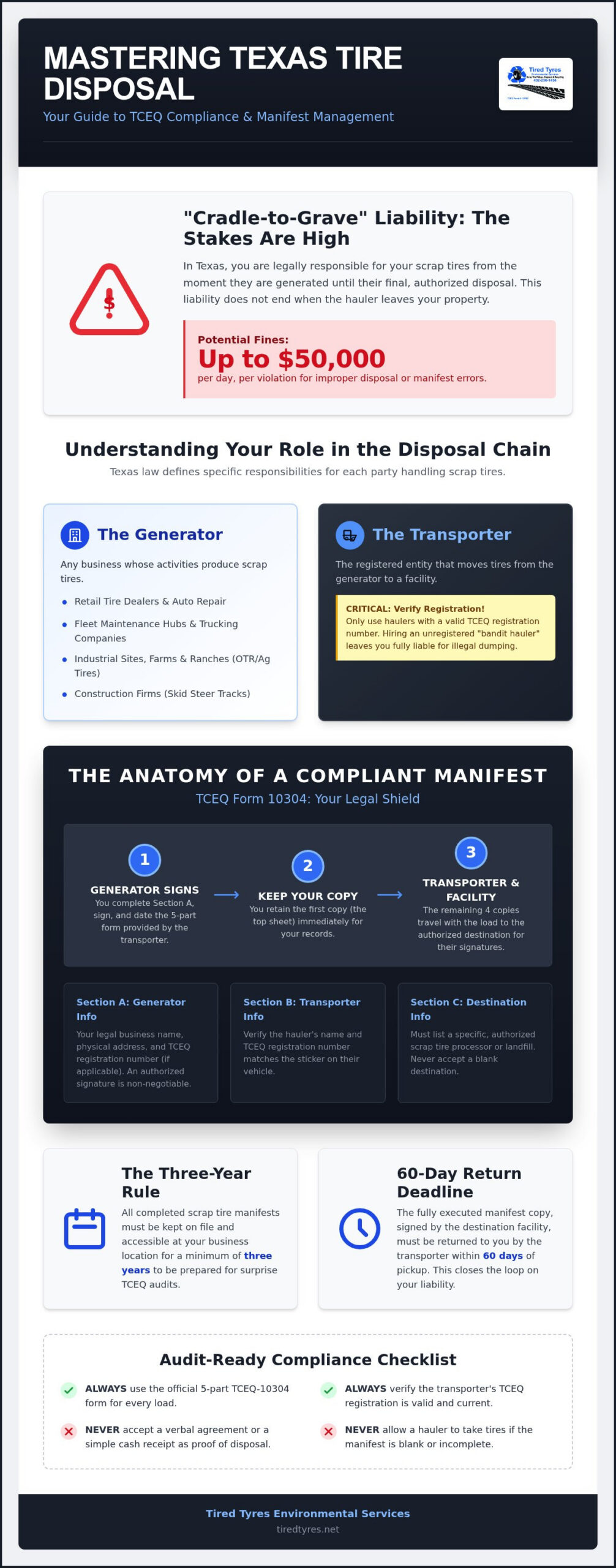
Cradle-to-grave liability is a legal principle that keeps you responsible for your scrap tires from the moment they’re removed until they reach a final authorized destination. In the eyes of the Texas Commission on Environmental Quality (TCEQ), your ownership doesn’t end when the hauler’s truck pulls out of your lot. If those tires are eventually found in an illegal dump site, the agency follows the paper trail directly back to the source. This system ensures that every tire is accounted for, whether it’s destined for a landfill or Tire recycling facilities.
The TCEQ monitors the movement of millions of tires across the state to prevent environmental hazards and fire risks. Commercial generators are the primary targets for audits because they produce the highest volume of waste. The financial stakes are significant. Recently, improper documentation and manifest errors led to over $2.4 million in penalties for businesses across Texas. When you consider that fines can reach $50,000 per day per violation, it’s clear that missing paperwork is a risk no West Texas business can afford to take.
Who Qualifies as a ‘Generator’ in Texas?
A generator is any person or business whose activities produce scrap tires. This definition is broad and covers more than just traditional tire shops. In the Permian Basin and South Plains, common generators include:
- Retail tire dealers and automotive repair facilities.
- Fleet maintenance hubs and trucking companies.
- Industrial sites, ranches, and farms disposing of OTR Tire Collection or Agricultural Tire Collection.
- Construction firms replacing scrap skid steer tracks or conveyor belts.
If your operations result in scrap rubber, you must follow the commercial tire disposal manifest requirements Texas law dictates to prove the waste was handled legally.
The Legal Risks of Unauthorized Haulers
Hiring an unpermitted hauler, often called a “bandit hauler,” is a dangerous shortcut. These haulers often offer lower rates but lack valid TCEQ registration. If they dump your tires in a ravine or an abandoned lot, your business remains legally liable for the cleanup and the resulting fines. You can’t claim ignorance as a defense. A simple cash receipt or a verbal agreement is not a legal substitute for a manifest. Only a correctly completed TCEQ-10304 manifest serves as your legal shield, confirming that you’ve fulfilled your duty to the state.
The Anatomy of TCEQ Form 10304: Manifest Requirements
The TCEQ-10304 form is the primary document used to track the movement of scrap rubber across the state. Understanding the commercial tire disposal manifest requirements Texas mandates starts with this 5-part form. Each part serves as a check and balance for a different player in the disposal chain. When a hauler arrives at your shop, they must provide this specific manifest. You’ll sign it, keep the first copy for your records, and the remaining copies stay with the hauler until they reach the destination facility.
Accuracy is non-negotiable. One of the most frequent errors involves how you document the volume of waste. Texas allows you to record totals by either count or weight. For Passenger & Light Truck Tire Collection, counting the individual units is standard. However, for massive OTR Tire Collection or Agricultural Tire Collection loads, recording the weight in tons is often more practical. If you’re unsure about the technical details, Tired Tyres provides full manifest support with every collection to keep your records audit-ready.
Section A: Generator Information
This section identifies your business as the source of the waste. You must use your legal business name and the physical address where the tires are located. If you operate multiple shops in Midland or Odessa, each location needs its own specific manifest. Don’t forget to include your TCEQ Registration Number if your site is a registered generator. The most critical part of Section A is the authorized signature and the date of pickup. An unsigned manifest is legally void and offers zero protection during an audit.
Section B & C: Transporter and Destination Details
Sections B and C track where the tires are going and who is taking them there. You should always verify that the hauler’s TCEQ registration number on the form matches the registration sticker on their vehicle. The ‘Authorized Facility’ listed in Section C must be a legitimate scrap tire processor or landfill. If a hauler refuses to name a specific destination or leaves this section blank, don’t allow them to load the tires. A blank manifest is a major red flag that often points to illegal dumping. Ensuring these sections are completed correctly before the truck leaves your property is your best defense against future liability claims.
Generator vs. Transporter: Comparing Legal Responsibilities
Compliance isn’t a one-sided deal. In the chain of custody, both the generator and the transporter have specific legal burdens to meet. The manifest acts as the tether between your shop and the final disposal site. It proves you handed off your scrap rubber to a registered professional. One critical rule: never sign a blank manifest provided by a driver. Doing so gives a hauler total control over what is recorded. If they add more tires later or change the destination, you’re the one legally responsible for those discrepancies.
The commercial tire disposal manifest requirements Texas enforces are designed to prevent “incidental” dumping. You must ensure the counts are exact before the truck leaves. Whether you’re dealing with a Semi-Truck Tire Collection or a Scrap skid steer track collection, the numbers on the paper must match the physical load. This documentation protects you if a transporter fails to deliver the load to an authorized facility.
The Generator’s Compliance Checklist
Before any rubber leaves your facility, you must perform a quick inspection. Check the transporter’s vehicle for a current TCEQ decal. It should be visible and match the registration number on their paperwork. Follow these steps for every load:
- Verify the tire count or weight matches the manifest record exactly.
- Ensure all five parts of the TCEQ-10304 are legible and signed.
- Retain the ‘Generator Copy’ immediately upon the truck’s departure.
Don’t let a driver take all copies with the promise of mailing one back later. That first copy is your only proof of a legal transfer if an inspector walks in five minutes after the truck leaves.
When the Transporter Takes Over
Once the truck pulls away, the transporter is responsible for the safe and legal passage of the load. They must follow registered routes and deliver only to authorized sites. This is where professional services like Tired Tyres provide peace of mind. We manage the entire ‘Return Copy’ process for you. Under Texas law, you must receive a completed copy from the destination facility within 60 days. If you don’t receive it, you’re required to notify the TCEQ. We handle this tracking automatically, ensuring your records stay closed and compliant. This includes documenting non-standard items like scrap conveyor belts or scrap hoses, which are often overlooked but still fall under strict disposal rules.
The Three-Year Rule: Recordkeeping for West Texas Businesses
Texas law is clear about your responsibility after the tires leave your lot. You must retain every completed scrap tire manifest for a minimum of 36 months. This three-year window is the standard for any TCEQ audit. If an inspector visits your facility in Lubbock or Midland, they won’t just look at your most recent pickups. They’ll likely request a random sample from two years ago to ensure your compliance is consistent. Failing to produce these documents on demand is one of the fastest ways to trigger a deeper investigation and potential fines.
Maintaining these records is a core part of meeting the commercial tire disposal manifest requirements Texas enforces. While the state doesn’t mandate a specific filing system, your records must be organized and legible. Whether you prefer a physical binder or a digital archive, the goal is immediate accessibility. If you lose your records due to a fire, flood, or simple misplacement, your first step should be contacting your registered transporter. Professional haulers keep their own copies and can often help you reconstruct your compliance history. If you’re struggling to stay organized, schedule a professional tire collection with Tired Tyres to ensure your paperwork is always handled correctly.
Best Practices for Compliance Folders
A pile of loose papers in a desk drawer won’t satisfy a TCEQ inspector. Organize your manifests by calendar year and then by tire category. Keeping your Passenger & Light Truck Tire Collection records separate from your OTR or agricultural loads makes internal audits much easier. We recommend cross-referencing every manifest with your service invoices. This creates a double-entry system that proves the number of tires removed matches the number of tires you’ve billed or replaced. Finally, ensure more than one employee knows exactly where these records are stored. Inspections often happen when the owner is off-site.
Special Rules for OTR and Industrial Rubber
Recordkeeping gets more complex when you move beyond standard car tires. In the Permian Basin, site remediations often involve large volumes of OTR Tire Collection or Agricultural Tire Collection waste. These loads require precise documentation because of their size and environmental impact. You must also track non-standard items like scrap skid steer tracks and scrap conveyor belts. While these don’t always look like traditional tires, the TCEQ still classifies them as scrap rubber that requires a manifest. For bulk site cleanups, keep a separate log that links the manifest to the specific project or job site address to provide a clear audit trail for industrial waste management.
Simplifying Compliance with Professional Tire Collection
Managing the commercial tire disposal manifest requirements Texas expects can be a full-time job for your administrative staff. Instead of burdening your team with complex TCEQ codes and tracking deadlines, you can treat Tired Tyres as your outsourced compliance department. We specialize in removing the technical headache from your daily operations. Our process is designed to be transparent and efficient, ensuring that every load leaving your property is backed by a perfectly completed manifest.
We provide more than just a truck and a driver. Our team uses specialized equipment specifically designed for OTR Tire Collection, Semi-Truck Tire Collection, and heavy industrial rubber. This professional approach prevents damage to your facility and ensures that even the largest agricultural tires are handled safely. Local expertise in Midland, Odessa, and Lubbock matters because we understand the regional regulatory climate. We know exactly which facilities are authorized to accept specific types of waste, which protects you from the risks of accidental non-compliance.
Documented Pickups for Auto Shops and Fleet Managers
Scheduled collection services are the best way to keep your shop floor clear and your business legal. When your scrap pile grows, it becomes a safety hazard and a potential TCEQ red flag. We help you stay audit-ready by automating the recordkeeping process. Every time we visit, you receive a signed, dated manifest that meets all state standards. This consistent documentation makes it easy to provide Reliable Tire Disposal in Midland, Odessa & Lubbock while keeping your internal files organized. You won’t have to scramble for paperwork when an inspector arrives; your compliance folder will already be complete.
Handling Heavy-Duty and Industrial Scrap
Industrial waste requires a higher level of oversight. Large-scale OTR and agricultural tire disposal often involve non-standard weights and sizes that confuse inexperienced haulers. We ensure that your scrap skid steer tracks, scrap hoses, and scrap conveyor belts are documented with the same precision as standard tires. Texas law is strict about all scrap rubber, not just what’s on a rim. By partnering with a specialist, you ensure that even your most difficult industrial waste is disposed of at authorized sites. Don’t leave your environmental liability to chance with unverified haulers. Contact Tired Tyres for a compliant pickup quote today and let us handle the paperwork so you can focus on running your business.
Protecting Your West Texas Business with Compliant Disposal
Compliance in the Lone Star State isn’t just about hauling away waste; it’s about protecting your company’s future. You now understand that cradle-to-grave liability means your responsibility continues long after the tires leave your property. By mastering the commercial tire disposal manifest requirements Texas mandates, you avoid the heavy fines that come with missing paperwork or unverified haulers. Keeping your 5-part manifests organized for the full 36-month period ensures you’re always ready for a surprise inspection.
You don’t have to manage this technical burden alone. Tired Tyres has served Midland, Odessa, and Lubbock since our inception, providing specialized OTR and Semi-truck tire collection. We provide full TCEQ manifest management for every load, so you can focus on your daily operations without the fear of environmental liability. Secure your business with a TCEQ-compliant tire pickup from Tired Tyres today. Let’s make your compliance process simple, legal, and completely stress-free.
Frequently Asked Questions
What is a TCEQ-10304 form and why do I need it?
The TCEQ-10304 is the mandatory five-part manifest used to track scrap tires from your facility to an authorized disposal site. You need it to fulfill the commercial tire disposal manifest requirements Texas law enforces. Without this form, you have no legal proof that your waste was handled correctly. It serves as your primary defense during environmental audits, confirming that you’ve transferred your liability to a registered transporter and a legitimate processing facility.
How long must I keep tire disposal manifests in Texas?
You must retain all completed scrap tire manifests for a minimum of three years from the date of collection. This 36-month recordkeeping requirement is strictly enforced by the TCEQ during routine inspections. Keeping these records organized by year and tire type ensures you can produce them immediately if an inspector visits your Midland or Odessa location. Failing to provide these documents on demand can result in significant fines and increased regulatory scrutiny for your business.
Can I use a standard bill of lading instead of a tire manifest?
No, a standard bill of lading isn’t a legal substitute for the TCEQ-10304 form. While a bill of lading tracks the transport of goods, it doesn’t meet the specific environmental reporting standards required for scrap rubber. Texas law mandates the use of the official manifest system to ensure “cradle-to-grave” tracking. Using incorrect paperwork leaves you liable for illegal dumping penalties because it fails to document the authorized destination and the registered status of the transporter.
What happens if a hauler I hired dumps tires illegally?
Under the principle of “cradle-to-grave” liability, your business remains legally responsible for the tires even after they leave your property. If a hauler dumps them illegally, the TCEQ will trace the tires back to you. If you don’t have a correctly completed manifest proving you handed them to a registered professional, you could face fines up to $50,000 per day. This is why verifying your hauler’s registration and destination is critical for your protection.
Are there exemptions for hauling my own business’s tires in Texas?
Yes, certain entities are exempt from transporter registration, including business owners hauling their own scrap tires to an authorized facility. However, you’re still required to maintain records of the disposal. Even if you aren’t a registered transporter, you must be able to prove to the TCEQ that your tires reached a legal destination. For most West Texas businesses, hiring a professional service is safer and provides the necessary manifest documentation automatically without the logistical burden.
How do I verify if a tire hauler is properly registered with the TCEQ?
You can verify a hauler’s status by checking for a current TCEQ registration decal on their vehicle. This decal should be clearly visible and up to date. Additionally, you should ask for their registration number and verify it through the TCEQ’s online database. Professional companies like Tired Tyres always maintain active registrations and provide clear documentation to ensure your compliance with all commercial tire disposal manifest requirements Texas mandates for the 2026 calendar year.
Do I need a manifest for scrap skid steer tracks or industrial hoses?
Yes, the TCEQ classifies scrap skid steer tracks, industrial hoses, and conveyor belts as scrap rubber that requires proper documentation. While these items aren’t traditional tires, they still fall under the same “cradle-to-grave” disposal rules. You must use a manifest to track their movement from your site to an authorized processor. Including these items in your regular scrap rubber collection ensures your entire waste stream remains compliant and avoids potential red flags during a state audit.
What should I do if I discover an error on a manifest after the hauler has left?
If you find an error, contact your transporter immediately to request a corrected copy. You should document the mistake and keep any correspondence regarding the correction in your compliance folder. If the error involves the tire count or destination, it’s vital to resolve it before the 60-day return deadline. Maintaining a clear paper trail of how you identified and fixed the error shows inspectors that you are actively managing your compliance and acting in good faith.