
That growing pile of worn conveyor belts, scrap hoses, and spent OTR tires sitting on your Permian Basin property isn’t just an eyesore. It’s a liability. Industrial rubber disposal in Midland TX sits at the intersection of site safety and TCEQ compliance, and the businesses that treat it as a simple hauling job are the ones that end up facing enforcement actions, mosquito abatement orders, or worse, a fire hazard that shuts down operations.
If you’ve already called a landfill and been turned away, you’re not alone. Bulk industrial rubber, from heavy conveyor belts to off-the-road tires and skid steer tracks, falls outside what most standard waste facilities will accept. The frustration is real, and the regulatory stakes are higher than most operators expect.
This guide cuts straight to what you need to know. You’ll learn how TCEQ rules apply to industrial rubber stockpiles in the Midland area, what materials qualify for specialized collection, and how working with a local Permian Basin operation removes the compliance burden and the logistics headache from your plate entirely.
Key Takeaways
- Industrial rubber disposal Midland TX is governed by TCEQ regulations that most standard landfills cannot accommodate — knowing the rules before you haul protects your operation from enforcement action.
- Conveyor belts, OTR tires, skid steer tracks, and scrap hoses each require different handling approaches, and misclassifying your waste stream is one of the fastest ways to create a compliance problem.
- Stockpiling industrial rubber on-site carries real consequences beyond aesthetics — fire risk and mosquito breeding grounds are two liabilities that can trigger regulatory intervention in West Texas.
- A TCEQ-permitted hauler with manifest documentation isn’t optional for Midland businesses — it’s the legal baseline, and this guide explains exactly what that process looks like in practice.
- Tired Tyres operates locally across the Permian Basin with the specialized equipment and compliance expertise to remove bulk industrial rubber efficiently, so your team can focus on the work that actually moves your operation forward.
The Challenge of Industrial Rubber Disposal in Midland, TX
Most Midland businesses figure out the hard way that industrial rubber disposal isn’t a standard waste management problem. You load up a trailer, drive to the nearest facility, and get turned away at the gate. It happens constantly across the Permian Basin, and the reason isn’t arbitrary. Municipal collection infrastructure simply wasn’t designed for the volume and material composition of heavy industrial rubber.
Understanding exactly why that rejection happens, and what the consequences of working around it look like, is the first step toward building a compliant disposal process for your operation.
Why Landfills Say No to Industrial Rubber
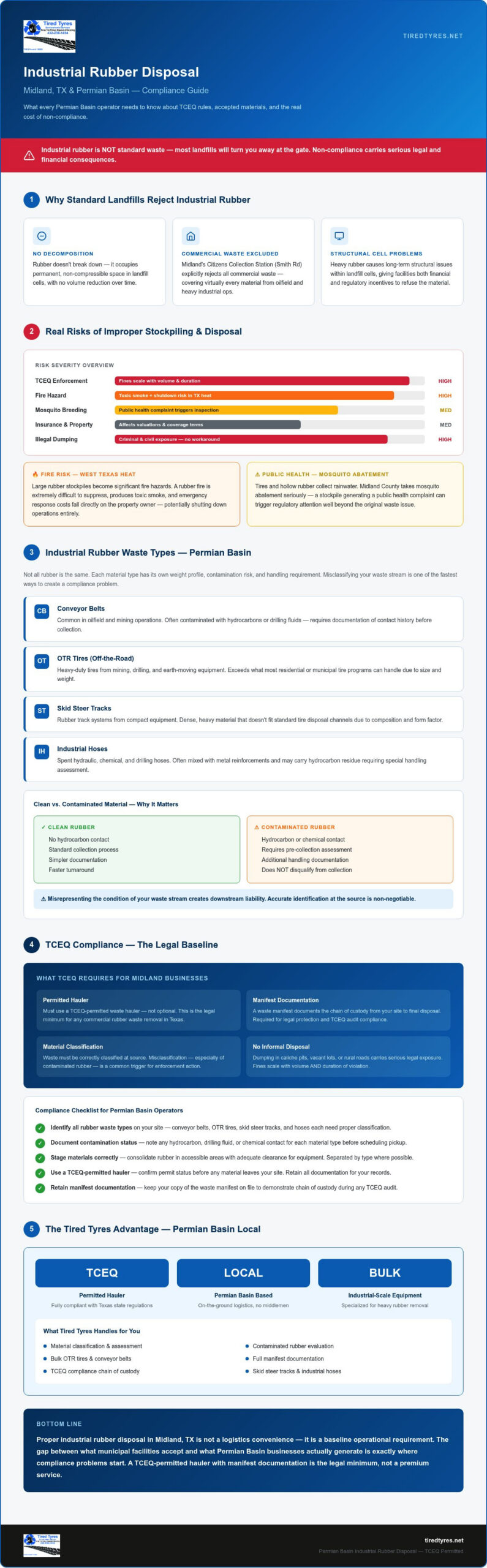
Rubber doesn’t break down. That’s the core problem. Unlike organic waste or even most construction debris, heavy rubber products, including conveyor belts, OTR tires, skid steer tracks, and industrial hoses, occupy permanent, non-compressible space in a landfill cell. Facilities operating under volume and airspace constraints have strong financial and regulatory incentives to refuse materials that deliver no decomposition benefit and create long-term structural issues within the landfill.
Midland’s Citizens Collection Station on Smith Road makes this explicit. The facility’s posted guidelines reject commercial waste of any type, which covers virtually every rubber material generated by oilfield, agricultural, and heavy industrial operations. There’s no workaround available there. The station serves residential customers, and bulk industrial rubber falls completely outside its scope.
Some operators attempt to solve the problem informally, dumping material in vacant lots, caliche pits, or along rural roads. That approach carries serious legal exposure. Unauthorized disposal of scrap rubber in Texas can trigger TCEQ enforcement action, and the fines aren’t administrative slaps on the wrist. They scale with the volume of material and the duration of the violation.
The True Cost of Improper Stockpiling
Letting rubber accumulate on-site creates a different category of risk. In West Texas heat, large rubber stockpiles become significant fire hazards. A rubber fire is difficult to suppress, produces toxic smoke, and can trigger emergency response costs that fall directly on the property owner.
There’s also a public health dimension that’s specific to this region. Tires and hollow rubber components collect rainwater, and standing water in industrial waste creates breeding conditions for mosquitoes. Midland County has historically taken mosquito abatement seriously, and a stockpile that generates a public health complaint can bring regulatory attention that extends well beyond the waste issue itself.
Insurance carriers and commercial property assessors also factor in visible compliance liabilities. Unmanaged rubber accumulation can affect both property valuations in the Midland-Odessa market and the terms of commercial liability coverage.
Proper industrial rubber disposal in Midland TX isn’t a logistics convenience. It’s a baseline operational requirement, and the gap between what municipal facilities accept and what Permian Basin businesses actually generate is exactly where compliance problems start.
Identifying Common Industrial Rubber Waste in the Permian Basin
Not all industrial rubber is the same, and treating it as a single waste category is where disposal problems begin. The Permian Basin generates a remarkably diverse range of rubber waste, driven by oilfield operations, heavy equipment cycles, and agricultural activity across the region. Each material type has its own weight profile, contamination risk, and handling requirement. Getting that classification right from the start determines whether your disposal process runs smoothly or stalls at the first handoff.
One distinction that matters immediately is whether your material is clean or contaminated. Rubber that’s been in contact with hydrocarbons, drilling fluids, or chemical compounds requires a different assessment before collection. Contaminated rubber doesn’t automatically disqualify material from collection, but it does affect how it’s handled and documented. Misrepresenting the condition of your waste stream creates downstream liability, so accurate identification at the source is worth the time it takes.
Conveyor Belts and Industrial Hoses
Conveyor belts present some of the most physically demanding challenges in industrial rubber disposal Midland TX operations. Heavy-duty belts used in oilfield and processing facilities are typically steel-cord or fabric-reinforced, which means they’re rigid, dense, and often arrive in lengths that don’t fit standard equipment. Cutting and sectioning on-site before loading isn’t optional with these materials; it’s a prerequisite. Tired Tyres brings the specialized equipment needed to handle bulk belt removal without putting the burden on your crew.
Scrap hoses from oilfield operations add a different layer of complexity. High-pressure hose assemblies are often coiled, heavy, and awkward to stage for pickup. Volume accumulates quickly on active sites, and the temptation to let it pile up between maintenance cycles is understandable. It’s also how stockpiles grow into compliance problems. Scheduled scrap hose collection keeps that accumulation from reaching a threshold that draws regulatory attention.
OTR, Agricultural, and Solid Tire Waste
Off-the-road tires used on drilling rigs, earthmovers, and heavy haul equipment are a category in their own right. These aren’t passenger tires scaled up. OTR tires can weigh hundreds of pounds each, and moving them without purpose-built equipment creates both safety and logistics problems that standard haulers aren’t equipped to solve.
West Texas farming operations contribute a steady stream of agricultural tire waste, from large tractor tires to implement and trailer tires that wear out across long field seasons. Solid rubber tires and scrap skid steer tracks round out the picture, particularly for construction and oilfield support contractors running compact equipment year-round.
- OTR tires: heavy machinery, drilling rigs, earthmovers
- Agricultural tires: tractors, implements, trailers
- Solid tires and skid steer tracks: compact construction and oilfield support equipment
- Conveyor belts: processing facilities, bulk handling operations
- Scrap hoses: oilfield high-pressure lines, industrial plant connections
Tired Tyres handles this full range of materials across the Permian Basin. If you’re unsure how your specific waste stream should be categorized before scheduling a pickup, reach out to the Tired Tyres team to get a straightforward answer before the material becomes a larger problem.
Navigating TCEQ Regulations and Compliance for Businesses
Texas doesn’t leave industrial rubber disposal in a regulatory gray area. The Texas Commission on Environmental Quality has established a clear framework for how scrap tires and bulk rubber waste must be handled, documented, and transferred. For Midland businesses generating this material, understanding that framework isn’t optional. It’s the difference between a clean audit and an enforcement action that disrupts your operation.
Your role in that framework starts the moment rubber leaves your property. Under TCEQ rules, the business that generates the waste is legally the generator of record. That status carries specific documentation obligations that don’t disappear once the hauler pulls out of your gate. If the material ends up mishandled downstream, the generator’s liability doesn’t automatically transfer with it.
The Manifest System Explained
The manifest is the legal proof that your industrial rubber disposal Midland TX operation was handled correctly from pickup to final destination. Every transfer of scrap tires and bulk rubber through a TCEQ-regulated process requires a manifest that captures the generator’s name and address, the type and quantity of material, the permitted hauler’s information, and the receiving facility’s details. All parties sign it. You keep your copy.
TCEQ requires generators to retain manifest records for a minimum of three years. That timeline matters because enforcement investigations don’t always happen immediately after a violation. A clean paper trail from every collection event is your protection if questions arise later.
Key fields that must appear on a compliant scrap tire manifest include:
- Generator information: business name, physical address, and contact
- Material description: tire type, quantity, and approximate weight
- Hauler details: TCEQ registration number and vehicle identification
- Destination facility: permitted processor or end-use location
- Signatures: generator and hauler at point of transfer
Avoiding Illegal Dumping Fines
One misconception that surfaces regularly across the Permian Basin is that disposing of rubber on private land avoids regulatory exposure. It doesn’t. Texas law treats unauthorized disposal of scrap tires as illegal dumping regardless of who owns the property. Dumping on a caliche pit you control carries the same potential penalties as dumping on public land.
TCEQ’s penalty structure for illegal tire and rubber disposal scales with volume and duration. Violations can result in administrative penalties reaching into the thousands of dollars per day, and repeat or large-volume violations can escalate to referral for civil or criminal enforcement. These aren’t theoretical outcomes. They’re documented enforcement actions that have affected Texas operators across multiple industries.
Working with a TCEQ-permitted hauler like Tired Tyres removes every layer of that risk. The manifest is completed correctly at pickup. The material moves to a permitted facility. Your records are clean. There’s no ambiguity about where the rubber went or whether the process was compliant, which is exactly the kind of clean audit trail that protects your business when regulators ask questions about your industrial rubber disposal Midland TX practices.
Best Practices for Staging and Preparing Bulk Rubber for Pickup
How you prepare your site before the collection truck arrives has a direct effect on how fast the job gets done and what you pay for it. Poorly staged material slows loading, complicates sorting, and can push a straightforward pickup into a multi-trip job. A few hours of preparation on your end translates into a faster turnaround and a cleaner quote for your industrial rubber disposal Midland TX operation.
Site Access and Material Sorting
The first thing a collection team assesses is whether their equipment can actually reach your stockpile. Heavy rubber removal requires purpose-built vehicles with significant turning radius and weight ratings. Blocked pathways, low-clearance structures, or unstable ground between the gate and the material pile create delays that affect everyone’s schedule. Before your pickup date, walk the access route and confirm there’s a clear, firm path wide enough for a loaded collection truck to enter, maneuver, and exit without obstruction.
Sorting matters almost as much as access. Tires and non-tire rubber waste, including conveyor belts, scrap hoses, and skid steer tracks, load differently and may be destined for different processing streams. Mixing them together in a single pile slows the sorting process at your site. Separate material types into distinct staging areas before the crew arrives. It’s also worth removing non-rubber components where you reasonably can. Metal rims still mounted on OTR or agricultural tires add weight and complicate handling. Excessive dirt or mud packed into hollow rubber components creates similar friction. Neither issue is a dealbreaker, but addressing them in advance keeps the job moving.
Safety and Efficiency Checklist
Heavy rubber is awkward to move. The weight-to-grip ratio on large OTR tires and rolled conveyor belt sections creates real injury risk for anyone handling them without proper equipment. Your employees shouldn’t be manually repositioning bulk rubber to accommodate a collection truck. That’s the collection team’s job, and it’s why specialized equipment exists. Keep your crew clear of the loading zone during pickup.
This reliance on specialized machinery is common across high-stakes property maintenance; for instance, the technical precision and equipment used in professional arboriculture by Cut And Run Tree Service mirrors the expertise required to safely clear heavy industrial debris from a site.
Two pre-pickup steps that consistently get overlooked: draining any standing water from hollow rubber components before collection day, and ensuring the staging area itself is visible and unobstructed from the site entrance. Water-filled tires are heavier, harder to load, and contribute to the mosquito breeding risk covered earlier in this guide. Eliminating standing water before pickup is a simple step that reduces both the load weight and your liability exposure.
For a deeper look at how Texas regulations affect your staging and documentation obligations, the Texas Tire Disposal Regulations guide for West Texas businesses covers the compliance side in detail.
Tired Tyres serves sites across Midland, Odessa, and Lubbock, and the team can advise on site-specific staging requirements before scheduling. Contact Tired Tyres to discuss your site layout and get a collection plan that works around your operation, not against it.
Partnering with Tired Tyres for Efficient Permian Basin Disposal
Most of the compliance friction covered in this guide, the manifest requirements, the landfill rejections, the staging logistics, traces back to a single root problem: using a general hauler for a specialized job. Tired Tyres exists specifically to close that gap. The operation is built around the Permian Basin’s actual waste profile, not a generic service model retrofitted to West Texas conditions.
That local focus matters more than it might initially seem. A hauler that understands Midland’s site conditions, knows the TCEQ documentation requirements inside out, and runs equipment sized for OTR tires and steel-cord conveyor belts doesn’t create delays at your gate. The job gets done correctly the first time, and your compliance record stays clean.
Comprehensive Collection Services
Tired Tyres handles the full range of industrial rubber waste generated across the Permian Basin. That means passenger and light truck tires, semi-truck tires, agricultural tires, OTR tires, solid tires, scrap skid steer tracks, scrap hoses, and scrap conveyor belts. Whether you’re running a small auto shop clearing a seasonal backlog or managing waste streams at a large industrial complex, the collection process scales to your volume without requiring you to coordinate multiple vendors for different material types.
Scheduling is built around your operation, not the other way around. Minimizing downtime during collection is a practical priority, not a marketing phrase. For a detailed breakdown of how Tired Tyres serves businesses across the region, the Reliable Tire Disposal in Midland, Odessa and Lubbock guide covers service specifics for each market.
Every collection is backed by proper TCEQ manifest documentation. You receive your copy at pickup. Your records are complete. That’s the baseline for every job, regardless of size.
There’s also an environmental dimension worth stating plainly. Responsible industrial rubber disposal Midland TX businesses that route material through permitted processors rather than stockpiles or unauthorized sites contribute directly to West Texas environmental health. Rubber that reaches a legitimate processing stream gets repurposed rather than left to degrade or burn. That outcome benefits the region, and it’s the only outcome Tired Tyres works toward.
Get Your Custom Disposal Quote
The quote process is straightforward. Inventory your material by type: tires by category, belts by approximate length, hoses and tracks by volume. That information is enough to generate an accurate quote without a site visit in most cases. No lengthy intake forms, no waiting on a national call center to route your request to someone who’s never been to Midland.
Local businesses across the Permian Basin choose Tired Tyres for industrial rubber disposal Midland TX needs because the alternative, piecing together a compliant disposal process from general haulers and incomplete documentation, costs more time and carries more risk than it’s worth. The expertise is already here. The equipment is already here.
Contact Tired Tyres today for an industrial rubber disposal quote and get a clear answer on what collection looks like for your specific site and material mix.
Take Control of Your Industrial Rubber Waste in 2026
Industrial rubber doesn’t manage itself, and the Permian Basin’s regulatory environment doesn’t leave much room for improvisation. The core lesson from this guide is straightforward: industrial rubber disposal Midland TX requires a permitted hauler, proper manifest documentation, and equipment matched to the material. Cutting corners on any one of those three elements creates liability that outlasts the convenience.
Tired Tyres handles the full picture. TCEQ-compliant manifest documentation comes standard with every collection. Specialized equipment covers OTR tires, industrial belts, scrap hoses, and skid steer tracks without requiring your crew to do the heavy work. And as a local Permian Basin operation serving Midland, Odessa, and Lubbock, the team understands your site conditions and your compliance obligations.
Your rubber stockpile doesn’t need to be a problem waiting to escalate. The solution is already here.
Get a professional quote for industrial rubber disposal and get that material off your property the right way.
Frequently Asked Questions About Industrial Rubber Disposal in Midland, TX
Can I take industrial tires or conveyor belts to the Midland city landfill?
No. The Midland Citizens Collection Station on Smith Road is restricted to residential customers and explicitly rejects commercial waste. Industrial tires, conveyor belts, and other bulk rubber materials generated by oilfield, agricultural, or heavy industrial operations fall completely outside what that facility accepts. Attempting to drop off commercial rubber waste there isn’t a gray area; it’s a rejection at the gate.
Your only compliant path is a TCEQ-permitted hauler equipped to handle industrial-grade material. That’s not a workaround; it’s the standard process for every Permian Basin business generating this type of waste.
What is a TCEQ manifest and why does my business need one for rubber disposal?
A TCEQ manifest is the legal document that records the transfer of scrap tires and bulk rubber from your property to a permitted facility. It captures your business information, the material type and quantity, the hauler’s TCEQ registration number, and the destination facility. Both you and the hauler sign it at pickup. You keep your copy.
Texas requires generators to retain manifest records for a minimum of three years. As the generator of record, your liability doesn’t transfer with the material if documentation is incomplete. A clean manifest from every collection is your protection if TCEQ asks questions about your industrial rubber disposal Midland TX practices.
Does Tired Tyres collect scrap skid steer tracks and industrial hoses?
Yes. Scrap skid steer tracks and industrial hoses are both part of Tired Tyres’ standard collection service across the Permian Basin. These materials accumulate quickly on active construction and oilfield sites, and they don’t belong in general waste streams. Tired Tyres handles both alongside OTR tires, agricultural tires, conveyor belts, and solid tires, so you don’t need to coordinate multiple vendors for different rubber types.
How much does industrial rubber disposal cost in Midland, TX?
Pricing for industrial rubber disposal depends on the material type, volume, and site-specific logistics involved in the collection. Because no two jobs are identical, particularly when OTR tires, steel-cord conveyor belts, and mixed rubber streams are involved, a custom quote based on your actual material inventory is the only accurate way to get a number. Contact Tired Tyres directly with a breakdown of your material types and approximate quantities to receive a straightforward quote.
Is there a limit to how much industrial rubber I can have collected at once?
Tired Tyres is equipped to handle large-volume collections, including bulk industrial rubber from major oilfield, agricultural, and processing operations. There’s no standard upper limit that applies across all jobs. Volume, material mix, and site access are the practical factors that shape collection planning. If you’re managing a significant backlog, reach out early so the right equipment and scheduling can be arranged for your specific site.
Can you pick up OTR tires that are still on the rims?
OTR tires mounted on rims can be collected, but it’s worth discussing your specific situation before scheduling. Rims add weight and affect how material is loaded and processed downstream. In some cases, demounting tires before collection simplifies handling and may affect your quote. Contact Tired Tyres with details about your OTR tires, including approximate size and whether they’re mounted, and the team can advise on the most efficient approach for your site.
How do I prepare bulk conveyor belts for collection?
Conveyor belts need to be cut and sectioned before loading; full-length runs of steel-cord or fabric-reinforced belt aren’t manageable in a single piece. Tired Tyres brings specialized equipment to handle bulk belt removal, so your crew doesn’t need to do the heavy work. What helps most on your end is ensuring clear site access for the collection vehicle and staging the belt material in an area the truck can reach without obstruction. If you’re unsure about specific prep requirements for your belt type or site layout, contact Tired Tyres before your pickup date.
Do you offer scheduled rubber collection services for industrial sites in Odessa?
Yes. Tired Tyres serves Odessa as part of its Permian Basin service area alongside Midland and Lubbock. Scheduled collection for industrial sites is available, and the service is designed to work around your operation’s schedule rather than disrupting it. Regular pickups prevent rubber accumulation from reaching the stockpile thresholds that create fire hazards, mosquito breeding conditions, and TCEQ compliance exposure. Reach out to discuss a collection frequency that fits your site’s waste volume.