
Did you know that storing as few as 50 unregistered scrap tires on your property can trigger TCEQ fines of $10,000 per day? In the Permian Basin, a single oversight in waste management isn’t just a mess; it’s a massive financial liability. When you are evaluating your commercial tire disposal service, you need a partner that offers more than just a hauling truck. You likely already know the frustration of unreliable pickup schedules or the sting of hidden fees that suddenly appear on your invoice. It’s a common struggle for industrial operations across Midland, Odessa, and Lubbock.
This 2026 guide provides the critical criteria for vetting your tire disposal partner to ensure total legal compliance and predictable, transparent pricing. We’ll walk through the latest TCEQ manifest requirements, how to identify reliable service providers, and the best ways to keep your commercial site clean and hazard-free. By the end of this article, you’ll have a clear roadmap to protect your business from regulatory penalties while maintaining a professional, safe workspace.
Key Takeaways
- Understand “cradle-to-grave” liability to protect your business from significant TCEQ penalties for improper scrap tire management.
- Master the process of evaluating your commercial tire disposal service by verifying state registration and specific equipment capabilities.
- Determine if an on-call or scheduled collection model better fits your operation’s seasonal volume and operational budget.
- Identify professional disposal solutions for specialized industrial waste like scrap conveyor belts and skid steer tracks that many landfills refuse.
- Secure your operation with transparent manifest reporting from a local partner who understands Permian Basin industrial requirements.
The Risks of Improper Commercial Tire Disposal in Texas
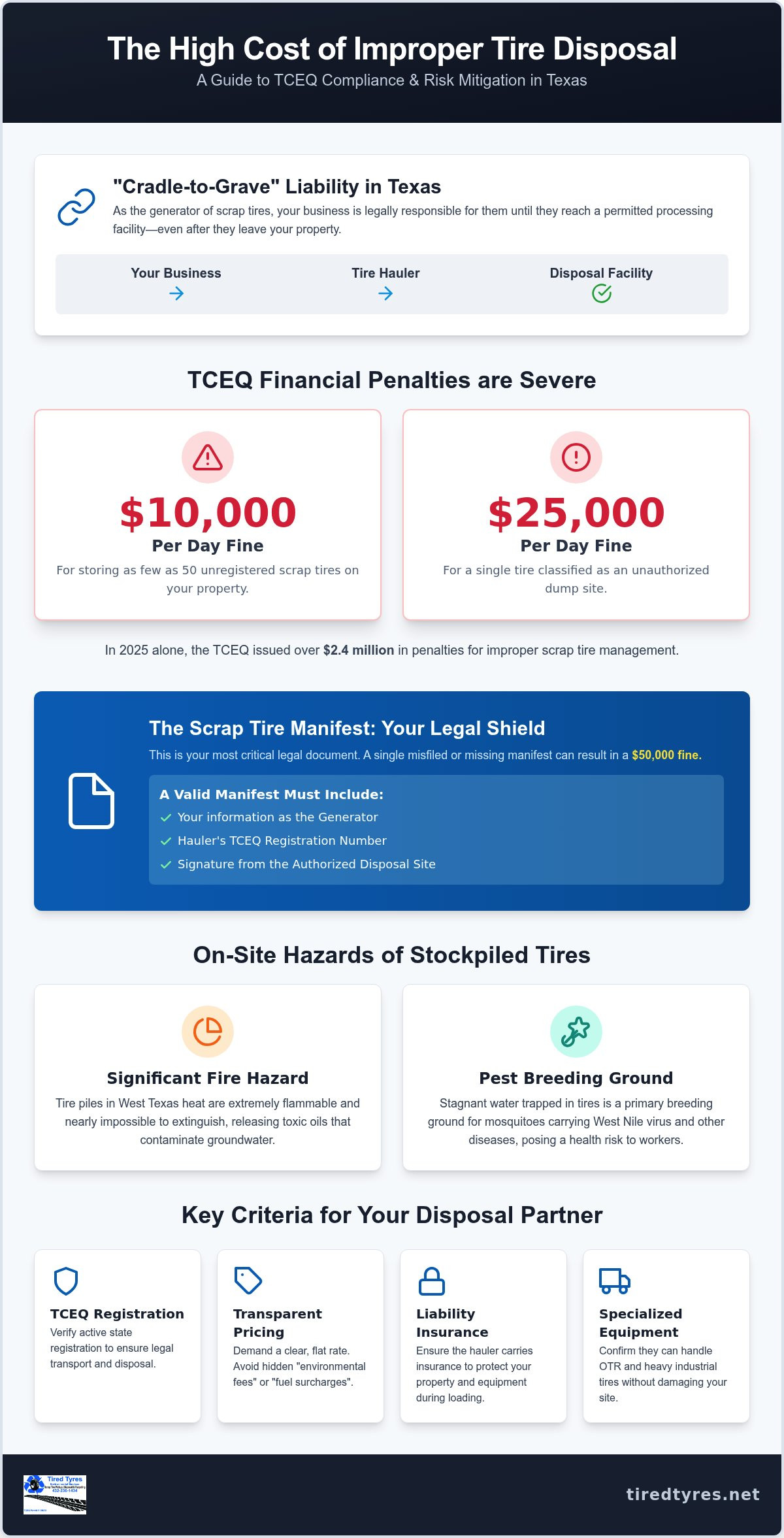
In Texas, the responsibility for a scrap tire doesn’t end when it leaves your property. The state enforces a “Cradle-to-Grave” liability policy. This means that as the business generating the waste, you’re legally responsible for those tires until they reach a permitted processing facility. If a hauler dumps your tires in a West Texas field to avoid disposal fees, the Texas Commission on Environmental Quality (TCEQ) will trace those tires back to you. When you’re evaluating your commercial tire disposal service, you’re essentially choosing who manages your legal reputation.
The TCEQ maintains strict oversight through 30 TAC Chapter 328, Subchapter F. The financial stakes are incredibly high. For example, in 2025, the TCEQ issued over $2.4 million in penalties for improper scrap tire management. Choosing a low-cost, unpermitted hauler might save a few dollars today, but it exposes your business to massive risks. A single tire classified as an unauthorized dump site can trigger fines of up to $25,000 per day. For larger stockpiles of just 50 unregistered tires, you could face penalties of $10,000 per day.
The Scrap Tire Manifest: Your Legal Shield
The manifest is the most important document in your disposal chain. A generator is defined as any person or business whose activities produce scrap tires or whose act first causes a scrap tire to become subject to regulation. As a generator, you must ensure every load is documented. A valid manifest must include your information, the hauler’s TCEQ registration number, and eventually, the signature of the authorized disposal site. Don’t ignore red flags like haulers who use generic invoices instead of state-approved manifests. The TCEQ can issue a $50,000 fine for a single misfiled or missing manifest, making professional documentation your best defense against litigation.
Environmental Hazards of On-Site Tire Stockpiles
Beyond legal fines, letting scrap tires pile up creates immediate physical dangers for your facility. West Texas heat makes tire piles a significant fire hazard. Once a rubber-based blaze starts, it’s nearly impossible to extinguish; it often melts into toxic pyrolytic oil that contaminates local groundwater. Understanding the Tire recycling process helps illustrate why professional intervention is necessary to prevent these disasters.
Additionally, old tires are the primary breeding ground for mosquitoes in the Permian Basin. Stagnant water trapped inside the tire casing provides a protected environment for pests that carry West Nile and other diseases. Keeping your site clean isn’t just about aesthetics; it’s about worker safety and community health. For a deeper look at the specific legal requirements you must meet this year, review our guide on Texas Tire Disposal Regulations.
Key Criteria for Evaluating Your Disposal Provider
Selecting a partner for waste management requires more than just looking at a price sheet. When you are evaluating your commercial tire disposal service, start by verifying their TCEQ registration status and active permit. A legitimate hauler must be registered with the state to transport and dispose of scrap rubber. Using an unpermitted provider is a shortcut that often leads to the legal liabilities discussed earlier. While federal scrap tire regulations provide a broad framework for waste management, the specific enforcement and manifest tracking happen at the state level in Texas.
Transparency in pricing is another hallmark of a professional provider. You should look for a clear, flat rate that covers the entire disposal process. Many haulers attempt to pad their margins with “environmental fees” or “fuel surcharges” that never appeared in the original quote. Beyond costs, ask about insurance coverage. A professional team carries liability insurance to protect your property and equipment during the loading process. If a hauler damages a fence or a piece of machinery while loading a bulk pile, you don’t want to be the one left holding the bill.
Specialized Equipment for OTR and Heavy Tires
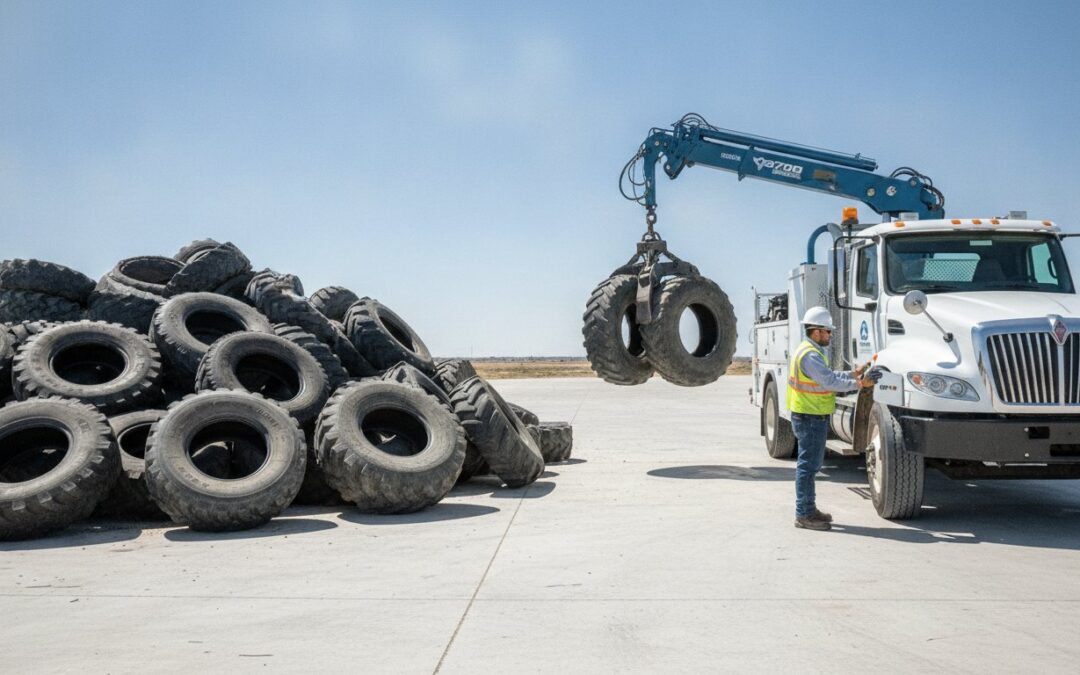
OTR (Off-the-Road) and agricultural tires present unique logistical challenges. A standard utility trailer or a small pickup truck isn’t built to handle the weight and volume of heavy-duty industrial rubber. If your provider lacks specialized loading equipment, they may end up damaging your yard or leaving a mess behind. Ask potential partners about their loading techniques for bulk piles. If you’re looking for a partner who understands these local industrial needs, explore our commercial collection capabilities. Proper equipment ensures the job is done quickly without disrupting your daily operations.
Reliability and Service Frequency
Reliability is the backbone of a functional commercial site. You need to decide whether a scheduled pickup model or an on-call basis fits your business better. Seasonal businesses, like West Texas farming operations, often prefer the flexibility of on-call service. However, high-volume industrial shops in Lubbock or Odessa benefit from the consistency of a weekly or monthly schedule. A local presence ensures that when you call, someone actually answers the phone and can respond to your needs. Consistent removal keeps your facility organized, professional, and free from the hazards of long-term stockpiling.
Comparing Service Models: On-Call vs. Scheduled Collection
Choosing the right logistics model is a critical part of evaluating your commercial tire disposal service. For many West Texas businesses, the decision depends entirely on monthly volume and operational flow. If you’re managing a high-volume retail tire shop in Midland, your needs differ significantly from a rancher in Lubbock clearing out a decade’s worth of agricultural tires. Understanding these differences helps you avoid paying for service you don’t need or, conversely, letting hazardous piles accumulate beyond legal limits.
A thorough cost-benefit analysis often reveals that the “cheapest” per-tire price isn’t the most efficient. You have to consider labor costs. Every time your employees have to move, stack, or reorganize a pile of scrap rubber, it’s costing you money. A streamlined disposal process ensures that tires are moved once, directly to a designated collection point, where they are quickly whisked away by a professional team.
When to Choose On-Call Bulk Removal
On-call service is the most flexible option for businesses with unpredictable waste streams. It’s the ideal choice for construction site cleanups, property acquisitions, or end-of-season agricultural clearing where tires aren’t generated on a daily basis. To make this model work effectively, you need to prepare your site properly. This involves consolidating the tires in a central, accessible location so the hauler can load them quickly without navigating obstacles.
Clear access is vital for the heavy trucks used in bulk removals. If your site is cluttered or the tires are scattered across a wide area, the pickup takes longer and can drive up the total project cost. For more details on regional availability and specific equipment for these large-scale projects, check out our Commercial Tire Disposal in Midland, Odessa & Lubbock guide. While on-call service provides flexibility, it requires proactive management to ensure piles don’t sit long enough to attract pests or trigger regulatory red flags.
The Efficiency of Scheduled Routes
For auto shops, fleet centers, and industrial hubs, a scheduled route is almost always the superior choice. Weekly or bi-weekly pickups ensure your shop floor stays clean and your technicians have maximum usable workspace. When tires are removed on a set schedule, you eliminate the “emergency cleanup” fees that often come with last-minute calls when a pile becomes unmanageable.
- Maintain a professional, organized appearance for customers.
- Eliminate the fire and pest risks associated with long-term storage.
- Simplify accounting with predictable, recurring invoices.
Predictable budgeting is a major advantage for local managers. You’ll know exactly what your disposal costs will be every month, which simplifies your operational planning. Beyond the financial benefits, scheduled routes significantly reduce the risk of TCEQ violations by preventing the long-term accumulation of scrap rubber on your property. It’s a reliable solution that allows you to focus on your core business while we handle the compliance and logistics.
Beyond Tires: Evaluating Industrial Rubber Waste Solutions
West Texas industrial operations generate more than just scrap pneumatic tires. If you manage an oil field site in the Permian Basin or a construction fleet in Lubbock, you likely have piles of reinforced conveyor belts, hydraulic hoses, and heavy rubber tracks taking up valuable space. When you are evaluating your commercial tire disposal service, it’s vital to ask if they can handle the full spectrum of industrial rubber waste. Relying on multiple vendors for different materials complicates your logistics and doubles your manifest paperwork.
A single-source solution is the most efficient way to maintain a clean, compliant facility. Many standard haulers will take passenger tires but refuse to touch the heavier, more complex materials used in industrial applications. This leaves you with a “split” site where half your waste is gone while the most difficult items remain. A professional partner should have the equipment and the permits to clear everything in one go, from standard truck tires to specialized rubber components.
Conveyor Belt and Industrial Hose Removal
The conveyor systems used in Permian Basin midstream and mining operations are built to last, but once they fail, they become a logistical nightmare. These belts are incredibly heavy and often reinforced with steel, making them impossible to manage with standard waste equipment. Leaving them to degrade in the sun isn’t just an eyesore; it’s a liability. As industrial hoses and belts break down, they can leach chemicals into the soil, creating environmental hazards that the TCEQ monitors closely. Tired Tyres specializes in the collection of these non-standard materials, providing the heavy-duty loading capabilities required to clear your site quickly.
Skid Steer and Solid Tire Collection
Solid rubber tires and skid steer tracks present a unique challenge because many municipal landfills won’t accept them. Unlike pneumatic tires, solid rubber doesn’t compress and requires specific processing methods to be recycled or disposed of properly. Collecting these items from a job site requires more than just a trailer; it requires specialized lift equipment and a team that understands the weight involved. A scrap skid steer track can weigh hundreds of pounds and is notoriously difficult to secure for transport.
- Ensure your provider has the right trailers and lift equipment for solid rubber waste.
- Verify that your hauler has a designated downstream facility for industrial tracks.
- Avoid the risk of landfill rejection by using a specialized rubber waste partner.
If your current provider can’t handle the weight of your industrial waste, you’re only getting half the service you need. We provide comprehensive solutions for all your rubber waste, ensuring your entire site stays clean and compliant. Schedule a pickup for your industrial rubber waste to see the difference a specialized partner makes.
Why Tired Tyres is the Right Choice for West Texas
Choosing a partner for waste management is ultimately about trust and accountability. When you are evaluating your commercial tire disposal service, the final and most important factor is local expertise. A provider that understands the specific industrial landscape of the Permian Basin can offer a level of service that national corporations simply can’t match. We’ve built our reputation on being a reliable, straightforward partner for businesses across Midland, Odessa, and Lubbock.
Our commitment to 100% TCEQ compliance isn’t just a talking point; it’s the foundation of our business. We understand that your reputation is on the line every time a load of scrap rubber leaves your facility. By providing transparent manifest reporting and ensuring every tire reaches a permitted facility, we take the legal weight off your shoulders. Whether you’re dealing with standard passenger tires or the massive OTR and agricultural tires common in our region, our team has the equipment to handle the job safely and efficiently.
Local Expertise, Local Support
Being based right here in West Texas matters for your response times and your bottom line. We aren’t a national call center located three states away. When you call us, you’re speaking directly with decision-makers who understand the logistical challenges of the South Plains and the Permian Basin. We’re familiar with the specific rules of local landfills and the environmental challenges unique to our region, from extreme heat to dust control during loading.
This local presence allows us to be more agile. If your site has a sudden influx of waste from a large project, we can adjust our routes to accommodate you. Our “No-Hassle” approach is designed specifically for busy commercial operations that don’t have time to chase down a hauler or worry about hidden fees. We show up when we say we will, we load the waste professionally, and we provide the documentation you need to stay compliant.
Get Started with a Custom Disposal Plan
Every West Texas business has different needs. A high-volume fleet center in Lubbock requires a different strategy than a construction firm in Odessa. We don’t believe in one-size-fits-all solutions. Instead, we work with you to develop a custom disposal plan that fits your generation volume and your budget. This includes everything from our standard tire collections to the specialized industrial rubber waste solutions like conveyor belts and skid steer tracks discussed in the previous section.
Getting started is a simple, transparent process. We provide clear quotes without the surprise surcharges that often plague this industry. Our goal is to create a long-term partnership where you never have to worry about your scrap rubber again. Request a commercial tire disposal quote for your Midland or Odessa facility today and let us handle the logistics while you focus on your core business.
Secure Your Operation with Professional Tire Disposal
Managing scrap rubber in West Texas requires more than just clearing space; it’s about mitigating risk. By now, you understand that evaluating your commercial tire disposal service involves checking for TCEQ registration and verifying that a hauler can handle specialized materials like OTR tires or industrial skid steer tracks. Proper manifest documentation is your primary shield against the steep fines associated with illegal dumping and improper storage.
As a TCEQ Registered Hauler serving Midland, Odessa, and Lubbock, we specialize in the heavy-duty industrial rubber that standard services often leave behind. We prioritize transparent reporting and reliable schedules so you can focus on your daily operations without worrying about environmental liability. Our team understands the Permian Basin landscape and the specific challenges of West Texas industrial sites.
Don’t let scrap piles become a hazard to your property or your bottom line. Schedule your commercial tire disposal evaluation with Tired Tyres today to ensure your facility remains clean, compliant, and hazard-free. We’re ready to help you build a reliable disposal plan that works for your specific business needs and keeps your site professional.
Frequently Asked Questions
What documentation should I receive after a commercial tire pickup?
You should receive a signed scrap tire manifest immediately after every collection. This document tracks the waste from your site to the final disposal facility and serves as your legal proof of compliance. It includes the hauler’s registration number and the total count of tires collected. Keeping these records for at least three years is essential for proving your adherence to state regulations during any potential audit.
Can you dispose of OTR and agricultural tires in the Permian Basin?
Yes, we specialize in the bulk collection of OTR and agricultural tires across the entire Permian Basin. These heavy-duty tires require specialized loading equipment and reinforced trailers that can handle extreme weight and volume. We serve industrial sites in Midland and Odessa specifically to ensure these large-scale rubber materials are removed safely, quickly, and within all legal guidelines for industrial waste management.
Is there a minimum number of tires required for a commercial pickup?
We primarily focus on bulk collections and scheduled routes for commercial entities across West Texas. While there isn’t a single universal minimum, we tailor our service to businesses that generate a consistent volume of scrap rubber to maintain cost efficiency. If you have a specific pile size or a one-time cleanup project, it’s best to contact us for a custom quote based on your location.
How do I verify if a tire disposal company is TCEQ-permitted?
You can verify a hauler’s status by asking for their TCEQ registration number and checking it against the state’s Central Registry database online. This is a vital step when evaluating your commercial tire disposal service to avoid significant legal liability. A legitimate provider will always be transparent about their permit status and carry active liability insurance to protect your facility during the loading process.
Do you handle industrial rubber waste like conveyor belts and hoses?
Yes, we handle a wide variety of industrial rubber waste, including scrap conveyor belts, hydraulic hoses, and skid steer tracks. These materials often require different processing methods than standard pneumatic tires. Since many landfills in West Texas refuse these specific items, using a specialized partner like Tired Tyres ensures your entire site stays clean and compliant with all regional and state environmental standards.
What happens if a hauler dumps my tires illegally?
If an unpermitted hauler dumps your tires illegally, your business is held legally responsible under Texas “Cradle-to-Grave” liability laws. You could face TCEQ fines of up to $25,000 per day for an unauthorized dump site. This massive financial risk underscores the importance of evaluating your commercial tire disposal service based on their permit status and manifest history rather than simply choosing the lowest possible price.
How often should my auto shop schedule tire pickups?
Are there extra fees for solid tires or skid steer tracks?
Solid tires and skid steer tracks involve different pricing structures because they are significantly heavier and more difficult to process than standard pneumatic tires. They require specialized lift equipment for both loading and transport to a processing facility. We provide transparent, flat-rate quotes for these industrial materials so you know the total cost upfront without worrying about hidden fees or surcharges.