
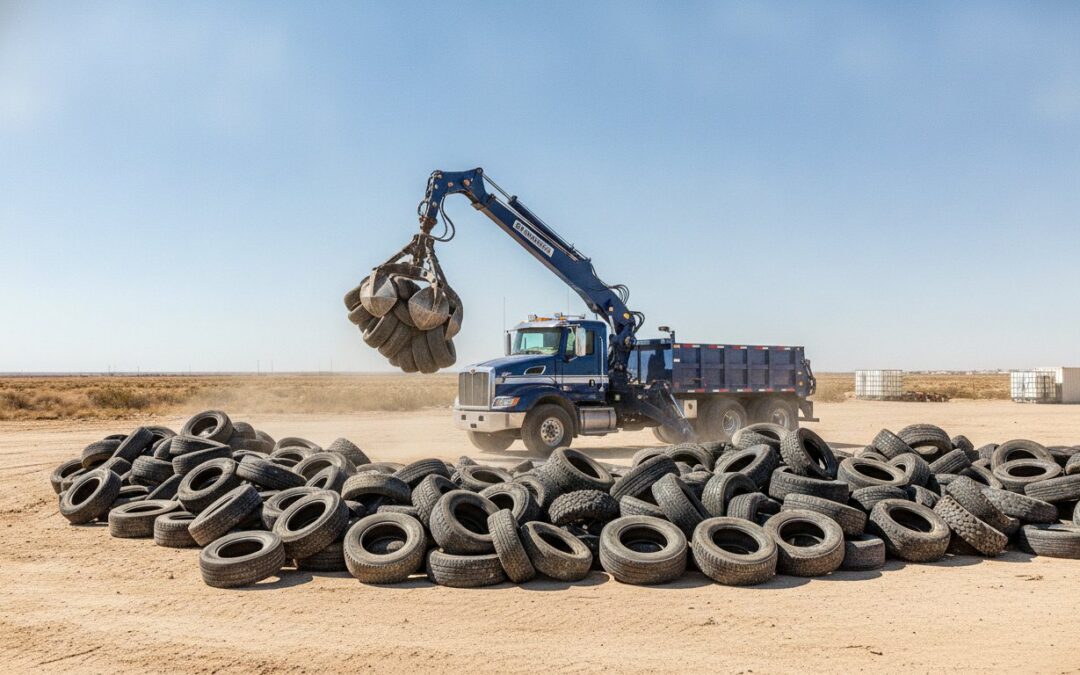
Did you know that a stack of abandoned tires on your property could cost you up to $25,000 per day in civil penalties? In West Texas, discovering a pile of rubber isn’t just an eyesore; it’s a serious financial and legal liability. Many landowners are left wondering what happens to illegally dumped tires once they’re left out in the elements. These tires quickly become breeding grounds for mosquitoes carrying West Nile Virus and pose a severe fire risk that’s notoriously difficult to extinguish. With the TCEQ monitoring over 120 unauthorized sites across the state, the pressure to maintain a clean property has never been higher.
It’s frustrating to be held responsible for waste you didn’t create, especially when local disposal options feel limited. We understand the need for a solution that protects both your wallet and your community’s health. This article explores the environmental dangers of scrap rubber, the latest Texas legislation like HB1463, and the proper steps for legal removal. You’ll find out how to navigate the strict requirements for hauling and how to secure a professional service in Midland or Odessa to clear your land safely.
Key Takeaways
- Identify why the Permian Basin’s remote areas are targets for unauthorized disposal and how to recognize a legal disposal manifest.
- Discover what happens to illegally dumped tires regarding environmental leaching and the severe health risks posed by mosquito-borne diseases.
- Protect yourself from the TCEQ “Strict Liability” trap that makes landowners legally and financially responsible for abandoned rubber.
- Master the remediation process by learning how to properly document and report illegal dump sites to establish a legal record.
- Find out how professional removal services efficiently clear stockpiles ranging from passenger tires to heavy OTR and agricultural models.
The Reality of Illegal Tire Dumping in West Texas
Illegal dumping is defined as any disposal of scrap tires outside of a TCEQ-permitted facility or without a required manifest. In the Permian Basin, the vast, remote stretches of land often hide these sites until they’ve grown into massive liabilities. Landowners often worry about what happens to illegally dumped tires when they’re left in these rural areas. Usually, they sit for years, accumulating dust and water, because standard municipal waste services refuse to handle bulk tire loads. Most local landfills have strict limits or require tires to be shredded first. This isn’t an option for a landowner facing a surprise pile of 500 tires. The scale of the problem is massive; tires don’t compress in a standard truck, which makes them expensive and difficult for traditional trash companies to manage.
Common Types of Illegally Dumped Rubber
In West Texas, the variety of rubber found in illegal sites is unique to our industrial landscape. While residential areas deal with passenger and light truck tires from residential “fly-tipping,” the rural landscape often sees much larger debris. Commercial semi-truck tires are frequently abandoned by unlicensed haulers who take payment for disposal but dump the load to avoid tipping fees. Perhaps most challenging are the massive OTR (Off-the-Road) and agricultural tires left on ranch lands or near oilfield sites. These giants require specialized equipment to move. They can’t simply be tossed into the back of a pickup truck, making them a permanent fixture if not handled by professionals with the right machinery.
Identifying a Dump Site vs. Temporary Storage
There’s a fine line between temporary storage and an illegal dump site under Texas law. The TCEQ sets specific thresholds for how many tires can be kept on-site without a permit. If you exceed these numbers without a manifest or a reliable tire disposal plan, you’re looking at a stockpile violation. A key factor in staying legal is using a permitted hauler. These professionals ensure the Tire recycling process is followed correctly, providing the paperwork you need to prove the waste was handled right. Without this paper trail, a small pile can grow rapidly. This is known as the “broken window” effect. Once a few tires appear, others see the spot as a free-for-all disposal zone. What started as five tires can become five hundred in a matter of weeks.
Environmental and Health Hazards of Abandoned Rubber
Understanding what happens to illegally dumped tires is essential for protecting your property and community. These items are far from harmless debris. As they sit, the complex chemical compounds within the rubber begin to degrade. This process releases heavy metals and oils into the surrounding soil. In the Permian Basin, where soil quality and groundwater protection are vital, this toxic leaching poses a direct threat to the environment. Once these contaminants reach the water table, they are difficult and expensive to remediate. Local wildlife also suffers as these toxins enter the local food chain through contaminated vegetation.
The Threat of Tire Fires in Arid Climates
Biological Risks: Mosquitoes and Vermin
Even in dry climates, the unique shape of a tire allows it to trap and hold water for months. This creates a perfect, shaded incubator for mosquitoes. In Lubbock and across the South Plains, these sites are primary breeding grounds for insects that carry the West Nile Virus. It only takes a small amount of stagnant water to start a colony. Additionally, tire piles provide ideal nesting sites for rodents and other vermin. These pests use the rubber as a fortress, often leading to infestations that spread to adjacent buildings. If you are dealing with an accumulation on your land, choosing professional scrap rubber removal is the most effective way to eliminate these biological threats before they escalate. Prompt action prevents a small dump site from becoming a permanent public health hazard.
The Legal and Financial Consequences for Landowners
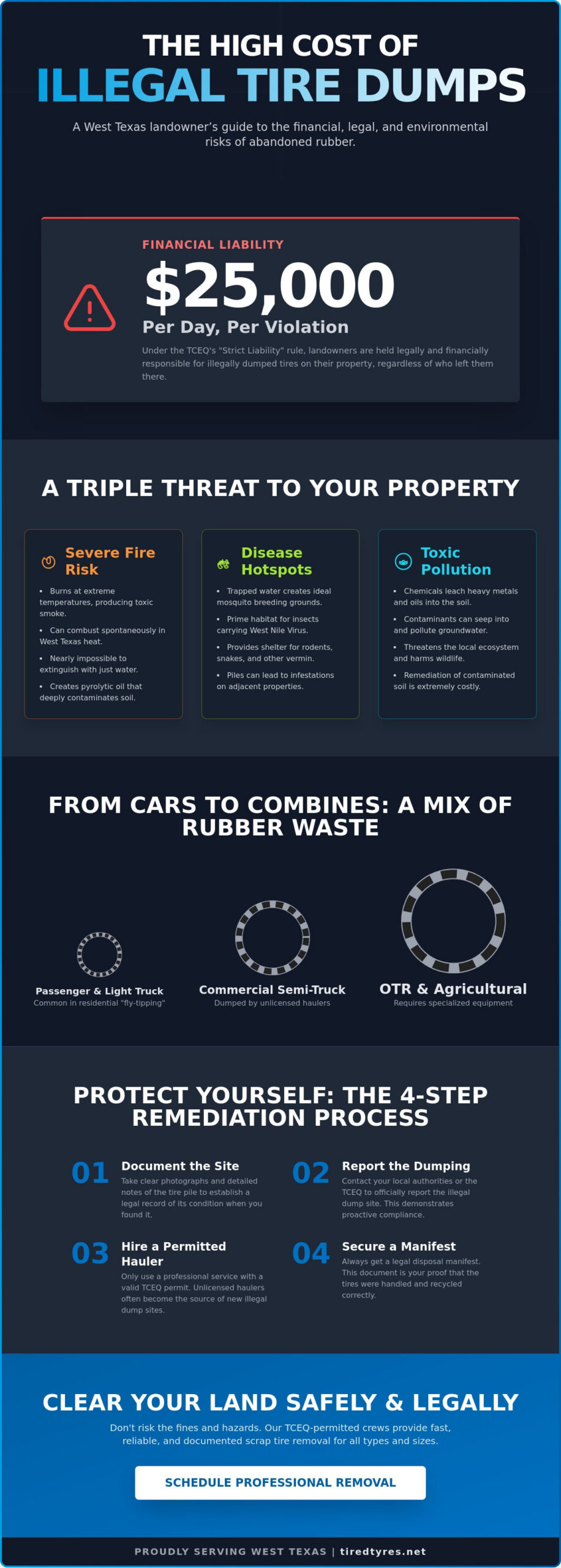
Many property owners are shocked to learn they are legally responsible for waste they didn’t generate. This is known as the “Strict Liability” trap. If a pile of rubber appears on your land and the culprit isn’t caught, the state looks to you for the solution. When investigating what happens to illegally dumped tires, the TCEQ focuses on the environmental threat of the stockpile rather than who put it there. Civil penalties for these violations are severe. The Texas Commission on Environmental Quality is authorized to assess fines of up to $25,000 per day for violations of the Solid Waste Disposal Act. Relying on the hope that authorities won’t find the site is a high-stakes gamble that rarely pays off.
Criminal penalties are equally steep. In Texas, dumping more than five pounds of waste is a misdemeanor. However, if the weight exceeds 200 pounds, which is roughly 10 standard passenger tires, it becomes a state jail felony. Fines for these offenses can exceed $4,000 per occurrence. New legislation, such as HB1463, further empowers county commissioners courts to levy fines of up to $500 per tire on generators who use unregistered transporters. This means businesses can be fined even if they thought their tires were being handled correctly.
Texas Tire Disposal Regulations
Business owners must adhere to Texas tire disposal regulations to avoid these legal traps. A critical part of compliance is the Scrap Tire Manifest system. This document tracks every tire from the point of generation to its final permitted destination. In Lubbock and Midland, local ordinances are becoming increasingly strict. Counties are now authorized to impose disposal fees and conduct more frequent inspections of rural and commercial properties. Establishing a paper trail with a permitted hauler is the only way to prove you’ve met your legal obligations.
Hidden Costs of Doing Nothing
How to Safely Remediate an Illegal Tire Dump Site
Clearing an illegal dump site requires a strategic approach. It isn’t just about moving the rubber; you must follow a process that protects you legally and environmentally. When landowners see what happens to illegally dumped tires that are left to rot, the urgency for a professional solution becomes clear. Follow these steps to clear your liability:
- Step 1: Document the site. Take high-quality photos from multiple angles. Create an estimated count of the tires to provide to haulers and authorities.
- Step 2: Report the dumping. Contact local law enforcement or the county judge’s office to establish a formal record. This helps prove you are the victim of the dump, not the person responsible for creating the stockpile.
- Step 3: Secure the area. Use fencing, gates, or dirt berms to block access. Preventing further dumping is cheaper than cleaning up a second load.
- Step 4: Contact a TCEQ-permitted hauler. Reach out to a professional for an on-site assessment. They have the equipment to handle bulk loads that standard trash services won’t touch.
- Step 5: File disposal manifests. Ensure you receive a signed Scrap Tire Manifest for every load that leaves your property. Keep these records for at least three years to satisfy TCEQ inspectors.
Professional Assessment of the Site
A professional hauler will categorize the waste to determine the best disposal route. They distinguish between standard passenger tires, semi-truck tires, and the massive OTR or agricultural models often found in West Texas oilfields. The condition of the rubber also matters. Surface piles are straightforward, but buried tires require excavation equipment and careful handling to avoid disturbing the soil further. Prioritizing tire recycling ensures that the rubber is repurposed into useful materials rather than simply taking up space in a landfill or posing a future fire risk. This assessment provides a clear picture of what happens to illegally dumped tires once they are removed from your land.
Choosing the Right Removal Partner
Don’t risk your financial safety on an unlicensed “cheap” hauler. If an unregistered transporter dumps your tires elsewhere, the state can trace the waste back to your property, leading to massive fines. Always verify hauler permits and insurance coverage before work begins. A qualified partner should also have the capacity to handle industrial rubber waste. This includes scrap skid steer tracks, conveyor belts, and scrap hoses that often accumulate in commercial dump sites. When you need to clear a stockpile and secure a valid manifest, schedule a professional removal service to ensure the job is done right. This is the only way to guarantee your site is remediated correctly and your legal liability is fully closed.
Professional Scrap Tire Removal with Tired Tyres
Landowners and business owners in the Permian Basin need a partner who understands the specific challenges of West Texas waste management. We offer a specialized approach to reliable tire disposal that prioritizes legal compliance and environmental safety. When you are faced with a stockpile, the question of what happens to illegally dumped tires is replaced by the need for a swift, documented solution. We handle the logistical heavy lifting, ensuring every load is tracked and managed according to state law. Our team provides the required Scrap Tire Manifests, giving you the paper trail necessary to protect your business from TCEQ scrutiny and potential fines.
Our fleet is equipped to handle rubber waste of all scales. While many services only accept small passenger tires, we maintain the capacity for industrial-sized loads. This includes our OTR (Off-the-Road) Tire Collection and Agricultural Tire Collection, which are common in our local oilfield and farming sectors. We also manage specialized rubber waste that others often refuse, such as:
- Passenger and Light Truck Tire Collection
- Semi-Truck Tire Collection
- Scrap skid steer track collection
- Scrap conveyor belt and hose collection
- Scrap solid tire and general scrap rubber collection
Service Areas: Midland, Odessa, and Lubbock
We focus our expertise on the unique landscape of West Texas. Our team understands the environmental challenges of the region, from the arid climate to the specific industrial needs of the Permian Basin. We offer flexible scheduling to accommodate the busy operations of commercial and industrial clients. Whether you need a rapid response for a site remediation or a scheduled bulk cleanup for an existing facility, we provide a professional and direct service. We don’t waste your time with fluff; we focus on getting the rubber off your land and into a legal disposal stream as efficiently as possible.
Get a Quote for Your Remediation Project
Every remediation project is different, and we provide transparent pricing based on your specific volume and the type of rubber waste involved. We believe in direct communication and honest assessments. You can rely on our experience to determine the most effective way to clear your site and resolve your liability. Don’t let an illegal dump site grow into a permanent financial burden. Contact Tired Tyres for a professional tire pickup quote today and let our experts take the weight of abandoned rubber off your shoulders.
Secure Your Property and Eliminate Environmental Risks
Understanding what happens to illegally dumped tires is the first step toward protecting your land from becoming a costly liability trap. These stockpiles invite disease-carrying mosquitoes, pose severe fire hazards, and can trigger TCEQ fines of up to $25,000 per day. In the Permian Basin, a small pile can quickly attract more waste, turning a minor issue into a massive legal and financial headache for the landowner.
We provide a direct solution to these risks. Our team offers TCEQ-compliant hauling throughout Midland, Odessa, and Lubbock. We specialize in the heavy-duty removal of OTR and industrial rubber, providing the manifests you need to stay fully compliant and protected. Secure your property and get a legal tire disposal quote from Tired Tyres today. Taking professional action now ensures your property remains safe, clean, and free from the dangers of abandoned waste. You can trust us to handle the heavy lifting so you can focus on your business with total peace of mind.
Frequently Asked Questions
Is it illegal to have a few old tires on my property in Texas?
Yes, it can be illegal depending on the quantity and how they are stored. Texas law has strict limits on scrap tire storage to prevent health hazards. If you have more than 500 tires on your land without a TCEQ permit, you are operating an illegal stockpile. Even a few tires can lead to citations if they aren’t managed to prevent mosquito breeding or fire risks.
What should I do if I find tires dumped on my land in Midland?
You should immediately document the site with photos and report the incident to local authorities. Contact the Midland County Sheriff’s Office or the TCEQ to establish a formal record of the dumping. Reporting the crime helps prove that you aren’t the responsible party. After reporting, secure the area with gates or fencing to prevent more tires from being added to the pile.
Can abandoned tires really catch fire on their own?
Yes, spontaneous combustion is a documented risk in large tire stockpiles. The internal structure of a tire pile can trap heat, eventually reaching an ignition point during intense West Texas summers. These fires are notoriously difficult to extinguish and produce toxic pyrolytic oil. This liquid byproduct can seep deep into the ground, causing long-term soil and groundwater contamination that is very expensive to remediate.
Why don’t landfills in West Texas accept tires from businesses?
Most landfills lack the specialized equipment required to process and shred bulk tires for stable disposal. Whole tires are bulky and trap air, which often causes them to “float” back to the surface over time. This process destabilizes the landfill’s protective cap. The City of Midland landfill, for example, does not accept whole tires, forcing businesses to find a permitted hauler for legal disposal.
How do tires contribute to the spread of West Nile Virus?
The hollow rim of a tire acts as a perfect incubator for mosquitoes by trapping and shading stagnant water. Even in our arid climate, a small amount of moisture can remain in a tire for months. This creates an ideal breeding ground for insects that carry the West Nile Virus. In Lubbock and the South Plains, abandoned tire piles are major contributors to local mosquito-borne disease outbreaks.
What is a scrap tire manifest and why do I need one?
A scrap tire manifest is a state-required tracking form that documents the movement of tires from your property to a permitted facility. It’s your primary defense against legal liability. This document proves that you used a registered hauler and that the tires reached a legal destination. You must keep these records for at least three years to satisfy any potential TCEQ inspections or audits.
How much does it cost to have a professional service remove dumped tires?
Removal costs depend on the volume of waste, the location of the site, and the size of the tires. Handling massive OTR or agricultural tires requires different equipment than standard passenger tires. While we don’t provide fixed prices here, professional removal is consistently more affordable than paying state-mandated cleanup costs or daily civil fines. Choosing a permitted service ensures the job is done right the first time.
Can illegally dumped tires be recycled?
Yes, recycling is the preferred method for managing scrap rubber once it is safely removed. Many tires can be shredded and repurposed for rubberized asphalt, playground mulch, or tire-derived fuel. This recycling process ensures that what happens to illegally dumped tires doesn’t end with them sitting in a landfill. Professional haulers prioritize these sustainable outlets to reduce the environmental footprint of the waste.