
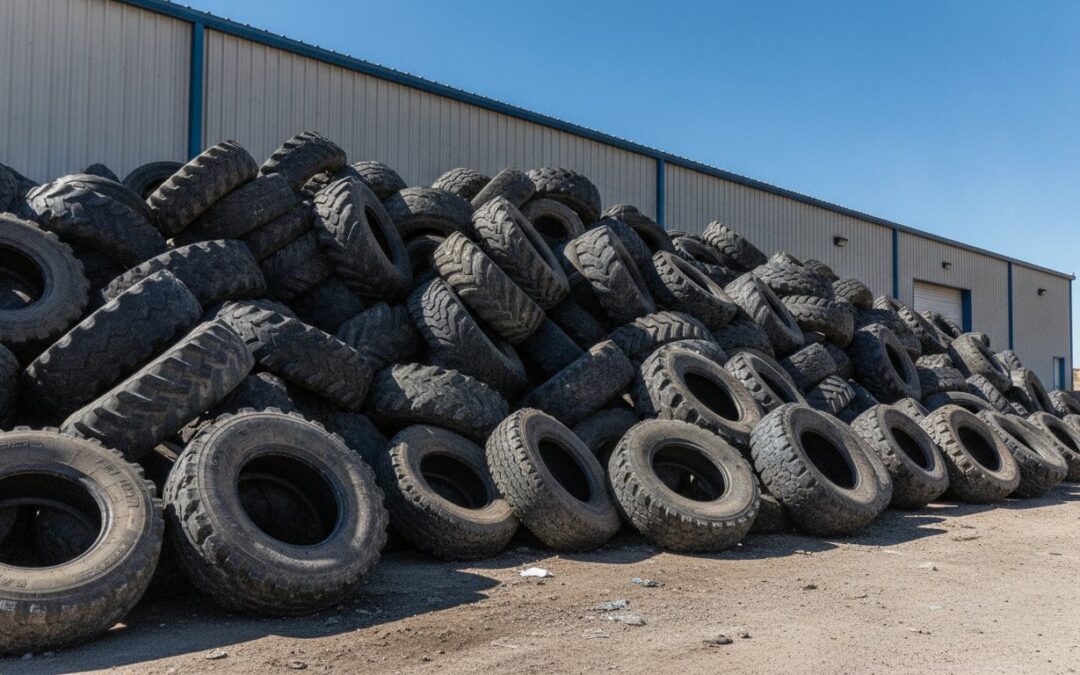
That stack of scrap rubber on your property isn’t just taking up space; it’s a potential $25,000-a-day liability. Many West Texas business owners consider hauling their own waste to save money, but the DIY commercial tire disposal risks often outweigh any perceived savings. It’s natural to want to manage your overhead by handling things in-house. However, the Texas Commission on Environmental Quality (TCEQ) maintains strict standards that turn a simple weekend chore into a legal minefield.
You’ve likely felt the pressure of rising waste management costs and the frustration of watching bulk rubber clutter your workspace. We understand that you need a practical, cost-effective way to clear your property without attracting heavy fines. In this article, you’ll discover the hidden legal and financial dangers of self-hauling and why professional collection is the only safe path for your business. We’ll break down the TCEQ “cradle to grave” manifest system and show you how to avoid the millions in penalties issued to Texas companies every year. Clearing your property doesn’t have to be a gamble when you understand the regulations and the professional solutions available to you.
Key Takeaways
- Understand the physical dangers of handling heavy industrial rubber and why specialized equipment is required for OTR tires.
- Stay compliant with Texas laws by learning when the TCEQ requires a registered transporter for scrap tire hauling.
- Evaluate the financial impact of DIY commercial tire disposal risks, including potential civil penalties of up to $25,000 per day.
- Find out why municipal landfills often reject commercial loads and how professional collection bypasses these logistics hurdles.
- Protect your company from long-term liability through the “cradle to grave” manifest system used by professional services.
The Physical Dangers of Handling Heavy Commercial Tires
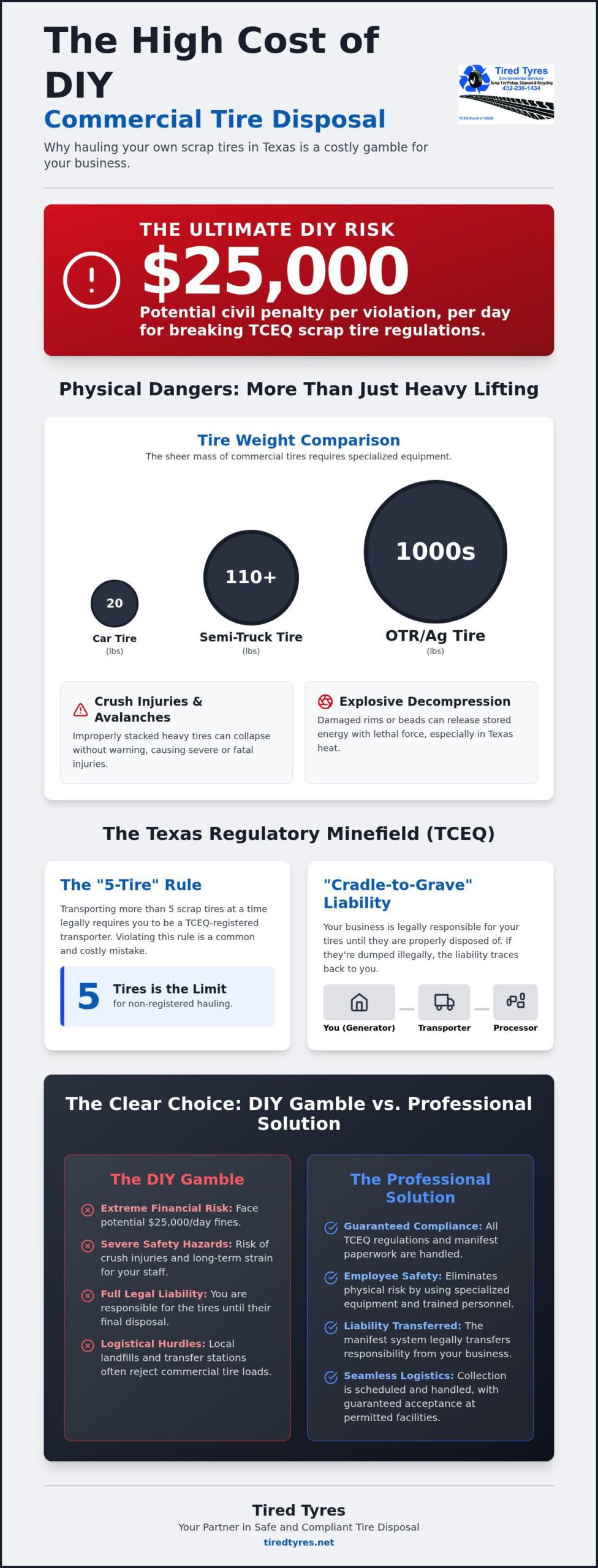
Commercial tires exist in a different category of risk compared to standard passenger vehicle tires. While a typical car tire weighs about 20 pounds, a single semi-truck tire can easily exceed 110 pounds. When you move into Agricultural or OTR (Off-the-Road) models, weights often reach several hundred or even thousands of pounds. Attempting to manage these items without industrial-grade equipment is one of the primary DIY commercial tire disposal risks that business owners overlook. The sheer mass involved means that a simple slip or a failed strap can result in life-altering crush injuries.
Properly understanding the tire recycling process is essential, but that journey begins with safe physical handling at your facility. When scrap tires are stacked haphazardly, they create a condition known as a “tire avalanche.” Because of their round shape and massive weight, even a small shift in the pile can cause hundreds of pounds of rubber to collapse instantly. These incidents often lead to severe fractures or fatalities, especially in confined storage spaces where workers have no room to retreat.
Weight and Ergonomic Risks for Employees
Stored Energy and Structural Instability
Scrap tires aren’t always inert objects. Damaged tire beads or compromised multi-piece rims, historically known as “widowmakers,” can harbor massive amounts of tension. If a rim is damaged or a bead is under stress, simply moving the tire can trigger an explosive decompression. This sudden release of energy can hurl heavy metal components or rubber shards with enough force to be lethal. In the intense West Texas heat, thermal expansion further complicates these DIY commercial tire disposal risks by increasing internal pressure and destabilizing the structural integrity of the rubber. Stored energy in commercial tires refers to the potential for a sudden, violent release of pressurized air or mechanical tension from damaged internal components that can cause catastrophic injury during handling.
Texas Regulatory Risks: TCEQ and the Permitted Hauler Rule
Texas maintains some of the most stringent scrap tire management laws in the country. The state’s primary goal is to prevent illegal dumping, which often starts with well-meaning business owners trying to handle waste internally. One of the most significant DIY commercial tire disposal risks involves the TCEQ permitted hauler rule. Under this regulation, any business transporting more than five tires at a time must be a registered transporter. If you load up a flatbed with ten semi-truck tires and head to a facility without the proper credentials, you’re in violation of state law before you even leave your property.
The state operates on a “cradle-to-grave” liability model. This means your business remains legally responsible for every tire you generate until it reaches a permitted processing or disposal site. If you hire an unpermitted “man with a van” and those tires end up in a West Texas ravine, the TCEQ will trace them back to you. You’ll be the one facing the enforcement action, not just the person who dumped them. It’s a high-stakes environment where cutting corners on logistics can lead to permanent legal marks on your business record.
Understanding the Scrap Tire Manifest System
A scrap tire manifest is a multi-part tracking document that serves as your only legal shield. It records the number of tires, the generator’s information, the transporter’s ID, and the final destination’s signature. For Midland and Odessa business owners, keeping these records for at least three years is a mandatory requirement. At Tired Tyres, we ensure all Texas tire disposal regulations are met by providing comprehensive documentation for every pickup. This paper trail proves you’ve followed the law if an inspector ever knocks on your door.
Fines and Legal Consequences in Lubbock and the Permian Basin
The financial fallout for ignoring these rules is substantial. The TCEQ can assess civil penalties of up to $25,000 per day, per violation. In 2025 alone, the agency issued over $2.4 million in penalties for improper scrap tire management. Authorities in Lubbock County and across the Permian Basin are increasingly aggressive in tracking tire flow to prevent environmental hazards. Using a “cheap” unpermitted hauler is a gamble that rarely pays off when compared to the risk of a five-figure fine. Choosing professional scrap tire collection is the most reliable way to protect your bottom line from these regulatory pitfalls.
Environmental Liabilities: Fire Hazards and Pest Infestations
Storing scrap tires on your commercial property creates a set of environmental liabilities that go far beyond simple clutter. Unlike other forms of industrial waste, stacked rubber presents unique challenges that can lead to catastrophic property damage and public health crises. One of the most severe DIY commercial tire disposal risks involves the potential for uncontrollable fires. These incidents are notoriously difficult for local fire departments to manage because the hollow structure of a tire provides a constant supply of oxygen to the core of the blaze. Once a large pile ignites, it can burn for weeks, even when buried or doused with water.
The environmental impact isn’t limited to the air. When tires burn, they undergo a process called “internal combustion” that generates pyrolytic oil. This toxic, free-flowing liquid contains heavy metals and hydrocarbons that penetrate the ground almost immediately. In the Permian Basin, where soil permeability and groundwater protection are critical concerns, a single tire fire can lead to decades of environmental remediation costs. These expenses often fall directly on the property owner, potentially bankrupting a small or mid-sized business.
The Permian Basin Heat and Tire Fire Risks
The intense sun in Midland and Odessa makes large tire stockpiles a ticking time bomb. High ambient temperatures accelerate the off-gassing of volatile compounds within the rubber, lowering the ignition point of the entire stack. If a fire breaks out, the cost of the emergency response and subsequent soil cleaning can reach hundreds of thousands of dollars. Tire fires produce a thick, oily residue known as pyrolytic oil that leaches heavy metals and hydrocarbons directly into the soil and underlying aquifers.
Public Health Risks: Mosquitoes and West Nile Virus
Tires are perfect incubators for pests because their shape is designed to trap and hold stagnant water. Unlike a flat surface, the interior of a tire remains dark and insulated, providing an ideal breeding ground for disease-carrying mosquitoes. This creates a significant liability for West Texas business owners. If a tire pile on your property is identified as the source of a local West Nile Virus outbreak, you could face personal injury lawsuits and public health citations. Understanding how waste tire problems affect the community helps you see why prompt, professional removal is a necessity rather than an option. Choosing a reliable collection service eliminates these DIY commercial tire disposal risks before they turn into a community-wide health hazard.
The Logistics Gap: Why Local Landfills May Reject Your DIY Load
Driving a trailer full of scrap rubber to the local dump seems like a straightforward solution. However, the logistics gap between commercial waste and municipal capacity is vast. One of the most frustrating DIY commercial tire disposal risks is the high probability of being rejected at the gate after hours of transit. Most West Texas landfills operate under strict permits that limit the volume and type of rubber they can accept. Whole tires are particularly problematic for landfill managers. Because they’re hollow and resilient, they trap methane gas and “float” to the surface of waste cells over time. This upward movement can puncture expensive landfill liners, leading to environmental leaks. To prevent this, many facilities require tires to be shredded or quartered before they’re even considered for disposal.
OTR and large agricultural tires present an even bigger challenge. These massive items are often too large for standard landfill compactors to handle. If you show up with a single OTR tire that hasn’t been pre-processed, you’ll likely be turned away. This leaves you with a heavy, unmanageable load and nowhere to put it. The machinery required to shred industrial-scale rubber is expensive and rarely found at municipal sites, making DIY commercial tire disposal risks a significant hurdle for businesses that don’t have a professional partner.
Landfill Restrictions in Midland and Odessa
The City of Midland landfill and similar facilities in Odessa have specific thresholds for commercial tire volume. If you arrive with a load that exceeds their daily limit for non-permitted haulers, you’ll be turned away immediately. This rejection often happens after your crew has already spent the morning loading and driving. Many sites also require tires to be split or quartered before they’ll accept them. If your team isn’t equipped with specialized industrial cutters, you’ll find yourself stuck with a load that’s legally and physically impossible to dump at a standard municipal site.
The True Cost of ‘Free’ or DIY Disposal
When you calculate the actual expense of self-hauling, the “free” option starts to look very expensive. You have to account for the lost man-hours of your crew. Every hour they spend sitting in line at a landfill is an hour they aren’t completing billable work or maintaining your fleet. There’s also the physical toll on your company vehicles. Standard light-duty trucks aren’t designed to haul thousands of pounds of scrap rubber across uneven landfill terrain. Over time, this leads to increased maintenance costs and suspension damage. Choosing reliable tire disposal is a strategic move that protects your equipment and keeps your team focused on their primary roles. It’s often more cost-effective to outsource the headache to experts who have the right permits and machinery. If you’re ready to clear your property without the logistical nightmare, you can schedule a professional tire pickup today.
The Professional Alternative: Tired Tyres Commercial Collection
The DIY commercial tire disposal risks we’ve discussed, from physical injury to $25,000-a-day fines, make professional collection the only logical choice for West Texas businesses. Tired Tyres provides a turn-key solution that eliminates these hazards entirely. We handle the logistical heavy lifting, ensuring your facility remains clear, safe, and fully compliant with state regulations. Our team arrives with the specialized equipment necessary to manage industrial-scale rubber, so your crew can stay focused on their actual jobs. You don’t have to worry about your staff risking a “tire avalanche” or struggling with OTR models that weigh hundreds of pounds.
We understand that commercial waste isn’t just about tires. Many industrial sites accumulate various types of rubber that standard waste services won’t touch. By choosing a professional partner, you gain a single point of contact for all your rubber disposal needs. We provide the mandatory manifest documentation that serves as your legal shield against “cradle-to-grave” liability charges. This gives you the peace of mind that your waste has reached a permitted facility and won’t result in an unexpected knock on the door from a TCEQ inspector.
Comprehensive Industrial Rubber Removal
Our service goes beyond standard commercial tire disposal. We specialize in the collection of heavy-duty Agricultural and OTR models that municipal landfills frequently reject. Unlike local dumps, we have the capacity to process scrap solid tires and massive industrial hoses. We also clear your property of other industrial waste, including:
- Scrap skid steer tracks
- Scrap conveyor belts
- Scrap hose collection
- Scrap rubber collection
We offer scheduled pickups tailored to your business volume. This proactive approach prevents the buildup of waste rubber, reducing the environmental and fire risks associated with long-term storage in the West Texas heat. Keeping your yard clear of debris also eliminates potential breeding grounds for mosquitoes, protecting both your employees and the surrounding community.
Service Areas and Getting a Quote
Tired Tyres serves the entire Permian Basin and the South Plains. Whether your business is located in Midland, Odessa, or Lubbock, we provide fast and reliable collection services. Once we collect your scrap rubber, it’s transported to our facility where we prioritize responsible processing. We ensure that every tire and belt is handled in an environmentally conscious way, keeping West Texas clean. Avoiding DIY commercial tire disposal risks is as simple as making a phone call. We’ll provide a clear, professional quote based on your specific inventory and location. Contact Tired Tyres today to schedule your pickup and secure your business’s compliance.
Protect Your Bottom Line with Professional Tire Management
Managing industrial waste shouldn’t be a source of stress or legal liability for your company. You’ve seen how the DIY commercial tire disposal risks can quickly spiral from physical safety hazards to five-figure TCEQ penalties. Between the complex manifest requirements and the high rejection rates at local landfills, self-hauling is a gamble that West Texas businesses don’t need to take. It’s much safer to let a professional handle the heavy lifting and the paperwork.
Tired Tyres provides a direct path to compliance and property safety. We’re a TCEQ Permitted Hauler specialized in OTR and heavy industrial rubber collection. Serving the Midland, Odessa, and Lubbock areas, we bring the right equipment and the necessary expertise to your job site. We’ll ensure your scrap rubber is handled correctly, keeping you focused on your core operations while we manage the logistics. This strategy of delegating specialized tasks is common in many fields; for example, healthcare providers often utilize Tausch Medical to manage complex billing and financial operations.
Don’t let scrap rubber accumulate and threaten your business’s reputation or financial health. We’re here to help you clear your property quickly and correctly. Get a Professional Tire Collection Quote for Your Business and start your path toward a safer, cleaner property today.
Frequently Asked Questions
Is it illegal to haul my own business tires to a recycler in Texas?
It is illegal to transport more than five scrap tires at once in Texas without being a TCEQ-registered transporter. State law requires businesses to use permitted haulers for anything beyond this small limit to prevent unauthorized dumping. If you’re caught hauling a trailer full of semi-truck or agricultural tires without the proper registration, you face immediate legal action and heavy fines.
What is a scrap tire manifest and why does my business need one?
A scrap tire manifest is a state-mandated document that tracks the “cradle-to-grave” journey of waste rubber. It provides a paper trail showing that your tires were picked up by a registered hauler and delivered to an authorized facility. This document is your only legal protection if an inspector audits your Midland or Odessa business to ensure you aren’t dumping waste illegally.
Can I put commercial truck tires in a standard construction dumpster?
No, you cannot put commercial tires in standard construction or municipal dumpsters. Most waste management companies classify tires as “special waste” that requires separate handling. Mixing tires with general debris can lead to your entire load being rejected at the landfill, and the dumpster provider will likely charge you a significant penalty for the violation.
Why do landfills refuse to take whole OTR or agricultural tires?
Whole tires are resilient and trap methane gas, which causes them to “float” to the surface of a landfill over time. This movement can puncture the protective liners designed to keep toxins out of the groundwater. Because OTR and agricultural tires are so large and heavy, they are impossible for standard landfill compactors to manage, making them a major logistical risk for municipal sites.
How much are the fines for illegal tire dumping in Midland or Odessa?
The TCEQ can assess civil penalties of up to $25,000 per day for each violation of the solid waste disposal act. These financial penalties are among the most severe DIY commercial tire disposal risks that West Texas businesses face. In 2025 alone, the agency issued millions of dollars in fines to entities that failed to follow proper scrap tire management protocols.
What happens to the tires after Tired Tyres picks them up?
Once we collect your scrap rubber, we transport it to a permitted processing facility for recycling or authorized disposal. We manage the entire chain of custody and provide the necessary documentation to prove your business followed the law. Our process ensures that your waste rubber doesn’t end up as an environmental hazard or a liability for your company.
Does Tired Tyres collect other rubber items like conveyor belts or skid steer tracks?
Yes, we collect a wide range of industrial rubber waste, including scrap skid steer tracks, conveyor belts, and industrial hoses. These items often face the same disposal hurdles as commercial tires and are rarely accepted by standard trash services. We provide a single, compliant solution for clearing all types of heavy-duty rubber from your shop or job site.
How can I tell if a tire hauler is actually permitted by the TCEQ?
You should always ask a hauler for their TCEQ transporter registration number before they touch your waste. A legitimate hauler will also provide a multi-part manifest form for you to sign and keep for your records. You can also verify a hauler’s status by checking the TCEQ central registry database to ensure they are authorized to operate in Texas.