
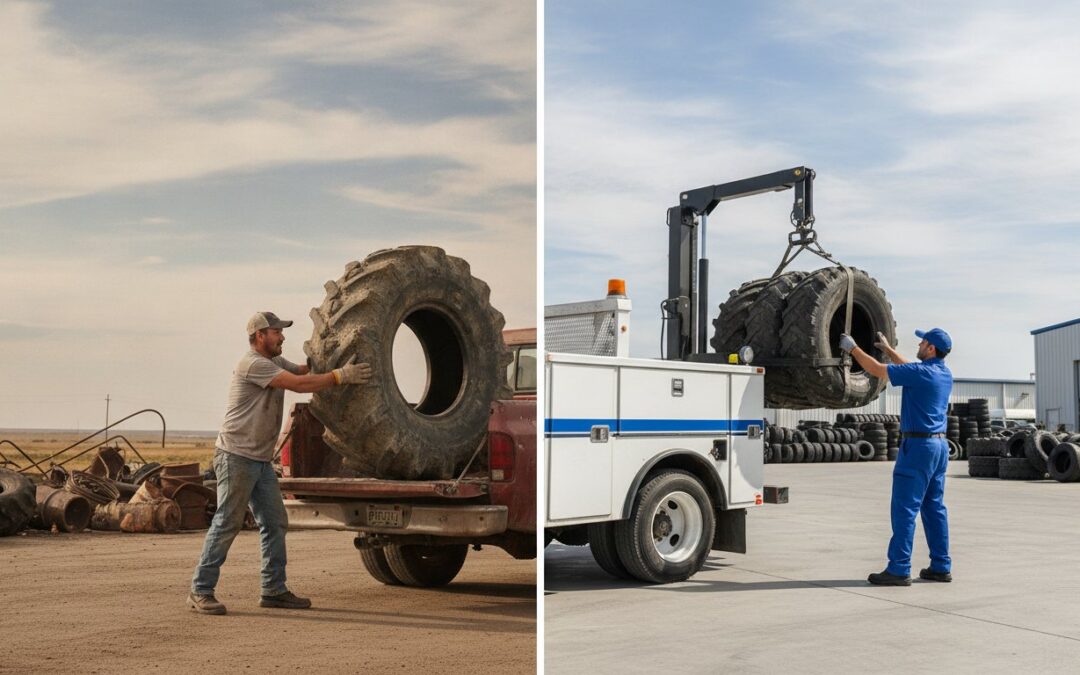
Most West Texas business owners assume hauling scrap tires to the local landfill is the cheapest way to clear space, but the math often tells a different story. When you calculate the labor, transport, and strict processing requirements, the choice between professional rubber disposal vs landfill drop-off becomes much clearer. It’s not just about the dump fee. It’s about the hours your crew spends loading heavy agricultural tires and the risk of arriving at a gate that won’t accept whole tires.
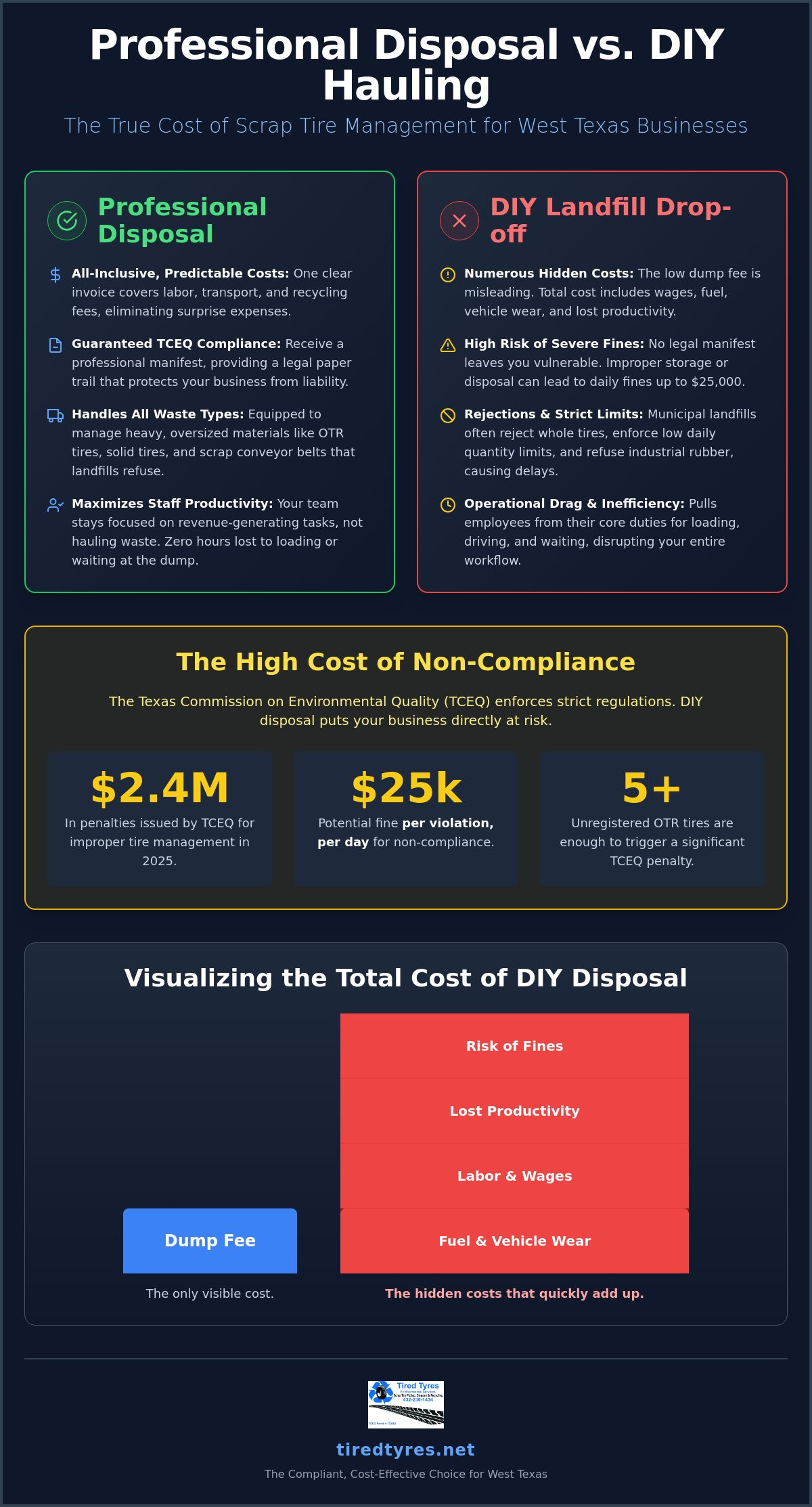
You’ve likely felt the pressure of keeping your yard clean while fearing the $2.4 million in penalties the TCEQ issued for improper management in 2025. Storing just five unregistered off-the-road tires can trigger fines of up to $25,000 per day, making compliance a top priority for your operations. We’ll help you discover the most cost-effective and compliant way to handle scrap tires and industrial rubber in Midland, Odessa, and Lubbock. This 2026 comparison breaks down the total cost of disposal, explains current Texas environmental laws, and shows you how to minimize disruptions to your daily business.
Key Takeaways
- Compare the true costs of DIY hauling, including labor and vehicle wear, against the efficiency of a managed pickup service.
- Learn why municipal landfills in West Texas often reject whole tires and how to navigate strict daily quantity limits at the gate.
- Protect your business from TCEQ fines by securing a professional manifest that proves legal compliance and proper chain of custody.
- Evaluate the benefits of professional rubber disposal vs landfill drop-off to determine which method actually saves your operation more time and money.
- Discover how specialized collection services handle heavy materials like OTR tires, solid tires, and scrap conveyor belts that municipal sites often refuse.
The Scrap Rubber Dilemma: Landfill vs. Professional Disposal
Managing scrap tires in West Texas often feels like a choice between two very different paths. On one hand, you have the DIY route of landfill drop-off. This involves loading your own trucks, paying employees to sit in line at municipal sites, and hoping you don’t exceed daily limits. On the other hand, professional rubber disposal offers a managed, end-to-end collection service where experts handle the loading, hauling, and legal documentation for you.
For businesses in Midland, Odessa, and Lubbock, this decision has become more critical in 2026. Rising labor costs and stricter enforcement by the Texas Commission on Environmental Quality (TCEQ) mean that a simple trip to the dump isn’t always simple. Understanding the difference between professional rubber disposal vs landfill drop-off starts with recognizing that rubber isn’t standard trash. It’s a regulated material that requires a specific chain of custody to protect your business from liability.
Why Rubber Waste Requires Specialized Handling
Storing rubber in the Permian Basin heat presents real risks. Scrap piles quickly become breeding grounds for mosquitoes and rodents. Even worse, the intense West Texas sun increases the risk of tire fires, which are notoriously difficult to extinguish. This is especially true for bulkier items like OTR (Off-the-Road) and agricultural tires. These massive components don’t just take up space; they require specialized equipment to move safely. By understanding the Tire recycling process, it becomes clear that these materials should be processed rather than left to bake in a yard. Proper handling ensures these materials are repurposed instead of becoming a permanent environmental hazard on your property.
The Limitations of Municipal Waste Systems
Local municipal systems are designed for residential convenience, not industrial volume. Standard curbside trash services won’t touch a passenger tire, let alone a semi-truck tire or a scrap conveyor belt. Most landfills in the region have strict policies. They often limit drop-offs to a handful of tires per day or require you to quarter or shred them before arrival. This creates a massive gap for commercial operations that need to move hundreds of tires at once. Relying on municipal sites often leads to a bottleneck where waste piles up faster than the city allows you to haul it away. Navigating these challenges requires a clear look at how professional rubber disposal vs landfill drop-off impacts your bottom line and your legal standing in the state of Texas.
Professional Collection vs. DIY Hauling: A Cost-Benefit Analysis
Choosing between professional rubber disposal vs landfill drop-off involves more than comparing a single invoice to a dump fee. Many West Texas businesses overlook the operational drag of self-hauling. While a landfill fee might look smaller on paper, the “hidden costs” of DIY can quickly erode your weekly profits. Fuel expenses are just the beginning. Hauling heavy, grit-covered scrap tires or solid tires causes significant wear and tear on trailers and truck suspensions. When you factor in the hourly wages of employees who are loading, driving, and waiting in line, the DIY method often becomes the more expensive route.
Efficiency is where the gap between these two choices widens. A professional pickup service handles everything in one visit. Your team stays focused on their actual jobs while specialized equipment manages the heavy lifting. For auto shops and industrial sites in the Permian Basin, scheduled pickups provide a predictable workflow. You don’t have to worry about scrap piles reaching dangerous levels or pulling staff away from revenue-generating work to make multiple trips to a municipal site.
The “Total Cost of Disposal” Framework
To find your true cost, you have to look at the entire process. Start by calculating the labor hours spent on scrap management. If two crew members spend three hours loading and hauling OTR or semi tires, that is six hours of lost productivity. There is also the physical risk. Manually lifting oversized tires or heavy scrap conveyor belts is a frequent cause of workplace back injuries. A single worker’s compensation claim far outweighs any perceived savings from avoiding a professional collection fee. Using a reliable scrap tire collection service removes these risks from your business entirely.
When Landfill Drop-Off Makes Sense
Landfill drop-off is a viable option for small, one-time tasks. If you are a resident with a single set of four passenger tires, the local landfill is usually the most practical choice. However, businesses reach a point of diminishing returns very quickly. Once you have more than a dozen tires or any heavy industrial rubber, the logistics of self-hauling become a burden. If you decide to handle a small load yourself, be sure to check the specific site rules. You can find detailed information on regional requirements in our guide on tire disposal in Midland, TX. Understanding where the DIY path ends and professional service begins is the key to maintaining a lean, compliant operation.
Navigating Landfill Rules in Midland, Odessa, and Lubbock
Arriving at a municipal landfill with a trailer full of scrap rubber can be a frustrating experience if you aren’t prepared for the local restrictions. In West Texas, municipal sites are primarily designed for household waste. This means that even if they accept tires, the rules are rigid. Most facilities in Midland and Odessa require all tires to be off-rim before they will even consider accepting them. Additionally, residential drop-off points often enforce strict quantity limits, typically allowing only 4 to 8 tires per day. If you show up with a commercial load without prior authorization, you’re likely to be turned away at the gate.
The choice between professional rubber disposal vs landfill drop-off often comes down to these gate policies. For example, the Midland city landfill refuses whole tires entirely. To dispose of them there, you must ensure they are already split, shredded, or quartered. While Midland County occasionally offers free drop-off events, these are limited to 12 tires per visit. In Odessa, the city doesn’t even publish a public fee schedule for tire disposal; instead, they officially recommend that businesses use professional disposal companies to handle their scrap rubber needs. These local hurdles make the DIY approach difficult for anyone managing more than a single set of passenger tires.
Local Landfill Restrictions for Commercial Entities
Commercial operations face even tighter scrutiny than residents. In Lubbock, landfill fees are calculated by weight. As of October 1, 2025, the Caliche Canyon Landfill charges $33.94 per ton, while the West Texas Region Disposal Facility charges $40.94 per ton. However, paying the fee doesn’t guarantee acceptance. Businesses must often provide specific paperwork or commercial manifests to prove where the waste originated. There is a constant risk that local rules will change without notice. Spending an hour driving a heavy load to Lubbock only to find the facility has reached its daily tire quota is a common and costly setback for many local contractors.
The Industrial Rubber Gap
Standard landfills have a significant “industrial gap” when it comes to non-tire rubber. Most municipal sites will flatly reject items like scrap conveyor belts, scrap hose collections, or scrap skid steer tracks. These materials are difficult for standard landfill equipment to process and take up too much vertical space in the cells. OTR and solid tires face similar rejections due to their sheer size and density. Because these items can’t be easily shredded by city equipment, professional services are often the only legal route for disposal. Handling these heavy industrial materials requires specialized loaders and transport trailers that the average business doesn’t have on hand. Failing to use a managed service for these items often leads to illegal stockpiling, which carries heavy financial risks under Texas law.
Compliance and the Paper Trail: Why Businesses Can’t Risk DIY
The Texas Commission on Environmental Quality (TCEQ) maintains strict oversight of scrap rubber because of its potential environmental impact. In 2025, the agency issued over $2.4 million in penalties for improper scrap tire management. This high level of enforcement is why the choice between professional rubber disposal vs landfill drop-off is a matter of legal protection for your business. When you handle disposal yourself, the burden of proving compliance falls entirely on your shoulders. Professional collectors ensure that every tire is tracked from the moment it leaves your property until it reaches a permitted processing facility.
Using an unpermitted hauler to save a few dollars is a dangerous gamble. If that hauler dumps your tires illegally, the TCEQ can trace them back to your business. Without a valid manifest, you’re legally responsible for the cleanup and the resulting fines. Professional disposal provides the “closed-loop” documentation required to prove that your scrap was handled according to state standards. It’s the only way to ensure your business isn’t tied to an environmental violation.
Understanding the Texas Scrap Tire Manifest
Texas utilizes a 5-part manifest system designed to track tires from cradle to grave. This document records the generator, the hauler, and the final disposal site. As a business owner, you’re required to keep these records on file for at least three years. This isn’t just busywork; it is your primary defense during a TCEQ audit. If you can’t produce a manifest for the tires you’ve generated, you’re at risk of significant fines. You can find more details on these requirements in our Texas tire disposal regulations guide. Ensuring you have the right paperwork is the most critical step in your waste management plan.
Avoiding Illegal Dumping Fines
Under Texas law, illegal dumping is a serious offense. Dumping more than 200 pounds of waste, which is roughly 10 standard passenger tires, is a state jail felony. Fines for these occurrences often exceed $4,000. For industrial sites, the stakes are even higher. Storing as few as five unregistered off-the-road (OTR) tires can trigger fines of up to $25,000 per day. Landfill drop-off often fails to provide the commercial-grade audit trail needed to satisfy these specific regulatory demands. To protect your company’s reputation and bank account, you need a partner who understands the law. Schedule a compliant scrap rubber removal to ensure your operations stay within state guidelines.
Streamlining Your Waste Management with Tired Tyres
Tired Tyres provides a direct solution to the logistical hurdles of scrap management. We take the complexity out of the process by offering on-site collection across Midland, Odessa, and Lubbock. Instead of losing staff hours to landfill queues, your team can stay focused on their core tasks. We handle the entire lifecycle of your waste, ensuring every load is documented and processed according to state law. The debate between professional rubber disposal vs landfill drop-off ends when you realize that your time is better spent growing your business than hauling old tires. For readers who may also be managing broader property or site clearing projects, you can learn more about Clear This Ltd House Clearance Services for expert rubbish removal support.
Comprehensive Collection for Every Industry
We offer specialized services for commercial tire disposal that cover every material your operation generates. Our team handles everything from standard passenger tires to massive agricultural and OTR tire collections. We also collect scrap hoses, skid steer tracks, and scrap solid tire collections that municipal sites typically refuse. If your site has a scrap conveyor belt collection or semi-truck tires taking up space, we have the capacity to clear it. Scheduling a bulk pickup is straightforward. You tell us the volume and location, and we coordinate a time that causes minimal disruption to your daily operations.
The Tired Tyres Advantage in West Texas
Operating in the Permian Basin requires a partner who understands the local landscape and the specific pressure of TCEQ enforcement. We provide reliable scheduling that fits your operational rhythm, whether you need a one-time cleanup or a recurring service. You get more than just a hauling service; you get the peace of mind that comes with a professional paper trail. Every collection includes the necessary manifests to protect your business from potential fines. When you weigh professional rubber disposal vs landfill drop-off, the value of a compliant, hassle-free partner is clear. Contact Tired Tyres for a customized scrap rubber pickup quote and let us handle the heavy lifting for you.
Secure Your Operations with Compliant Rubber Disposal
Choosing between professional rubber disposal vs landfill drop-off is ultimately a decision about where your time and resources are best spent. The DIY route often leads to hidden labor costs, vehicle wear, and the constant risk of being turned away at municipal gates due to strict daily limits. In 2026, the stakes for compliance are higher than ever. TCEQ enforcement is actively targeting businesses that lack proper documentation and manifests. Protecting your company from five-figure fines requires a system that ensures every scrap tire and industrial belt is handled legally and efficiently.
Tired Tyres removes the burden of waste management from your shoulders. As a TCEQ permitted hauler serving Midland, Odessa, and Lubbock, we bring specialized equipment to handle heavy OTR and industrial rubber that standard landfills won’t touch. We ensure your facility stays clean while providing the audit trail you need for total peace of mind. Get a Professional Tire Disposal Quote for Your Business today and clear your yard with confidence. Let our team handle the logistics so you can focus on what matters most: running your business safely and efficiently.
Frequently Asked Questions
Do West Texas landfills accept tires from commercial businesses?
Most West Texas landfills accept tires from commercial entities, but they rarely accept whole tires. Per TCEQ regulations effective in 2026, tires must be processed before they are allowed in a landfill cell. Midland and Odessa facilities have strict gate policies that often require businesses to provide specific documentation. Many businesses find that these processing requirements make professional collection a more efficient and reliable choice.
How many tires can I legally haul to the dump in Midland or Odessa?
Legal hauling limits vary by city and whether you’re a resident or a business. Midland County periodic drop-off events typically limit participants to 12 tires per visit. Standard residential limits in the region often range from 4 to 8 tires per day. If you exceed these numbers without a hauler’s permit, you risk significant fines. For larger commercial volumes, a professional service is the only way to stay within Texas state laws.
What is the cost difference between landfill fees and professional tire pickup?
Landfill fees usually cover only the disposal at the gate, while professional pickup covers labor and transport. In Midland, historical fees have been $10 for passenger tires and $30 for commercial tires. Lubbock landfills charge approximately $33 to $40 per ton as of October 2025. When comparing professional rubber disposal vs landfill drop-off, you must include employee wages and vehicle wear to find the true total cost.
Does Tired Tyres provide a manifest for TCEQ compliance?
Yes, Tired Tyres provides a state-approved 5-part manifest for every collection we perform. This document is essential for your business’s legal protection. It tracks the scrap from your facility to the final processing site, proving a clear chain of custody. Since the TCEQ issued over $2.4 million in penalties in 2025, having this paper trail is the best way to avoid liability for improper disposal.
Can I dispose of industrial rubber like conveyor belts at a city landfill?
Most municipal landfills in West Texas don’t accept industrial rubber like scrap conveyor belts or skid steer tracks. These materials are difficult for standard landfill compactors to manage and take up excessive space. Because they aren’t part of a typical residential waste stream, city facilities often reject them at the gate. Professional disposal services are generally the only legal and practical option for managing heavy industrial rubber waste.
What happens to the tires after Tired Tyres collects them?
After collection, tires are transported to state-permitted facilities for processing and recycling. The goal is to divert as much material as possible from landfills. These tires are often shredded and repurposed for various industrial or civil engineering projects. This professional rubber disposal vs landfill drop-off choice ensures that your waste contributes to a sustainable recycling process rather than sitting in a dangerous, fire-prone stockpile on your property.
Is there a limit on the size of tires Tired Tyres can pick up?
There’s no size limit for our collection services in West Texas. We are equipped to handle everything from standard passenger tires to massive agricultural and OTR tires. We also manage heavy solid tires and scrap skid steer tracks that require specialized loading equipment. Whether you have a single oversized tire or a yard full of heavy machinery rubber, we have the machinery and trailers to remove it.
How do I schedule a bulk scrap rubber collection in Lubbock?
Scheduling a collection in Lubbock is a direct and simple process. You can contact us through our website to provide details about the volume and type of rubber you need removed. We coordinate a pickup time that fits your business schedule to ensure minimal disruption. Our team handles the loading and provides the necessary TCEQ compliance paperwork on-site, making the entire disposal process hassle-free for your operation.