
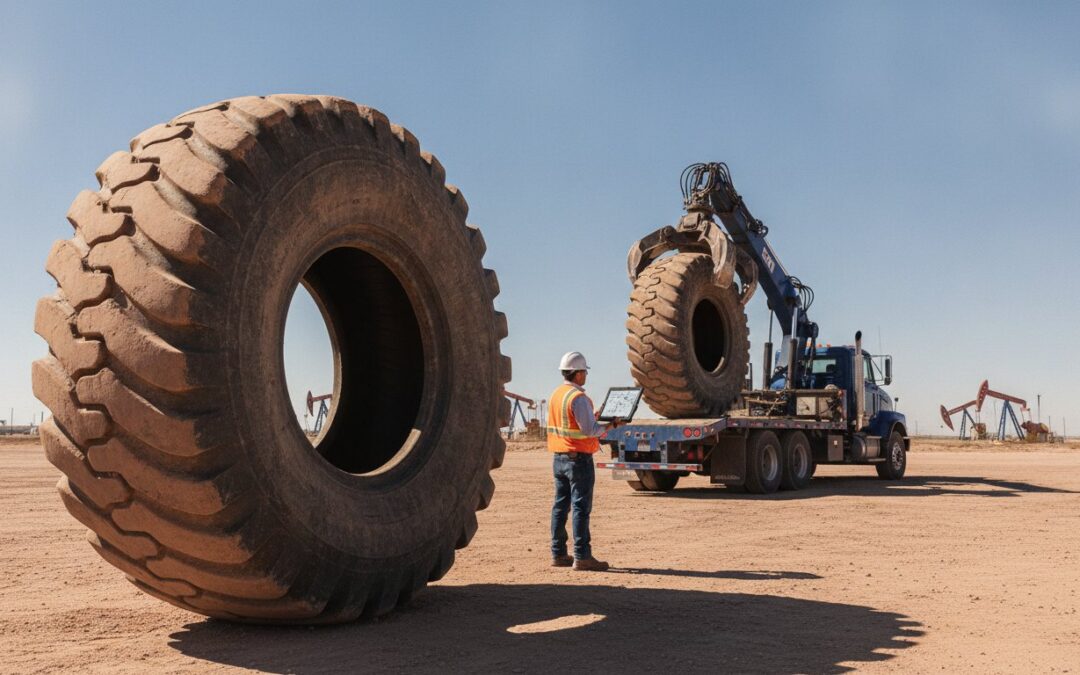
The TCEQ issued over $2.4 million in penalties for improper scrap tire management in 2025, with fines reaching as high as $25,000 per day for non-compliance. In the heart of the Permian Basin, managing massive earthmover and loader tires is more than a logistics challenge; it’s a serious legal liability. You likely already realize that standard haulers aren’t equipped for the sheer weight of these units, yet letting them sit on your site only invites regulatory scrutiny and safety hazards. Finding a reliable partner for OTR tire collection in the Midland and Odessa area shouldn’t be the hardest part of your industrial operation.
We understand that your primary goal is maintaining a safe, efficient worksite without the constant fear of a surprise inspection. This 2026 guide explains how to manage your industrial rubber waste legally while securing the manifest documentation you need for total peace of mind. We’ll walk through the current TCEQ storage limits, the importance of “cradle to grave” tracking, and how local West Texas expertise can take the heavy lifting off your hands for good.
Key Takeaways
- Understand the critical TCEQ manifest requirements for 2026 to ensure your disposal is legally documented and audit-ready.
- Learn why specialized equipment is essential for professional OTR tire collection when handling massive industrial units that exceed 12 feet in diameter.
- Identify the primary factors influencing hauling logistics, including geographic proximity to Midland and Odessa and the specific condition of the scrap rubber.
- Discover how to clear your worksite of more than just tires by including industrial waste like conveyor belts, skid steer tracks, and hoses in your removal plan.
Understanding OTR Tires and the Massive Disposal Challenge in West Texas
Understanding OTR Tires begins with recognizing their specialized design for environments where pavement doesn’t exist. These Off-the-Road units are the backbone of mining, quarrying, and heavy construction across the Permian Basin. Their deep treads and reinforced sidewalls allow massive machinery to operate in punishing conditions. However, their utility in the field is matched only by the difficulty of their disposal once they reach the end of their service life. In West Texas, where industrial growth remains constant, the backlog of these tires is a growing concern for site managers.
Size is the primary hurdle. When a single tire exceeds 12 feet in diameter and weighs several tons, it stops being a simple spare part and becomes a structural obstacle. In the busy industrial corridors between Midland and Odessa, these massive casings often end up in “legacy piles.” These are collections of scrap rubber that have sat for years because the site manager simply didn’t have a viable plan for OTR tire collection. These piles don’t just take up valuable real estate; they represent a significant safety and compliance risk that grows with every passing season.
The high volume of oilfield and construction activity in the Permian Basin creates a constant stream of rubber waste. Every new drill site, pipeline project, or road expansion relies on heavy machinery that eventually leaves behind worn rubber. In addition to managing physical waste, many operators partner with TEG Reclamation Services to handle critical glycol reclamation and dehydration needs for their process equipment. Without a proactive strategy, these tires become breeding grounds for pests and potential fire hazards. This often leads to unwanted attention from state regulators who monitor industrial waste accumulation. Solving the problem requires moving beyond temporary storage toward a permanent disposal solution.
Common OTR Tire Categories Found in the Permian Basin
Not all OTR units are the same. In our region, we typically see three main types that require specialized handling:
- Earthmover and mining tires: These include G-series, E-series, and L-series tires used on haul trucks and loaders in large scale excavation.
- Agricultural and flotation tires: Essential for South Plains farming operations near Lubbock, these are designed to minimize soil compaction in the field.
- Industrial and port handling tires: Often found at logistics hubs and rail yards, these are built for high-load capacity on rugged, unpaved surfaces.
Why Standard Disposal Methods Fail for OTR Units
You can’t just toss an earthmover tire into a standard dumpster or call a typical junk hauler. Most municipal landfills in Texas strictly refuse whole OTR tires because they take up too much space and don’t compact. They have a tendency to “float” back to the surface of a landfill over time, which disrupts the site’s structural integrity. This makes legal disposal a complex task that requires specific permits and destinations.
Logistics are another major barrier. Standard tow trucks or flatbeds don’t have the crane capacity or the deck width to safely transport these units. Managing a tire that weighs 4,000 pounds or more requires specialized loaders and heavy duty trailers. This physical reality is why professional OTR tire collection is a specialized trade rather than a general hauling service. If you don’t have the right equipment, the tires simply stay where they are, creating a bottleneck for your entire operation.
TCEQ Regulations and the Risks of Improper OTR Storage
The Texas Commission on Environmental Quality (TCEQ) manages scrap tires under a strict “cradle to grave” regulatory framework. This means your business is legally responsible for every casing from the moment it’s removed from equipment until it reaches a permitted processing facility. In 2025 alone, the TCEQ issued over $2.4 million in penalties for improper tire management. With daily fines reaching as high as $25,000 per violation, a backlog of unmanaged rubber is a significant financial liability. Professional OTR tire collection ensures you have the necessary paper trail to prove compliance during a state audit.
The scrap tire manifest is the most critical document in this process. It acts as your legal receipt, documenting the quantity of tires, the registered hauler’s information, and the final disposal site. Without a signed manifest, you have no proof that your waste was handled legally. According to U.S. tire recycling statistics, the specialized nature of OTR units makes them harder to track than passenger tires, which often leads to oversight. Keeping these records organized for at least three years is a standard requirement for any industrial operation in West Texas.
TCEQ Compliance Checklist for West Texas Businesses
To stay on the right side of state law, your site management plan should include these three pillars:
- Verify Hauler Registration: Always ask to see a current TCEQ scrap tire transporter registration. Using an unpermitted “midnight dumper” doesn’t absolve you of liability if those tires are found illegally abandoned.
- Monitor Storage Limits: You generally need a specific TCEQ registration if you store more than 500 scrap tires on the ground or more than 2,000 in lockable containers.
- Manifest Retention: Ensure every load of OTR tire collection is accompanied by a completed manifest. Store these documents in a secure digital or physical file for quick retrieval.
Environmental Hazards Specific to Midland and Odessa
Improper storage isn’t just a legal risk; it’s a physical threat to your property. In the arid climate of the Permian Basin, tire fires are a public health nightmare. These fires are nearly impossible to extinguish, often burning for weeks and releasing toxic oils into the soil. Because OTR tires are so large, they trap heat and fuel fires that can easily spread to nearby equipment or structures.
Even without a fire, stagnant water trapped inside a 12-foot tire is the primary breeding ground for disease-carrying mosquitoes in West Texas. These “micro-habitats” protect larvae from the wind and sun, creating a nuisance and a health risk for your crew. Over time, the additives in vulcanized rubber can also leach into the ground, potentially contaminating local groundwater. If you’re concerned about your current storage situation, choosing a permitted partner for industrial rubber removal is the most effective way to eliminate these risks before they escalate into a TCEQ enforcement action.
The Logistics of OTR Tire Collection: What to Expect
Successful OTR tire collection starts long before a truck arrives at your gate. It begins with a detailed pre-collection assessment. We look at the total count, the specific dimensions, and the current state of the rubber. Are they buried in mud? Are they filled with foam or water? These factors dictate the machinery we bring to your Midland or Odessa facility. Accessibility is just as vital. A 12-foot earthmover tire is an immovable object if a grapple truck can’t get within reach of the pile. We plan the route and the loading zone to ensure a fast, safe operation.
Once the assessment is complete, we establish a clear chain of custody. This process bridges the gap between your industrial site and the final processing facility. Every unit moved is accounted for on your manifest. This ensures the physical movement of the rubber matches your legal documentation perfectly. You aren’t just getting rid of waste; you’re securing a verified record of disposal. This transparency is what protects your business during future TCEQ audits or site inspections.
Specialized Equipment for Massive Tire Removal
Standard hauling equipment can’t handle the physics of a four-ton tire. We utilize grapple trucks and knuckle booms to lift these units safely. These machines provide the leverage needed to load oversized casings without damaging your site’s ground or surrounding equipment. For the largest mining tires, we deploy low-boy trailers and reinforced flatbeds designed for heavy, wide loads. Experienced operators are essential here. They understand how to secure these massive weights to prevent shifting during transit across West Texas highways. Safety is the priority, and because industrial accidents can have devastating consequences, those in need of expert legal guidance can explore Traumatic Brain Injuries to learn about the specialized services of The Dedric Brown Law Firm.
Streamlining the Pickup Process
You can reduce your downtime by preparing the site in advance. Organize your scrap rubber into a centralized location with a clear path for heavy machinery. If tires are scattered across a 40-acre yard, it slows the process. Grouping tires by size also helps us maximize trailer space. This allows for more efficient loads and fewer trips. Scheduling recurring pickups is the best way to prevent a legacy pile from forming. It keeps your Lubbock or Permian Basin worksite clear and your compliance records current. Don’t wait for a pile to become a mountain.
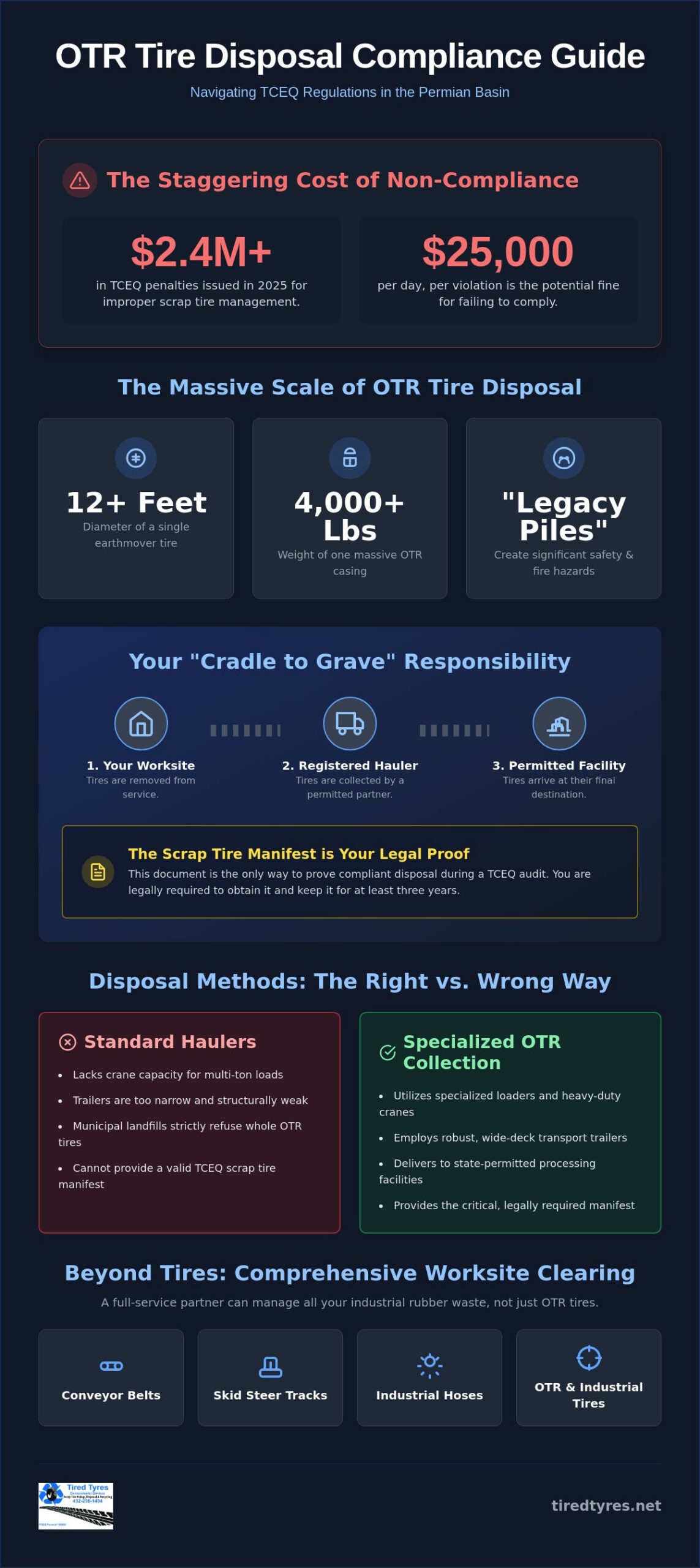
Factors Influencing OTR Tire Collection Costs and Logistics
Budgeting for OTR tire collection requires an understanding of several variables that go beyond a simple head count. While light truck tires are often priced by weight or flat volume, industrial units are priced individually based on their specific physical profile. The condition of the tire is often the first thing a specialist will evaluate. A clean, dry casing is straightforward to handle. However, tires that have been sitting in the mud for years often accumulate hundreds of pounds of dirt and water. If a tire is foam-filled to prevent punctures, its weight can triple, requiring much heavier lifting capacity and higher disposal fees at the processing facility.
The economics of the service also depend on volume. Mobilizing a grapple truck and a heavy-duty trailer for a single unit is rarely cost-effective. Most industrial operators in the Permian Basin find that bulk collection offers better value. By clearing an entire legacy pile at once, you spread the mobilization costs across multiple units. It’s also vital to distinguish between hauling fees and disposal fees. Hauling covers the specialized equipment, labor, and fuel needed to move the rubber. Disposal fees are the “tipping” costs charged by the permitted facility to accept and process the waste. Understanding this breakdown helps you avoid surprises when the final invoice arrives.
The Impact of Tire Size and Type on Logistics
Size categories significantly dictate the equipment used. Standard OTR tires for medium loaders are manageable with common industrial grapples. However, Giant OTR units, those exceeding 105 inches in diameter, require oversized load permits and specialized low-boy trailers. Solid rubber tires also present a unique challenge. Because they lack an air core, they’re incredibly dense and heavy, often reaching weight limits on a trailer much faster than pneumatic tires. We also handle adjacent industrial waste, such as scrap conveyor belts and skid steer tracks, which can often be bundled into the same logistics plan to maximize efficiency.
Why Location Matters in West Texas
In the vast expanse of the South Plains and Permian Basin, geography is a major cost driver. Pickups at remote oilfield sites or rural farms often involve “deadhead” miles, where the truck travels empty to reach your location. Proximity to hubs like Midland, Odessa, or Lubbock generally lowers these transport costs. Additionally, we must navigate weight restrictions on Texas county roads. During the rainy season or in areas with soft soil, moving a fully loaded trailer of OTR tires requires careful route planning to avoid damaging infrastructure or getting equipment stuck. For a deeper look at local requirements, see our guide on Tire Disposal Midland TX.
If you need an accurate estimate for your site, the best first step is a professional assessment. You can request a quote for OTR tire collection to get a clear breakdown of the logistics and costs specific to your operation.
Tired Tyres: Your Permitted Partner for OTR Collection in West Texas
Tired Tyres operates as a permitted tire hauler with a primary focus on the Midland, Odessa, and Lubbock regions. We’ve built our reputation on being a reliable partner for companies that need more than just a general waste hauler. Our team specializes in OTR tire collection, bringing the right equipment and local knowledge to every job site. We understand that in the Permian Basin, a delay in clearing waste can lead to a bottleneck in your production or a safety hazard for your crew. It’s our job to move those obstacles so you can focus on your core operations.
Our service isn’t limited to tires alone. We provide comprehensive rubber waste solutions designed for the heavy industries that drive West Texas. This includes the removal of scrap conveyor belts, skid steer tracks, and industrial hoses. By handling all your industrial rubber waste through a single partner, you simplify your logistics and ensure that every piece of scrap is documented correctly. Our commitment to TCEQ compliance means you’ll always receive transparent manifest documentation for every load we haul. You’ll have the proof you need for your records without the headache of chasing down paperwork.
Serving the Unique Needs of the Permian Basin
The oilfield service companies and construction firms in our region face disposal challenges that most haulers aren’t equipped to handle. We support bulk rubber removal for oilfield sites where large volumes of scrap accumulate quickly. We also assist West Texas construction firms with site remediation, helping you clear legacy piles to prepare a property for new development or to meet environmental standards. Our local presence means we can react quickly to your needs and navigate the specific road and weather conditions of the South Plains. For more information on our business to business services, you can read our guide on Commercial Tire Disposal.
Get Started with a Professional OTR Pickup
Onboarding as a new industrial client is a straightforward process. We don’t believe in complicating your schedule with unnecessary paperwork or vague timelines. It starts with a custom quote based on your specific tire inventory and site location. We’ll evaluate the size, condition, and quantity of your tires to provide an accurate logistics plan. Once the plan is approved, we handle the heavy lifting, the loading, and the legal documentation. Our goal is to make OTR tire collection the easiest part of your site management plan.
If you’re ready to clear your worksite and secure your compliance records, we’re here to help. Contact Tired Tyres today for a reliable OTR tire collection quote and experience the difference of working with a local West Texas expert.
Secure Your Worksite and Regulatory Compliance for 2026
Managing industrial rubber waste shouldn’t be a source of constant stress for your West Texas operation. By prioritizing the removal of legacy piles and understanding current TCEQ manifest requirements, you protect your business from significant financial penalties and environmental risks. Professional disposal ensures that every massive earthmover or loader tire is tracked correctly from your site to a permitted facility. This process leaves you with the ironclad legal documentation you need for any future state audits or inspections.
Partnering with a local specialist for OTR tire collection is the most effective way to clear your worksite safely. As a TCEQ Registered Hauler with Local West Texas Ownership, we utilize specialized heavy-duty equipment designed specifically for the weight of industrial rubber. We understand the unique logistics of the Permian Basin and South Plains, ensuring your waste is handled without disrupting your daily workflow. Request an OTR Tire Collection Quote in the Permian Basin today to start clearing your property. We’re ready to help you maintain a cleaner, safer, and fully compliant industrial site for years to come.
Frequently Asked Questions
What qualifies as an OTR tire for collection purposes?
Off-the-Road (OTR) tires include any large-scale rubber units designed for mining, quarrying, and heavy construction equipment. This category covers earthmovers, loaders, and graders, along with agricultural flotation tires used on South Plains farms. If the tire is built for off-pavement industrial use and exceeds standard truck dimensions, it qualifies for specialized OTR handling.
Does Tired Tyres provide the scrap tire manifest required by the TCEQ?
Yes, we provide a completed scrap tire manifest for every load we transport. This document acts as your legal proof of proper disposal from “cradle to grave” as required by Texas state law. You should retain these records for at least three years to stay prepared for any potential TCEQ audits or site inspections.
Can you pick up OTR tires that are filled with foam or calcium?
We can pick up foam-filled or calcium-filled tires, though they require different handling than pneumatic units. These tires are significantly denser and heavier, which impacts the loading process and the transport weight limits. Because we use specialized heavy-duty equipment for OTR tire collection, we can safely manage these high-weight units without damaging your site.
How much does OTR tire collection cost in the Midland/Odessa area?
Costs for OTR tire collection are determined by the size and condition of the tires, as well as your site’s proximity to our hubs. Factors like foam filling or heavy mud accumulation also influence the price because they increase the disposal fees at the processing facility. We provide custom, transparent quotes based on a physical assessment of your specific inventory.
Do you collect other industrial rubber waste like conveyor belts or skid steer tracks?
Yes, our service extends to a wide range of industrial rubber waste common in the Permian Basin. We regularly collect scrap conveyor belts, skid steer tracks, industrial hoses, and solid rubber tires. Bundling these items into a single pickup is often the most efficient way to clear your worksite and manage your disposal documentation.
Is there a minimum number of tires required for a scheduled pickup?
We don’t have a strict minimum, but the logistics of moving heavy machinery are most cost-effective for bulk removals. Most of our industrial clients find that scheduling a pickup for multiple units or a legacy pile offers better value than single-unit hauling. We can work with you to find a schedule that prevents waste from accumulating beyond legal storage limits.
How do I prepare my site for a heavy-duty OTR tire collection?
The best way to prepare is to consolidate your tires in a centralized area with a clear, stable path for a grapple truck and a low-boy trailer. Ensure the loading zone is free of soft mud or overhead obstructions like power lines. Organizing tires by size can also help our operators load the equipment more efficiently, saving time during the pickup.
Are there fines for storing too many scrap tires on my property in Texas?
The TCEQ can issue fines up to $25,000 per day for improper scrap tire storage or for exceeding registered storage limits. In 2025, the state issued over $2.4 million in penalties for these violations. Keeping your site clear through regular professional collection is the most reliable way to avoid these significant financial liabilities.