

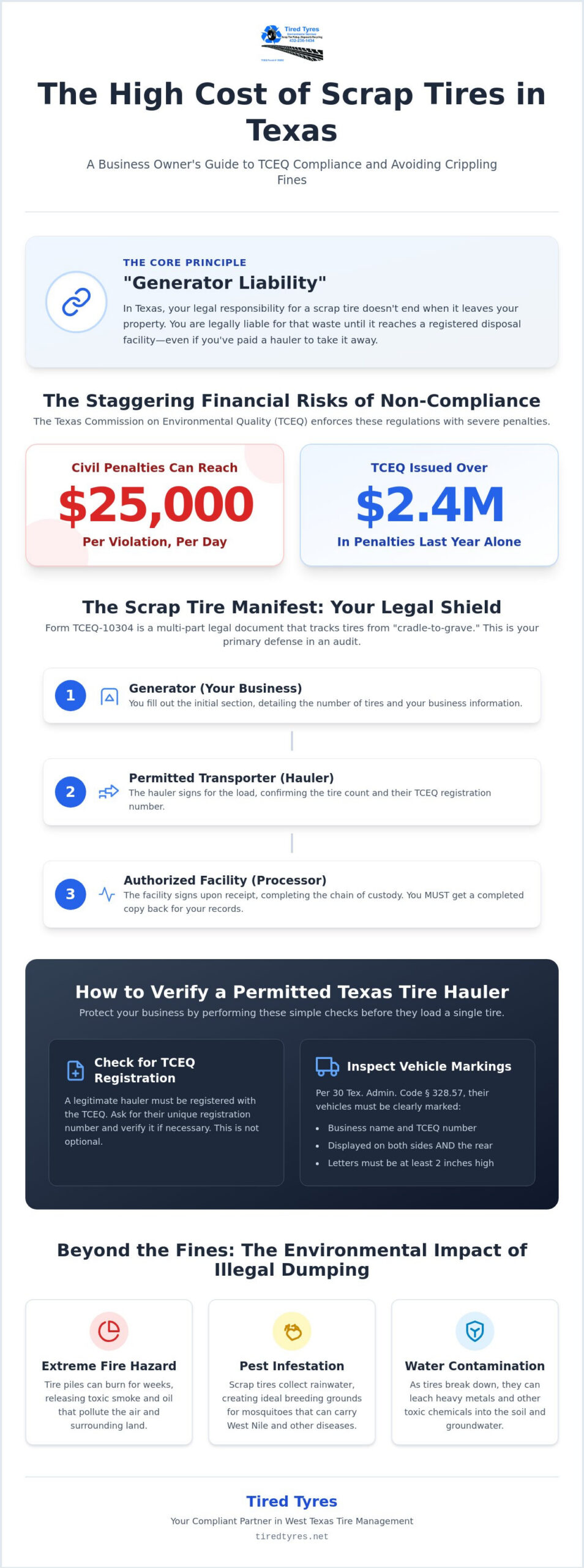
Did you know that your legal responsibility for a scrap tire doesn’t end when it leaves your lot? In Texas, you’re liable for that waste until it reaches a registered disposal facility, even if you paid someone else to take it away. With the TCEQ issuing over $2.4 million in penalties last year for improper management, hiring a permitted tire hauler Texas businesses can trust is no longer optional. It’s a critical shield for your bottom line and your professional reputation.
We understand that managing accumulating tire piles is a logistical nightmare. Between the risk of flash fires, pest infestations, and the headache of complex manifest paperwork, it’s easy to feel overwhelmed by environmental regulations. You want a clean property and the peace of mind that comes with knowing you won’t be hit with fines that can reach $25,000 per day. This 2026 guide will show you exactly how to protect your West Texas business from liability. We’ll break down the latest TCEQ registration requirements, explain the manifest process, and help you find a reliable partner to keep your commercial property tire-free and fully compliant.
Key Takeaways
- Understand the “Generator Liability” principle, which keeps you legally responsible for scrap tires until they reach a registered disposal facility.
- Learn how the multi-part manifest system serves as your primary legal defense during TCEQ audits and inspections.
- Discover how to verify a permitted tire hauler Texas requires by checking for TCEQ registration numbers and current vehicle decals.
- Identify the severe financial risks of illegal dumping, including civil penalties that can reach $25,000 per violation per day.
- Protect your West Texas commercial property by partnering with a specialist capable of handling OTR, agricultural, and industrial rubber waste.
What is a Permitted Tire Hauler in Texas?
In Texas, a permitted tire hauler isn’t just someone with a heavy-duty trailer and some spare time. It’s a professional entity registered with the Texas Commission on Environmental Quality (TCEQ) to legally collect and transport scrap tires. This registration serves as a formal bond between the hauler and the state. It ensures that every tire picked up is accounted for from the moment it leaves your property until it reaches an authorized disposal or processing site.
The TCEQ acts as the primary watchdog for environmental safety across the state. They don’t just hand out registration numbers. They require haulers to submit annual activity reports by March 1st and maintain a strict paper trail for every load. If you hire a random individual because they offer a lower price, you aren’t just saving money. You’re bypassing the state’s safety net. Without a formal permitted tire hauler Texas registration, that person has no legal obligation to dispose of the tires properly. This leaves you holding the bill if those tires end up in a West Texas ravine.
You do have the option to haul your own scrap tires to a landfill or processor. However, businesses often find this impractical. Moving heavy OTR or agricultural tires requires specialized equipment and significant time. When you hire a service, you’re outsourcing the logistical burden and the compliance risk to experts who understand the “cradle-to-grave” responsibility of waste management.
The Legal Framework: 30 Tex. Admin. Code § 328.57
Texas law is very specific about who can move scrap tires. Under 30 Tex. Admin. Code § 328.57, transporters must follow rigorous standards. This includes marking their vehicles on both sides and the rear with the business name and their unique TCEQ registration number. These markings must use letters and numbers at least two inches high. While some exemptions exist, such as municipal fleets or people hauling five or fewer tires, almost all commercial operations must use a registered service. Hiring a professional permitted tire hauler Texas ensures your business stays on the right side of these specific administrative codes.
Why Permitting Exists: Preventing Illegal Dumping
The permitting system exists to create a transparent tracking mechanism. Because Tire recycling in the United States is a massive logistical challenge, Texas uses these permits to prevent tires from becoming environmental hazards. In the Permian Basin, illegal tire piles aren’t just eyesores. They’re breeding grounds for mosquitoes and significant fire risks that can burn for weeks. These piles can also leach chemicals into the groundwater, threatening the delicate ecosystem of West Texas. By using a permitted hauler, you ensure your scrap tires contribute to a sustainable recycling loop rather than a local environmental crisis.
The Texas Scrap Tire Manifest System Explained
The scrap tire manifest is the most important document in your disposal process. It isn’t just a simple receipt. It’s a five-part legal document, specifically form TCEQ-10304, designed to track the movement of tires across the state. Think of it as a chain of custody. If that chain breaks, the TCEQ looks to the original source to find out why. By hiring a permitted tire hauler Texas businesses can ensure every manifest is completed correctly at the point of collection, shielding themselves from future audits.
The system relies on a three-way handshake between different entities. First, the Generator (your business) fills out the initial section. Next, the Transporter (the hauler) signs for the load. Finally, the Authorized Facility (the processor or landfill) completes the document upon receipt. You must receive a completed copy back from the facility to prove the tires reached their legal destination. If a manifest is missing or incomplete during a surprise inspection, the penalties are steep. In 2020, one enforcement case resulted in a $12,037 fine specifically for failing to properly use and retain these forms. For businesses in the Permian Basin, partnering with experts for professional tire collection services ensures this paperwork is never a liability.
Critical Information on a Legal Manifest
A valid manifest requires specific data to be considered compliant by state inspectors. You can’t just list “a trailer full of tires.” The form must include:
- The exact number of whole tires or the total weight of tire pieces.
- The unique TCEQ registration numbers for both the hauler and the destination facility.
- Wet signatures from the generator and the transporter at the time the tires leave your property.
- The date of transport and the intended destination.
Record-Keeping Duties for West Texas Businesses
Texas law requires you to keep copies of every scrap tire manifest for at least three years. We recommend keeping these records organized by year in a dedicated compliance folder. While the TCEQ is moving toward digital reporting through the STEERS system, physical copies with original signatures are still the gold standard for on-site inspections. Whether you’re handling a bulk removal of semi-truck tires or a smaller load of passenger tires, the manifest requirement remains the same. Don’t let “incidental” loads slip through the cracks without paperwork. If an unpermitted hauler dumps those tires in a Lubbock alley, your name on the manifest is the only thing that proves you followed the law.
The Liability Trap: Why Unpermitted Haulers Are a Risk
Many business owners believe their legal obligation ends the moment the tires are loaded onto a truck and leave their property. This is a dangerous misconception. Under Texas law, you are the “Generator.” This means you retain legal responsibility for those tires until they are documented as received by an authorized processing or recycling facility. If you hire an unpermitted hauler and they dump your scrap tires in a West Texas field, the TCEQ won’t just look for the driver. They’ll trace the waste back to the original source.
TCEQ investigators are experts at identifying the source of illegal dump sites. They often find business records, invoices, or specific tire markings that lead directly back to the original shop or industrial site. In 2025, the TCEQ issued over $2.4 million in penalties for improper scrap tire management. Choosing a permitted tire hauler Texas requires is the only way to break this chain of liability. A “cheap” hauler might save you a few dollars today, but that saving vanishes instantly when compared to administrative fines that range from $50 to $25,000 per violation, per day.
The idea that “once it’s off my property, it’s not my problem” is the quickest way to face an enforcement case. When you use a permitted tire hauler Texas, you’re buying more than a service. You’re buying a legal shield. The manifest system discussed earlier acts as your proof that you fulfilled your duty as a responsible generator.
The Hidden Costs of Non-Compliance
The price of hiring an unpermitted hauler often hides massive future expenses. If your tires are found in an illegal stockpile, you won’t just face fines. You may be held responsible for the total cost of remediation, which includes paying for the professional cleanup and transport of the tires to a legal facility. Beyond the financial hit, the reputational damage to your Midland or Odessa business can be permanent. In cases of massive illegal stockpiling, the state can even pursue criminal charges, turning a simple disposal task into a legal crisis.
Environmental and Fire Hazards
Unpermitted haulers often create “tire graveyards” that pose severe risks to the West Texas community.
- Fire Risks: In our arid climate, tire fires are a nightmare. They burn at extremely high temperatures and are nearly impossible to extinguish; often, they must be left to burn out over weeks.
- Public Health: Stagnant water inside tires creates a perfect breeding ground for mosquitoes carrying West Nile or Zika virus.
- Groundwater: As tires decompose or burn, they release toxic pyrolytic oils that can contaminate the soil and local groundwater.
How to Verify a Permitted Tire Hauler in Texas
Protecting your business requires more than just a handshake. You must verify that your service provider is a legitimate permitted tire hauler Texas businesses can rely on. The first step is asking for their TCEQ Transporter Registration Number. A registered hauler should have no problem providing this. Once you have it, go to the TCEQ Central Registry database. This online tool allows you to confirm that their status is “Active” and that they’ve submitted their required annual activity reports by the March 1st deadline.
Next, look at the vehicle itself. Texas law requires hauling vehicles to be marked on both sides and the rear with the business name and registration number. These markings must be at least two inches high. Additionally, check for the current year’s TCEQ decal. These decals are issued annually and serve as immediate visual proof of compliance. If the truck is unmarked or the decal is expired, the hauler is likely operating illegally. This puts your business at risk of being traced back to an unauthorized dump site.
You should also confirm the paperwork before any tires are loaded. A professional hauler will always use the official Texas Scrap Tire Manifest, form TCEQ-10304. Ask them exactly where the tires are going. They should be able to name a specific, authorized processing facility or landfill. If they’re vague about the destination, it’s a major warning sign that the tires might be dumped illegally in a West Texas ravine or alleyway.
Red Flags to Watch Out For
Be wary of haulers who insist on cash-only payments or refuse to provide a formal receipt. These “under-the-table” transactions leave no paper trail, which is exactly what you need to avoid during an audit. Vague answers regarding disposal sites are another red flag. Finally, look at their equipment. If you need to move OTR or agricultural tires, the hauler must have specialized equipment. A standard pickup truck isn’t designed for bulk industrial rubber removal and can’t safely handle the weight of large-scale scrap.
Verifying Local Service in Lubbock and Midland
While TCEQ rules apply statewide, local enforcement can vary. In areas like Midland, Ector County, and Lubbock, local jurisdictions have increased monitoring of commercial tire stockpiles. A hauler familiar with West Texas will understand the specific landfill requirements in these counties. For a deeper look at regional compliance, read our Texas Tire Disposal Regulations: A 2026 Guide for West Texas Businesses. If you need to clear your property, you can schedule a compliant tire pickup with our team to ensure your business remains a “Compliance Shield” in the Permian Basin.
Tired Tyres: Your Compliant Partner in the Permian Basin
Tired Tyres serves as your “Compliance Shield” in West Texas. We ensure every piece of rubber waste we collect is handled according to the strictest TCEQ standards. For businesses operating in the Permian Basin, the stakes are high. You need a partner who understands the local landscape and the specific requirements of the oil and gas industry. As a permitted tire hauler Texas authorities recognize, we handle the heavy lifting while you focus on your core operations.
Our team doesn’t just pick up tires. We provide the full paper trail you need to stay compliant. From the moment we arrive in Midland or Odessa, we manage the manifest process with precision. This ensures your records are audit-ready at all times. We’ve built our reputation on reliability and transparency, making sure every load reaches an authorized facility without the risk of illegal dumping. We understand that your business’s safety and professional standing are in our hands, and we take that responsibility seriously.
Comprehensive Rubber Waste Solutions
Our capabilities extend far beyond standard passenger tires. We specialize in the collection of OTR (Off-the-Road) tires, semi-truck tires, and large agricultural tires that many standard haulers simply won’t touch. Our specialized equipment is designed to handle the weight and volume of industrial rubber waste common in the South Plains and Permian Basin regions. We have the tools and the expertise to clear even the most challenging industrial sites.
We also collect other industrial rubber materials, including:
- Scrap skid steer tracks
- Industrial scrap hose collection
- Scrap conveyor belts
- Solid tire collection
Handling these materials requires a deep understanding of state regulations. You can learn more about our specific regional approach in our Commercial Tire Disposal in Midland, Odessa & Lubbock: The 2026 Guide.
Get Started with a Legal Pickup Today
Clearing your property of scrap rubber shouldn’t be a source of stress. Our process is straightforward and designed for commercial efficiency. When you contact us, we’ll provide a clear quote based on your specific volume and tire types. Once scheduled, our team arrives on time with the necessary equipment to clear your site quickly and safely. We pride ourselves on a “no-nonsense” approach that respects your time and your property.
Most importantly, we provide the completed manifests and documentation you need for your compliance files. This is the proof you need to demonstrate total compliance with Texas environmental laws. Don’t risk your business reputation on an unverified service. Partner with a permitted tire hauler Texas professional to keep your Midland, Odessa, or Lubbock property clean and your business protected. Contact Tired Tyres today to schedule your compliant collection and experience the peace of mind that comes with professional service.
Secure Your West Texas Business Today
Protecting your commercial operation means moving beyond the “out of sight, out of mind” approach to waste. We’ve explored how generator liability and the TCEQ manifest system create a strict legal chain that you simply can’t afford to break. By verifying your permitted tire hauler Texas registration and keeping meticulous records, you eliminate the risk of surprise audits and devastating environmental fines. Whether you’re managing a fleet of semi-trucks in Lubbock or a heavy industrial site in Midland, the right partner ensures your property stays clean and your liability stays at zero.
Tired Tyres brings specialized OTR and industrial rubber expertise to every pickup across the Permian Basin. As a fully TCEQ-permitted transporter, we handle the complex documentation and heavy-duty logistics so you don’t have to. It’s time to clear your lot with total confidence. Schedule a Compliant Scrap Tire Pickup with Tired Tyres today to secure your property and your peace of mind. Proper disposal is a straightforward step that protects your bottom line and our local environment. We’re ready to help you get it done right.
Frequently Asked Questions
What qualifies as a permitted tire hauler in Texas?
A permitted hauler is a professional entity registered with the Texas Commission on Environmental Quality (TCEQ) as a scrap tire transporter. They must hold a valid registration number and display a current year decal on their vehicles. These haulers are legally bonded to follow the state manifest system, ensuring every tire reaches an authorized disposal or recycling facility rather than an illegal dump site.
Is it illegal to haul my own scrap tires to a landfill in Midland?
It isn’t illegal to transport your own scrap tires, but you must deliver them directly to a registered facility. Most West Texas businesses find this impractical because standard vehicles aren’t equipped for bulk OTR or agricultural tire removal. Hiring a permitted tire hauler Texas businesses trust allows you to outsource the logistical burden while ensuring your manifest paperwork is handled correctly from the start.
How long do I need to keep scrap tire manifest records?
You must keep copies of all scrap tire manifests for at least three years. These documents are your primary defense during a TCEQ audit or inspection. We recommend organizing these records by calendar year in a dedicated compliance folder. Having these files ready proves you fulfilled your legal duty as a generator and that your waste reached a registered destination.
Can a business be fined if their hauler dumps tires illegally?
Yes, you can be held liable for tires dumped by an unpermitted hauler under the “Generator Liability” principle. Because the tires originated at your business, the TCEQ can trace them back to you if they are found in an unauthorized stockpile. Fines for these violations can reach $25,000 per day, making the choice of a registered transporter a critical financial safeguard.
What are the TCEQ requirements for scrap tire transporters in 2026?
Transporters must register annually with the TCEQ and submit an activity report by March 1st each year. They’re required to mark their vehicles with their business name and registration number in letters at least two inches high. A permitted tire hauler Texas requires must also use the official five-part manifest form for every load to track the waste from the generator to the processor.
Do I need a manifest for just a few passenger tires?
Yes, every commercial shipment of scrap tires requires a manifest regardless of the quantity. While private individuals hauling five or fewer tires may have different rules, commercial generators must document every tire that leaves their property. This strict tracking prevents small loads from accumulating in unauthorized areas and ensures your business remains fully compliant with state environmental standards.
How do I find a registered scrap tire facility in Lubbock?
You can find authorized facilities by searching the TCEQ Central Registry database online. However, the simplest way is to ask your hauler for the registration number of the facility they use. Legitimate transporters only deliver to authorized processors or landfills. They should be able to provide the name and location of the destination facility before they ever load a tire onto their truck.
What is the difference between a tire generator and a tire transporter?
A tire generator is the business where the scrap tires are first created, such as a tire dealership, fleet operator, or industrial site. The transporter is the service provider who moves those tires to a disposal site. Both parties have distinct legal duties, but the generator remains responsible for the waste until the transporter delivers it to an authorized facility and returns a completed manifest.