
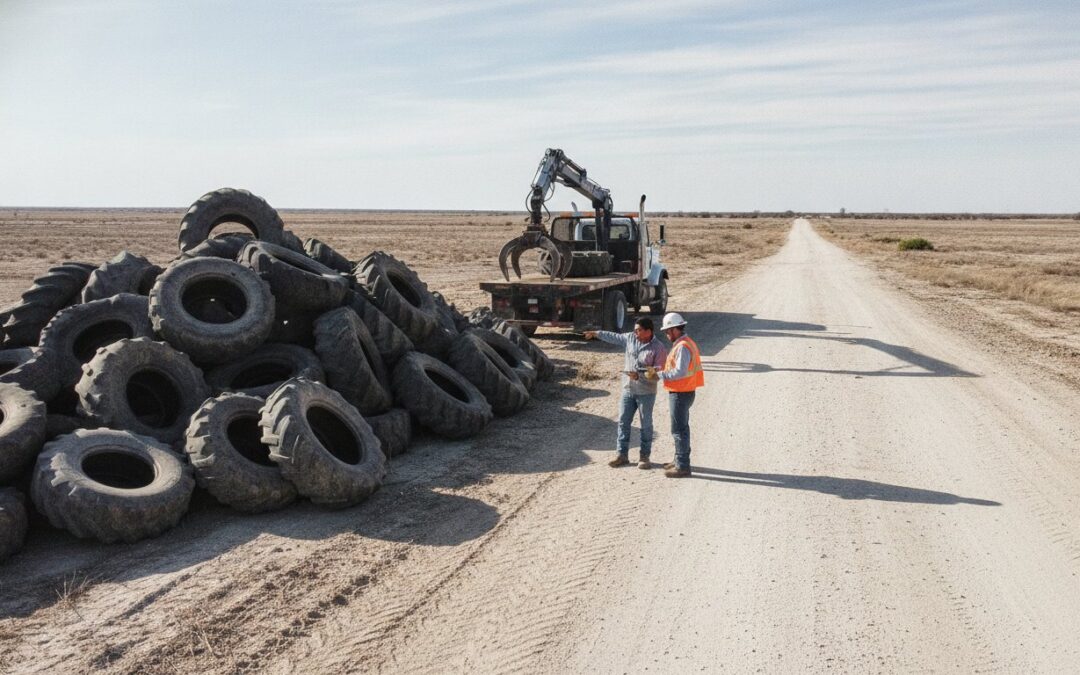
That pile of worn-out tractor tires sitting behind your barn isn’t just an eyesore; it’s a liability waiting to happen. Agricultural tire disposal in Odessa comes with a set of real obstacles that most farmers don’t anticipate until they’re already stuck: local landfills routinely reject whole agricultural tires, standard junk haulers don’t have the equipment to move multi-hundred-pound OTR rubber, and a growing stockpile can quickly become a mosquito breeding ground and a serious fire risk on your property.
You already know getting rid of these tires is harder than it should be. The frustrating part is that doing nothing carries its own consequences under TCEQ regulations, including potential fines for unauthorized scrap tire accumulation on your land.
This guide cuts straight to what Permian Basin farmers need to know for 2026. You’ll learn exactly how to identify your disposal options, what TCEQ compliance actually requires from you, and why working with a permitted hauler who brings the right equipment is the practical way to clear your farm without the legal headaches. Let’s get into it.
Key Takeaways
- Agricultural tire disposal in Odessa is heavily regulated – understanding TCEQ rules before your pile grows is the difference between a routine cleanup and a costly compliance violation.
- Texas law treats farms accumulating over a threshold number of scrap tires as unauthorized storage sites, which carries real legal exposure for Ector County landowners.
- Moving oversized OTR and agricultural tires isn’t a standard hauling job – the right equipment and a licensed operator are non-negotiable for safe, legal removal.
- A proper Scrap Tire Manifest isn’t bureaucratic paperwork; it’s your documented proof that tires left your property through a permitted channel, protecting you from illegal dumping liability.
- A bulk tire pickup starts well before the truck arrives – knowing how to audit your rubber inventory and prepare site access can significantly streamline the entire process.
The Challenge of Agricultural Tire Disposal in Odessa and Ector County
Agricultural tire disposal isn’t simply hauling old rubber to the nearest dumpsite. Under Texas law, it’s a regulated process that requires licensed transporters, documented chain of custody, and approved end destinations. For Permian Basin farmers, that process starts with a hard reality: the tires on your operation don’t fit neatly into any standard removal framework. A worn combine tire can weigh several hundred pounds. Irrigation pivot tires are often too wide to load without specialized equipment. These aren’t items a general junk removal crew can handle with a pickup truck and a dolly.
The physical challenge is only part of the problem. Attempting to move oversized OTR rubber without the right equipment creates serious injury risk. Improperly loaded tires shift during transport, and on West Texas highways, that’s a hazard that extends well beyond your property line. Understanding the full scope of agricultural tire disposal in Odessa means recognizing both the regulatory requirements and the practical logistics before you make a single call.
Why Ector County Landfills Have Strict Tire Rules
Whole agricultural tires are almost universally rejected at Texas municipal solid waste facilities. The reason is operational: landfills can’t compact whole tires, and buried rubber traps methane gas and migrates upward over time, destabilizing landfill caps. Before any tire can be accepted, it must be shredded, quartered, or processed into a form that compacts predictably. That processing costs money, and facilities pass those costs on as tipping fees that make landfilling unprocessed farm rubber economically impractical for most operations. Standard residential tire drop-off programs explicitly exclude commercial agricultural equipment, so the drop-off lane at a municipal facility isn’t an option either. For a broader look at how tire recycling and disposal methods work across the full scrap tire lifecycle, the underlying logistics explain why these restrictions exist at the local level.
Environmental and Health Hazards on the Farm
A single large tractor tire can hold well over 50 gallons of stagnant water in its cavity, creating an ideal breeding environment for mosquitoes that carry West Nile virus, a persistent public health concern in Texas summers. Stockpiles multiply that risk across dozens of collection points on a single property.
Fire risk is arguably worse. Agricultural tire fires burn at extreme temperatures, produce toxic black smoke containing sulfur dioxide and particulate matter, and are nearly impossible to extinguish with standard firefighting methods. Some burn for days. The damage to surrounding soil, air quality, and neighboring land can be significant, and the liability for that damage rests squarely with the property owner. Proper agricultural tire disposal in Odessa removes these risks before they escalate into something far more costly than a scheduled pickup.
Texas Scrap Tire Regulations: Staying Compliant in 2026
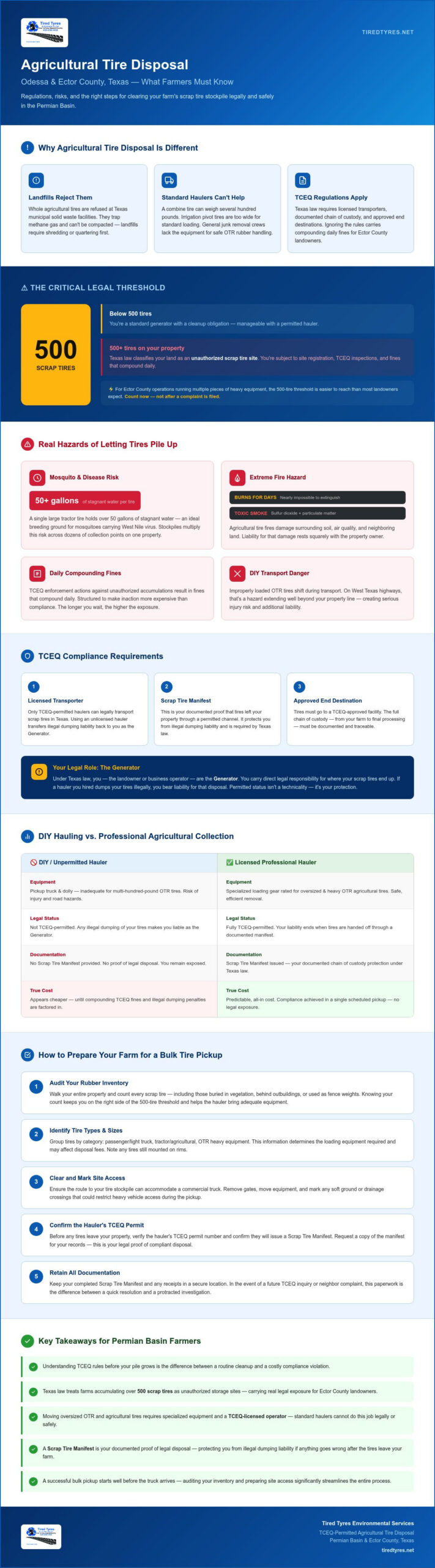
Texas law draws a clear line between a farmer who accumulates a manageable number of worn tires and one who is, in the eyes of the TCEQ, operating an unauthorized scrap tire site. That line is 500 tires. Once your property holds more than 500 scrap tires at any one time, you’re no longer just a generator with a cleanup problem; you’re subject to site registration requirements, inspections, and escalating penalties. For Ector County operations running multiple pieces of heavy equipment, that threshold is easier to cross than most landowners realize.
The consequences of crossing it without proper documentation aren’t theoretical. TCEQ enforcement actions against unauthorized scrap tire accumulations can result in fines that compound daily. Penalties vary based on the severity and duration of the violation, but they’re structured to make inaction more expensive than compliance. If you’re unsure whether your current stockpile puts you over the limit, count now, not after a complaint has been filed.
Hiring an unpermitted hauler creates a separate and equally serious problem. Under Texas law, the Generator is the landowner or business operator who produces or holds scrap tires, and that role carries direct legal responsibility for where those tires end up. If a hauler you found on social media dumps your tires illegally, you bear liability for that disposal. Permitted status isn’t a technicality; it’s your only real protection against being named in an enforcement action for someone else’s decision.
The Scrap Tire Manifest System Explained
Every legal scrap tire transaction in Texas requires a Scrap Tire Manifest, a chain-of-custody document that follows the rubber from your property to a permitted processor or end-use facility. Your hauler completes it at pickup, the receiving facility signs off at delivery, and you retain your copy. TCEQ requires generators to keep those records for a minimum of three years. That paperwork is your documented proof that tires left your farm through a legal channel. For a deeper breakdown of how these requirements apply across West Texas, Texas tire disposal regulations covers the full compliance picture for 2026.
Avoiding Illegal Dumping Fines in Ector County
Local authorities in Ector County use aerial surveillance and satellite imaging to identify unauthorized tire piles on rural properties, a method that makes remote locations no protection at all. Texas law also distinguishes between legitimate beneficial use of scrap tires, such as approved agricultural applications like erosion control under specific guidelines, and simple stockpiling. Stockpiling without registration isn’t a gray area; it’s a violation. Proper agricultural tire disposal in Odessa handled through a TCEQ-permitted scrap tire hauler keeps your operation on the right side of that distinction from the moment the tires leave your property.
DIY Hauling vs. Professional Agricultural Collection
The math on self-hauling looks simple until you actually run it. Gas, time, equipment wear, and the very real possibility of showing up at the landfill only to be turned away with a full load make the “free” option considerably less free than it first appears. Farmers across Ector County have learned this the hard way. Proper agricultural tire disposal in Odessa isn’t a one-trip errand; it’s a logistics operation, and treating it like one changes the cost calculation entirely.
The Logistics of Moving OTR Rubber
Weight is the first problem. A standard agricultural tractor rear tire can weigh anywhere from 300 to over 600 pounds depending on the equipment. Combine tires and large sprayer tires push that further. No standard pickup truck handles that kind of load safely, and loading these tires without mechanical assistance creates serious injury risk. A tire that shifts during loading or rolls off an unsecured trailer on a West Texas highway isn’t a minor inconvenience; it’s a liability event.
Multiple trips compound the issue. A typical farm cleanup involving worn tractor, pivot, and implement tires rarely fits in a single haul. Each trip burns fuel, takes you off the field, and adds wear to your own equipment. If the receiving facility rejects whole tires on arrival, you’ve spent that time and fuel for nothing.
Professional Service Advantages for Ag Operations
A professional agricultural collection service brings equipment built for exactly this kind of work: boom trucks and heavy-duty trailers rated for multi-ton loads, operated by crews who handle oversized rubber routinely. The difference in efficiency is significant.
Scheduling matters as much as equipment. A reputable service coordinates pickup around your operation’s calendar, not theirs. That means cleanups happen during slow periods rather than cutting into planting or harvest windows. For Permian Basin farms where every productive day counts, that flexibility has real operational value.
There’s also the documentation angle. Commercial tire disposal services that operate with proper TCEQ permits provide the Scrap Tire Manifest at pickup, closing the chain of custody before the truck leaves your gate. That single document is what separates a clean compliance record from potential liability if tires end up somewhere they shouldn’t.
The practical case is straightforward: professional collection handles the weight, the paperwork, and the legal risk in a single scheduled visit. That’s not a premium; it’s the baseline for doing this correctly.
How to Prepare Your Odessa Farm for a Bulk Tire Pickup
A well-prepared site makes the difference between a pickup that wraps up in a few hours and one that drags on because the crew is working around obstacles, guessing at what they’re loading, or waiting on access they weren’t told about. The preparation work happens on your end, before the truck arrives. It’s not complicated, but skipping it costs time you don’t have.
Inventorying and Categorizing Your Tires
Start with a physical count. Walk the property and log every tire by category: passenger and light truck (PLT), semi-truck, and oversized OTR or agricultural equipment tires. That distinction matters because each category has different weight profiles and loading requirements. A crew arriving with equipment sized for PLT volume isn’t prepared for a stack of combine tires.
Note which tires still have rims attached. Tires on rims behave differently during loading and may affect how the hauler stages the trailer. Separating rim-mounted tires from bare rubber before pickup speeds up the entire process. Also flag any tires that are filled with foam or ballast, which are common on agricultural equipment, since these weigh significantly more than standard pneumatic tires and require different handling.
Your inventory doesn’t need to be a formal spreadsheet. A simple count by category, communicated to the collection service when you schedule, ensures the right equipment shows up. Underestimating volume is one of the most common reasons agricultural tire disposal in Odessa takes multiple visits instead of one.
Optimizing the Pickup Site for Heavy Equipment
Collection trucks for OTR and agricultural loads are not small vehicles. Before scheduling, check that your gate width accommodates a heavy-duty trailer, and confirm that the access road to your staging area can support the weight without the truck sinking into soft ground. West Texas caliche roads generally hold up well, but low-lying areas that collect moisture after rain can be a problem. If the ground is soft, flag an alternate route in advance.
Staging location matters as much as access. Group tires on firm, level ground with enough clearance for a boom truck to maneuver. Keep the staging area clear of overhead power lines, which restrict crane and boom arm movement. Mixing tires in with general farm scrap, old fencing, or metal debris slows loading and can create safety hazards for the crew. Tires only, staged together, by category.
For a closer look at how site layout affects collection logistics across the region, our guide on tire disposal in Midland and Odessa covers site preparation in additional detail.
Getting this right upfront is the fastest path through a bulk pickup. If you’re ready to schedule agricultural tire disposal in Odessa with a crew that brings the right equipment from the first visit, contact Tired Tyres to arrange your collection.
Tired Tyres: Reliable Agricultural Disposal in the Permian Basin
Most haulers operating in West Texas are generalists. They handle furniture, construction debris, and residential junk. Agricultural tire disposal in Odessa is a different category entirely, and treating it like a standard removal job is exactly how farms end up with incomplete pickups, missing manifests, and compliance gaps they didn’t anticipate. Tired Tyres focuses specifically on the Permian Basin agricultural and OTR market because that focus is what makes the difference between a job done and a job done correctly.
Local knowledge matters here in ways that aren’t obvious from the outside. Ector County road conditions, access constraints on working ranches, and the specific tire profiles common to Permian Basin operations all shape how a pickup gets planned and executed. A crew that’s never loaded a foam-ballasted irrigation pivot tire on caliche in July isn’t the same as one that does it routinely. That operational familiarity is what Tired Tyres brings to every scheduled collection.
The ‘No Tire Left Behind’ principle is straightforward: no load gets left on your property because it’s too heavy, too large, or too awkward to move. Oversized OTR rubber, multi-hundred-pound tractor tires, and pivot equipment tires all fall within what the fleet is built to handle. Farmers shouldn’t have to sort out which tires qualify for pickup and which ones don’t. They all do.
Pricing is communicated upfront, based on your inventory count and tire categories. There are no surprise fees at the gate. Every collection includes a completed Scrap Tire Manifest, delivered to you before the truck leaves your property. That document is your legal protection, and it’s a standard part of every job, not an add-on.
Specialized Equipment for Heavy Loads
The Tired Tyres fleet is equipped for agricultural and OTR loads that standard junk removal trucks simply can’t manage. Boom-assisted loading handles the heaviest tires without manual risk, and trailers are rated for the cumulative weight of bulk farm cleanups. Crews understand agricultural site logistics, including working around active equipment, livestock areas, and variable ground conditions. For large-scale remediation or farms with significant tire accumulations, bulk scheduling is available to clear the property in a single coordinated effort.
Get Started with Your Odessa Ag Pickup
Requesting a quote starts with your tire inventory: a count by category, PLT, semi, agricultural, and OTR, along with any notes on rim-mounted or ballasted tires. That information lets Tired Tyres match the right equipment to your specific load before arrival. From there, the process is a single scheduled visit, on-site manifest completion, and a clean property with documented proof of legal disposal.
If you’re ready to clear your land and close out your compliance exposure, contact Tired Tyres to schedule your agricultural tire collection in Odessa and reclaim the space your operation needs.
Clear Your Land, Close Your Compliance Gap
Agricultural tire disposal in Odessa isn’t a problem you can defer indefinitely. The regulatory exposure is real, the environmental risks compound over time, and the logistics don’t get easier the longer tires sit on your property. What this guide has laid out is straightforward: know your count, use a TCEQ-permitted hauler, and keep your manifest on file.
Tired Tyres handles what standard haulers can’t. Specialized equipment for heavy OTR and agricultural loads, proper documentation at every pickup, and service across Odessa, Midland, and Lubbock means your operation gets a complete solution, not a partial one. You get a clean property and a paper trail that protects you.
The next step is simple. Count your tires, note the categories, and reach out. Get a quote for agricultural tire collection on your Odessa farm and put this problem behind you for good. Your land, your operation, and your compliance record will all be better for it.
Frequently Asked Questions About Agricultural Tire Disposal in Odessa
Can I take tractor tires to the Odessa landfill?
No. Whole agricultural tires are rejected at Texas municipal solid waste facilities because landfills can’t compact them and buried rubber causes structural problems over time. Before any tire is accepted, it must be shredded or processed into a compactable form. That processing carries costs that make landfilling unprocessed farm rubber impractical, and commercial agricultural equipment is explicitly excluded from residential drop-off programs.
Your practical option is a TCEQ-permitted hauler who transports tires directly to an approved processor. That route keeps your disposal legal and documented without the wasted trip to a facility that will turn you away at the gate.
How much does it cost to dispose of an agricultural tire in Odessa?
Disposal costs vary based on tire category, total volume, and site access conditions. Agricultural and OTR tires cost more to move than passenger tires because they require specialized equipment and rated trailers. Foam-ballasted or rim-mounted tires add handling complexity that affects pricing as well. Contact Tired Tyres directly with your inventory count broken down by category to get an accurate quote for your specific load.
What’s worth factoring in: the cost of a permitted collection is typically lower than the combined expense of fuel, equipment wear, and lost field time from multiple self-haul attempts that may still end in rejection at the landfill.
What happens if I have more than 500 tires on my farm in Texas?
Texas law treats any property holding more than 500 scrap tires at one time as an unauthorized storage site unless it’s registered with TCEQ. That threshold triggers site registration requirements, potential inspections, and penalties that compound daily if the violation goes unaddressed. Ector County farms running multiple pieces of heavy equipment can reach that number faster than most landowners expect.
If you’re close to or over that count, the priority is scheduling a collection before a complaint is filed, not after. Enforcement actions are structured to make delay more expensive than compliance, so acting now is the straightforward path.
Do you pick up tires that are still on the rims?
Yes. Tired Tyres picks up both bare tires and tires still mounted on rims. Rim-mounted tires behave differently during loading, so it’s useful to flag them when you provide your inventory count. That information lets the crew plan the load correctly before arrival rather than adjusting on-site.
When you’re inventorying your property ahead of scheduling, separate rim-mounted tires from bare rubber in your count. It’s a simple step that speeds up the entire pickup process and ensures the right equipment configuration shows up for your specific load.
What is a scrap tire manifest and why do I need one for my farm?
A Scrap Tire Manifest is the chain-of-custody document that Texas law requires for every legal scrap tire transaction. Your hauler completes it at pickup, the receiving facility signs off at delivery, and you keep your copy on file for a minimum of three years. It’s your documented proof that tires left your property through a permitted, legal channel.
For agricultural tire disposal in Odessa, this document is your primary protection if questions arise later about where your tires ended up. Without it, you have no legal shield if a hauler disposes of your tires improperly. Tired Tyres provides a completed manifest at every pickup before the truck leaves your gate.
Does Tired Tyres handle other farm rubber like pivot tires or tracks?
Yes. Beyond standard tractor and agricultural tires, Tired Tyres collects scrap solid tires, scrap skid steer tracks, and scrap rubber across the range of materials that accumulate on working Permian Basin operations. Pivot irrigation tires, which are often wide and awkward to handle, fall within the agricultural collection service.
When you schedule, include any non-standard rubber in your inventory notes. That way the crew arrives prepared for the full scope of what’s on your property, not just the straightforward tire stacks.
How do I prepare my site for a heavy-duty tire collection truck?
Check gate width and road access before the truck arrives. Collection vehicles for OTR and agricultural loads are large, and soft ground after rain can create access problems on rural properties. Confirm your access route can support the weight, and flag an alternate path if low-lying areas are a concern. Overhead power lines near your staging area will restrict boom arm movement, so factor that into where you group the tires.
Stage tires on firm, level ground, grouped by category, with general farm debris cleared away. That setup lets the crew load efficiently without working around obstacles. A well-prepared site is consistently the fastest way through a bulk pickup.
Are there any free tire disposal events for farmers in Ector County?
Periodic collection events do occur in Texas, often coordinated through county or state agricultural programs, but availability, scheduling, and eligibility requirements vary and aren’t guaranteed year to year. These events also tend to have volume limits and may not accommodate oversized OTR or agricultural tires. Checking with Ector County or the Texas Department of Agriculture directly is the reliable way to find out what’s currently offered.
For farms with significant tire accumulations or time-sensitive compliance concerns, waiting for an event that may not materialize isn’t a practical strategy. A scheduled collection through a permitted hauler gives you a confirmed date and handles the full volume without the uncertainty.