
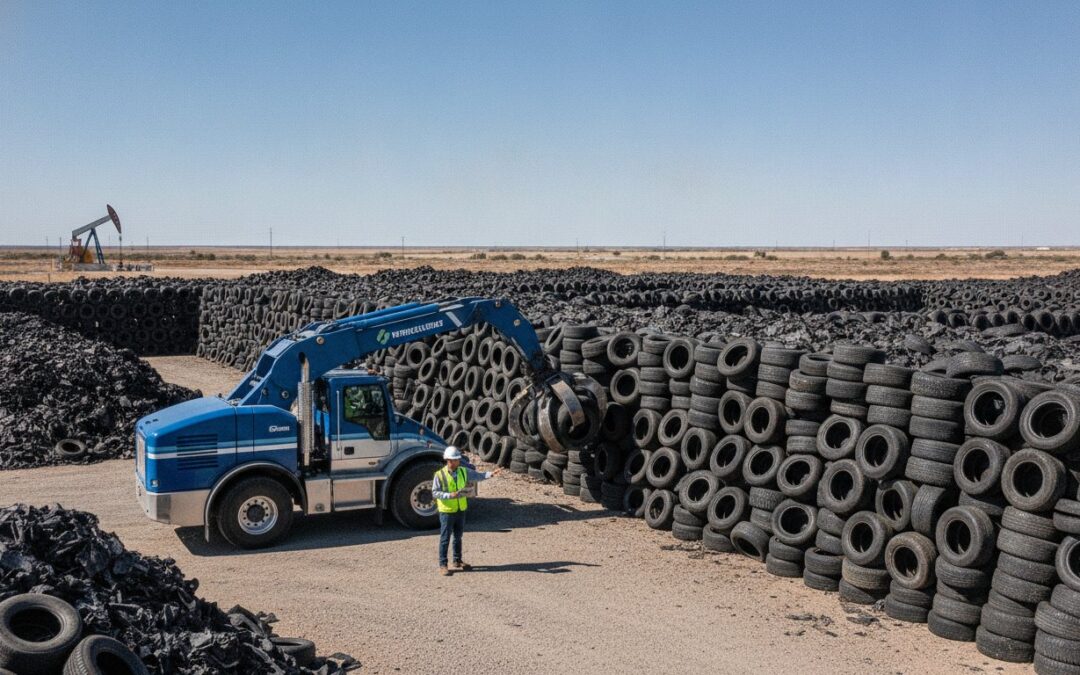
In 2025, the TCEQ issued over $2.4 million in penalties for improper scrap tire management. With strict liability laws now in effect, the cost of illegal tire dumping texas has never been higher for local business owners. What used to be a minor weight-based violation has transformed into a rigid system where a second offense can trigger a $5,000 fine. If you feel like your tire pile is becoming a magnet for pests or a liability trap for state inspectors, you’re certainly not alone.
It’s frustrating to manage growing stacks of rubber while trying to keep up with complex manifest paperwork. We understand that you want a clean, hazard-free property without the constant fear of a surprise audit. This guide will help you master the latest Texas regulations, from the 2026 storage thresholds to the mandatory “cradle to grave” tracking requirements. You’ll learn exactly how to protect your business from massive fines and ensure every scrap tire is handled with full legal compliance.
Key Takeaways
- Understand the 2026 TCEQ penalty structure where repeat offenders face strict liability fines reaching $50,000.
- Learn how the “Generator” rule makes you legally responsible for your scrap tires until they reach a permitted site to avoid charges related to illegal tire dumping texas.
- Discover the critical difference between a simple receipt and a state-mandated manifest for proving legal disposal to inspectors.
- Identify the specific storage thresholds that trigger mandatory TCEQ registration to keep your property from being flagged as an unauthorized site.
- Find reliable disposal solutions for specialized rubber waste, including OTR, agricultural, and semi-truck tires in the Permian Basin and South Plains.
The Legal Stakes of Illegal Tire Dumping in Texas (2026)
The Texas Health and Safety Code, specifically Chapter 365, provides a clear definition of what constitutes illegal dumping. It’s the disposal of litter or other solid waste at a place that isn’t an approved solid waste site. For business owners, this means any tire left on a curb, tucked behind a warehouse, or handed off to an unpermitted hauler falls under the umbrella of illegal tire dumping texas. The Texas Commission on Environmental Quality (TCEQ) holds the ultimate authority to enforce these rules. They operate with a “cradle to grave” philosophy. This means you’re responsible for the tire from the moment it’s removed from a rim until it reaches a registered recycling facility.
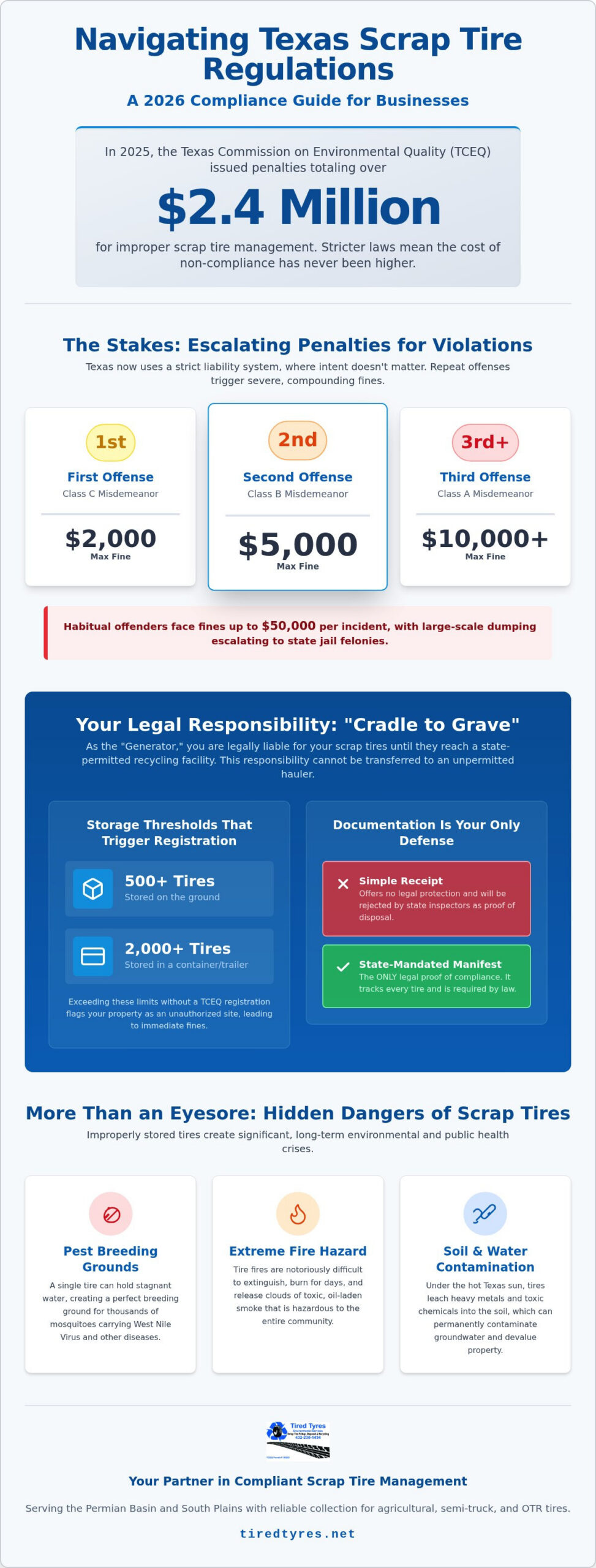
State inspectors don’t accept “ignorance of the law” as a valid defense. If an inspector finds a stockpile on your property that exceeds 500 tires on the ground or 2,000 in a container without registration, the fines start immediately. The law is designed to prevent the significant Environmental and Health Hazards of Scrap Tires, such as toxic fires and groundwater contamination. Because the risks are so high, the state has shifted toward a strict liability system where intent doesn’t matter; only the presence of the waste does.
Criminal Penalties and Fines
Recent legislative shifts have made penalties much more punitive for Texas businesses. A first offense now carries a Class C misdemeanor fine of up to $2,000. If you’re caught a second time, it’s a Class B misdemeanor with a $5,000 cap. By the third offense, you’re looking at a Class A misdemeanor and a $10,000 fine. For habitual offenders, these amounts can climb by $10,000 for every subsequent occurrence, reaching a maximum of $50,000 per incident. Large-scale dumping that exceeds specific weight or volume thresholds can even escalate to state jail felonies, which include mandatory jail time for those involved.
The Role of Local Law Enforcement in West Texas
In the Permian Basin and South Plains, local authorities work together to protect the landscape. County sheriffs in Midland, Odessa, and Lubbock collaborate closely with TCEQ investigators to track down unauthorized dump sites. Many counties have established reporting hotlines and “stop dumping” initiatives to encourage residents to flag suspicious activity. These efforts are necessary because illegal dumping places a heavy burden on local municipal budgets. Every tire pulled from a Lubbock alleyway or a Midland ditch requires taxpayer-funded equipment and labor for proper remediation. When businesses bypass legal disposal, they aren’t just breaking the law; they’re shifting their operational costs onto the entire community.
Why Texas Cracks Down: Environmental and Health Hazards
Texas doesn’t treat tire piles as simple eyesores. The state views them as significant public safety threats. This perspective drives the aggressive enforcement of regulations. When a business engages in or ignores illegal tire dumping texas, they aren’t just risking a fine. They’re creating a localized environmental crisis. Scrap tires are uniquely dangerous because of their shape and chemical makeup. They trap heat, water, and pests, turning a small pile into a long-term liability for the entire community. Understanding these risks helps explain why the Texas Illegal Dumping Laws and Penalties are among the strictest in the nation.
The chemical composition of a tire is a double-edged sword. While it makes them durable on the road, it makes them a nightmare for the environment. When tires are dumped, they don’t just sit there. They eventually leach heavy metals and oily compounds into the soil. During the intense West Texas heat, this process can accelerate. If these chemicals reach the groundwater, the damage is often permanent and incredibly expensive to remediate. This environmental degradation directly impacts West Texas property values, as buyers and developers avoid land with a history of waste mismanagement.
Public Health and Vector Control
A single tire left in a Lubbock alleyway can become a “mosquito factory” after just one rain shower. The curved interior of a tire creates the perfect pocket of stagnant, shaded water. This is the ideal breeding ground for mosquitoes that carry the West Nile Virus. Lubbock County health departments frequently report higher infection rates in areas with significant tire debris. Municipalities spend thousands of dollars annually on mosquito abatement programs. Removing these breeding grounds is the most effective way to protect public health. If you’re worried about these hazards on your property, arranging legal scrap tire collection is the most effective way to eliminate the risk.
The Permian Basin Fire Risk
In the dry climate of the Permian Basin, fire is a constant concern. Tire fires are notoriously difficult to extinguish. Because tires are 75% air, they provide an endless supply of oxygen to a blaze. They burn at extremely high temperatures and can smolder for weeks or even months. A major tire fire in Midland or Odessa doesn’t just produce toxic smoke; it creates a thick, black “tire ash” that settles on everything for miles. Property owners can be held civilly liable for millions of dollars if a fire on their land spreads to adjacent industrial sites or residential neighborhoods. The cost of a professional pickup is a fraction of the potential payout for a single accidental ignition.
Business Liability: The Difference Between a Receipt and a Manifest
Many Texas shop owners believe their responsibility ends the moment the scrap tires leave their property. That’s a dangerous assumption. Under state law, you’re the “generator” of that waste. This status means you’re legally liable for those tires until they reach an authorized processing or recycling facility. If you hire a “trunk hauler” who promises cheap rates but ends up engaging in illegal tire dumping texas, the TCEQ won’t just go after the driver. They’ll come after your business. The state follows the paper trail, and if that trail leads back to your shop, you’re on the hook for the cleanup and the penalties.
A simple cash receipt doesn’t prove compliance. If an inspector walks into your shop in Lubbock or Odessa, they won’t ask for a sales slip. They’ll ask for your manifests. Without this specific documentation, you have no proof that your scrap rubber was handled correctly. This lack of evidence can lead to the heavy fines discussed earlier, even if you paid someone in good faith to take the tires away. Professional collection services provide the necessary paperwork to shield you from these liability traps.
The TCEQ Manifest System Explained
The TCEQ uses a mandatory manifest system to track scrap tires across the state. This isn’t just a standard invoice. It’s a legal document that identifies the generator, the hauler, and the final disposal site. A valid manifest must include the quantity of tires, the hauler’s TCEQ registration number, and the signature of the receiving facility. You’re required by law to keep your copy of these manifests for at least three years. During a state audit, these records are your only defense. If you can’t produce a manifest for every tire your business has generated, the state may assume you’ve contributed to illegal tire dumping texas.
Vetting Your Tire Hauler
Protecting your business starts with vetting your service provider before any rubber leaves your lot. Never hand tires over to someone who can’t provide a valid TCEQ registration number on the spot. “Fly-by-night” operations often pop up in Midland and Odessa, offering low prices because they don’t pay for proper disposal fees or insurance. A professional hauler should be fully bonded and insured. This protects your property during the collection process and ensures the tires are managed within the legal framework. It’s better to pay for a legitimate, manifest-backed service than to risk a $10,000 fine because you hired a hauler who disappeared into the night with your liability in their trailer.
Checklist for Compliant Scrap Tire Management
Managing a busy auto shop or industrial site in West Texas is demanding enough without the added stress of environmental audits. If you have a growing pile of rubber on your property, you need a proactive plan. Ignoring the problem only increases the risk of being flagged for illegal tire dumping texas. It’s easy to let a few tires turn into a mountain, but the state sees every unmanaged pile as a potential liability. Use this checklist to bring your facility into full compliance and protect your bottom line from unexpected inspections.
Storage and Vector Control Best Practices
Tires stored outside must be kept dry. This is the most effective way to prevent mosquito breeding and vector-borne illnesses. Use dedicated tire sheds or lockable trailers whenever possible. If you must store them outdoors, they should be covered with heavy duty waterproof tarps that don’t allow water to pool in the center. As of March 2026, the TCEQ requires formal registration if you store more than 500 scrap tires on the ground or more than 2,000 in enclosed, lockable containers. Keeping your inventory well below these specific thresholds helps you avoid being flagged for “unauthorized storage” during a routine check. For outdoor piles, apply approved chemical treatments regularly to kill larvae. This is a critical step for public health in communities like Lubbock and Midland where West Nile Virus remains a concern.
Step-by-Step Disposal Process
Transitioning from random accumulation to a professional disposal schedule is simpler than most managers think. It removes the guesswork and ensures your records are always audit-ready. Follow these four steps to secure your business:
- Audit your current scrap tire volume: Count your passenger, semi-truck, OTR, and agricultural tires. Knowing your exact volume helps you determine if you need weekly, bi-weekly, or monthly pickups.
- Schedule a pickup: Contact a permitted tire hauler to arrange a collection that fits your shop’s workflow.
- Verify and sign the manifest: At the time of collection, ensure the hauler’s TCEQ registration number is clearly printed on the form. Don’t let a single tire leave your lot without a signed, five-part manifest.
- File your records: Store your copy of the manifest in a dedicated compliance folder. Texas law requires you to keep these documents for at least three years.
Maintaining a clean property isn’t just about shop appearances. It’s about safety and legal protection. If you’re ready to clear your lot and eliminate the headache of paperwork, you can schedule a manifest-backed tire collection today. This ensures your scrap rubber is handled correctly from the moment it leaves your sight.
Professional Tire Collection Solutions in West Texas
Avoiding the penalties associated with illegal tire dumping texas requires more than just good intentions. It requires a partner who understands the local landscape and the specific demands of state regulators. Tired Tyres provides manifest-backed scrap tire collection across Midland, Odessa, and Lubbock. We don’t just pick up passenger tires. Our team is equipped to handle Semi-truck tires, Agricultural tires, and massive OTR (Off-the-Road) rubber. By choosing a permitted hauler, you ensure your business remains compliant with every regulation mentioned in this guide. Local shops and industrial sites rely on us for reliable tire disposal that stands up to any state inspection.
We go beyond standard tire collections. Many industrial sites accumulate specialized rubber waste that standard haulers won’t touch. Our services include:
- Scrap skid steer track collection
- Scrap hose collection
- Scrap conveyor belt collection
- Scrap solid tire collection
- Scrap rubber collection
These materials are often the hardest to dispose of legally. Instead of letting these items pile up and attract pests, you can clear your lot with a single call. Our team handles the heavy lifting so your staff can stay focused on their primary work.
Specialized Services for the Oil & Gas and Ag Sectors
The Permian Basin runs on heavy machinery. We specialize in removing heavy-duty OTR tires from job sites and oilfield yards where standard equipment isn’t enough. For our partners in the South Plains, we offer agricultural tire collection to keep farming operations clean and compliant. We understand that high-volume commercial clients need flexibility. We provide custom pickup schedules that match your generation rate. This prevents your inventory from ever hitting the storage thresholds that trigger TCEQ registration. Whether you’re managing a fleet of semi-trucks or a single construction site, we have the capacity to handle your volume safely.
The Tired Tyres Compliance Guarantee
Compliance is the core of our service. Every pickup we perform includes a fully compliant TCEQ manifest. We don’t just take the tires; we take the liability off your shoulders. Your waste is transported directly to authorized processing and recycling facilities. You’ll have the exact documentation needed to prove your “cradle to grave” responsibility was met during any audit. Don’t leave your shop’s future to chance with unpermitted haulers who might engage in illegal tire dumping texas. Protect your business—Request a tire pickup quote today.
Secure Your Business Against Environmental Liability
The regulatory landscape in Texas has shifted toward a strict liability system where the “generator” remains responsible for waste until it reaches a permitted facility. Relying on unpermitted haulers or improper storage isn’t just a risk; it’s a direct path toward charges for illegal tire dumping texas and fines that can reach $50,000 for repeat offenses. By maintaining a three-year record of TCEQ-compliant manifests and adhering to storage thresholds, you shield your property from both public health hazards and state audits.
Clearing your lot doesn’t need to be a source of operational stress. We provide the specialized equipment needed for OTR and industrial rubber removal while ensuring every pickup includes a fully compliant manifest. Our local service in Midland, Odessa, and Lubbock is designed to take the burden of compliance off your shoulders. Get a Legal Tire Disposal Quote for Your West Texas Business today. You can maintain a clean, hazard-free facility while our experts handle the legal details for you.
Frequently Asked Questions
What is the fine for illegal tire dumping in Texas?
Fines for illegal tire dumping texas are now enforced through a strict liability system as of 2026. A first offense carries a fine of up to $2,000; while a second offense can cost you up to $5,000. Third offenses reach $10,000; and habitual offenders face penalties that increase by $10,000 per occurrence up to a maximum of $50,000.
Can I take my old tires to the Midland or Odessa landfill?
You generally can’t dispose of whole tires at the Midland or Odessa municipal landfills. Texas state law requires tires to be split, quartered, or shredded before they’re accepted at a landfill to prevent them from resurfacing over time. Most businesses find it’s more efficient to use a professional collection service that handles this processing for them.
Do I need a permit to haul my own tires in Texas?
You must register as a tire transporter with the TCEQ if you plan to haul more than five scrap tires at a time on public roads. This rule applies even if you’re a shop owner moving your own business waste. Proper registration ensures you’re compliant with the state’s tracking requirements and helps you avoid fines during roadside inspections.
How do I report illegal tire dumping in Lubbock?
You can report illegal dumping in Lubbock by calling the city’s 3-1-1 information line or contacting the Code Enforcement department directly. For large-scale or commercial dump sites, it’s best to contact the TCEQ Region 2 office. They have the authority to investigate unauthorized sites and enforce remediation orders to protect the local environment.
What is a scrap tire manifest and why do I need one?
A scrap tire manifest is a mandatory five-part tracking document that records the movement of tires from your shop to a recycling facility. It’s your primary defense during a state audit. You’re required to keep these records for three years to prove that you didn’t contribute to illegal tire dumping texas by using an unpermitted hauler.
Are there free tire disposal events in West Texas?
Some West Texas counties host “Tire Amnesty Days” where residents and small businesses can drop off tires for free. These events are often funded by the state’s Scrap Tire Remediation Grant Program. You’ll need to check the official websites or social media pages for Lubbock, Midland, or Ector counties to find the next scheduled event.
How many tires can I store on my property legally?
You can store up to 500 scrap tires on the ground before you’re required to register as a storage site with the TCEQ. If you use enclosed, lockable containers, the limit increases to 2,000 tires. Exceeding these specific thresholds without a state permit can lead to daily penalties and mandatory cleanup orders from environmental inspectors.
What happens to the tires after Tired Tyres picks them up?
We transport your scrap rubber directly to authorized processing and recycling facilities. These tires are typically shredded for use as tire-derived fuel or repurposed into materials like rubberized mulch, playground surfaces, and road asphalt. This cycle ensures the rubber stays out of West Texas ditches and provides a sustainable solution for industrial waste.