
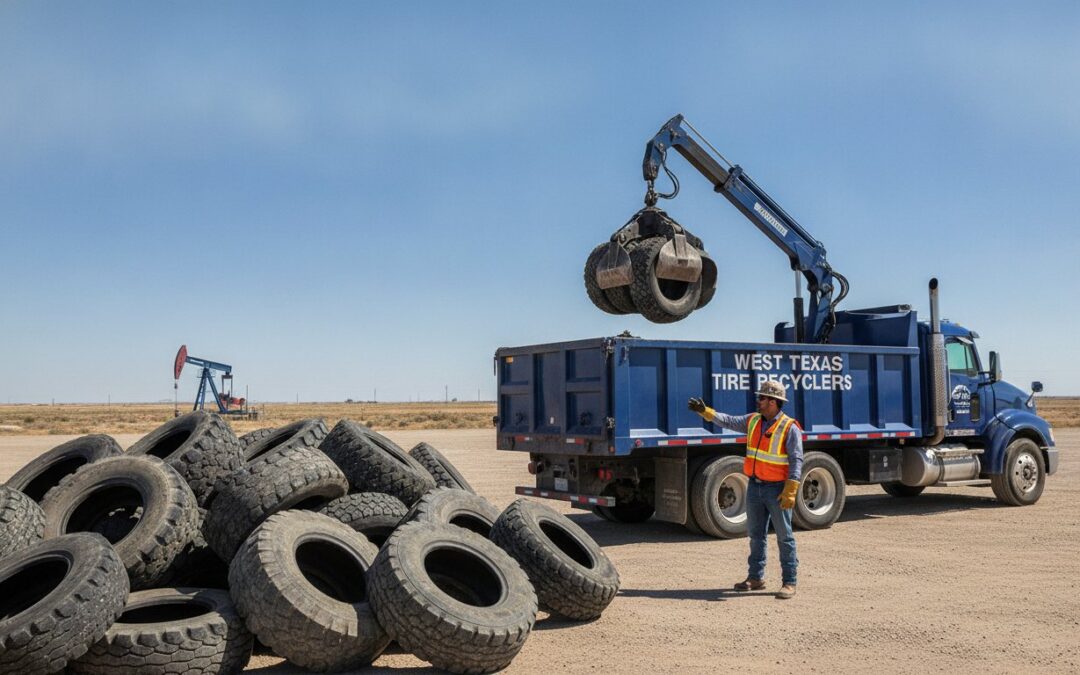
Did you know that there are currently over 11.6 million scrap tires sitting across 108 known sites in Texas? For businesses in Midland, Odessa, and Lubbock, managing a growing stockpile of heavy OTR or semi-truck tires is more than just a space issue. It’s a significant liability that invites fire hazards, mosquito breeding, and the very real risk of TCEQ fines. Relying on a professional local tire collection service is the most efficient way to protect your property and your bottom line.
We understand that you’d rather focus on your daily operations than worry about the logistics of hauling heavy rubber waste. This guide will help you understand the latest 2026 Texas reporting requirements and the critical role of the manifest system in maintaining environmental compliance. You’ll discover how a structured pickup schedule for scrap tires, conveyor belts, and industrial hoses can provide total peace of mind while keeping your West Texas business running smoothly.
Key Takeaways
- Learn why a professional local tire collection service is essential for avoiding heavy TCEQ fines and maintaining a safe, hazard-free workplace in West Texas.
- Understand the limitations of municipal landfills and why professional removal is the only viable option for bulk OTR and agricultural tires.
- Discover the legal importance of the Texas Scrap Tire Manifest and the specific record-keeping timeframe required to protect your business during an audit.
- Identify the full range of industrial rubber waste that can be removed, including specialized items like conveyor belts, skid steer tracks, and industrial hoses.
- Find out how to streamline your disposal process with a structured pickup schedule tailored to the specific needs of businesses in Midland, Odessa, and Lubbock.
Why Businesses Need a Reliable Local Tire Collection Service in West Texas
A professional local tire collection service is more than just a hauling company. It’s a specialized operation that ensures scrap tires and industrial rubber waste are transported and disposed of according to strict state guidelines. In the industrial hubs of Midland, Odessa, and Lubbock, businesses often find that managing these materials internally is a logistical nightmare. Scrap tires are heavy, difficult to stack, and frequently rejected by local municipal landfills unless they’ve been processed or shredded first.
Relying on a professional service keeps your commercial lot clear for daily operations. When your yard is cluttered with old semi-truck tires or agricultural rubber, it limits your team’s ability to move equipment and safely navigate the site. Beyond the physical space, there’s the high cost of “free” disposal. Many business owners in Lubbock County have learned the hard way that letting an unpermitted individual haul away tires for a low cash price often leads to illegal dumping. If those tires are traced back to your business, you’re the one facing the fines, not the person who dropped them in a ditch.
The Legal Burden of Scrap Tire Storage
The Texas Commission on Environmental Quality (TCEQ) maintains rigorous standards under Title 30, Chapter 328 of the Administrative Code. Non-permitted sites have strict limits on how many tires they can accumulate before they’re classified as an unauthorized storage facility. Local code enforcement in Midland and Odessa has tightened in recent years to prevent the growth of “legacy” tire piles. By partnering with a permitted hauler, you effectively transfer the liability of transport. We provide the necessary documentation to prove your waste was handled legally, which is your only real shield during a state audit.
Community Impact and Health Risks
Stockpiled tires are a significant health hazard in West Texas. The hollow shape of a tire is the perfect vessel for trapping stagnant rainwater. These small pools become primary breeding grounds for mosquitoes, which can spread West Nile virus and other diseases throughout the community. There’s also the extreme fire risk. Rubber stockpiles are notoriously difficult to extinguish once they ignite in the intense Texas heat. These fires release toxic smoke and can burn for weeks, leading to massive environmental cleanup costs. Once collected, these materials are processed using various tire recycling methods to ensure they don’t end up in unauthorized landfills or become a permanent blight on the Permian Basin landscape.
Comprehensive Rubber Waste Removal: From Passenger Tires to Industrial Belts
Many businesses assume that a local tire collection service only handles standard automotive waste. While we certainly manage high volumes of passenger and light truck tires, our capabilities extend much further into the industrial and agricultural sectors. In West Texas, where the oil field and farming industries drive the economy, specialized rubber removal is a necessity. Standard trash services and many municipal landfills simply aren’t equipped to handle reinforced rubber products or oversized tires. We bridge that gap by providing a reliable outlet for every type of scrap rubber your operation generates.
Industrial Rubber and Conveyor Belt Disposal
Industrial operations in the Permian Basin often generate waste that doesn’t fit into a standard category. Heavy-duty reinforced conveyor belts, for example, are incredibly difficult to dispose of because of their weight and the steel or fabric reinforcements built into the rubber. According to scrap rubber waste statistics provided by the EPA, rubber products outside of tires make up a significant portion of the material waste stream that requires specialized management. These items are often rejected by local trash collectors, leaving business owners with few options.
Our service includes the professional handling of:
- Scrap conveyor belts from industrial or mining sites.
- Industrial hoses used in oil field fluid transfer.
- Scrap skid steer tracks and solid forklift tires.
- General scrap rubber collections from manufacturing processes.
These materials require specialized hauling equipment and a deep understanding of disposal regulations. We ensure they don’t become a long-term liability for your company by providing the correct transport and documentation for every load.
Heavy Equipment and OTR Tire Collection
The logistics of moving Off-the-Road (OTR) tires are complex. Whether they’re from a construction site in Odessa or a large farm in the South Plains, these tires can weigh hundreds or even thousands of pounds. You can’t simply load them into a standard trailer. Our fleet is specifically designed to handle the removal of Agricultural and OTR heavy equipment tires safely and efficiently. This specialized capability is a core part of our local tire collection service, ensuring that even the largest scrap items are removed without disrupting your daily workflow.
Managing these large-scale items requires a professional approach to safety. We coordinate with site managers to schedule pickups that make sense for your operational timeline. If you’re dealing with a growing pile of oversized rubber, it’s worth checking out our scrap rubber collection options to see how we can clear your site quickly. Proper scheduling ensures that agricultural sites across the South Plains stay compliant with state regulations while keeping their land clear for production.
Comparing Professional Collection vs. Municipal Disposal in the Permian Basin
Many West Texas residents wait for annual “tire amnesty” days to clear out their garages. These municipal events are helpful for homeowners with four or five tires, but they aren’t a viable solution for businesses. Most city-run programs specifically exclude commercial waste and bulk quantities. If you show up to a local cleanup event with a trailer full of semi-truck tires, you’ll likely be turned away. Choosing a professional local tire collection service provides a level of predictability and scale that municipal events simply can’t match.
The convenience of on-site pickup is a major factor for businesses in Midland and Odessa. Self-hauling tires to a collection center requires significant labor, the right vehicle, and hours of downtime for your staff. When you factor in the cost of fuel and the potential for multiple trips, the “free” or low-cost municipal option quickly becomes expensive. Professional collection moves the logistics off your plate, allowing your team to stay focused on their primary jobs.
When to Choose Professional Collection
If your business has more than 10 tires on-site, it’s time to move beyond municipal options. Volume is the first threshold. Most city programs have strict per-person limits. Weight is another critical consideration. Handling semi-truck and OTR tires safely requires specialized equipment that most businesses don’t have. Finally, frequency matters. If your operation generates scrap rubber on a constant basis, waiting for an annual city cleanup isn’t an option. You need a partner that works on your schedule, not the city’s calendar.
Understanding Landfill Limitations
Landfills in the Permian Basin have strict rules regarding rubber waste. For example, the City of Midland landfill and others in the region often refuse whole tires. They frequently require tires to be quartered or shredded before they’re accepted. This processing takes time and specialized machinery that most businesses don’t own. There are also hidden costs to consider, such as tipping fees that can fluctuate based on the weight and type of material.
Choosing reliable tire disposal simplifies this entire process. Instead of worrying about whether your tires are processed correctly for landfill acceptance, you can let a professional hauler handle the details. We understand the specific requirements of regional disposal sites and ensure that your waste meets every standard. This professional approach eliminates the risk of being turned away at the landfill gate after a long drive.
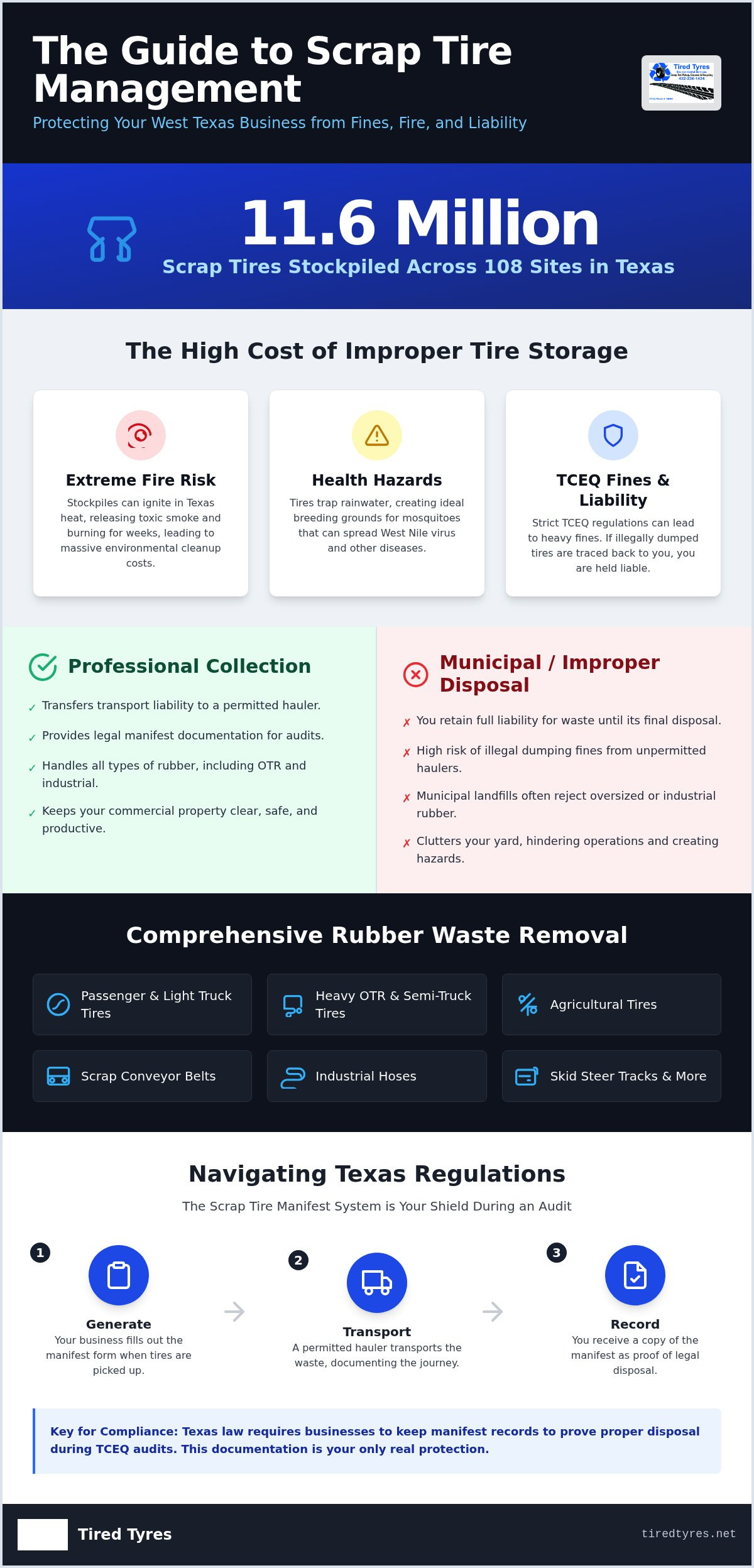
Navigating Texas Scrap Tire Regulations and Manifest Requirements
For any business in West Texas, the Texas Scrap Tire Manifest isn’t just another piece of paperwork. It’s your primary legal shield. This document tracks the movement of scrap tires from the moment they leave your property until they reach a permitted processing facility. If a state inspector visits your shop in Midland or your industrial site in Odessa, this is the first thing they’ll ask to see. Without a properly executed manifest from a permitted local tire collection service, you remain legally responsible for those tires, even after they’ve been hauled away.
Texas law is clear about record-keeping. Under Title 30, Chapter 328, Subchapter F of the Texas Administrative Code, businesses must maintain these records to prove compliance. For the 2026 calendar year, it’s vital to remember that generators must submit operational status reports by December 31st. Keeping your manifests organized and accessible ensures that you’re always ready for an audit and that your liability is clearly transferred to the hauler once the tires are in transit.
TCEQ Compliance for West Texas Businesses
Staying on the right side of the law requires an understanding of the latest Texas tire disposal regulations. These rules are designed to prevent the unauthorized stockpiling that has led to over 11 million scrap tires sitting in sites across the state. A manifest acts as a verified paper trail. It records the number of tires, the registration number of the hauler, and the signature of the receiving facility. Common pitfalls for auto shops often involve failing to verify that all sections of the manifest are complete before the driver leaves. A missing signature or an incorrect registration number can invalidate your compliance efforts.
Avoiding Illegal Dumping Penalties
It’s tempting to use an unpermitted “guy with a truck” who offers a lower price for disposal. This is a high-risk gamble that rarely pays off. If that individual dumps your tires in a Lubbock County ditch or an Odessa alleyway, the TCEQ will trace them back to you using the tire’s brand and wear patterns or other identifying markers. You’ll be the one facing the heavy fines and the damage to your brand’s reputation.
Always verify a hauler’s credentials before they load a single tire. A professional local tire collection service will openly provide their state registration and a valid manifest. Protecting your business from the fallout of illegal dumping is simple when you prioritize transparency and legal compliance. If you need a partner that takes these regulations as seriously as you do, you can schedule a compliant pickup with Tired Tyres today to secure your documentation. We ensure every load is handled with the precision that Texas law demands.
Scheduling Your Tire Pickup with Tired Tyres in Midland, Odessa, and Lubbock
Professional tire disposal is a necessity for West Texas businesses, but it doesn’t have to be a logistical burden. Our local tire collection service is designed to handle the high-volume needs of the Permian Basin and the South Plains. We’ve built our reputation on being a direct, reliable partner for industries that can’t afford to let scrap rubber pile up. Whether you’re managing a fleet of semi-trucks in Odessa or a large-scale agricultural operation near Lubbock, we have the specialized equipment required to move heavy OTR tires and industrial waste safely.
Getting started is a straightforward process. We don’t believe in wasting your time with complex marketing hurdles. When you reach out for a quote, we focus on the practical details. We’ll ask about your scrap rubber volume and the specific types of materials you need removed. Knowing whether we’re picking up passenger tires, scrap skid steer tracks, or reinforced conveyor belts allows us to dispatch the right crew and equipment for the job. This efficiency ensures that your site is cleared quickly and your daily operations remain uninterrupted.
Our Process: From Quote to Compliance
We’ve refined our workflow to be as efficient as possible, moving you from a cluttered lot to full legal compliance in three clear steps:
- Step 1: Volume Assessment. We begin with a volume assessment conducted either over the phone or through an on-site visit. We’ll identify the specific categories of waste, from agricultural tires to industrial hoses, to provide an accurate estimate.
- Step 2: Professional Loading and Hauling. Our experienced team handles all the heavy lifting. We use specialized trailers and loading techniques to manage OTR and semi-truck tires that standard trash services refuse to touch.
- Step 3: Provision of Manifests. Once the load is secured, we provide the necessary Texas scrap tire manifests. These documents are essential for your records and prove that your waste is headed to a permitted processing facility.
Serving Midland, Odessa, and Lubbock
Our deep knowledge of the West Texas industrial landscape sets us apart. We understand the unique challenges of the oil field and the seasonal demands of the agricultural sector. Our commitment goes beyond simple hauling; we’re dedicated to keeping our local communities clean and safe from the fire and health hazards associated with rubber stockpiles. We offer flexible scheduling, providing either one-time cleanups for legacy piles or recurring collection services for high-volume commercial sites. Don’t let scrap rubber become a liability for your business. Contact Tired Tyres for a pickup quote in Midland today and experience a local tire collection service that prioritizes your compliance and peace of mind.
Secure Your Compliance and Clear Your Site Today
Managing scrap rubber shouldn’t be a source of stress for your business. By choosing a reliable local tire collection service, you ensure that your property stays clean and your operations remain fully compliant with Texas state law. We’ve discussed how professional hauling protects you from the legal risks of illegal dumping and the physical hazards of stockpiled rubber. Whether you’re dealing with standard passenger tires or heavy industrial conveyor belts, the right partnership makes all the difference in maintaining a safe and efficient workplace.
Tired Tyres is a permitted Texas Scrap Tire Hauler with the specialized OTR and industrial rubber equipment needed to handle the toughest loads. We’re proud to serve the communities of Midland, Odessa, and Lubbock with a commitment to transparency and professionalism. Don’t let old rubber waste become a liability for your brand. Take the first step toward a hassle-free disposal process and guaranteed peace of mind.
Get a Professional Tire Collection Quote for Your West Texas Business and let our team handle the logistics while you focus on what you do best.
Frequently Asked Questions
Is there a limit to how many tires a local collection service can pick up?
There is no upper limit to the volume of rubber we can remove, though larger stockpiles require coordinated scheduling to ensure enough equipment is dispatched. Whether you have a dozen semi-truck tires or a legacy pile of hundreds, our local tire collection service can manage the entire removal process. We specialize in bulk removals for commercial lots and industrial sites that far exceed municipal amnesty limits.
Do you collect tires from oil field sites in the Permian Basin?
Yes, we provide regular collection for oil field sites throughout the Permian Basin and South Plains. Our fleet is equipped to handle the heavy OTR and semi-truck tires commonly found at drilling and production locations in Midland and Odessa. We understand the specific safety protocols and logistical challenges of oil field site access and can coordinate pickups that don’t disrupt your operations.
What happens to the tires after they are collected by Tired Tyres?
All collected materials are transported to state-permitted processing facilities for legal management. These tires are typically shredded or processed for use in various recycling methods, such as tire-derived fuel for cement kilns or civil engineering applications. We ensure every tire follows a documented path that complies with Texas environmental standards to protect your business from liability.
Can you pick up scrap conveyor belts and industrial hoses?
Yes, we accept scrap conveyor belts, industrial hoses, and solid skid steer tracks. These reinforced rubber products are often rejected by standard trash services because of their weight and the difficulty of processing them. We have the specialized equipment needed to load and haul these materials from industrial yards, manufacturing plants, and mining sites across West Texas.
How much does a commercial tire collection service cost in Lubbock?
Commercial collection costs vary based on the total volume of rubber and the specific types of tires being removed. Factors like the distance from the pickup site and the weight of industrial rubber also influence the final quote. It’s best to request a customized estimate to get an accurate assessment for your specific location in Lubbock or the surrounding areas.
Do I need to be present during the tire pickup?
It’s highly recommended that a representative be present to sign the Texas Scrap Tire Manifest at the time of pickup. This document is your primary proof of legal transfer, so ensuring it’s signed and filed is a critical compliance step for your records. If you can’t be on-site, we can make prior arrangements to handle the paperwork securely and provide your copy digitally or by mail.
Is Tired Tyres a permitted scrap tire hauler in the state of Texas?
Yes, Tired Tyres is a state-permitted scrap tire hauler operating under all necessary TCEQ registrations. We strictly follow the regulations established in the Texas Administrative Code, Title 30, Chapter 328. This means every pickup we perform includes a state-approved manifest, which serves as your legal protection during any environmental audit or local code enforcement inspection.
What is the difference between tire recycling and tire disposal?
Tire disposal is the broad process of legally removing and managing scrap rubber, while recycling refers to the specific methods used to repurpose that material into new products. A professional local tire collection service ensures that disposal leads to recycling whenever possible. Recycling can transform old tires into rubberized asphalt, playground mulch, or fuel, keeping waste out of unauthorized dumpsites and landfills.