
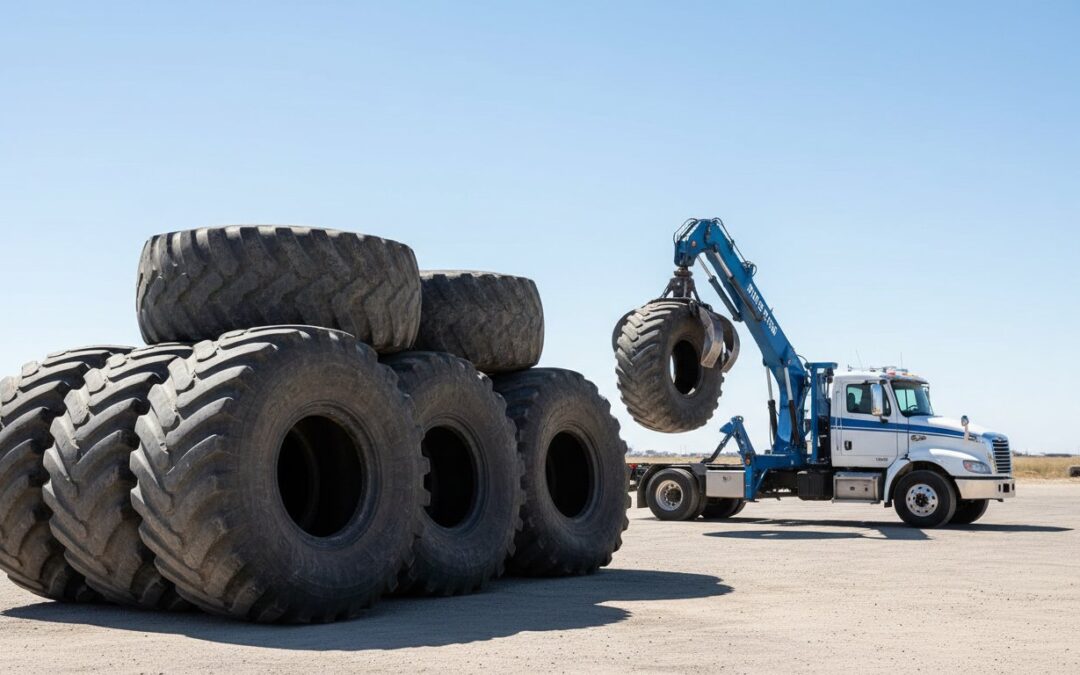
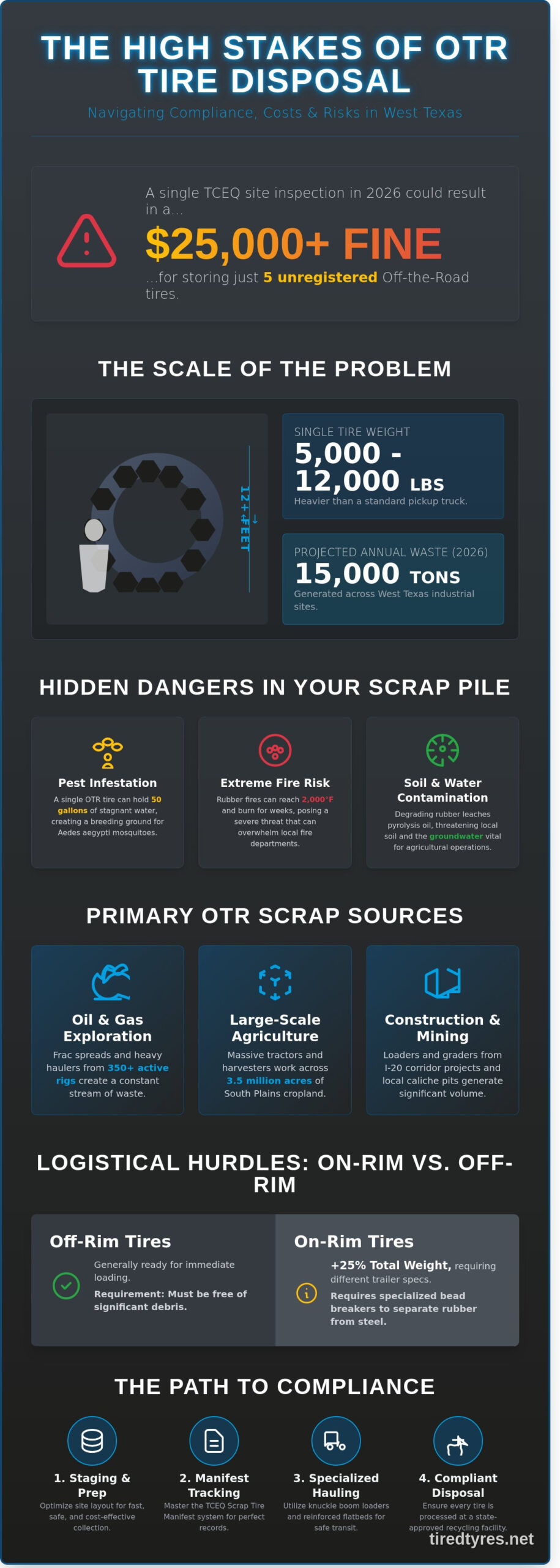
Storing just five unregistered off-the-road tires on your Odessa property can trigger TCEQ fines exceeding $25,000 during a 2026 site inspection. It’s a heavy price to pay for a problem that literally weighs over 1,000 pounds per unit. You likely feel the pressure of watching your yard space shrink while the risk of a paperwork error or a missed manifest keeps you up at night. Managing OTR tire collection shouldn’t feel like a gamble with your company’s reputation or its bottom line.
We’ll show you exactly how to handle heavy-duty disposal in Midland and Odessa without the usual logistical headaches. You’ll learn how to secure fixed-rate pricing and maintain perfect records that satisfy every state auditor. This guide covers the essential 2026 protocols for securing predictable costs, managing manifest tracking, and clearing your West Texas site with total confidence. We’ll help you ensure your operations remain lean, compliant, and focused on the job at hand instead of the scrap pile.
Key Takeaways
- Identify the specialized hauling equipment and logistical differences between on-rim and off-rim disposal for massive earthmoving machinery.
- Protect your business from legal liability by mastering the TCEQ Scrap Tire Manifest system and mandatory compliance standards.
- Optimize your site layout and staging techniques to ensure your next OTR tire collection is as fast, safe, and cost-effective as possible.
- Implement professional safety protocols to protect your staff during the high-risk process of loading heavy-duty industrial tires.
- Leverage local Permian Basin expertise to secure transparent, industrial-grade pricing tailored to West Texas operational needs.
What is OTR Tire Collection and Why Does West Texas Need It?
OTR stands for Off-the-Road. These aren’t your standard truck tires; they are the massive rubber giants found on 400-ton earthmovers, front-end loaders, and heavy agricultural equipment. In the Permian Basin, these tires are the backbone of the local economy. By 2026, industrial activity in West Texas is projected to generate over 15,000 tons of scrap OTR rubber annually. Because a single tire can stand 12 feet tall and weigh upwards of 5,000 pounds, managing this waste requires more than a simple dumpster. Professional OTR tire collection is the only way to keep industrial sites clear and compliant.
Standard municipal waste services in Midland and Odessa aren’t equipped for this scale. Most city garbage trucks have a maximum lift capacity of 500 to 1,000 pounds per bin. They can’t physically move an OTR tire, and local landfills often lack the permits to accept them. Managing these giants requires a specialized tire recycling process that involves heavy-duty loaders and specialized transport trailers. Tired Tyres provides this essential infrastructure, offering reliable collection services across Midland, Odessa, and the South Plains.
Common OTR Tire Sources in the Permian Basin
The demand for specialized disposal comes from three primary sectors in West Texas:
- Oil and Gas Exploration: Frac spreads and heavy haulers operating in the Delaware and Midland Basins consume massive amounts of rubber. As of 2025, over 350 active rigs in the region contribute to a constant stream of worn-out casings.
- Large-Scale Agriculture: The South Plains near Lubbock contains 3.5 million acres of cotton and cropland. The massive tractors and harvesters used here require specialized agricultural tire collection services when their tires reach the end of their service life.
- Construction and Mining: Infrastructure projects along the I-20 corridor and local caliche pits utilize loaders and graders that generate significant scrap volume.
The Environmental Risk of Abandoned OTR Tires
Leaving giant tires to rot on a job site creates immediate hazards. These massive casings act as super-habitats for pests. A single OTR tire can hold 50 gallons of stagnant rainwater, creating a breeding ground for Aedes aegypti mosquitoes. In the West Texas heat, these stockpiles also become extreme fire risks. A rubber fire involving OTR sizes can reach 2,000 degrees and burn for weeks, making it nearly impossible for local volunteer fire departments to extinguish. Over time, degrading rubber also risks leaching pyrolysis oil into the local soil, potentially contaminating the groundwater that 100% of our local agricultural operations depend on.
The Logistics of Heavy-Duty OTR Tire Disposal
Moving a single earthmover tire isn’t a task for standard equipment. These components can weigh up to 12,000 pounds and stand over 12 feet tall. Effective OTR tire collection requires a fleet of specialized knuckle boom loaders and reinforced flatbeds capable of handling concentrated weight. Since the 2025 update to Texas hauling regulations, load securement has become even more rigorous. We use industrial-grade chains and custom racking systems to ensure these massive rubber loads don’t shift during transit across the Permian Basin.
The logistics of OTR tire disposal change significantly based on whether the tire is on-rim or off-rim. Off-rim tires are generally ready for immediate loading, provided they’re free of debris. On-rim tires present a different challenge. They require specialized bead breakers and hydraulic presses to separate the rubber from the steel. If you’re looking to salvage the rim for reuse, the separation must happen on-site or at a dedicated facility. If the rim is also scrap, the total weight of the pickup increases by roughly 25 percent, requiring different trailer specifications.
Site productivity depends on clear workspaces. Accumulated scrap tires aren’t just an eyesore; they’re a safety hazard that can obstruct heavy machinery. We focus on scheduled pickups to keep your operations moving. Most OTR tire collection cycles in the Odessa area are now managed through 30-day or 60-day rotations to prevent inventory buildup. Maintaining a clean yard prevents safety hazards and keeps your site compliant with local environmental codes. You can schedule a site assessment to clear your inventory before it impacts your daily workflow.
Sizing Up Your OTR Scrap: What We Collect
- Standard Earthmover Tires: We handle all 25-inch rim sizes and up, commonly found on loaders and graders.
- Giant OTR Tires: This includes the 57-inch and 63-inch tires used in heavy mining and quarry work near the New Mexico border.
- Agricultural Tires: We recover large-diameter tires from tractors and combines, specifically serving the high-volume farming regions near Lubbock.
Transportation Challenges in West Texas
Navigating the oilfield lease roads surrounding Odessa requires experienced drivers and rugged equipment. These roads are often unpaved and can become impassable for standard trucks after heavy rain. We utilize 4×4 recovery vehicles to reach remote sites where tires are often abandoned near wellheads. Coordinating logistics for a bulk site cleanup, which can involve moving over 50 tons of rubber, requires a different strategy than a single-tire emergency pickup. Each load is mapped to avoid weight-restricted bridges, ensuring the 150-mile transport corridor between Midland and specialized processing centers remains safe and efficient.
TCEQ Compliance: Protecting Your Business from Liability
The Texas Commission on Environmental Quality (TCEQ) strictly regulates how every scrap tire moves across Midland and Odessa. If your business generates waste tires, you’re legally classified as a “generator.” This means you’re responsible for those tires until they reach an authorized processing site. Failing to follow Texas Administrative Code Title 30, Chapter 328, isn’t a minor clerical error; it’s a significant liability that can lead to heavy state intervention. Engaging in OTR tire collection without a verified, permitted partner leaves your company’s reputation and bank account vulnerable.
The 2026 Texas Scrap Tire Regulations
Current 2026 regulations mandate that commercial tire generators keep all scrap tire manifests, specifically TCEQ Form 10311, for a minimum of 3 years. These records are your only proof that your waste didn’t end up in a West Texas gully or an unauthorized landfill. Under Texas Health and Safety Code Section 365.012, illegal dumping is a criminal offense. It covers any tire disposal at a site that isn’t specifically permitted by the state. You should never let a hauler touch your inventory until you’ve verified their TCEQ registration number through the state’s Central Registry database. If they can’t produce a valid, active registration, they aren’t a legal hauler.
Liability Beyond the Gate
Your responsibility follows the tire long after the truck leaves your sight. In Texas, the “cradle to grave” rule means you’re financially liable for cleanup costs if your tires are dumped illegally by a third party. Avoid the “Solar Cowboy” hauler trap common in the Permian Basin. These unpermitted operators often disappear at the first sign of trouble, leaving you with the bill. Fines for non-compliance regularly range from $500 to $10,000 per day for each violation.
Tired Tyres eliminates this risk by acting as a fully permitted partner. We provide a complete, transparent paper trail for every OTR tire collection service we perform. Our team handles all necessary documentation and ensures every tire reaches a permitted facility. We focus on the details so you can focus on your operations, knowing your business is protected from environmental lawsuits and surprise state inspections.
Preparing for Your OTR Tire Collection in Midland or Odessa
Preparing your site for an OTR tire collection ensures the process stays on schedule and avoids extra labor fees. In West Texas, where space is often plentiful but ground conditions vary, proper staging is the difference between a 45-minute pickup and a three-hour ordeal. Efficiency isn’t just about speed; it’s about maintaining a professional environment that respects your staff’s time and our drivers’ safety.
Staging and Accessibility Tips
Our drivers use heavy-duty cranes to lift units that often weigh over 2,500 lbs. You need to maintain a 25-foot “clear zone” around the tire pile. This area must be free of overhead power lines, debris, and parked vehicles. Grouping your inventory by size also speeds up the process. For example, separating giant earthmover tires from standard 24.5-inch semi tires can reduce loading times by 20% or more. Ensure your site contact is available via phone and that all gate codes for remote Midland yards are provided 24 hours in advance. Tired Tyres equipment requires a minimum 40-foot turning radius to navigate safely through industrial lots.
Documentation and Inventory Management
Accurate record-keeping protects your business during an OTR tire collection. As of January 2026, environmental regulations in Ector and Midland counties require stricter tracking of industrial waste. Start by creating a physical count before the truck arrives. We recommend taking three high-resolution photos of the pile from different angles. This serves as proof of the initial volume for your internal environmental audits. When the driver arrives, compare your count to the manifest immediately. Don’t wait until the truck is loaded to verify the numbers, as it’s much harder to double-check once the units are stacked on the trailer.
Safety is our priority during every pickup. Site staff should stay at least 50 feet away while the crane is in operation. Once the loading is complete, verify the final manifest signature. This document is your legal proof that the tires were handled by a licensed professional. If you’re ready to clear out your yard, schedule your professional OTR tire collection today to ensure your site stays compliant and organized.
Why Tired Tyres is the Trusted Choice for West Texas OTR Disposal
Tired Tyres is built on Midland soil. We don’t operate from a remote office three states away; we live and work in the Permian Basin. This local focus means we understand the specific pressures of the West Texas oil and gas industry. Our 2026 operational strategy prioritizes a no-nonsense pricing model. You won’t find hidden fuel surcharges or complex disposal fees here. We provide flat-rate quotes that allow industrial managers to budget accurately for OTR tire collection without surprises. We’re professional, direct, and focused on getting the job done right the first time.
Serving the Entire West Texas Region
Our fleet covers a 160-mile radius from the Midland-Odessa metro area. Whether your site is near the heart of the city or on the outskirts of Lubbock, we’ve got you covered. We maintain a 48-hour rapid response window for critical oilfield site remediations. For our high-volume commercial partners, we offer customized collection intervals. These schedules ensure your yard stays clear and meets all state environmental safety regulations without you having to call for every pickup.
Beyond OTR: A Comprehensive Rubber Waste Solution
Managing an industrial site means dealing with more than just tires. We’ve expanded our capacity to handle mixed loads. We regularly process scrap skid steer tracks, heavy-duty industrial hoses, and passenger tires in a single haul. For facilities in the South Plains, we provide specialized conveyor belt removal services. In the last year alone, we helped 45 local firms clear over 600 tons of mixed rubber debris. Fleet managers dealing with large volumes of commercial casings can also benefit from our semi-truck tire disposal services that complement our OTR capabilities. For farming operations managing large tractor and combine tires, our agricultural tire collection in Midland, Odessa & Lubbock provides specialized solutions for the unique challenges of farm equipment disposal. See our full range of scrap rubber services to find a solution that fits your specific inventory.
Don’t let scrap rubber become a liability for your operation. Accumulated tires are fire hazards and magnets for local pests. They clutter your workspace and slow down your crew. It’s time to clean up your site. Contact Tired Tyres today for a professional OTR tire collection and secure your business for the year ahead. We’ll handle the heavy lifting so you can focus on your core operations.
Secure Your Permian Basin Site Today
Managing large-scale rubber waste in the Permian Basin doesn’t have to be a liability for your daily operations. By 2026, stricter TCEQ environmental standards mean that documented disposal is no longer optional for industrial sites. Tired Tyres provides a streamlined OTR tire collection service that handles the heavy lifting so your team can focus on production. As a TCEQ Permitted Hauler with local Midland and Odessa ownership, we understand the unique demands of West Texas oilfields and construction zones. We utilize specialized heavy-lift equipment to safely move tires that weigh over 5,000 pounds, ensuring your site stays clear and compliant with all state regulations. Don’t risk heavy fines or safety hazards when professional help is a single click away. Our team combines technical precision with local accountability to solve your disposal challenges quickly and effectively. You’ll get a transparent process and a partner who treats your site’s safety as a top priority. We’re ready to clear your yard and protect your business interests.
Get a Fast OTR Collection Quote for Your West Texas Site
Frequently Asked Questions
Is it legal to bury OTR tires on my property in Texas?
No, it’s illegal to bury OTR tires on your property under Texas Administrative Code Title 30, Chapter 328. TCEQ regulations require all scrap tires to be transported to authorized processing or disposal facilities. Violating these rules can result in state fines starting at $5,000 per day. We ensure your site stays compliant by documenting every step of the removal process professionally.
How much does OTR tire collection cost in Midland?
OTR tire collection costs in Midland typically range from $150 to $850 per tire based on the weight and specific dimensions. A standard 25-inch loader tire usually costs around $325 for removal and certified processing. We provide fixed quotes within 24 hours of receiving your inventory list. This transparency helps you manage your site maintenance budget without facing hidden disposal surcharges later.
Do you provide TCEQ manifests for every OTR tire pickup?
Yes, we provide a completed TCEQ Form 00309 manifest for every single pickup we perform. This document serves as your legal proof that the tires were handled by a registered transporter and delivered to a licensed facility. We keep digital copies on file for 3 years to ensure you’re always ready for a state environmental audit or a routine site inspection.
Can you pick up OTR tires that are still on the rims?
We pick up OTR tires still mounted on rims using our specialized 20-ton hydraulic lifting equipment. There’s an additional handling fee of $75 per wheel for this service because of the extra weight and labor involved. Our team handles the heavy lifting, so you don’t need to worry about demounting massive earthmover tires before we arrive at your yard or job site.
What is the maximum size of OTR tire you can collect?
We collect OTR tires up to 63 inches in diameter, including the massive 59/80R63 sizes used on ultra-class mining trucks. Our fleet includes heavy-duty flatbeds and specialized loaders capable of moving units weighing over 10,000 pounds. Whether you have standard grader tires or the largest haul truck rubber in the Permian Basin, we have the mechanical capacity to haul it safely.
Do you offer bulk discounts for site cleanups in Odessa?
We offer a 15% discount on collection fees for site cleanups in Odessa involving 10 or more OTR tires. For large-scale projects with over 50 units, we provide custom project pricing that can reduce total disposal costs by up to 25%. These bulk rates help oilfield operators and construction firms clear their yards efficiently while maintaining high environmental standards and local compliance. For businesses looking to establish a regular maintenance routine, consider setting up a scheduled tire pickup Odessa service to prevent accumulation and ensure consistent compliance.
How quickly can you schedule a pickup for an oilfield site?
You can typically schedule an oilfield pickup within 48 hours of your initial request. We understand that Permian Basin operations move fast, so we keep 2 dedicated crews available for rapid site clearances. If you call our office before 10:00 AM, we can often provide same-day assessments for urgent OTR tire collection needs across Ector and Midland counties.
What happens to the OTR tires after they are collected?
Collected tires go to a licensed processing facility where they’re shredded or repurposed for industrial use. Approximately 70% of the rubber from Permian Basin OTR tires is converted into Tire Derived Fuel or used in rubberized asphalt for Texas highway projects. This process prevents tires from becoming fire hazards or breeding grounds for pests in local landfills while supporting a circular economy.