
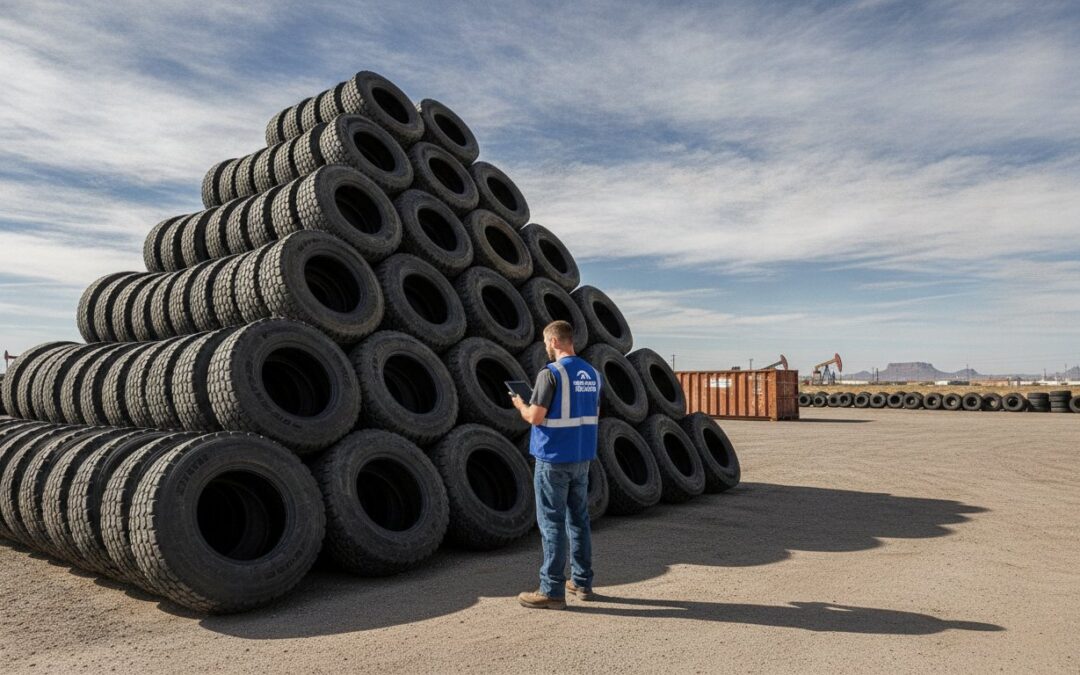
In 2025, the Texas Commission on Environmental Quality (TCEQ) issued over $2.4 million in penalties for improper scrap tire management. For many West Texas business owners, these fines are a constant worry, especially when scrap piles eat up valuable yard space and hauler pricing feels completely opaque. You might feel that getting a better price on commercial tire disposal is a matter of luck or who you know. It isn’t. It’s about understanding the logistics system and managing your inventory before the hauler even arrives.
We know that managing waste shouldn’t be the hardest part of your work week. You want a reliable pickup schedule and fees that don’t fluctuate wildly every month. This article will show you how to transform your tire disposal from a chaotic expense into a predictable operational strategy. We’ll explore specific negotiation tactics, internal volume management, and the manifest tracking steps necessary to keep your business fully TCEQ-compliant while lowering your total overhead. By the end of this guide, you’ll have a clear roadmap for reducing costs and reclaiming your storage space.
Key Takeaways
- Identify the specific preparation steps, such as rim removal and lacing techniques, that can slash your disposal fees before the truck even arrives.
- Learn how aligning your pickup schedule with existing hauler routes in the Permian Basin is a proven tactic for getting a better price on commercial tire disposal.
- Understand how West Texas geography affects fuel surcharges and how businesses with multiple locations in Midland and Odessa can secure volume discounts.
- Avoid common pitfalls like “heavy tire” surcharges by managing water accumulation and preventing mixed-load rejections at the landfill.
- Discover how transparent manifest tracking and flat-rate pricing models eliminate the risk of surprise TCEQ fines and hidden fees.
Understanding the Factors That Drive Commercial Tire Disposal Costs
Disposal fees aren’t arbitrary. They are built from four primary components: transportation, labor, processing, and tipping fees. In West Texas, geography dictates a significant portion of your bill. A shop in Midland often faces different fuel surcharges than a facility in Lubbock because haulers must account for the distance to the nearest permitted landfill or processing center. The tire recycling process requires specialized machinery, especially for OTR and agricultural tires. These oversized tires carry a premium because they can’t be handled by standard equipment and often require manual breakdown before they can be shredded.
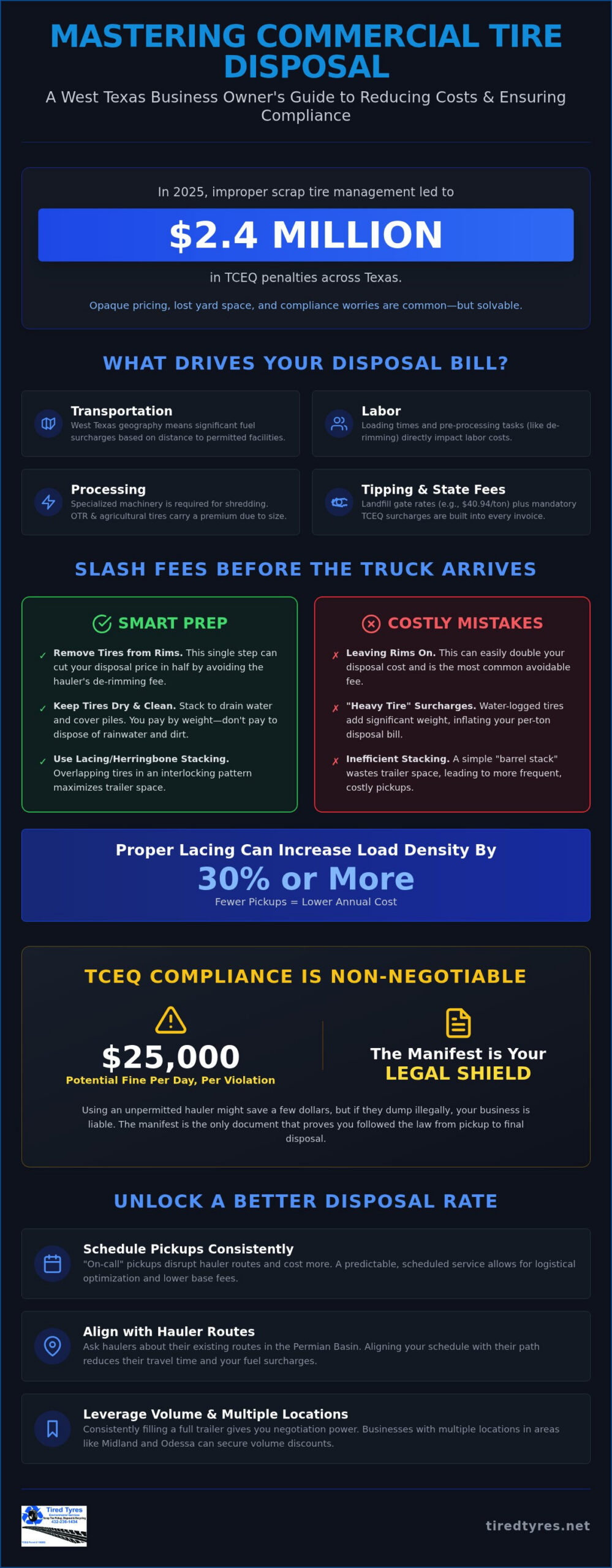
Getting a better price on commercial tire disposal starts with understanding these logistics. For example, the gate rate at the West Texas Regional Disposal Facility in Abernathy is $40.94 per ton as of June 2026. This includes a mandatory TCEQ surcharge. If your hauler has to drive 100 miles to reach this facility, that fuel and time will be reflected in your invoice. Illegal dumping might seem like a way to dodge these costs, but the hidden risks can bankrupt a local business through massive environmental cleanup liabilities and legal fees.
The Role of Volume and Frequency in Pricing
Haulers prefer predictability. “On-call” pickups often carry a higher base fee because they disrupt optimized routes. By contrast, a scheduled route allows a hauler to plan their day, reducing their overhead. Most providers consider a “load” to be a specific volume threshold, such as a full box truck or trailer. If you can consistently generate enough volume to fill a trailer, you gain leverage. This consistency lets haulers optimize their logistics, which is the most effective way of getting a better price on commercial tire disposal over the long term.
TCEQ Compliance and the Cost of Legality
The Texas Commission on Environmental Quality (TCEQ) is the state agency responsible for overseeing the legal collection, transportation, and disposal of scrap tires to prevent environmental hazards. They mandate a scrap tire manifest system to track every tire from your shop to the final disposal site. This paperwork is your primary defense against liability.
Using unpermitted haulers might save a few dollars today, but the long-term risk is extreme. In 2025, the TCEQ issued over $2.4 million in penalties for improper management. In April 2026 alone, they approved an additional $1.4 million in fines against 88 entities. If an unauthorized hauler dumps your tires illegally, the manifest is the only thing proving you followed the law. Without it, your business could face fines as high as $25,000 per day.
Preparation Strategies: How to Lower Your Fees Before the Truck Arrives
You don’t need expensive baling equipment to reduce your waste costs. While some competitors suggest investing in $20,000 machinery, most West Texas shops can achieve better results through simple manual prep. The work your team does before the truck arrives is the most direct way of getting a better price on commercial tire disposal. By focusing on load density and material purity, you remove the labor hurdles that haulers usually charge extra to handle.
One of the biggest cost-drivers is leaving tires on rims. This can easily double your disposal price because it requires the hauler to use specialized de-rimming equipment before processing. Similarly, allowing water, dirt, or debris to collect in your scrap pile adds significant weight. Since many facilities charge by the ton, you’re effectively paying for the disposal of West Texas rainwater. If you need to verify your internal weights to avoid billing discrepancies, you can check out Industrial Scale & Measurement for professional scale calibration. Keeping your pile covered or stacked to drain prevents these “heavy tire” surcharges and keeps you clear of mosquito-related health violations.
Maximizing Load Density Without Heavy Machinery
The way you stack tires determines how many trips the hauler has to make. A standard “barrel stack” (vertical columns) is easy to build but leaves too much empty air in the trailer. Instead, train your staff on the “herringbone” or lacing technique. This involves overlapping tires in an interlocking pattern. Lacing can increase your load density by 30% or more, allowing you to fit more inventory into a single pickup. Incorporating this into your daily shop cleanup ensures the pile is always ready for a high-efficiency load-out. If you are managing a large volume of inventory, reviewing a commercial tire disposal guide can help you refine these internal processes.
Handling Specialty Rubber Waste
Mixing different types of rubber waste is a common mistake that leads to “mixed load” surcharges. Separating your passenger tires from semi-truck tires and OTR (Off-the-Road) tires allows the hauler to bypass the sorting stage at their facility. This is especially true for industrial items like scrap skid steer tracks and conveyor belts. These heavy, awkward items require different handling than standard tires. By keeping specialty rubber in its own designated area, you make the pickup faster and more predictable for the driver. For businesses in the Permian Basin, maintaining a clean, sorted inventory is the first step toward securing transparent flat-rate pricing that fits your specific business needs.
Negotiating Your Disposal Contract: 5 Steps to a Better Rate
Switching haulers every week based on the lowest quote is a strategy that often backfires. It ignores the value of long-term reliability and leaves your business vulnerable to compliance gaps. Getting a better price on commercial tire disposal is about building a partnership that reduces the hauler’s operational friction. If your business operates multiple shops, start by requesting a multi-site discount. Bundling your Midland and Odessa locations into one service agreement reduces administrative overhead for the hauler and gives you significant leverage during price talks.
You should also look for “backhaul” opportunities. This means aligning your pickup schedule with the hauler’s existing routes in your area. When a truck is already nearby, the provider saves on fuel and driver time, which can translate into a lower rate for you. Additionally, leverage your internal management. If you follow the lacing and sorting techniques discussed in previous sections, offer a “Clean Load” guarantee. By promising sorted, rim-free tires, you remove the labor costs the hauler would otherwise face at their facility.
Don’t overlook the importance of auditing your invoices. Some providers tack on vague “miscellaneous” or “environmental” fees that aren’t actually required by the TCEQ. Question these line items immediately. A professional hauler will provide a transparent breakdown of every charge and shouldn’t hide behind opaque surcharges.
What to Ask a Potential Tire Hauler
Before signing any contract, ask for the hauler’s TCEQ registration number. Verify that they are authorized to transport scrap tires and that they provide a completed manifest at the moment of collection. This manifest is your legal shield. You should also ask if they can offer a fixed price per tire for 12 months. Locking in a rate protects your bottom line from the volatility of fuel prices and disposal gate rate increases.
The Value of a Service Agreement
Moving from a “pay-as-you-go” model to a consistent service agreement is a game-changer for your operations. It ensures a reliable tire disposal schedule, which prevents scrap piles from becoming a liability. When tires sit too long, they collect water and attract pests, often leading to emergency pickup fees that destroy your budget. A subscription-style model provides predictable monthly costs and is one of the most effective methods for getting a better price on commercial tire disposal while staying fully compliant. If you operate in other regions and need similar reliability, you can discover Red Kite Recycling | Business Waste Management Solutions for bespoke waste management throughout the UK.
Common Pitfalls That Inflate Commercial Disposal Costs
Small operational oversights often lead to massive surcharges that shop owners don’t expect. One of the most frequent mistakes is allowing water to collect in scrap piles. A single gallon of water weighs over eight pounds; a tire half-full of West Texas rainwater can easily double in weight. Since many processing facilities and landfills charge by the ton, you’re effectively paying for the disposal of water. This single oversight can destroy your chances of getting a better price on commercial tire disposal, regardless of how well you negotiated your base rate.
Mixing different materials is another costly error. If you combine industrial rubber waste, like scrap hose or conveyor belts, with a standard load of passenger tires, many landfills will reject the entire shipment. Those that do accept mixed loads often apply the highest possible rate to the total weight. Similarly, leaving tires in an unsecured “curb-side” area is a major risk. People often see an existing scrap pile as an invitation to drop off their own waste tires under the cover of night. You end up paying the disposal fees for tires your business never even touched.
The Hidden Dangers of Scrap Tire Stockpiles
Waiting until your yard is overflowing before calling for a pickup is a recipe for financial disaster. Massive stockpiles are often reclassified as “remediation” projects, which carry much higher labor and equipment fees than routine collection. Beyond the cost, these piles are significant fire hazards. Tire fires are notoriously difficult to extinguish and can lead to millions of dollars in environmental cleanup costs and civil litigation. Additionally, standing water in tires attracts mosquitoes, which can trigger immediate fines from local health departments. You can learn more about managing these risks in our guide on waste tire problems in the Permian Basin.
Why “Free” Disposal is Often the Most Expensive Option
If a hauler offers to take your scrap tires for free or at a price that seems too good to be true, it’s likely a scam. In Texas, the “generator” of the waste is legally responsible for its final destination. If a “fly-by-night” hauler takes your tires and dumps them in a ravine or an abandoned lot, the TCEQ will trace those tires back to your shop. The resulting fines can reach $25,000 per day per violation. Getting a better price on commercial tire disposal should never involve sacrificing the manifest system. A professional collection fee is a fraction of the cost of a legal defense. For secure, compliant hauling that protects your business, schedule a professional tire collection today.
Tired Tyres: Transparent Pricing for West Texas Businesses
Reliability in the Permian Basin isn’t just about showing up; it’s about providing a service that doesn’t surprise you with hidden fees. Tired Tyres offers a straightforward, flat-rate pricing model that eliminates the guesswork from your monthly overhead. We understand that getting a better price on commercial tire disposal is a priority for high-volume shops in Odessa and Lubbock. That’s why we focus on operational efficiency and volume-based scheduling rather than opaque surcharges. Whether you manage a fleet of semi-trucks or a large agricultural operation, our team provides the specialized equipment necessary to handle heavy OTR and machinery tires safely.
Compliance is the cornerstone of our service. Every pickup we perform includes full TCEQ manifest documentation. This paperwork is your proof that your scrap tires were handled legally and responsibly. We don’t just move rubber; we protect your business from the significant penalties issued by the state for improper waste management. For shops with high-turnover inventory, we offer customized collection schedules. This prevents the “pile-up” emergencies discussed earlier and keeps your workspace clear and safe for your employees.
Comprehensive Rubber Waste Solutions
Our expertise extends beyond standard tire collections. We serve the unique needs of the West Texas oilfield by providing specialized disposal for industrial rubber waste. This includes scrap skid steer track collection, scrap hose collection, and scrap conveyor belt collection. These items often require different handling and disposal routes than passenger tires. By offering a single point of contact for all your rubber waste, we simplify your logistics and help you maintain a clean, compliant site. If you are specifically looking for tire disposal Midland TX services, our local experts are ready to assist with a plan tailored to your volume.
Get a Custom Quote Today
Obtaining an accurate estimate is a simple process. Before you call, we recommend having a rough count of your inventory separated by type. Knowing how many passenger, semi-truck, or OTR tires you have allows us to provide a precise over-the-phone quote. Our service area covers the heart of the Permian Basin and extends through the South Plains to Lubbock. We’re dedicated to providing the most efficient route for your business, ensuring that getting a better price on commercial tire disposal is a reality, not just a goal. Contact Tired Tyres today to schedule your first pickup and experience a professional, transparent approach to waste management.
Optimize Your Operations and Protect Your Bottom Line
Managing scrap rubber doesn’t have to be a source of constant stress or unpredictable expenses. By implementing the stacking techniques and rim removal strategies we’ve discussed, you’ve already taken the most important steps toward getting a better price on commercial tire disposal. These internal adjustments, combined with a consistent pickup schedule, transform your waste management from a reactive chore into a streamlined operational process. It’s about working smarter with your inventory before the truck even pulls into your yard.
Tired Tyres is here to ensure that your business stays compliant and efficient. As an authorized TCEQ Permitted Hauler serving Midland, Odessa, and Lubbock, we bring specialized equipment for OTR and industrial rubber waste directly to your site. We provide the manifest documentation you need to avoid heavy fines while offering the transparent, flat-rate pricing you deserve. Don’t let scrap piles take over your workspace or your budget. Get a custom commercial tire disposal quote for your West Texas business today and start reclaiming your yard with a partner you can trust.
Frequently Asked Questions
How much does commercial tire disposal cost in Midland, TX?
Commercial tire disposal costs depend on the tire size and the total volume of the load. While gate rates at regional facilities provide a baseline, haulers also factor in transportation and labor costs. To ensure you are getting a better price on commercial tire disposal, it’s best to provide a specific count of passenger, semi-truck, and OTR tires when requesting a quote. This helps avoid “mixed load” surcharges that inflate the final invoice.
What is a scrap tire manifest and do I really need one?
A scrap tire manifest is a state-mandated tracking document that records the movement of tires from your facility to a permitted disposal site. You absolutely need one for every transaction. It serves as your legal proof of compliance if the TCEQ audits your business. Without a completed manifest, your business remains liable for the tires even after they leave your property, which could lead to significant fines.
Can I dispose of semi-truck tires at a local landfill in Odessa?
You generally cannot dispose of whole semi-truck tires at municipal landfills in Texas. TCEQ regulations require tires to be split, quartered, or shredded before they are accepted at a landfill. Many local facilities in the Permian Basin don’t have the equipment to process these tires on-site. Using a professional hauler ensures your tires are processed correctly before they reach their final destination, saving you from rejection fees.
How can I tell if a tire hauler is legally permitted by the TCEQ?
You can verify a hauler’s status by asking for their TCEQ registration number and checking it against the state’s database. Legitimate haulers will always have this number readily available and will provide a signed manifest at the time of pickup. If a hauler cannot prove they are permitted, they are likely operating illegally. Using unpermitted haulers exposes your business to civil penalties that far outweigh any potential savings on collection fees.
Do you charge extra for tires that are still on the rims?
Yes, leaving tires on rims significantly increases the disposal cost. This is because the hauler must use specialized equipment to remove the rim before the tire can be shredded or recycled. Removing rims yourself before the truck arrives is one of the easiest ways of getting a better price on commercial tire disposal. It reduces the labor required at the processing facility and allows for more efficient stacking in the trailer.
What happens if I just leave my scrap tires in a locked dumpster?
Leaving tires in a dumpster is considered illegal dumping and can lead to severe legal consequences. Dumpster providers usually refuse to empty bins containing tires, and you may face “contamination” surcharges. Beyond the legal risk, tires in dumpsters trap heat and water, creating a major fire hazard and a breeding ground for mosquitoes. This can trigger health department inspections and fines that exceed the cost of professional collection.
Is there a discount for bulk agricultural tire disposal in Lubbock?
High-volume loads, such as those from large agricultural operations in Lubbock, often qualify for volume-based pricing. Haulers can optimize their logistics more effectively when they can pick up a full trailer load from a single location. If you have a large quantity of tractor or machinery tires, it’s beneficial to schedule a dedicated bulk pickup. This reduces the per-tire cost compared to smaller, frequent on-call services.
How do I properly stack tires to reduce my collection fee?
The most effective way to stack tires is using the “herringbone” or lacing method. This involves overlapping the tires in an interlocking pattern to eliminate empty space. Proper stacking allows the hauler to fit more tires into a single load, reducing the number of trips required. Training your staff to lace tires during their daily cleanup ensures your pile is always ready for a high-density, low-cost pickup.