
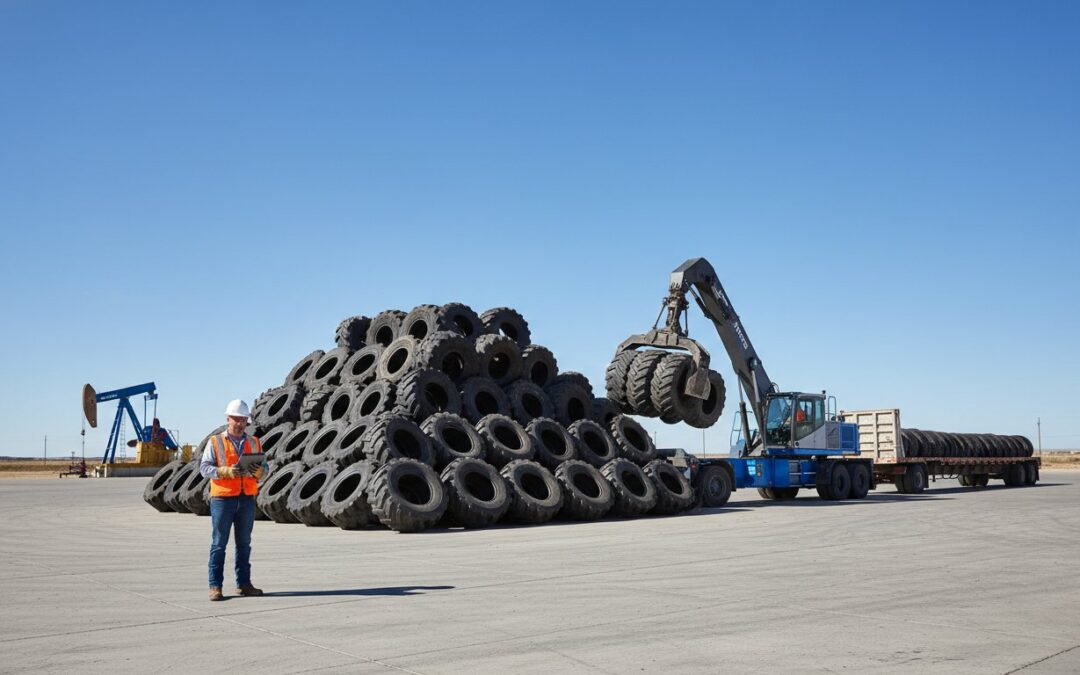
A single misfiled manifest in Midland can result in a $50,000 fine from the Texas Commission on Environmental Quality (TCEQ). It’s a staggering cost for a clerical error that takes only minutes to occur. If you’re operating an industrial site or a fleet in West Texas, you likely feel the pressure of keeping up with texas tire disposal regulations while managing your daily operations. We know the paperwork is a headache, especially when local options for massive OTR and industrial tires are limited in the Permian Basin.
You shouldn’t have to risk your business’s reputation or bank account because of confusing state mandates. This 2026 guide breaks down the latest scrap tire laws so you can master TCEQ compliance without the stress. We’ll show you how to handle manifest documentation for audits and where to find efficient removal services in Odessa and Lubbock. By the end of this article, you’ll have a clear plan to clear your bulk tire piles legally and permanently.
Key Takeaways
- Learn how to navigate the latest texas tire disposal regulations to ensure your West Texas business stays fully compliant with TCEQ standards.
- Discover the critical “500 Tire Rule” and specific storage requirements that determine whether your facility needs official state registration.
- Protect your company from devastating daily fines and potential criminal liability by identifying the high costs of non-compliance and illegal dumping.
- Master the practical steps for classifying rubber waste and verifying that your hauler is legally permitted to operate in Midland, Odessa, and Lubbock.
- Find out how professional manifest management can simplify your record-keeping and provide total peace of mind during state inspections.
Understanding Texas Tire Disposal Regulations in 2026
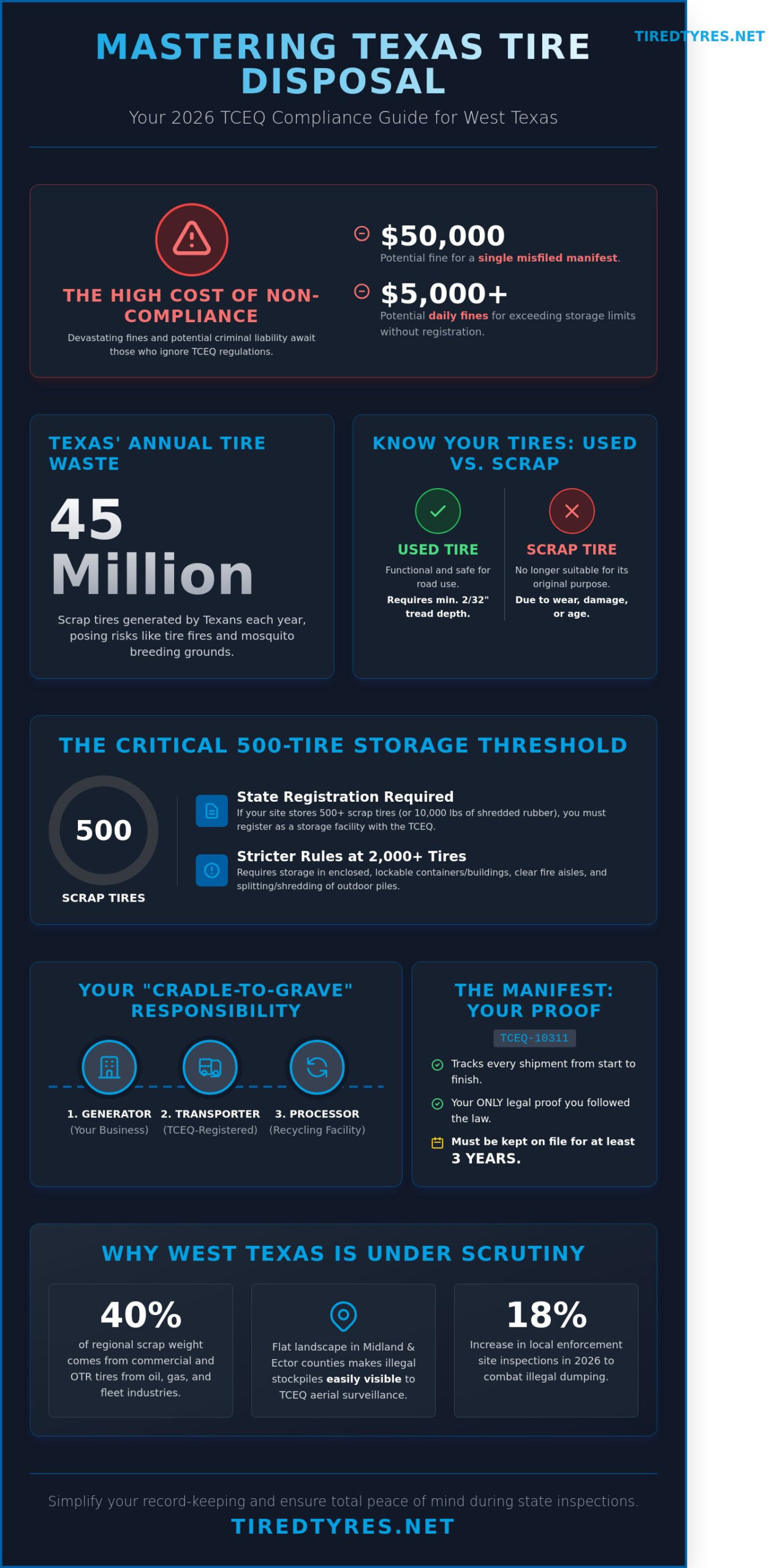
Texas Health and Safety Code Section 361.112 remains the primary legal framework for managing rubber waste across the state. By January 2026, the Texas Commission on Environmental Quality (TCEQ) has tightened its oversight to manage the 45 million scrap tires generated by Texans every year. These texas tire disposal regulations aren’t just red tape. They’re designed to prevent massive tire fires that are nearly impossible to extinguish and to eliminate breeding grounds for mosquitoes carrying the West Nile virus. Tire recycling programs are the state’s preferred method for handling this waste, but the legal burden of proper transport and disposal sits squarely on the business owner.
The law makes a sharp distinction between ‘used’ and ‘scrap’ tires. A used tire is one that’s still functional and safe for road use, generally requiring a minimum tread depth of 2/32 of an inch. A scrap tire is any tire that’s no longer suitable for its original purpose due to wear, damage, or age. If your site stores more than 500 scrap tires at any time, you’re legally required to register as a storage facility. Ignoring this threshold can result in daily fines that quickly exceed $5,000.
Why West Texas Businesses Face Unique Scrutiny
In the Permian Basin, the oil and gas industry creates a massive volume of heavy-duty tire waste. Commercial fleet tires account for 40% of the regional scrap weight in 2026. Because the landscape in Midland and Ector Counties is so flat, illegal stockpiles are easily spotted by TCEQ aerial surveillance. Local enforcement has increased site inspections by 18% this year to ensure that industrial sites don’t let old rubber pile up in the sun.
The Core Objective: Chain of Custody
Texas follows a ‘cradle-to-grave’ philosophy for waste. As a shop owner or fleet manager, the state identifies you as a ‘Generator.’ This means you’re responsible for a tire’s journey until it reaches a registered processor. Under texas tire disposal regulations, you must only hire TCEQ-registered transporters. You’re required to keep every manifest on file for at least 3 years. If a transporter dumps your tires illegally, that manifest is your only proof that you followed the law. It’s about professional accountability and keeping our local environment safe.
TCEQ Requirements: Storage Limits and Manifests
Compliance with texas tire disposal regulations starts with understanding your inventory. The state monitors every tire from the moment it’s removed from a rim until it’s recycled or processed. Staying compliant means keeping strict counts and perfect paperwork. If you’re operating a shop in West Texas, you’re responsible for the “cradle-to-grave” lifecycle of every scrap unit you generate.
The 500-Tire Storage Threshold Explained
The TCEQ sets a clear line at 500 scrap tires. If you hit this number, or 10,000 pounds of shredded rubber pieces, you’re legally classified as a storage site. For farmers near Lubbock, certain exemptions apply when using tires for agricultural commodities like securing silage covers or controlling erosion. However, commercial shops don’t get these passes. Once your inventory exceeds 2,000 tires, the rules tighten significantly. You must store them in enclosed, lockable containers or buildings to prevent arson and pest breeding. Indoor storage requires clear fire aisles, while outdoor piles must be split or shredded to prevent water collection.
Mastering the Scrap Tire Manifest System
Every tire shipment requires a TCEQ-10311 Scrap Tire Manifest. This document tracks the three-part journey between the Generator, the Transporter, and the Processor. Most audit failures happen because of missing signatures or incorrect tire counts in the documentation. You must keep these records for at least three years to satisfy state inspectors. Following these TCEQ Requirements for Tire Generators ensures your paper trail is bulletproof during a surprise inspection. If you’re overwhelmed by the paperwork, managing your scrap inventory with a professional partner can simplify the process and keep you focused on your customers.
Registration vs. Permitting for West Texas Sites
Most local tire shops only need a storage registration. Facilities that shred, quarter, or burn tires for fuel require a more intensive disposal permit. These registrations aren’t permanent; they carry a 60-month validity period. You should start your renewal process 180 days before the five-year mark to avoid a lapse in legal status. The TCEQ registration process is a formal notification system where site owners submit facility details and storage plans to the state to ensure environmental safety standards are met. Keeping your registration current is the simplest way to avoid the $5,000 per day fines associated with unauthorized storage.
- Tire Splitters: Must reduce tires to at least four pieces or halves before certain disposal methods.
- Shredders: Must maintain equipment to ensure pieces don’t exceed the 10,000-pound unregistered limit.
- Quartering: Essential for outdoor storage to eliminate mosquito breeding grounds.
The Consequences of Illegal Tire Dumping in Texas
Illegal dumping creates a massive liability for West Texas businesses. You aren’t just saving a few bucks on hauling; you’re risking the entire company’s future. Modern texas tire disposal regulations are strictly enforced to prevent environmental disasters in our sensitive arid climate. If the Texas Commission on Environmental Quality (TCEQ) finds a non-compliant site, the financial fallout starts immediately. For Midland-Odessa contractors, a single violation can lead to a permanent loss of trust with local municipal partners.
Fines and Legal Penalties in 2026
Civil penalties for improper disposal range from $50 to $25,000 per day per violation. For a Lubbock-based fleet manager or a Midland contractor with an unpermitted pile, those numbers accrue until the site is remediated. The TCEQ regional offices in Midland and Lubbock increased their unannounced site inspections by 18% during the 2025 fiscal year. They specifically check for compliance with Scrap Tire Storage Regulations to ensure tires don’t sit longer than 90 days without a permit.
Criminal liability is a serious reality under the Texas Health and Safety Code. If a business dumps more than 500 pounds or 200 cubic feet of tires, the charge often escalates to a state jail felony. In a 2024 enforcement action in Ector County, a local operator was fined $38,500 and required to pay for full site remediation after failing to manifest their scrap loads correctly. These records are public, meaning one mistake can ruin your bidding chances on future Permian Basin infrastructure projects.
Health and Safety Hazards of Scrap Tire Piles
Tire piles in West Texas are more than an eyesore; they’re a public health threat. Even in our dry weather, the shape of a tire is perfect for trapping small amounts of moisture. This creates a nursery for disease-carrying pests. You can learn more about How Scrap Tires in Lubbock Become Mosquito Habitats to understand the local West Nile and Zika risks.
Fire is the other major concern for rural West Texas businesses. A tire fire in an arid environment like the Permian Basin is nearly impossible to extinguish with standard water trucks. These fires require specialized foam and heavy machinery to smother the flames. The resulting runoff carries toxic oils and heavy metals directly into the soil, often leading to groundwater contamination. It’s a mess that costs hundreds of thousands of dollars to clean up. We’ve seen how quickly a small storage oversight turns into a catastrophic event. It’s always better to follow the rules from the start.
Practical Disposal Steps for Midland, Odessa, and Lubbock
Compliance with texas tire disposal regulations starts with accurate inventory management. Business owners in the Permian Basin and South Plains must treat scrap tires as a liability until they are officially processed. Your first step is to categorize your waste. Most West Texas sites generate a mix of passenger tires, semi-truck casings, and heavy OTR (Off-the-Road) rubber. Industrial rubber, such as solid forklift tires or rubber tracks, requires different handling than standard pneumatic tires.
Once you’ve identified your inventory, verify your transportation partner. You are legally responsible for where your tires end up. You must ensure you are using a permitted tire hauler in Texas to maintain a valid paper trail. In 2026, the TCEQ has increased audits on manifest records. If your hauler isn’t registered, your business faces the fines, not just the driver.
To keep your facility safe and compliant, follow these operational steps:
- Monitor the 500-tire limit: Never store more than 500 scrap tires on-site. Crossing this threshold reclassifies your business as a storage site, requiring expensive fire insurance and specialized permits.
- Document every load: Retain all tire manifests for at least three years. These documents must show the generator, the hauler, and the final disposal site.
- Separate rims: Most processors charge extra for “tires on wheels.” Removing rims before the hauler arrives saves an average of $5 to $15 per tire in labor fees.
Navigating Local Landfill Limitations
Most municipal landfills in West Texas refuse whole tires because they trap methane gas and “float” to the surface of waste cells. The City of Midland Landfill has strict 2026 guidelines that prioritize residential drop-offs over commercial volume. In Lubbock County, commercial generators are often redirected to private shredding facilities. Always call 24 hours in advance to confirm current tipping fees and daily volume caps for shredded rubber.
Managing Industrial and OTR Rubber Waste
Oil field and construction sites face unique challenges with massive skid steer tracks and conveyor belts. Standard waste services won’t touch these items due to their weight and density. For bulk pickups at remote sites, ensure a 50-foot clearance radius for heavy loading equipment. Solid tires and industrial hoses must be quoted separately, as they require specialized grinding machinery that standard tire recyclers don’t always operate. Finding reliable tire disposal in Midland, Odessa & Lubbock for these specialized materials requires working with a hauler who has the proper equipment and TCEQ registration to handle industrial-grade rubber waste.
Don’t let scrap rubber pile up and create a fire hazard. Schedule a professional pickup with Tired Tyres to stay compliant with all state and local laws.
How Tired Tyres Ensures Your Business Stays Compliant
Tired Tyres operates as a fully permitted and registered Texas scrap tire transporter. We’ve built our reputation on reliability throughout the Permian Basin. Staying aligned with texas tire disposal regulations requires more than just moving rubber from one spot to another; it requires a documented chain of custody. We handle the entire manifest process. Our team generates the required TCEQ documentation for every load we haul. This means your commercial records stay accurate without extra administrative work on your end. You get the peace of mind that comes with knowing every tire is tracked from your gate to the processing facility.
Our fleet utilizes specialized heavy-duty equipment designed for OTR, Ag, and industrial rubber. Standard haulers often struggle with the weight and size of oilfield tires found in West Texas. We don’t. Our trucks are equipped to handle large-scale removals efficiently. We offer flexible scheduling for commercial clients in Midland, Odessa, and Lubbock. We understand that a cluttered yard is a safety hazard and a liability. Whether you need a one-time cleanup or a recurring monthly pickup, we adapt to your specific operational pace.
The Tired Tyres Compliance Advantage
Our direct-to-processor route is a vital safety net for your company. By bypassing unofficial storage sites, we eliminate the risk of your tires being illegally dumped. This significantly reduces your long-term environmental liability. We maintain organized, digital records of every transaction. If a TCEQ inspector arrives for an audit, you can produce the necessary proof of legal disposal in seconds. Our commitment to ethical recycling ensures that 100% of the rubber we collect enters a legitimate secondary use stream. We prioritize transparency because we know your business reputation depends on it.
Get a Local Disposal Quote Today
Booking your first collection in Midland or Odessa is a straightforward process. We provide custom solutions for bulk tire pile remediation and complex site cleanups. If you have a legacy pile of 1,000 or more tires, we can deploy specialized crews to clear the area in a single shift. We focus on the heavy lifting so you can focus on your core business. Our pricing is transparent and reflects the current 2026 market rates for compliant disposal. You can Request a compliant tire pickup quote for your West Texas business to secure your spot on our route. We’re ready to help you maintain a clean, compliant, and professional job site.
Secure Your Compliance and Protect the Permian Basin
Navigating texas tire disposal regulations doesn’t have to be a burden for your operations in Midland or Lubbock. By 2026, the TCEQ mandates that every business maintain precise manifest records and adhere to strict storage limits to avoid costly penalties. Proper disposal isn’t just about following the law; it’s about keeping West Texas clean and your company’s reputation intact. You’ve worked hard to build your business, so don’t let a simple paperwork error or an unauthorized hauler put your 2026 goals at risk.
Tired Tyres has served the Permian Basin since our founding, providing the reliable local expertise you need to stay ahead of changing rules. We’re a TCEQ Registered Transporter equipped with specialized OTR and industrial equipment to handle your heaviest loads. We take the “tired” out of tire management by handling every step of the compliance process for you. Our team ensures that every manifest is filed correctly and every scrap tire is recycled responsibly. Understanding the complete tire recycling process in Midland, Odessa, and Lubbock helps you make informed decisions about your waste management strategy. Schedule a Compliant Tire Pickup in Midland, Odessa, or Lubbock today. We’re ready to help you keep your site clear and your records perfect.
Frequently Asked Questions
Is it illegal to dump tires on my own property in Texas?
Yes, it’s illegal to dump or bury tires on your own property under Texas Health and Safety Code 361.112. Even if you own the land, you’re creating a public health nuisance. TCEQ inspectors can issue fines up to $10,000 per day for unauthorized disposal sites. It’s better to use a registered processor than to risk the heavy financial penalties that West Texas authorities enforce.
How many tires can a business store in Texas without a permit?
You can store up to 500 scrap tires on your business premises without a specific TCEQ permit. Once your inventory reaches 501 tires, you’re legally classified as a storage site. This status requires formal registration and strict adherence to texas tire disposal regulations. Most West Texas shops keep their counts low to avoid the extra paperwork and the $500 annual registration fees.
What is a scrap tire manifest and do I really need one?
A scrap tire manifest is a mandatory tracking document that follows every tire from your shop to its final destination. You definitely need one because it’s your only proof of legal disposal. If the TCEQ audits your business, you’ll have to show these manifests to avoid fines. It’s a simple paper trail that confirms you’ve handed the waste to a registered hauler.
Can I take whole tires to the Midland or Odessa landfills?
No, you can’t dispose of whole tires at the Midland or Odessa landfills because Texas law bans them from burial. Landfills only accept tires that are already split, quartered, or shredded. If you bring whole tires to the City of Midland Landfill, they’ll likely turn you away. You’ll need to work with a local processor who can mechanically alter the rubber first.
What happens if I hire an unpermitted tire hauler?
You’re held legally liable for where those tires end up if you hire an unpermitted hauler. If an illegal hauler dumps your tires in a West Texas field, the state tracks them back to your business. You could face generator liability fines starting at $5,000 per incident. Always check for a valid TCEQ registration number before letting anyone load a single tire from your shop.
How should tires be prepared for legal disposal in Texas?
Tires must be kept dry and free of standing water to comply with texas tire disposal regulations. You should store them under a cover or in a locked container. This prevents mosquito breeding and stops the rubber from becoming contaminated with West Texas dirt. Clean tires are easier to process, which helps keep your hauling costs lower and ensures you pass local inspections.
Are there specific rules for disposing of OTR or tractor tires?
Yes, OTR and tractor tires fall under different handling categories due to their extreme size and weight. A single 400 pound tractor tire requires specialized shredding equipment that standard passenger tire haulers don’t carry. You’ll often pay a higher per ton rate for these items. Ensure your hauler is specifically registered to handle large scale agricultural or industrial rubber to stay compliant with state rules.
How long do I need to keep my tire disposal records for a TCEQ audit?
You must keep all tire disposal records and manifests for a minimum of 3 years. These documents must be available for immediate inspection if a TCEQ official visits your West Texas location. Keeping a clean, organized filing system is the best way to handle an audit. It proves you’ve followed the law consistently since 2023 and protects you from historical liability claims during a site visit.